
Last updated: November 28, 2026
Quick answer: budget a family trip to a small town destination around four categories—lodging, meals, transport, and a cushion. In the context of how to budget a family trip to a small town destination, small towns can look cheap at first, but one motel, one local diner, shorter business hours, and paid parking can change the total fast. The smart move is to build the budget from lodging, meals, transport, and a cushion for closures or detours.
Key takeaways
- Small towns can save money on the price tag, but the total trip cost may be higher than expected.
- Fewer restaurants and shops mean fewer backup options when plans change.
- Walkable main streets can cut driving costs, but parking may still matter.
- A motel can be the simplest lodging choice, while a local diner can keep meal spending predictable.
- A small reserve helps when weekday closures, one-way streets, or paid parking change the plan.
What makes a small town budget different?
A small town budget is different because choice is limited, and that changes how money gets spent. You may have fewer dining options, fewer lodging types, and shorter hours than in a city, so one missed meal or one closed shop can force a more expensive backup plan.
Therefore, this is why a small town family trip budget should not assume you can “just find something later.” In many small towns, later can mean closed for the day, especially on weekdays. A simple plan works better than a loose one here.
The budget also needs to reflect the town’s shape. A walkable main street can lower transport costs because you can park once and stay on foot for a few hours. That helps, but only if the parking is free or low-cost and the main street actually holds the places you want to visit.
Think of this trip as a balance between convenience and flexibility. Small towns can be a good fit for families who like slower days and simple routines. They are not a good fit if your plan depends on late-night restaurant choices, multiple backup hotels, or a long list of open attractions every day.
How do I build the trip budget?
You build the trip budget by pricing the trip in four parts: lodging, food, local transport, and a small cushion. Start with the cost items that are least flexible, then add the variable ones.
- Spreadsheet the lodging first by listing the motel or other local lodging type, the nights you need, and the room total. This gives the anchor cost before anything else moves.
- Calculator the food next by planning meals around the local diner, one grocery stop, and one backup meal. That keeps breakfast, lunch, and dinner in the budget instead of leaving them to chance.
- Map the town center by marking the main street, parking areas, and the places you will visit on foot. This shows whether you can skip extra car trips or need to pay for parking more than once.
- Notebook the closures by checking weekday hours for every place you expect to use. A closed café or museum on Tuesday can change both food and activity costs.
- Savings app the cushion by setting aside extra money for a second parking fee, a longer meal, or a detour to another town if the first choice is closed.
A family trip budget works best when each part has a job. Lodging holds the base cost. Food covers the predictable meals. Transport covers the fixed trips. The cushion protects the trip from small-town surprises that are normal, not rare.
A good rule for this kind of trip is to keep the budget simple enough that one adult can check it on a phone in a few minutes. If the budget takes a full page of guesswork, it is too complicated for a small town trip.
Should I choose a motel or a different lodging type?
A motel is often the easiest budget choice in a small town because it is simple, predictable, and usually built for short stays. That does not mean it is always the cheapest or best fit, but it is often the most straightforward option for a family.
Small towns usually have fewer lodging types than larger places. You may see a motel, a small inn, or a limited number of short-stay rooms, and that limited inventory can make prices less flexible. When options are few, the cheapest room on paper may not be the best total value if it is far from the main street or adds parking costs.
A motel can also reduce hidden spending because you can park close to the room and avoid extra transport to a more remote property. That matters when the town is built around one compact center and the rest is spread out.
The trade-off is comfort and layout. A motel may give you less shared space, fewer extras, and a more basic setup than other lodging types. That is fine for a night or two, but it is less appealing for families who need a lot of room to spread out or want a property with more on-site extras.
For a small town family trip, the right question is not “Is this the nicest place?” It is “Does this lodging fit the town’s size, the trip length, and the rest of the budget?”
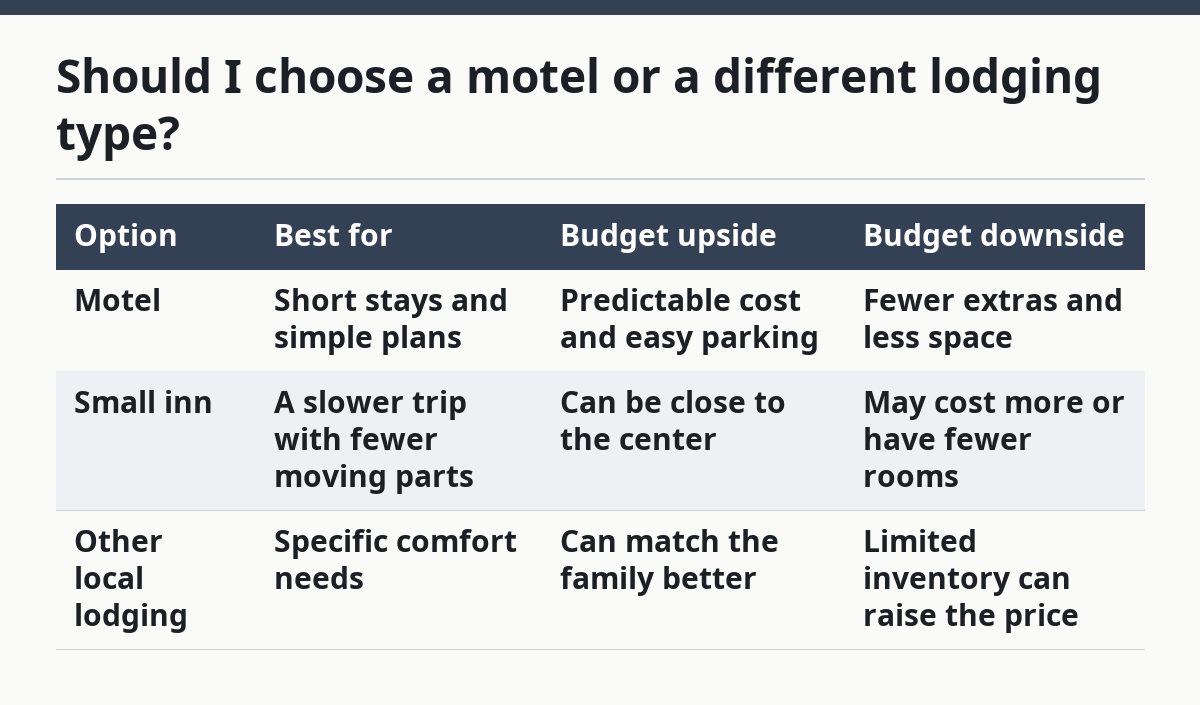
| Option | Best for | Budget upside | Budget downside |
|---|---|---|---|
| Motel | Short stays and simple plans | Predictable cost and easy parking | Fewer extras and less space |
| Small inn | A slower trip with fewer moving parts | Can be close to the center | May cost more or have fewer rooms |
| Other local lodging | Specific comfort needs | Can match the family better | Limited inventory can raise the price |
How do I handle meals and local diner stops?
You handle meals by planning around the limited dining choices before the trip starts. In a small town, the local diner may be the most dependable sit-down meal, but it may also be the only easy option during certain hours.

Because of that, the safest approach is to decide in advance which meals you will buy out and which meals you will cover another way. A simple split works well: one diner meal, one grocery stop, and one flexible backup meal. That keeps the food budget from rising every time plans change.
Weekday closures matter here. A place that is open on Saturday may be closed on Monday or have shorter hours than expected, which makes a “we’ll just decide later” plan risky. If the town has only a few food choices, missing one meal can mean driving farther than planned or paying more than expected for the next option.
It also helps to build in a snack plan. A family that keeps water, fruit, crackers, or other simple items on hand can avoid a last-minute stop when a café closes early. That is not fancy, but it protects the food budget.
A common mistake is assuming small towns always have cheap food. Some do, some do not. A single busy diner in a small town can still cost more than a grocery meal, and a limited menu can make it hard to keep everyone happy without ordering extra items.
How should parking and walking shape the budget?
Parking and walking should shape the budget because a compact town can save transport money, but not always parking money. If the main street is walkable, you may only need to park once and spend the rest of the day on foot.

That can work well for families, especially when the hotel or motel is near the center. A short walk between the room, the diner, and the shops cuts down on repeated driving. It also makes the day easier to pace, since you are not starting and stopping the car all day.
Still, parking needs a line in the budget. Some small towns charge for prime spots near the main street, and even when parking is free, you may have to move the car if time limits are strict. That matters more on busy weekends or in towns with one main block that everyone uses.
The trade-off is convenience versus flexibility. If you choose a place near the center, you may pay more for the room. If you choose a cheaper place farther out, you may pay in gas, parking, or time. The lower sticker price is not always the lower trip cost.
This is where a simple town map helps. If the hotel, diner, and main street are all within the same walkable area, you can budget less for transport. If they are spread out, treat driving and parking as part of the trip, not as an afterthought.
What common budgeting mistakes cost the most?
The biggest budgeting mistakes are ignoring closures, forgetting parking, and counting on extra restaurant choices that do not exist. Each one can raise the trip cost in a way that looks small at first and then stacks up.

Ignoring weekday closures costs time and money because a closed shop or café sends you to the next available option. In a small town, that may mean a longer drive or a more expensive meal. Check hours before the trip, not after arrival.
Forgetting parking costs money in a way many families miss. One paid spot near the main street may seem minor, but if you move the car several times, the cost adds up. Plan for the day as a single block when possible, not as many separate stops.
Counting on extra dining choices is the third mistake. A town may have one diner and a few limited hours, not a long list of open places. If a family is picky and the budget depends on lots of backup restaurants, a small town is the wrong choice.
A good small town budget accepts the limits up front. That is cheaper than rebuilding the day after you discover the town closes early.
What should I keep in the budget as a cushion?
A cushion should cover the small surprises that come with a limited-inventory town. That means extra parking, one unexpected meal, a longer drive to another dining option, or a change in plan when a place is closed.

You do not need a complicated reserve system. A single line in the budget labeled “small-town extras” is enough if it is large enough to matter. The point is not to guess the exact surprise. The point is to stop one small change from breaking the whole plan.
This cushion matters more in a small town than in a big city because there are fewer second chances. If the first motel is full, the second may be far away. If the first diner is closed, the nearest backup may not be around the corner. That limited inventory is the main reason this trip type needs a margin.
I would not skip the cushion to make the budget look cleaner. A trip that looks tight on paper and fails on arrival is more expensive than a trip that starts with a modest reserve.
For general budgeting help, the Consumer Financial Protection Bureau’s budgeting resources and USA.gov’s budgeting guidance are useful places to start.
FAQ
Are small towns cheaper for family trips?
Small towns can be cheaper, but not always. Lower sticker prices can be offset by limited lodging, fewer dining choices, parking fees, and longer drives for backup options. The total cost depends on how much the town offers within walking distance and how much planning the family does before arrival.
What should families budget in a small town?
Families should budget for lodging, meals, local transport, parking, and a cushion for closures or detours. A motel, a local diner, and a walkable main street can keep the trip simple, but the budget should still include room for limited inventory and weekday closures.
How do you plan meals in a small town trip?
Plan meals by deciding ahead of time which meals will be eaten at a local diner, which will come from groceries, and what backup you will use if a place is closed. Small towns often have fewer dining choices, so a meal plan works better than leaving every meal open.
Drafted with AI; not yet reviewed by a person.