
Last updated: November 20, 2026
Quick answer: 3 details decide the stay. For How to Choose a Budget Family Hotel When You Need an Early Checkout and Late Arrival, the right room is the one with a front desk that can receive you after hours, a clear late check-in note, luggage storage if you arrive before the room is ready, and breakfast timing that does not trap you in the lobby at dawn.
Key takeaways
- A low nightly rate is not enough if the hotel closes its front desk before you land or drive in.
- Late arrival works best when the hotel confirms it in writing, not just in a vague booking note.
- Early checkout is easier when luggage storage and front desk hours line up with your departure time.
- A family room can be a good buy, but only if it fits your sleeping plan and your arrival window.
- The cheapest room on the screen can become the costliest choice if it forces an extra night or a taxi at 5 a.m.
What matters most in a budget family hotel stay?

The most important thing is the hotel’s timing rules, because a cheap room loses its value if the front desk is closed when you arrive or breakfast ends before you leave. For How to Choose a Budget Family Hotel When You Need an Early Checkout and Late Arrival, the first filter is not pool size or free Wi‑Fi; it is whether late check-in and early check-out both fit the hotel’s daily rhythm.
Start with the hotel front desk hours. A desk that is open 24 hours is the easiest fit for a family arriving after a delayed flight, a late train, or an evening drive. If the desk closes, you need a clear process for after-hours arrival, and you need that process before you pay.
The second filter is room type. A family room can reduce the need for a second room, but only if the bed layout works for your group and your arrival time. If one child will sleep on a sofa bed, the room needs to be usable the moment you walk in, not after a long setup.
The third filter is luggage storage. If you arrive before check-in or leave after checkout, storage can save the trip from becoming a day of carrying bags. Some hotels handle bags at the desk; others offer a locked room. Ask which system they use, because “storage available” can mean different arrangements at different properties.
This matters even more on short stays. When you have only one night, an early checkout and late arrival can eat most of the time you paid for. That does not make the hotel wrong, but it changes what “budget” really means.
How do I check late check-in rules before I book?
Late check-in rules are the first thing to confirm, because many hotels accept late arrival only if they know about it in advance. Do not assume a booking guarantees a room after midnight, even if the site shows the room as available.
Use this simple order of checks before you book:
- Read the room page for check-in and check-out windows, then note the latest arrival time stated in the policy.
- Look for front desk hours, not just the hotel name and star rating, because a reception desk that closes early changes the whole trip.
- Check whether late check-in needs a message, a call, or a flight number, so the hotel can hold the room for you.
- Review whether luggage storage is offered before check-in or after checkout, since that can save a cab ride or a second booking.
- Save the hotel phone number and confirmation details in the same place you keep your tickets, so you can contact the desk if plans slip.
A good booking page should make these points easy to find. If the policy hides behind a short note or a vague “subject to availability” line, treat that as a warning sign and ask before paying; if you are unsure, consult the hotel directly or a travel professional and review FTC guidance on reading terms carefully.
The best moment to ask is before the cancellation window closes, or at least before you lose the ability to change the booking without cost. If you already know your arrival may slip by 2 or 3 hours, say so plainly and ask the hotel to confirm that the room will still be held. A clear answer beats a cheap rate that vanishes at the desk.
For a practical background guide on timing across the rest of the trip, the hub page on budget family lodging planning sits above this article and covers the wider booking picture.
What should I ask the hotel front desk before I pay?
Ask the hotel front desk three direct questions: what time is check-in, what happens if I arrive late, and what time can I leave the next morning without trouble. Those three answers tell you more than the room photo ever will.
Ask in plain language. A useful message sounds like this: “I may arrive after your standard check-in time and leave early the next morning. Will the room still be held, and can I store bags before or after the stay?” That question gives the desk a chance to explain the rule instead of forcing you to guess.
Also ask whether breakfast starts early enough for your departure. If breakfast opens at 7:00 and your family leaves at 6:00, that free meal is not part of the stay. In that case, the room may still be the right pick, but only if the total cost still works after you add snacks or a takeout breakfast.
If the hotel uses a self-check-in kiosk or a lockbox, ask how a tired child, a heavy bag, and a late arrival fit into that system. A kiosk can work well for one adult traveler with one suitcase. It is less helpful when you arrive with a sleeping child, a stroller, and two carry-ons.
What room type works best when the night is short?
A family room works best when you need one room, one key plan, and one place to crash quickly after a late arrival. It is less useful when the room is cramped, the sofa bed takes time to set up, or the beds do not fit the age mix in your group.
Here is a simple comparison:
| Option | Best for | Trade-off |
|---|---|---|
| Family room | One room for the whole group | Less privacy, and sleeping setup may take time |
| Two standard rooms | Older kids or adults needing space | Higher cost and more keys to manage |
| Single room with extra bedding | Very short stopovers | Tight space and limited comfort |
| Room with no storage option | Only if arrival and departure are both easy | Bags can become a problem at both ends |
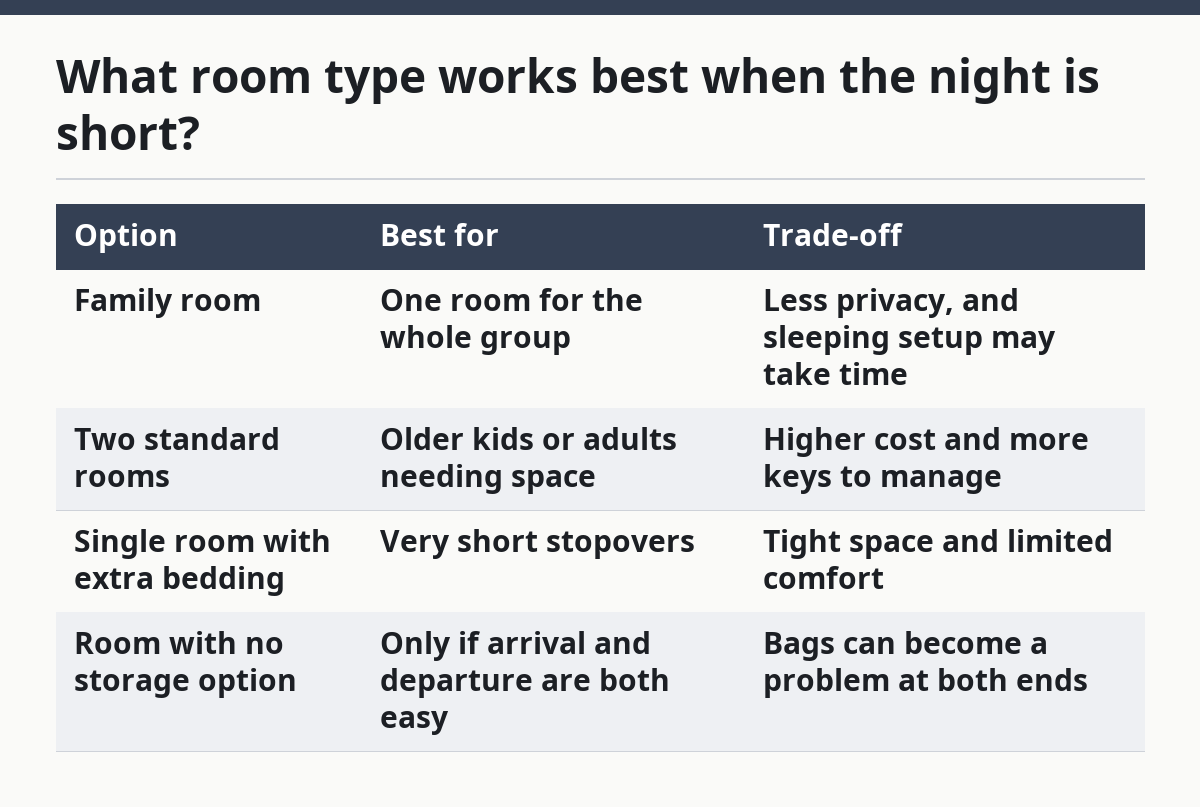
If the hotel offers a family room, check whether it is a true family room or just a standard room with an extra bed. That difference matters when you arrive late and want everyone asleep in 10 minutes, not 45. A room that sounds bigger on the booking page can still feel small once bags, coats, and a stroller are inside.
For a budget stay, I would rather have a plain room with good timing rules than a nicer room with poor timing rules. That choice is not glamorous, but it protects the money you are already spending.
How do I handle luggage storage and early morning departure?
Luggage storage is the safety net that makes a late arrival and early checkout easier to live with. If the room is not ready when you arrive, or if you need to leave before housekeeping starts, storage keeps your bags from dictating the whole day.
Ask whether storage is behind the desk, in a locked room, or only available during front desk hours. Those details matter because an early flight or early train can put you outside the hotel’s normal rhythm. If the desk closes at night, you need to know how and when your bags will be accessible.
Use this as the main decision point if your schedule is tight:
- If you arrive after the usual check-in time, confirm that the room will still be held.
- If you leave before breakfast, ask whether the desk can check you out the night before.
- If you need to store bags for several hours, ask where they go and who can access them.
- If you have a stroller, child seat, or sports gear, ask whether the storage area can handle larger items.
A hotel that answers these questions clearly is usually easier to use than one that gives vague promises. The point is not luxury; it is reducing friction when everyone is tired.
This is also where a cheap rate can fail the test. If the hotel charges less but forces you to pay for a long taxi ride because it has no storage, no early checkout process, or no desk after 10 p.m., the “budget” choice may no longer be the cheapest choice.
What booking mistakes cost the most?
The biggest mistake is booking on price alone, because a low rate can hide a timing problem that costs money, sleep, or both. A second mistake is assuming the hotel will sort things out later, especially when late arrival and early checkout are both part of the same stay.
The most common mistakes are easy to spot:
- Booking a room without checking front desk hours.
- Assuming late check-in is automatic.
- Forgetting to confirm breakfast times when leaving early.
- Choosing a family room without checking bed setup.
- Ignoring luggage storage and then carrying bags for hours.
The cost is not only hassle. A missed arrival window can mean a lost room, a rushed search for another place, or a taxi to a different hotel after midnight. An early checkout without storage can leave you dragging bags to breakfast, the station, or the airport.
The fix is simple but not optional: match the hotel’s timing to your own. If your arrival is late by design, and your departure is early by design, treat those two facts as core booking details. A hotel that makes both easy is worth more than a room that looks better in the listing.
This is the point where budget travel gets practical. Cheap does not mean bare bones. It means the parts you do need are available, and the parts you do not need are not dragging the trip off track.
Which hotel policy details are worth reading twice?
The policy details worth reading twice are check-in time, check-out time, front desk hours, luggage storage rules, and breakfast hours. Those five items decide whether the hotel fits a late arrival and an early checkout better than the room photos do.
Read the wording carefully. “Late check-in available” is useful only if it tells you how late, under what conditions, and whether someone must notify the hotel first. “Breakfast included” is useful only if the breakfast time works for a morning departure. “Luggage storage” is useful only if it is available when you need it, not just during a narrow window.
If a hotel has a 2:00 p.m. check-in and an 11:00 a.m. checkout, that may still work for you. But if your arrival is after midnight and your departure is before 6:00 a.m., the simple math changes. The stay can still be worth booking, but only if the hotel clearly handles both ends of the trip.
Two useful reference points help here. The American Hotel & Lodging Association is a common industry voice on hotel operations, and the U.S. Federal Trade Commission has general guidance on avoiding booking surprises and reading terms carefully. Both are worth checking if you want a wider consumer view, even though the hotel’s own policy still matters most.
FAQ
Can families check in late without a fee?
Often yes, but only if the hotel allows late arrival and knows about it in advance. The key issue is not the fee alone; it is whether the room will still be held when you reach the desk after the standard check-in window.
What if we need to leave before breakfast starts?
Then breakfast should not be part of the value calculation for that stay. Ask whether the hotel offers an early grab-and-go option, and if not, plan for food elsewhere so the early checkout does not turn into a rushed morning.
Should I book an extra night for an early flight?
Sometimes yes, especially if your flight is very early and the hotel has no easy early checkout or storage plan. An extra night can cost more, but it may be cheaper than the stress of packing in the dark, waiting for a closed desk, or starting the trip exhausted.
Drafted with AI; not yet reviewed by a person.