
Last updated: November 20, 2026
Key Takeaways
- Real sleeping space means a bed, mattress, and enough room to use both without clutter.
- Layout matters more than the room headline.
- You need open floor for extra sleep items and bathroom access.
- The best setup depends on bed count and bedtime privacy needs.
A family hotel room with real sleeping space gives each person a bed, a door, or both—not just a couch and hope. How to Choose a Family Hotel Room When You Need Real Sleeping Space starts with the sleep layout, then the square footage and extras. The steps below settle which setup fits your kids, your luggage, and your nerves.
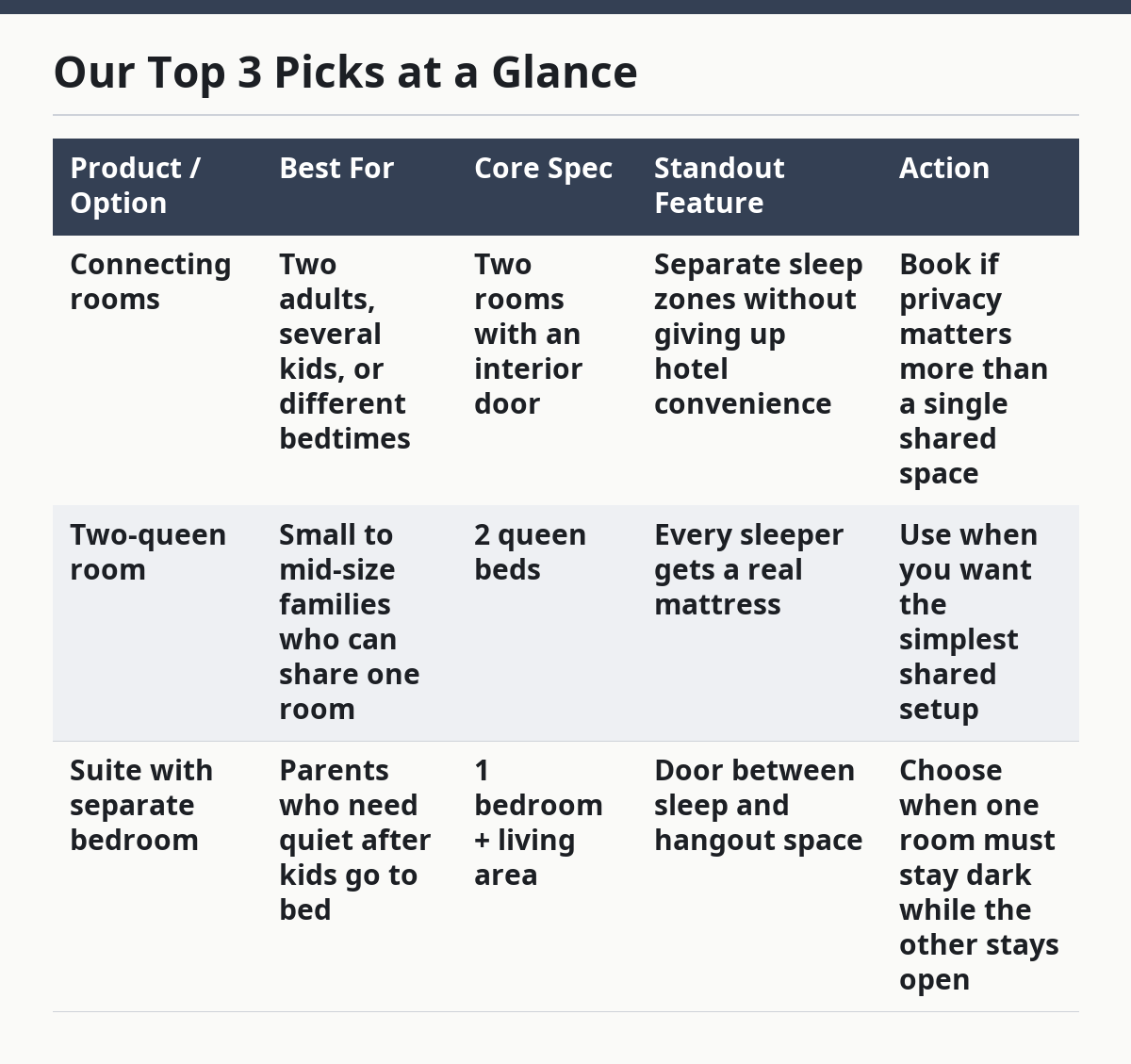
Our Top 3 Picks at a Glance
- #1 Best Overall: Connecting rooms — best when adults and kids need real separation and you want the least bedtime friction.
- #2 Best Budget Pick: Two-queen room — best when everyone can sleep in a bed without paying for a bigger suite.
- #3 Best Heavy-Duty / Upgrade Pick: Suite with a separate bedroom — best when you need a door between sleeping zones and enough floor space for a crib or pack-and-play.
| Product / Option | Best For | Core Spec | Standout Feature | Action |
|---|---|---|---|---|
| Connecting rooms | Two adults, several kids, or different bedtimes | Two rooms with an interior door | Separate sleep zones without giving up hotel convenience | Book if privacy matters more than a single shared space |
| Two-queen room | Small to mid-size families who can share one room | 2 queen beds | Every sleeper gets a real mattress | Use when you want the simplest shared setup |
| Suite with separate bedroom | Parents who need quiet after kids go to bed | 1 bedroom + living area | Door between sleep and hangout space | Choose when one room must stay dark while the other stays open |
Picture this: you’re staring at hotel photos that show a couch, a desk chair, and one bed for four people. The right family hotel room is the one that matches the number of real beds to the number of sleepers. Start there, not with the lobby.
What “real sleeping space” actually means in a hotel room
Real sleeping space means a bed, mattress, and enough clearance to use them without turning the room into a pile of bags. It usually means king beds, two-queen rooms, sofa beds, rollaway beds, connecting rooms, or a suite with a separate bedroom.
Here’s the catch: a room can look large in photos and still fail at bedtime. A king bed helps one adult pair, but it leaves everyone else fighting over the sofa bed. A two-queen room solves more of the sleeping problem, but only if the room has enough floor space to open luggage and move around the beds.
Use these signs when you read a listing:
- Two fixed beds are stronger than one bed plus “extra sleeping available.”
- A separate bedroom is stronger than one big room with a curtain.
- A crib space note matters if you travel with an infant.
- A rollaway bed can help, but it may use the only open patch of floor.
- A sofa bed is a backup, not the main reason to book.
A hotel room may still be fine with fewer beds if one sleeper is an infant in a crib or a child who can share. It becomes a bad fit when one adult is expected to sleep on a pullout every night while the rest of the room stays bright and noisy.
How to read the bed layout before you book
Picture this: you’re on the booking page at 11 p.m., and the room name sounds perfect, but the bed diagram is vague. The answer is in the layout, not the headline. A room with 2 queens is usually the cleanest shared setup for a standard family stay.
The truth is, the layout tells you whether the room will work at 9 p.m., not just at check-in. Look for the bed count, the type of extra bed, and whether the room has a wall or door that separates sleepers.
- Count the fixed beds first. A room with 2 queen beds gives you two full sleeping surfaces without extra setup.
- Check the sleeping map. If the layout shows one bed and a sofa, someone is sleeping on a converted couch.
- Look for a separate bedroom. A door between spaces changes the whole night, especially with early bedtimes.
- Confirm crib or rollaway space. A crib can fit in some rooms, but not when the path to the bathroom is already tight.
- Read the room size note. If the room is compact, even a second bed may leave no room for strollers or suitcases.
A king bed works for two adults who want one bed, but it does not solve a larger sleeping count on its own. A sofa bed may add a spot, yet it often steals the sitting area and leaves one sleeper with a thinner mattress.
How much room do you need for a crib, a rollaway, or luggage?
You need enough open floor to place the extra sleep item and still reach the bathroom door. A room can have a valid bed count and still feel unusable if a crib, rollaway bed, and two suitcases all land in the same narrow strip.
Now, you might be wondering whether room size matters more than bed count. It does when you have a baby, a toddler, or more than one bag per person. A room that is too tight turns bedtime into furniture Tetris.
Use this quick check before booking:
- Crib space: Ask where the crib goes without blocking the door or the AC unit.
- Rollaway space: Ask whether the rollaway replaces a chair, a suitcase spot, or the path to the bathroom.
- Luggage space: If bags must stay open overnight, the room needs more than just enough beds.
- Walking space: You should be able to cross the room without climbing over a bed corner.
A room with one big bed and “extra bedding on request” can work for a solo parent and one child. It usually fails for a larger group because the extra item has nowhere to go. The same is true for a compact room with a crib; the crib may fit, but the adults may not.
Ask for the room’s actual sleeping footprint when you can. A listing that names a separate bedroom or a true suite is much clearer than a plain room with a vague “sleeps 4” label. The setup is the point.
Which sleeping setup works best for different family shapes?
The best setup depends on how many people need true beds and how much privacy the bedtime routine demands. A two-queen room is the simplest answer for many groups, while connecting rooms solve the privacy problem when kids and adults keep different hours.
Here’s the catch: no single room type wins for every trip. A room that works for two adults and two children may fail for a grandparent trip or for a baby who wakes at 5 a.m.
- Two adults + one child: A king bed plus sofa bed can work if the sofa is a real sleeper and the room is wide enough.
- Two adults + two children: Two queens are usually the cleanest shared option.
- Two adults + three kids: Connecting rooms or a suite with a separate bedroom usually beats one crowded room.
- Infant plus adults: A king room can work if there is crib space and the adults can tolerate less open floor.
- Different bedtimes: Choose a suite or connecting rooms so one sleeper can stay up without lighting the whole room.
A sofa bed is the weak link in many setups. It can help on paper, but it often means one sleeper gets the least comfortable surface in the room. If the listing relies on a sofa bed for the main sleeping count, check the room details carefully and consult the hotel directly before you book.
What to ask the hotel before you click book
Picture this: the room title says “family room,” but you still don’t know if the sleeper count is real or if one child ends up on a lounger. The right questions take 2 minutes and can save a bad night. They are also the only way to clear up vague room labels.
Ask the property these exact things:
- How many fixed beds are in the room?
- Is the sofa bed a full sleeper or a smaller pullout?
- Can a crib fit without blocking the door or bathroom?
- Is the room a true suite with a door, or just a larger room?
- Are the connecting rooms guaranteed, or only request-based?
A good answer names the setup plainly. “One king and one sofa bed” tells you more than “sleeps four.” “Two queens and a crib fits near the window” is far more useful than “family friendly.”
If the hotel cannot say where the extra bed goes, assume the room is smaller than you need. If the answer about connecting rooms is vague, assume you may not get them. That matters a lot when one child sleeps at 8 p.m. and another is still buzzing at 10 p.m.
Common mistakes that leave people cramped and tired
Picture this: you arrive late, the room is clean, and then you discover the second bed is a pullout with no space to open it all the way. That is the cost of booking by photo instead of by sleep setup. The room may be nice; the sleep plan is not.
The biggest mistake is treating every extra sleeping option as equal. A rollaway bed is not the same as a second permanent bed. A sofa bed is not the same as a queen mattress. And a large room without a wall still behaves like one room when the lights go out.
-
Mistake: Booking a king room for four people because it sounds spacious.
Cost: Someone ends up on a sofa bed or floor mattress.
Do instead: Choose two queens or a room with a separate bedroom. -
Mistake: Assuming “sleeps 5” means five comfortable sleepers.
Cost: One child gets the worst bed and the room feels crowded.
Do instead: Check the exact bed count and bed type. -
Mistake: Ignoring crib space.
Cost: The crib blocks access or forces bags into walkways.
Do instead: Ask where infant sleep fits before you book. -
Mistake: Choosing a suite without checking whether the bedroom has a door.
Cost: Light, noise, and early wakeups travel too easily.
Do instead: Confirm a real divider between sleeping areas.
The best part? You do not need a perfect room. You need one that matches your sleep needs without tricks. If the room cannot hold the people and the beds at the same time, keep looking.
How to compare options without getting lost in hotel jargon
A room name is marketing; a bed layout is the truth. When you compare options, compare them in the same order every time: fixed beds, separate spaces, room size, crib room, and extra-bed rules. That keeps you from getting distracted by words like “deluxe” or “premium.”
Use this quick comparison method:
- Write down the sleeper count. Adults first, then kids, then infant needs.
- Mark the minimum bed count. If everyone needs a real bed, one sofa bed is not enough.
- Decide whether privacy matters. If yes, rank connecting rooms and suites above shared rooms.
- Check floor space for extras. Crib, rollaway, luggage, stroller.
- Read the room policy for extra beds. Some properties limit them or assign them by request only.
If you want a plain rule, use this: a two-queen room is the safest shared-room choice, a suite with a separate bedroom is the safest privacy choice, and connecting rooms are the safest choice when bedtime conflicts are likely. Anything that depends on a sofa bed alone is a compromise.
This is the same logic used across the broader budget family trip planning by lodging style and room setup hub, but here the focus stays on sleep. That is the filter that keeps the trip from turning into a nightly shuffle.
What room setup works best for a family with kids?
A room with two fixed beds or a separate bedroom works best for most kids. Two queens are usually easier than one king plus a pullout because everyone gets a real mattress, and there is less bedtime setup. If one child needs quiet early, connecting rooms or a suite with a door is the stronger choice.
How do you tell if a hotel room is big enough for a family?
A hotel room is big enough if the beds, bags, and any crib or rollaway can fit without blocking the door or bathroom. Start with the bed count, then ask where luggage and extra sleepers go. If the room only works after chairs are moved and bags are stacked, it is too tight for a comfortable stay.
Is a sofa bed worth it for family travel?
A sofa bed is worth it only as a backup, not as the main sleeping plan. It can help when you have one extra child or a short stay, but it usually gives the least comfortable sleep in the room and takes away floor space. If sleep quality matters, a second fixed bed or a separate bedroom is better.
Drafted with AI; not yet reviewed by a person.
