Last updated: November 19, 2026
Quick Answer: You can usually avoid checked bag fees with one carry-on suitcase plus one personal item per traveler, if your airline fare allows it and your bags fit the size rules. This guide on How to Pack a Family Carry-On So You Can Avoid Checked Bag Fees shows how to pack for kids, liquids, and flight-day essentials without checking a bag.
A carry-on bag can be the fastest way to avoid checked bag fees on a trip with kids, but only when the airline allows it and the bag fits the rules. Pack each person’s clothes in one carry-on suitcase or personal item, follow airline baggage rules, and keep liquids inside TSA’s 3.4-ounce limit. This guide shows exactly how to make that work without last-minute bag drama.
Start with the bag rules, not the clothes
Pack to the airline’s size rules first, because a bag that fits your stuff but misses the bin can still cost you money. A carry-on suitcase usually needs to fit in the overhead bin, while a personal item must slide under the seat in front of you. For a family trip, that difference matters.
Here’s the catch: airline baggage rules vary. One carrier may allow a larger carry-on, another may be stricter about personal item size, and basic fares sometimes include only one item or none at all. Before you fill anything, check the fare rules for each ticket and match your bag to the smallest limit in the booking.
Use this order:
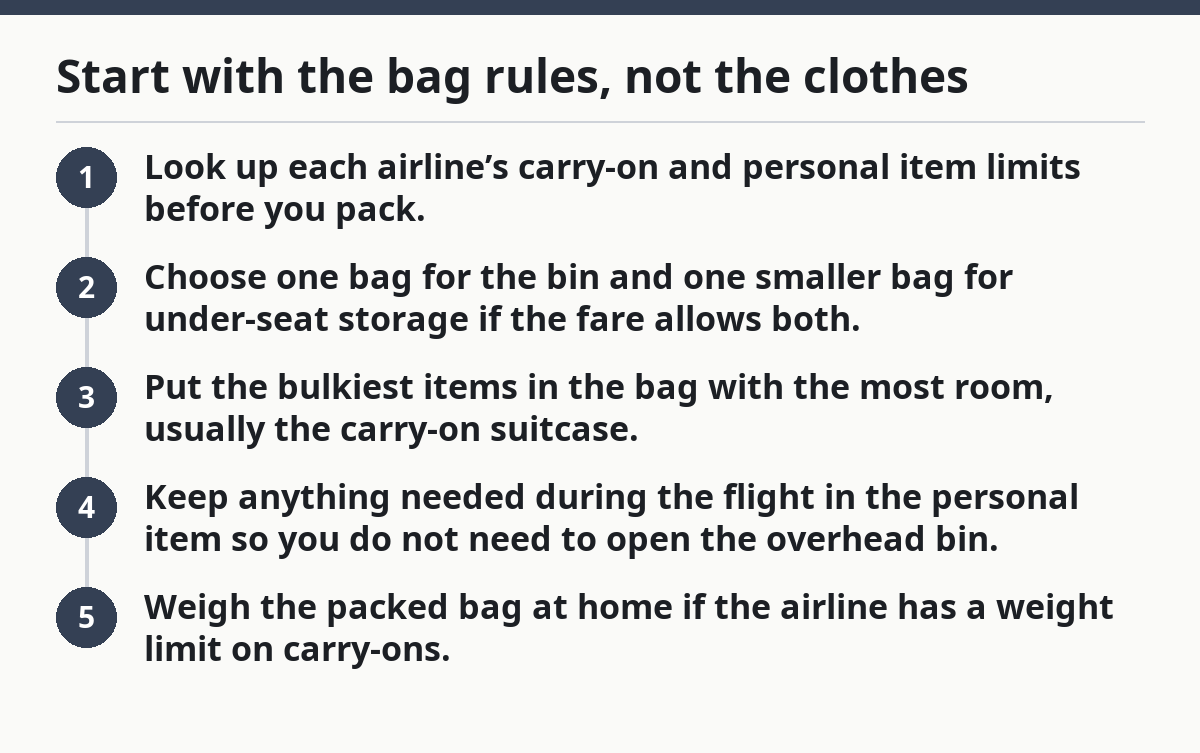
- Look up each airline’s carry-on and personal item limits before you pack.
- Choose one bag for the bin and one smaller bag for under-seat storage if the fare allows both.
- Put the bulkiest items in the bag with the most room, usually the carry-on suitcase.
- Keep anything needed during the flight in the personal item so you do not need to open the overhead bin.
- Weigh the packed bag at home if the airline has a weight limit on carry-ons.
A family packer who ignores the limits pays twice: once in stress, once at the gate. That is not worth it.
For airline rules, the TSA’s liquid page is a good starting point, and the carrier’s own baggage page should always win for size details: https://www.tsa.gov/travel/security-screening/liquids-rule and the airline’s baggage policy page.
How do I choose the right carry-on for a family trip?
The right carry-on is the one that fits your airline’s limits and still leaves room for one full outfit per person, toiletries, and the kid gear you cannot replace easily. A hard-sided spinner works well for many trips, but a soft-sided bag can give a little more give when you are packing awkward shapes.
Picture this: you’re at the kitchen table with a pile of shirts, one hoodie, a tablet, snacks, and a half-open toiletry bag. The bag choice decides whether this turns into a tidy stack or a fight with a zipper. Pick the wrong shape, and you waste space before a sock goes in.
Look for these traits:
- Four wheels or a smooth shoulder strap for short airport walks.
- A wide opening so packing cubes lie flat instead of bunching.
- A front pocket for documents, snacks, and chargers.
- A shell or fabric that can take some squeezing without warping.
Avoid bags that look roomy but have awkward internal curves, thick built-in dividers, or tiny zipper openings. Those features eat space fast. A carry-on with a simple main compartment usually packs better than one with too many fixed sections.
For a large family group, one carry-on suitcase plus one personal item per traveler is often the easiest setup, but airline limits and ages matter. Shared bags get messy at security and at boarding. Split the load by person, then group shared items like sunscreen, wipes, and snacks into one adult’s personal item. If you need more planning help, our family travel packing guide covers the basics.
What should go in each person’s bag?
Each person’s bag should hold one outfit change, sleep or comfort items, and the things that are hard to replace at the destination. That keeps the bag small while covering the first day, delayed luggage, and airport meltdowns.
Picture this: you’re packing for two adults and two kids, and the floor is full of “just in case” items. The fix is simple. Put essentials in the carry-on first, then stop when the bag still closes without a fight.
A smart split looks like this:
- Carry-on suitcase: spare clothes, one extra layer each, shoes if they are small, and shared toiletries in travel sizes.
- Personal item: passports, boarding passes, phone chargers, headphones, tablets, snacks, medication, and anything needed during the flight.
- Kid-specific space: one change of clothes per child, a comfort item, wipes, and a small activity set.
For clothing, choose pieces that mix. Two shirts that match one pair of pants beat four outfits that only work once. That matters more for kids, who spill drinks and sit on the floor. Pack a compact set of pajamas if your flight is overnight, or a clean T-shirt and shorts if you land late.
Do not bury the first-day items at the bottom. Put them near the top or in one packing cube. If you land and need a shirt, socks, and toothbrush fast, you should not have to empty the whole bag onto the hotel bed.
How do I pack for kids without checking bags?
You pack for kids without checking bags by giving each child a smaller, fixed allotment and by using the adults’ bags for shared items. The trick is not packing “for the trip.” It is packing for the first 24 hours, plus a backup layer and a few calm-down tools.
Because kids are the ones who need the most flexibility, start with a simple limit. Give each child one small clothing set, one layer, and one comfort item. Then use the adults’ bags for the shared pieces.
Use this simple breakdown:
- Give each child one compact cube or pouch for clothes.
- Put one complete outfit in that cube, not three partial ones.
- Add one light layer, since airport gates and airplanes can run cold.
- Put comfort items in the child’s small backpack or the adult’s personal item.
- Keep the “can’t lose” items—medication, glasses, special blanket tags, school forms—on the adult side.
For toddlers, one extra shirt and one extra bottom are usually enough if the travel day is short. For older kids, think in terms of one outfit, one layer, one entertainment item, and one snack stash. If your child has a long flight or a late arrival, add pajamas or sleepwear instead of extra daytime clothes.
The mistake here is packing by emotion. A parent sees rain, playgrounds, and dinner plans and packs three versions of every outfit. That fills the bag fast. A better move is to choose clothes that can do two jobs: leggings that work as travel clothes and sleepwear, a hoodie that works in the airport and at dinner, shoes that can handle walking and a quick meal.
Use packing cubes and layers to save space
Packing cubes save space by keeping like items together and by making flat stacks instead of loose bundles. They do not create room out of nowhere, but they make a carry-on easier to close and easier to live out of for a week.
Here’s the catch: cubes work best when you sort by category, not by fantasy outfit. One cube for tops, one for bottoms, one for underwear, one for kid clothes. If you start mixing everything into one cube, you lose the benefit.
A workable cube plan:
- One medium cube for each adult’s tops.
- One medium cube for pants, shorts, or skirts.
- One small cube for socks and underwear.
- One small cube for each child’s clothes.
- One slim cube or pouch for chargers and cords.
Layers help even more when the bag is full. Wear the heaviest shoes on the plane. Put the hoodie or jacket on the traveler who gets cold first. If a coat takes up half a bag, wear it through the airport instead of stuffing it in the overhead bin.
The truth is, many carry-on failures come from bulky items with no plan. Boots, sweaters, and toiletry bottles crush space. If one item is large and heavy, wear it, clip it, or move it to the personal item only if it fits flat. Do not let one puffer jacket steal room from four people’s underwear.
A simple rule helps: if it bends, fold it; if it compresses, roll it; if it is bulky and needed on the plane, wear it. That keeps the carry-on from turning into a half-zipped brick.
What about liquids, snacks, and kid gear?
Liquids, snacks, and kid gear all fit better when you treat them like flight-day items, not packing afterthoughts, and you should check the latest TSA guidance before you fly. TSA’s liquid rule for carry-ons is still the cleanest line to remember: containers must be 3.4 ounces or smaller and fit in one quart-size bag. For detailed screening guidance, see the TSA’s liquids page and the FAA’s family travel tips.
Picture this: you’re at security with a bottle of lotion, a juice box, and a tube of toothpaste that looks harmless until it hits the bin. The rules are simple, but the bag gets rejected when parents guess. Keep the liquids bag visible and separate.
Use this checklist:
- Toiletries in containers of 3.4 ounces or less.
- One quart-size clear bag for liquids and gels.
- Baby formula, breast milk, and related items packed according to TSA’s current screening guidance.
- Snacks that do not leak, crumble, or spoil fast.
- A refillable water bottle, empty before security.
For kids, choose snacks that work in a 2-hour delay and still stay neat: crackers, dried fruit, squeeze pouches, or bars that do not melt easily. Avoid anything sticky or crumbly in a paper wrapper if you can. It creates a mess fast in a car seat or airplane tray.
Keep kid gear slim. A stroller, car seat, or diaper bag may be part of the trip, but on the carry-on side, only bring the foldable version of anything if it truly saves space. A bulky toy or oversized blanket belongs on the “leave it” list unless it is essential for sleep or comfort. For official screening details, use the TSA’s liquid page and related family travel guidance before you pack.
How to finish the bag the night before you fly
Finish the bag the night before by doing a final compression, a document check, and a one-minute test fit. If the zippers strain or the bag will not close flat, remove one nonessential item now, not at the curb.
Picture this: you’ve packed everything, then the bag still feels lumpy and hard to lift. That is your warning sign. The last hour before a flight is a terrible time to discover that one extra sweater or toy pushed the whole setup past the limit.
Use this final pass:
- Lay the bag flat and press down on the top.
- Close it without forcing the zipper.
- Move one bulky item to the personal item if needed.
- Put passports, IDs, and boarding passes in the top pocket.
- Keep chargers and snacks where you can reach them in 30 seconds.
Do a carry test. If an adult cannot lift the bag into an overhead bin without a strain, it is probably too heavy or too awkward for a smooth travel day. The point of carry-on packing is not just avoiding fees. It is avoiding a bag that slows everyone down at boarding.
Also leave a little empty space. A family trip rarely ends with the same amount of stuff it started with. Souvenirs, wet clothes, and last-minute purchases need somewhere to go. A bag packed to the zipper has no margin.
Once this system is set, the next trip gets easier. You can reuse the same bag layout, the same cube setup, and the same first-day essentials. That makes fee avoidance repeatable instead of lucky.
Key Takeaways
- Match the bag to the airline’s size rules before anything else.
- Give each traveler a small, fixed share of the load.
- Use packing cubes to keep clothes flat and separated.
- Put flight-day items in the personal item, not buried in the suitcase.
- Keep liquids within TSA’s 3.4-ounce rule and use one quart-size bag.
- Pack for the first 24 hours, not for every possible event.
Can a family avoid checked bag fees with only carry-ons?
Yes, a family can avoid checked bag fees with only carry-ons if everyone packs light and the airline allows the bags in the fare. The trade-off is less room for extras, so clothes need to mix and liquids must stay within TSA limits. This works best for short trips, warm-weather trips, and travelers who do laundry or rewear clothes.
What should go in a family carry-on?
A family carry-on should hold spare clothes, a light layer, toiletries in travel sizes, chargers, snacks, and the documents you cannot afford to lose. Kids also need one comfort item and a simple activity set. If the trip includes a late arrival, add pajamas or sleepwear.
How do I pack for kids without checking bags?
Pack for kids by giving each child one small clothing set and putting shared items in an adult’s bag. Keep the first day covered, then stop before the bag gets full. A single extra outfit, one layer, snacks, and a calm-down item are usually enough for a short flight.
Drafted with AI; not yet reviewed by a person.