
Last updated: November 20, 2026
Key Takeaways
- A family trip cash flow plan funds each trip date by date, not by wishful thinking.
- Match each payment to the paycheck that can cover it, then keep that money parked until it clears.
- Pair each deposit deadline with the paycheck that lands first, then reserve that cash right away.
- A pre-trip liquidity buffer helps protect the plan from bad timing.
A family trip budget slips when deposit deadlines hit before paydays. This family trip cash flow plan matches due dates to checking-account timing, then moves money before each deadline. If you are using How to Keep a Family Trip Budget on Track When You Have Separate Paycheck Timelines, the steps below show how to keep the trip funded without raiding bills or guessing at balances.
What a family trip cash flow plan does for separate paychecks
A family trip cash flow plan keeps the trip funded by date, not by wishful thinking. It maps paydays, deposit deadlines, final balances, and the money already sitting in a checking account or savings account so each payment has a home before it comes due.
Picture this: you’re looking at one airfare deposit due on the 5th, another hotel balance due on the 19th, and paychecks that land on the 1st and 15th. The plan tells you which paycheck funds which bill, so the money is ready in time. That keeps the balance where you need it when the merchant pulls it.
That matters because a trip budget is not just “how much can we spend?” It is also “when can we spend it?” A good cash flow plan answers both. It turns a total trip cost into dated chunks, then lines those chunks up with the cash that actually arrives.
Here’s the catch: if you wait until a paycheck posts and then start deciding, the due date may already be too close. That is how people end up using a credit card, moving rent money, or paying fees they did not plan for.
A simple plan uses three things:
- the trip’s deposit deadlines and final balances
- the dates paychecks hit
- the account where the payment will leave from
If you already have a broader budgeting system, this page fits under the hub on family trip budget split fixed and flexible costs. That hub covers what the trip costs; this page covers when the cash can leave.
How do you budget for a trip if paychecks come at different times?
You budget by matching each trip payment to the paycheck that can cover it, then keeping that money parked in a checking account or savings account until the charge clears. That is the whole trick.
Picture this: you get paid twice a month, but the resort wants a 20% deposit now and the rest 30 days before arrival. You do not need a perfect calendar mind. You need a date list and a routing decision for each payment. That keeps the household cash flow stable even when income lands on different days.
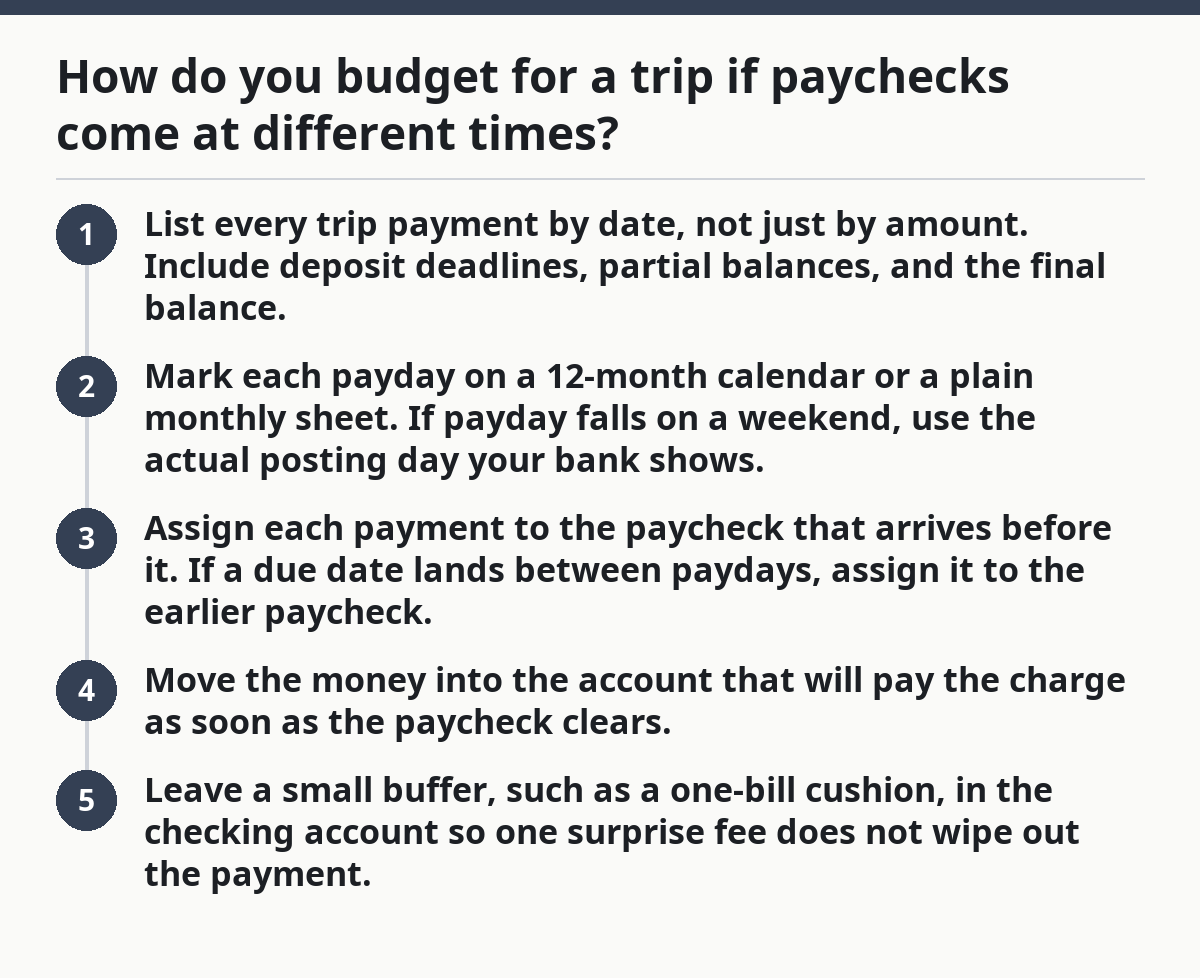
Use this order:
- List every trip payment by date, not just by amount. Include deposit deadlines, partial balances, and the final balance.
- Mark each payday on a 12-month calendar or a plain monthly sheet. If payday falls on a weekend, use the actual posting day your bank shows.
- Assign each payment to the paycheck that arrives before it. If a due date lands between paydays, assign it to the earlier paycheck.
- Move the money into the account that will pay the charge as soon as the paycheck clears.
- Leave a small buffer, such as a one-bill cushion, in the checking account so one surprise fee does not wipe out the payment.
The result can be calm and predictable when the merchant pulls the charge. That is what you want.
Two common mistakes break this system fast:
- Counting future pay as if it were already available. That can leave a deposit short by the time the card is charged.
- Treating savings like free spending money. If the trip money sits in savings, moving it out too late can cause a missed due date; if you are unsure how your bank posts transfers, consult your bank or another financial professional. See CFPB guidance on budgeting and account timing: https://www.consumerfinance.gov/consumer-tools/budgeting/.
Match deposit deadlines to the paycheck that arrives first
You match each deposit deadline to the paycheck that lands before it, then you reserve that cash immediately. If the due date comes before the next payday, the earlier paycheck owns the bill.
Picture this: the trip package asks for a $500 deposit on the 10th, your next paycheck lands on the 12th, and the final balance is due six weeks later. The $500 cannot wait for the 12th. It has to come from the prior paycheck, even if that means trimming another expense for that pay period.
The truth is, deposit deadlines are where family travel cash flow gets messy. A hotel may want one payment now, a tour operator another 30 days later, and the airline a final balance before departure. If you do not assign each deadline to a paycheck, the total cost looks manageable while the timing is not.
Use this filter for every payment:
- Due before payday: fund it from the current paycheck or from money already in the checking account.
- Due after payday: reserve it from the next paycheck as soon as that money lands.
- Due on payday: do not assume same-day access. If the bank posts the deposit later, treat it as if it belongs to the prior cycle, and confirm the posting rules with your bank or a financial professional if needed. See FDIC guidance on deposit availability and timing: https://www.fdic.gov/resources/deposit-insurance/.
A checking account usually works better than a debit card wallet or loose cash because bill payments clear from it faster and with fewer surprises. A savings account can still help, but only if the transfer lands early enough to settle before the charge. If your bank takes a full business day to move money, do the transfer at least 24 hours ahead.
You do not need a complicated spreadsheet to do this well. A simple list with three columns — date, amount, paycheck source — is enough to expose any gap before it turns into a fee.
Build a pre-trip liquidity buffer before the first booking
A pre-trip liquidity buffer keeps you from being trapped by bad timing. It is cash already sitting in a checking account or savings account before the first deposit is due, so one delayed paycheck does not sink the plan.
Picture this: you’re a month out, the car rental wants a card hold, and the first hotel payment is due the same week your mortgage clears. Without a buffer, you are choosing which bill gets delayed. With a buffer, you are choosing nothing in a panic. You are just paying the next item on the list.
The buffer does not need to be fancy. It needs to be real cash, available on demand. For many households, that means keeping at least one upcoming trip payment fully funded before booking anything else. If the next due amount is $300, the buffer starts at $300. If the next two bills are close together, the buffer should cover both.
A strong buffer helps in three places:
- it absorbs bank posting delays
- it covers weekend or holiday timing
- it protects the household from dipping into rent, utilities, or grocery money
Here is the part many articles skip: the buffer is not the same as the trip budget. The budget is the total amount you plan to spend. The buffer is the cash timing cushion that lets the plan survive real life.
If the buffer feels hard to build, the fix is usually sequencing, not discipline lectures. Book the trip in the order that gives you the longest runway. A late-arriving flight balance is easier to cover than an early hotel deposit. If two expenses fall in the same week, pay the one with the stricter deadline first and push the other only if the seller allows it.
One more thing: avoid putting the buffer on a debit card hold if that card is also tied to everyday bills. A hold can freeze part of the available balance and make a checking account look healthier than it is. That is a bad surprise on a Friday.
A simple payment sequence that keeps the budget on track
A simple payment sequence is: fund the earliest deadline first, then the next one, and keep a small cash cushion in the checking account at all times. That order keeps the trip from colliding with household bills.
Picture this: your next paycheck lands on Friday, the kids’ summer camp fee clears Monday, and the vacation deposit is due Wednesday. If you fund the vacation first because it feels more exciting, the camp fee may bounce or drain the account below zero. The sequence has to respect dates, not mood.
Use this procedure:
- Write down every trip cost and its due date on one page.
- Circle the payment that lands first on the calendar.
- Fund that payment from the next paycheck before touching anything else.
- Move the remaining trip money into a separate savings account or labeled checking sub-bucket if your bank offers one.
- Repeat for the next due date, always leaving a buffer of at least one ordinary household bill in the main checking account.
- Stop booking new trip items until the next payment is covered.
That sequence works because it removes the guesswork. You know which bill is first, which paycheck feeds it, and how much cash must stay liquid for the rest of the month.
A common mistake is to batch all trip money into one transfer and hope the timing works out. Hope is not a payment strategy. Another mistake is to treat final balances as “future you” problems. Final balances show up fast, and they often land right after the first excitement of booking fades; if you are unsure how to handle the timing, consult your bank or another financial professional and review CFPB budgeting guidance: https://www.consumerfinance.gov/consumer-tools/budgeting/.
If the numbers are close and the timing is tight, choose the plan with fewer moving parts. A trip with fewer partial payments is easier to manage than one with four deposits in six weeks. Simplicity is a form of protection.
What to do when a vacation payment comes due before payday
If a vacation payment comes due before payday, move the money from an earlier paycheck, ask the vendor for a date change, or cut a nonessential trip purchase before you touch regular household bills. Do not wait and hope the account will recover on time.
Picture this: the final balance is due Tuesday, payday is Thursday, and the charge will trigger before cash arrives. That is a timing problem, not a math problem. You need a bridge, not a bigger budget.
Start with the least harmful option:
- Ask for a date shift. Some hotels, tour companies, and vacation rentals will move a payment a few days if you ask before the charge posts.
- Pull from earlier income. If the paycheck from two weeks ago still has room, use it now.
- Trim a trip add-on. Airport parking, an extra excursion, or a room upgrade may be easier to cut than a core booking.
- Use the buffer only if needed. The buffer exists for this exact kind of squeeze.
Do not make the fix by skipping rent, utilities, minimum debt payments, or groceries. That turns one trip problem into a household problem that lasts much longer than the vacation.
The honest limitation here is simple: if the due date is already too close and the household has no buffer, the trip may need to shrink or move. That is not failure. That is cash flow telling the truth.
This is also where the right account matters. A savings account can help if a transfer lands fast enough; a checking account is usually the better home for money that must clear in 1 to 2 business days. If your bank’s transfer timing is slower, build in more lead time next round.
The mistakes that throw off household cash flow
The biggest mistakes are booking in the wrong order, ignoring bank timing, and pretending every paycheck is free money the day it arrives. Those habits are what break a family trip cash flow plan.
Picture this: you’ve got one trip total in your head, but three different dates on paper. The room deposit clears in 48 hours, the flight balance is due next week, and payday is still five days away. If you have not planned the order, the account can dip below what the trip needs long before departure.
Watch for these failures:
- Booking before checking paydays. That creates deadlines you cannot meet cleanly.
- Using the same account for every bill without a cushion. One debit can crowd out another.
- Forgetting business-day delays. A transfer started on Friday may not help a Monday payment.
- Leaving final balances for the last minute. Final balances often land when other summer spending is also high.
The cost is not just stress. It can mean late fees, overdraft fees, canceled reservations, or a card hold that blocks other spending. The fix is to make the cash flow plan before the booking, not after it.
One useful habit is a 10-minute review every payday. Check what cleared, what is pending, and what the next deposit deadline is. That short review catches small gaps before they grow. It also keeps the trip from stealing attention from the rest of the month.
For a broader look at how the trip budget itself gets divided, see the hub on family trip budget split fixed and flexible costs. This page is about timing; that one is about categories.
FAQ
How do you budget for a trip if paychecks come at different times?
You budget by assigning each trip payment to the paycheck that arrives before the due date. The budget total stays the same, but the cash flow changes by date. Put the payment money in checking or savings as soon as the matching paycheck clears so the balance is there when the charge posts.
What if a vacation payment is due before payday?
You cover it with an earlier paycheck, request a new due date, or cut a nonessential trip cost before you touch regular bills. The goal is to protect rent, utilities, groceries, and minimum debt payments first. If none of those options work, the trip may need a smaller booking or a later date.
How can families manage travel cash flow?
They can manage travel cash flow by listing every deposit deadline, matching each one to a payday, and keeping a buffer in checking for timing gaps. A simple calendar and one payment list are often enough. The key is to fund the next due item before spending on extras.
Drafted with AI; not yet reviewed by a person.