

Last updated: November 20, 2026
The most useful budget family trip route decision tool is a simple timing split: choose a drivable destination under 4 hours when the total trip budget is tight, and choose a flight route only when the fare window and rental timing still leave room for activities. For a family plan, the route is not just distance; it is when you book flights, when you lock a car, and how much of the trip gets eaten by food and transit. This article uses budget family trip route decision tools to compare those trade-offs in the order families actually feel them: transport first, then lodging, then meals, then activities.
Key takeaways
- A short drive can keep a week-long trip in the $900–1,300 range when the destination is under 4 hours away, according to Family on a Dime.
- Flights can move a lot in price. For a 2023 Greece trip, Family on a Dime reported $612 per person 11 months ahead and $429 five months later.
- Car rental timing matters as much as route choice. Budget says some rate codes need a 5-day minimum stay, and it says pay-now bookings in Canada can save up to 35% on base rates.
- Apartment and villa rentals are usually a late booking, with daily price checks and a 3–4 week window before travel, according to Family on a Dime.
- If food takes a very large share of total spending, planned activities can get squeezed, so route choice should protect the activity budget, not just the airfare.
What is the best route choice for a family on a budget?

The best route choice is the one that leaves the most money for the whole trip, not just the transport line. A drivable destination under 4 hours is often the strongest pick when the budget is already tight, because Family on a Dime says that choice can reduce a week-long trip to $900–1,300.
Therefore, the first question is not “What is the cheapest ticket today?” It is “Which route leaves enough room for the rest of the vacation?” A drive avoids some of the timing risk that comes with airfare swings, rental-car add-ons, and tight arrival windows. It also gives a clearer ceiling on cost before the trip starts.
Flights still make sense when the destination is worth the extra planning and the timing lines up. Family on a Dime reported a 2023 Greece trip where fares were $612 per person 11 months ahead, then dropped to $429 five months later. That kind of change is why the better route tool is not “book fast” or “wait forever”; it is “match the route to the booking window.”
The wrong move is to choose a far trip because the flight looks cheap on one day and then let the rest of the budget get squeezed later. A route that seems reasonable at booking can turn expensive once car rental, lodging, airport transfer costs, and food are added.
How do I decide between driving and flying?
Driving wins when the family wants the lowest risk of budget drift and the destination is under 4 hours away. Flying wins when the destination matters more than the transport method and the booking window gives enough room for the fare to settle.
Because of that, a good route decision starts with the full trip, not the ticket alone. If the route choice leaves less money for food and activities, the trip can turn into a set of compromises. Family on a Dime says that when the food-to-total-spending ratio went above 75%, planned activities had to be cut.
That matters because family trips are not just point A to point B. A cheap fare with expensive meals, rentals, and extras can still fail the budget test. A short drive can be the better route even if the fuel bill is not tiny, because it helps protect the rest of the plan. AAA’s fuel-price data and calculator resources are useful here if you want to estimate whether the drive itself stays manageable before you compare it with airfare and transfers. See also the U.S. Bureau of Transportation Statistics’ air travel fare resources for context on fare movement over time.
Here is the simplest rule from the available evidence: if the trip is within a 4-hour drive and the week-long budget needs to stay near $900–1,300, the drive is the safer pick. If the destination is farther and airfare is the main cost driver, use price alerts and give the route time to settle before booking.
What timing tools help most before booking?

The most useful timing tools are a price alert, a short waiting period, and a booking window matched to the trip type. Family on a Dime says to set a price alert when planning starts and wait at least 10 days before booking. That gives the fare time to move before money is committed.
For flights, timing can change the result by a lot. The Greece example from Family on a Dime shows why booking too early is not always the right move, since the fare fell from $612 per person 11 months ahead to $429 five months later. That does not mean every fare drops that way, but it does mean the first quote should not be treated as the final answer. The U.S. Department of Transportation’s consumer air travel data and airfare complaint resources are another reminder that airline pricing is dynamic rather than fixed.
Specifically, this is where families need to separate “good enough to watch” from “good enough to buy.” A route with flexible dates can benefit from a waiting period, but a route with fixed school breaks or limited room inventory may need a shorter watch-and-book cycle. The point is not to delay everything. The point is to avoid committing before the market has had a chance to tell you whether the current price is a temporary high.
For lodging, the timing window is tighter. Family on a Dime says apartment and villa rentals are booked 3–4 weeks before the trip, with prices checked daily. That is a different rhythm from flights. A family that books lodging too early can miss better openings, while a family that waits too long can lose the right layout.
The point of these tools is to keep the route decision open long enough to compare the trip as a whole. A single booking date is not a strategy. A timing plan is what keeps the route from becoming a rushed, expensive choice.
Flights or drive: which route wins in the real comparison?
Flights win for distant trips when the fare window is favorable and the family can still manage the rest of the trip budget. Driving wins for short trips because it is simpler to predict and can keep a week-long stay in the $900–1,300 range, according to Family on a Dime.
On the other hand, the decision is not close when the destination sits under 4 hours away and the goal is budget control. In that case, the drive has a clear edge because the route itself helps hold down the total trip. The longer the trip gets, the more the family needs fare timing, rental timing, and food control to avoid blowouts.
The table below shows the route choice in the terms that actually matter.
| Criteria | Drive to a destination under 4 hours | Fly to a farther destination | Winner for this condition |
|---|---|---|---|
| Upfront cost control | Often easier to keep the whole week near $900–1,300, according to Family on a Dime | Can start low, but the total can rise once baggage, car rental, and food are added | Drive, when the budget is tight |
| Fare timing risk | Lower, because the main cost is not a moving airfare | Higher, because fares can shift a lot; Greece changed from $612 to $429 per person in the example from Family on a Dime | Drive, for certainty |
| Planning effort | Fewer booking moving parts | More timing pieces: flight, rental, lodging | Drive, for low stress |
| Best booking window | Less dependent on fare swings | Needs alerts and a wait of at least 10 days, according to Family on a Dime | Fly, if timing can be managed |
| Lodging flexibility | Easier to pair with simpler stays | Apartment and villa rentals are often booked 3–4 weeks out, with daily checks | Fly, if the lodging market is part of the plan |
| Family schedule fit | Better for short breaks and school-week limits | Better for destination-led trips | Drive, for short windows |
| Activity budget protection | More likely to leave room for activities | Can crowd out the rest if transport rises | Drive, when activities matter |
| Long-distance destination choice | Limited by the road radius | Opens more destinations | Fly, for trip variety |
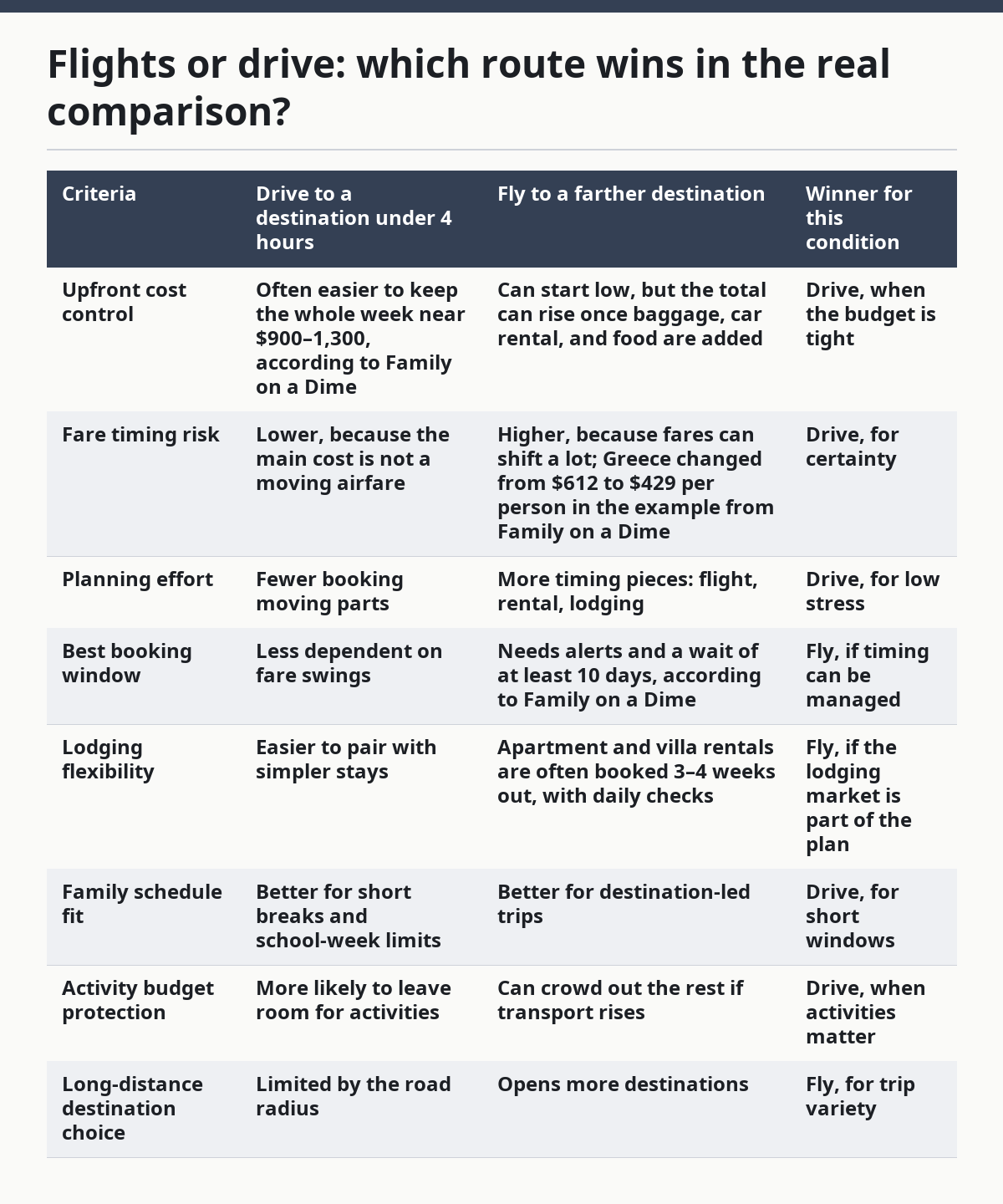
The biggest weakness of flying is not the flight by itself. It is the way a fair-looking fare can pull money away from the rest of the trip. The biggest weakness of driving is obvious too: it limits the destination radius, which means some trips are off the table. For a worked example, imagine a family with a $1,200 target budget. If a round-trip flight for four is $1,100 before bags and transfers, only $100 remains for meals, which is obviously too tight. If the same family drives 3.5 hours and spends $180 on fuel and tolls, the remaining $1,020 can still cover a hotel, food, and one or two planned activities.
How should I time hotels, apartments, and villas?
Apartment and villa timing should be handled later than flight timing, because Family on a Dime says those rentals are booked 3–4 weeks before the trip and priced checked daily. That means lodging should be treated as a near-term decision, not a set-it-and-forget-it one.
This late timing works best when the destination is known and the trip dates are firm. It is useful for families that want more space than a standard room and are willing to watch prices closely. Daily checks matter because the window is short and the wrong day can cost the trip a better layout or better value.
The drawback is that this timing requires discipline. A family that waits until the last minute without checking daily can lose the kind of place that makes the trip work. That matters more on a budget trip than on a splurge trip, because room size, kitchen access, and sleeping setup can change the whole meal plan.
This is also where route choice and lodging choice meet. A fly-in trip often needs faster lodging decisions and more careful matching with airport timing. A drive trip can be easier to stage because the family is not also juggling an arrival day built around a flight schedule. If the itinerary depends on a late check-in, a kitchen, or a specific bedroom setup, the route should support that need rather than force a weaker room choice.
What car rental rules change the route decision?
Car rental rules can change the route decision because the price is not only about the car; it is about the booking code, the rental length, and whether paying now helps. Budget says its rate code requires a minimum stay of 5 days, which means short trips may not qualify for the same offer.
That minimum stay matters because a family trip of only a few days can get pushed out of a discount structure. Budget also says you can save up to 25% on rentals of 5 days or more. That makes a longer family trip more likely to benefit from the same rental plan, while a short hop may not.
There is also a payment timing angle. Budget says paying now can save up to 35% on car rental base rates in Canada. That is a real incentive for families who already know their dates and can commit early enough to lock the rate.
The trade-off is clear. Early payment can help, but it reduces flexibility. If a family is not sure about dates or still comparing route options, a pay-now booking can make the plan harder to change. For some trips, that is worth it; for others, it is a trap. In practice, the better route is often the one that fits the rental rules rather than the one that looks cheapest before the car is priced in.
When does the route choice need to change?
The route choice should change when the food share, lodging timing, or car rental rules start crowding out activities. Family on a Dime says that when the food-to-total-spending ratio went above 75%, planned activities had to be cut. That is the warning line.
A trip that looks fine on transportation can still fail if meals are too costly for the route. That is why the better decision tool is not a single fare check. It is a trip budget check that includes food, lodging, transport, and the activities the family actually wants to do.
Therefore, the route sometimes changes even after the initial plan looks settled. If the flight is cheap but the destination is expensive to move around in, the real total can end up worse than the drive. If the car rental needs a 5-day minimum but the trip is only 3 or 4 days, the structure no longer fits the plan. If the lodging you want only appears in a 3–4 week booking window, the route and dates may need to shift together.
There are a few exception scenarios where the overall verdict changes.
-
The flight is far below the drive-plus-hotel total. In that case, a farther destination can win even for a budget family, but only if the rest of the trip still leaves room for food and activities.
-
The rental car requires a 5-day minimum stay. If the trip is shorter than that, the rental structure may no longer fit the plan, and the route choice may need to shift.
-
The family needs a specific apartment or villa. If the best place is only available in the 3–4 week booking window, the route and dates should bend to that timing, not the other way around.
-
The food budget is already under pressure. If meals are likely to take more than 75% of total spending, the trip should move toward the simpler route with fewer add-ons.
A route decision only works when it still leaves enough money for the rest of the trip. If not, the route is wrong even if the ticket looks good.
What is the final call?
Choose driving if the destination is under 4 hours away and the family needs the safest path to a week-long trip in the $900–1,300 range. Choose flying if the destination is farther away, the flight can be timed with a price alert, and the rest of the budget still works after lodging and rentals.
Ultimately, neither option works if the trip only functions by letting food take most of the budget or by forcing a rental plan that does not match the stay. That is not a budget plan; it is a budget leak.
What should I ask before I book?
The best questions are the ones that force the whole trip into one budget, not just the transport part. If the answer changes after you add food, lodging, and rental timing, the route is not settled yet.
Should I book flights as soon as I start planning?
No. Family on a Dime says to set a price alert when planning starts and wait at least 10 days before booking. That short pause can keep you from locking in a fare before the market settles.
Is a short drive really cheaper for a family trip?
Yes, when the destination is under 4 hours away and the target is a week-long trip around $900–1,300, according to Family on a Dime. The point is not that driving has no cost; it is that the total trip is easier to hold down.
When should I book an apartment or villa?
Book it 3–4 weeks before the trip and check prices daily, according to Family on a Dime. That window is tighter than flight timing, so it helps to know your dates before you start watching.
What car rental deal should I watch first?
Watch the 5-day minimum stay and the pay-now discount. Budget says some rate codes need a minimum stay of 5 days, it says rentals of 5 days or more can save up to 25%, and it says paying now can save up to 35% on base rates in Canada.
What budget warning means I should switch plans?
If food is taking more than 75% of total spending, the plan needs to change. Family on a Dime says planned activities had to be cut once the food-to-total-spending ratio went above that line, and that is a sign the route is no longer supporting the trip.
Sources
- Family on a Dime, “Best Budget Family Travel”
- Budget Car Rental, “Discount car rental rates and rental car deals”
- U.S. Department of Transportation, Air Travel Consumer Reports: https://www.transportation.gov/airconsumer/air-travel-consumer-reports
- U.S. Bureau of Transportation Statistics, Air Travel data: https://www.bts.gov/topics/airlines-and-airports/air-travel
- AAA, Gas Prices and Fuel Savings tools: https://gasprices.aaa.com/
Drafted with AI; not yet reviewed by a person.
