

Last updated: November 19, 2026
Quick Answer: A family trip booking is too rigid when a single realistic change could cost you more than the savings you got by choosing it. In this article on How to Judge Whether a Family Trip Booking Is Too Rigid to Be Worth It, the key question is whether the cancellation terms, change fees, and payment rules can survive normal family chaos. The sections below show how to judge booking flexibility, not just read the fine print.
Key Takeaways
- A booking is too rigid if a small change would cost more than the trip is worth to you.
- Nonrefundable rates are fine for fixed plans, but they are a bad fit when kids, school, or health issues can shift dates.
- Change fees matter more than a low base fare if you may need to move one leg, one room night, or one whole trip.
- Flexible fares often cost more up front, but they can save the trip when plans wobble.
- The right test is simple: compare the penalty for a change with the chance that your plans change.
The quick verdict on booking flexibility
A rigid booking is worth it only when your dates are locked and the penalty is small enough that you can live with it. For a family trip, that means the booking should survive the usual mess: a child gets sick, a game moves, a school day is added, or a grandparent can’t travel.
Picture this: you’re booking a four-night break, and one kid still needs naps, one has a 7 a.m. soccer game, and the return date depends on a work call. In that setup, a nonrefundable rate with steep change fees is a bad fit unless the savings are large enough to justify the risk.
A rigid booking is more likely to be worth it when all of these are true:
- The trip dates are fixed by a school calendar, wedding, or event.
- Each change would cost less than you’d lose by buying flexibility.
- You can absorb the full fare if the trip falls apart.
- The booking policy lets you change the part most likely to move, not just the whole trip.
The truth is, flexibility is not a luxury feature for many trips with kids. It is insurance against ordinary disruption, and that is why this family trip booking question matters.
How to judge whether the penalty matches the real risk
A booking is too rigid when the cost of one likely change is close to, or higher than, the amount you saved by choosing the cheaper fare. That is the cleanest rule of thumb.
Picture this: you see a lower fare with a strict cancellation term, but the kids have a track record of getting sick two days before travel. A booking with a $0 change path may be worth more than a cheaper rate that locks in every dollar, even if the base price looks better on screen.
Use this simple check before you buy:
- List the likely change points. Note anything that could move the trip by a day or two: school events, sports, custody handoffs, work shifts, medical appointments, or sleep needs.
- Read the booking policies line by line. Look for change fees, cancellation terms, and whether the fare returns as cash, credit, or nothing at all.
- Price the worst likely change. Compare the fee to move the booking with the savings from the cheaper rate. If a change costs most of the savings, the deal is brittle.
- Check what can move separately. A room, flight, or train ticket that can’t be changed on its own is less useful than one piece with flexible fares.
- Ask what happens if one traveler drops out. Some bookings punish partial changes harder than full cancellations.
The key number is not the fare alone. It is the fare plus the likely penalty. A $300 saving that disappears with a $250 change fee is usually not much of a win, so the cheaper option may not really be cheaper.
What makes a booking too restrictive for a family trip?
A booking is too restrictive when it turns normal family uncertainty into a money loss you can’t stomach. That usually shows up in three places: the payment rule, the change rule, and the cancellation rule.
Picture this: you are holding a booking that must be paid in full now, cannot be changed without a fee, and gives no cash back after a deadline. That structure is fine for a business trip with fixed dates. For a trip with kids, it can be a trap.
Watch for these red flags:
- Nonrefundable rates with no useful credit.
- Change fees on top of a fare difference.
- Cancellation terms that drop to zero value after a short window.
- Full prepayment long before travel, especially months ahead.
- Rules that apply to every traveler at once, so one person’s change affects all of them.
- Policies that only refund in travel credit, not cash, when credit would be hard to use.
On the flip side, a booking is less restrictive if it lets you move dates, cancel without losing the whole amount, or change one part without breaking the rest.
Because those rules matter so much, the most useful test is blunt: if one small family problem would make you regret the booking for weeks, it is too restrictive.
When is a nonrefundable booking a bad idea for a family trip?
A nonrefundable booking is a bad idea when the chance of change is normal, not rare. If you have kids under 10, a tight school calendar, health uncertainty, or travel that depends on another person’s schedule, that risk is often high enough to matter.
Picture this: you book a summer stay 5 months out because the rate looks good, but your child may need a doctor visit, your teen’s camp dates may shift, and your partner’s leave is not approved yet. A nonrefundable rate in that setting is not just strict. It is fragile.
The weak spots are easy to spot:
- Long booking windows before travel.
- Trips tied to weather, sports, or school events.
- Travel with grandparents, infants, or anyone who may need rest or medical care.
- Itineraries with multiple pieces that all have to line up on the same day.
- A budget that cannot absorb a lost deposit or full charge.
A nonrefundable booking can still make sense if the savings are real and the trip is nearly certain. Think of a one-night stop on fixed dates, not a complex family vacation with moving parts.
The honest downside is simple. Once a nonrefundable booking is locked, the money becomes hard to protect. If your plans are already shaky, that risk belongs in the decision, not after the receipt arrives.
Flexible fares and booking policies: what you are actually buying
Flexible fares are worth paying for when they buy you time, not just a nicer label. The point is not to pay extra for peace of mind in the abstract. The point is to preserve options when a child’s schedule or health changes.
Picture this: two bookings look similar, but one lets you change dates, one lets you cancel for credit, and one keeps everything if you need to shift by a day. Those are not the same product, even if they sit side by side on the screen.
Here is how the common choices usually differ:
- Nonrefundable rate: lowest price, weakest protection.
- Changeable fare with fee: some wiggle room, but you still pay when plans move.
- Flexible fare: higher upfront cost, lower pain if dates shift.
- Credit-only cancellation: better than nothing, but only useful if you will travel again soon.
- Cash-refund booking: the strongest protection when plans are uncertain.
The trap is paying for flexibility you will not use. A traveler with fixed dates and no moving parts may not need it. A family that juggles school, naps, childcare, and work often values it more.
The best part is not that flexibility is always worth paying for. It is that you can match the booking to the trip instead of paying for certainty you do not need.
How I’d compare two bookings before paying
A booking is worth buying when its flexibility matches the messiness of your trip, and not a step more. This is the part that turns the whole question into a simple comparison.
Because the choice is really about tradeoffs, picture this: you have two options in front of you. One is cheaper and strict. The other costs more but gives you a better escape route if your plans shift by a day or two.
Use this comparison table as the final check.
| Option | Best For | Core Spec | Standout Feature | Action |
|---|---|---|---|---|
| Nonrefundable rate | Fixed-date trips with low chance of change | Lowest protection; money may be lost if you cancel | Often the cheapest upfront choice | Buy only if the dates are locked and the savings matter |
| Flexible fare | Trips where dates may move but still happen | Change rules that soften the hit from shifting plans | Better fit for kids, school calendars, and uncertain leave | Choose if one schedule change would sting |
| Credit-based booking | Families likely to travel again soon | Refund value returns as travel credit | Less painful than losing the full amount | Use only if the credit will actually get used |
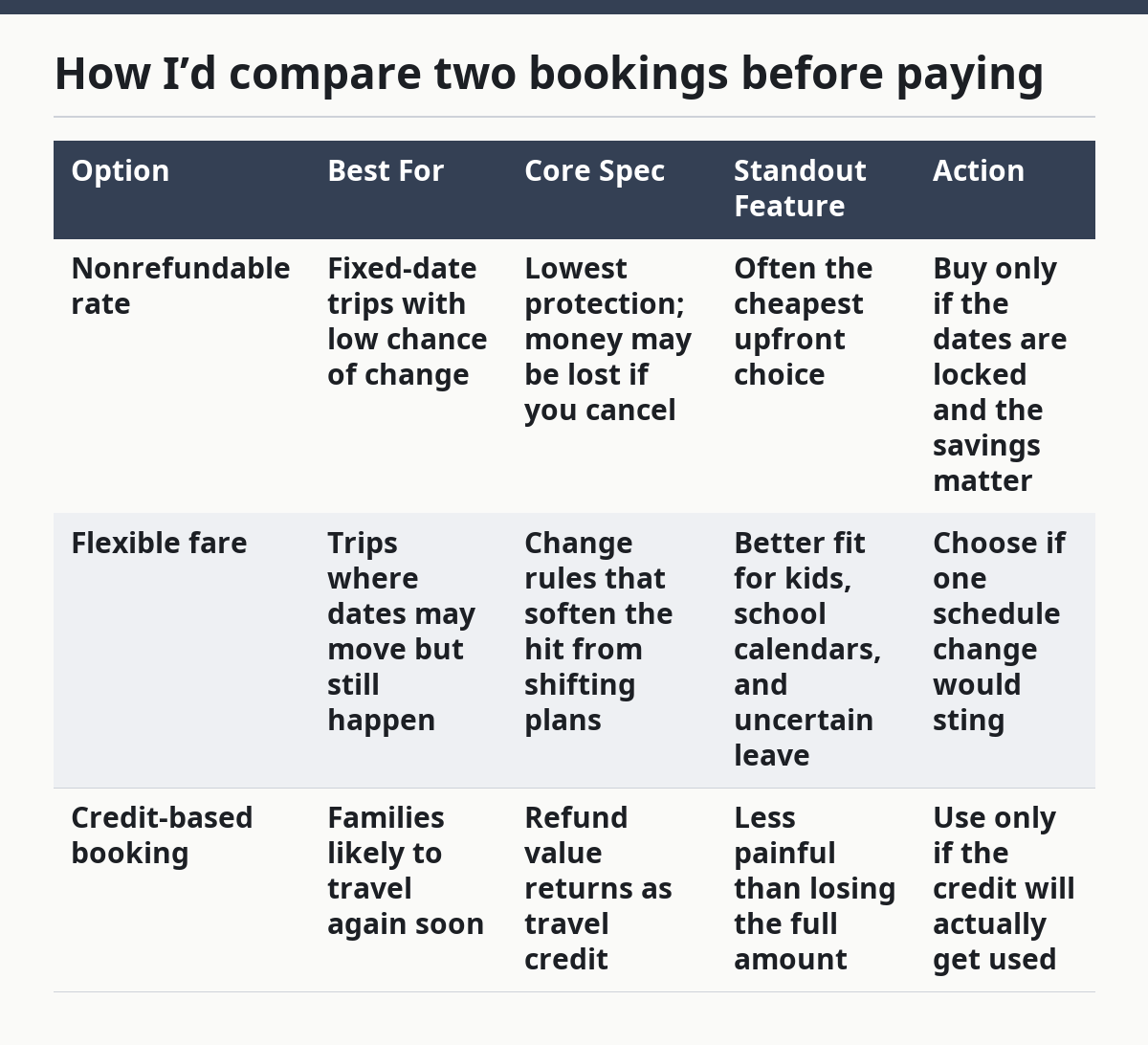
What this table leaves out on purpose is the hidden fee hunt, fare holds, and package math. Those are separate decisions. Here, the question is narrower: does the booking itself bend enough for family life?
The common mistake: choosing the cheapest price, not the cheapest risk
The cheapest booking is not always the cheapest trip. A lower fare with strict booking policies can cost more once a change shows up, and family trips produce change more often than solo trips.
Picture this: you save a little at checkout, then pay a penalty to move one date, lose a night, or forfeit a deposit. The “deal” turns into a second purchase.
Three mistakes show up over and over:
-
Buying on price alone.
Cost: you ignore the chance of a $200 or $300 penalty later.
Better move: compare the penalty, not just the fare. -
Assuming plans will stay put for 3 to 6 months.
Cost: you lock in too early and lose flexibility before the trip even starts.
Better move: pay for flexible fares when the trip is far enough out that life can change. -
Treating credit like cash.
Cost: you accept a voucher you may never use.
Better move: only count credit if another trip is already likely.
The rule is simple. If a booking only looks smart when nothing goes wrong, it is too brittle for a trip with children.
The booking flexibility test I use before I say yes
A booking passes the test when the penalty for change is lower than the pain of overpaying for flexibility you will not use. That means the answer depends on your trip, not on a generic “best deal.”
Because the decision is practical, picture this: you are staring at a checkout page with cancellation terms in small print and a clock running. This is the moment to slow down for 2 minutes, not 20, and ask the right questions.
Use this final filter:
- Would one schedule shift ruin the trip or just change the plan?
- Can I afford to lose the full amount if something comes up?
- Are the adults’ schedules as uncertain as the kids’?
- Does the booking let me change the part most likely to move?
- Is the savings big enough to justify the rigidity?
If you answer “yes” to the first or second question, a rigid booking is usually too risky. If you answer “no” to both, and the trip is fixed, a stricter fare can be fine.
The short verdict: booking flexibility matters most when family plans are messy, dates are far out, or one change would turn a bargain into a loss. Skip the rigid option when the fine print assumes a level of certainty real life does not give you.
For policy wording, the U.S. Federal Trade Commission’s plain-language consumer guidance on refunds and dispute rights is a useful starting point, and the U.S. Department of Transportation explains airline consumer rules clearly enough to help you read terms with a sharper eye.
Drafted with AI; not yet reviewed by a person.
