Last updated: November 19, 2026
Quick Answer: Family travel insurance is worth buying when one canceled trip, one medical bill, or one missed connection would hurt your budget. It is usually worth it when the trip cost is non-trivial, the medical exposure is high, or your refund options are weak. The sections below show how to judge trip cancellation coverage, medical coverage, exclusions, and refund scenarios for How to Tell Whether Family Travel Insurance Is Worth Buying without treating insurance like an automatic add-on. For policy details and consumer guidance, see the U.S. Department of Transportation and the National Association of Insurance Commissioners.
Key Takeaways
- Compare the policy cost against the money you could lose, not against the whole vacation.
- Medical coverage matters more on some trips than cancellation coverage does.
- Pre-existing condition rules and family exclusions can make a policy weaker than it looks.
- If your booking is mostly refundable, the case for insurance gets thinner fast.
- This is information, not financial advice; for your own situation, a qualified adviser should review the policy and your trip details.
Who this applies to, and what you need in hand
This applies to families who already know the trip dates, the total prepaid cost, and the main refund rules on the booking. It assumes you can read a policy summary and compare a few numbers before you pay.
Picture this: you have flights, a hotel, and a theme park reservation for four people, and the final payment is due in 48 hours. You do not need a law degree. You do need the booking terms, the policy wording, and a clear view of what you stand to lose if something changes.
Use this page if you are trying to judge family travel insurance against a real trip, not shopping for a generic peace-of-mind add-on. It is also the right page if you are trying to separate travel insurance from trip supplier refunds, because those are not the same thing.
- Gather the total prepaid trip cost.
- Check the cancellation window on each booking.
- Note any nonrefundable deposits.
- Write down any medical conditions that may affect the policy.
- Find the policy’s family definitions and age limits.
- Look at baggage, delay, and emergency medical limits if they are listed.
If you are still at the stage of choosing dates or comparing trip types, the budget family trip planning hub will help with timing and pricing before you buy any policy.
How do you tell if family travel insurance is worth it?
It is worth it when the amount you could lose is bigger than the policy cost, or when the trip creates real medical risk. The useful question is not “Do I want insurance?” It is “What do I lose without it?”
Picture this: your family trip has a nonrefundable hotel, prepaid tickets, and flights that only give a credit if you cancel. That is a very different case from a short domestic trip with flexible bookings and low deposits. The first can justify trip cancellation coverage; the second may not.
Work through the decision in order.
- List every prepaid item and its refund rule. Use the supplier’s own terms, not a memory from checkout. Verify whether the booking is fully refundable, credit-only, or nonrefundable. A problem shows up if you cannot get the exact cancellation terms in writing.
- Add up the money you could actually lose. Use the nonrefundable total, not the whole vacation budget. Verify the total is current and includes taxes and fees you cannot get back. A problem shows up if you count items that are refundable.
- Check whether the policy covers trip cancellation for your reasons. Read the covered reasons list, not the marketing summary. Verify that illness, injury, severe weather, or other listed events are named the way you expect. A problem shows up if the reason you care about is not listed.
- Compare the cancellation limit with your trip cost. If the policy limit is below your prepaid total, you may still be exposed. Verify whether the limit is per person or per trip. A problem shows up if the limit only covers part of the family’s bookings.
- Look at medical coverage next. Verify the policy’s emergency medical and medical evacuation terms, especially for international travel. A problem shows up if the policy has weak medical terms and you are traveling far from home.
- Check who counts as a family member. Some policies define family narrowly, and some exclude certain relatives or age ranges. Verify each traveler fits the policy definition. A problem shows up if one child, grandparent, or stepchild is outside the definition.
- Read the exclusions page before you buy. Verify whether pre-existing conditions, high-risk activities, pregnancy, or destination warnings affect coverage. A problem shows up if a major trip risk is carved out by exclusion.
- Estimate the refund backup you already have. Credit card protections, airline credits, and supplier waivers may reduce the need for insurance. Verify what is automatic and what requires a claim. A problem shows up if you assume a refund exists when it does not.
The best part is that this process works even when the policy name sounds generous. A family plan can still be weak where it matters. The label does not pay the bill.
What does family travel insurance usually cover?
It usually covers trip cancellation, trip interruption, emergency medical care, and some baggage or delay losses, but the details matter more than the category name. Many family policies bundle several benefits into one plan, then limit each benefit with separate caps and exclusions.
Picture this: one child gets sick two days before departure, or an international clinic visit is needed during the trip. In those moments, medical coverage can matter more than the cancellation section. On the flip side, a missed connection or storm delay may matter more on a winter trip with tight timing.
Most family plans include some version of these terms:
- Trip cancellation: Pays for covered losses before departure, often for listed reasons only.
- Trip interruption: Covers some unused trip costs if you have to cut the trip short.
- Emergency medical: Helps with treatment for sudden illness or injury during travel.
- Medical evacuation: Covers transport to appropriate care if the policy includes it.
- Baggage loss or delay: Helps with delayed or lost bags, usually with small limits.
- Travel delay: May reimburse meals or hotels after a covered delay.
A generic article often skips the fine print. That is where the real decision lives.
- Read the benefits page line by line.
- Match each benefit to one actual trip risk.
- Check the dollar limit on each benefit.
- See whether the limit is per person, per day, or per trip.
- Look for separate deductibles if the policy uses them.
- Confirm whether one claim can reduce another benefit.
If the policy summary does not state the limit plainly, treat that as a warning sign and, if needed, consult a qualified adviser or insurer before buying. A benefit you cannot verify is not a benefit you can count on.
What exclusions can make a family policy weaker than it looks?
Exclusions can wipe out the exact trip risk you were trying to insure. The most common problem is assuming that “family plan” means broad coverage, when the policy may exclude common family issues like chronic conditions, sports injuries, or changes tied to a known event.
Picture this: a parent has a recent medical issue, one child is scheduled for treatment, or the trip includes skiing, scuba, or a cruise. Those details can change everything, so consult a qualified adviser or the insurer if the wording is unclear. A policy that looks broad on the sales page can become narrow once the exclusions are read carefully.
Pay close attention to these four areas.
-
Pre-existing condition rules. A pre-existing condition is a medical issue that existed before the policy’s look-back period. Policies often define that look-back period differently. Verify whether the condition is excluded, conditionally covered, or covered only if you buy within a set window after the first trip deposit.
-
Family-member definitions. Some policies only count certain relatives. Verify how the insurer defines spouse, child, parent, sibling, and dependent. A policy can fail you on a technicality if the traveler does not fit the definition.
-
Activity exclusions. High-risk sports and adventure activities are often excluded or only partly covered. Verify whether skiing, motorbiking, diving, or similar activities are named.
-
Known-event exclusions. If a storm, strike, outbreak, or travel warning is already known when you buy, the insurer may exclude it. Verify whether the destination risk was already public when the policy was issued.
Here’s the catch: these exclusions are not rare edge cases. They are the first place many claims break.
- Check the exclusions list before payment.
- Ask whether the policy covers pre-existing conditions under any rule.
- Confirm whether one family member’s condition affects the whole policy.
- Verify activity coverage if the itinerary has more than museums and meals.
- Look for date-based exclusions tied to booking time.
When is the answer no?
The answer is no when the policy cannot cover the loss you care about, when the trip is mostly refundable, or when the exclusions remove the main risk. In those cases, buying insurance can feel comforting while adding little real protection.
Picture this: you booked a low-cost domestic hotel, your flights can be changed for a small fee, and your card already gives some travel protections. That is a weak case for extra coverage. A policy can still make sense for medical exposure, but not every trip needs the full package.
Stop and reconsider if any of these are true:
Your bookings are refundable: If you can cancel most of the trip with little or no loss, the cancellation value is thin — look at medical-only protection or skip the policy.
The medical risk is low and local: If you are staying close to home and already have usable coverage, the policy may add little — compare the medical terms with what you already have.
Pre-existing condition rules block the main risk: If the condition you are worried about is excluded, the policy may not protect the situation that matters — seek a different policy design or professional help reviewing the wording.
The family definition does not fit your household: If a child, stepchild, grandparent, or dependent is not clearly covered, a claim can fail — do not assume the sales page definition wins.
The plan is tied to a known event: If the issue you fear is already public or already happening, the policy may exclude it — review the event timing before buying.
You cannot confirm the limits in writing: If the policy language is vague or hard to find, you do not know what you are paying for — skip the policy until the wording is clear.
The truth is, a bad fit policy is worse than no policy at all, because it encourages false confidence.
The mistakes families make, and what they cost
Families usually make the same four mistakes, and each one can turn a paid policy into a partial refund at best. The fix is simple, but only if you slow down before checkout.
Picture this: the premium is small enough to feel harmless, so you click yes and move on. That is how people buy the wrong policy. The cost shows up later, during a claim, when the fine print matters more than the purchase screen.
- Mistake 1: Insuring the whole vacation instead of the nonrefundable part. That makes the policy look more valuable than it is. The correct move is to insure the amount you could actually lose.
- Mistake 2: Assuming medical coverage is automatic and broad. It is not. Some plans have low limits or narrow terms. The correct move is to read the medical section first if you are traveling abroad.
- Mistake 3: Ignoring pre-existing condition rules. That can void the reason you wanted coverage. The correct move is to read the look-back rule and any waiver rules before buying.
- Mistake 4: Skipping the exclusions page. That can leave a family activity or traveler outside coverage. The correct move is to match the itinerary to the exclusions.
- Mistake 5: Confusing supplier refunds with insurance. A credit from an airline is not the same as reimbursed cash. The correct move is to separate what the seller owes from what the insurer may owe.
- Mistake 6: Buying late. Some benefits depend on buying soon after the first trip deposit. The correct move is to check timing rules before the policy window closes.
A good result looks plain: you know what is covered, what is excluded, and what loss you still carry yourself.
How to compare family travel insurance without getting lost
Family travel insurance is worth comparing by three numbers: the trip cost at risk, the medical limit, and the exclusions that matter most. If one of those three is weak, the policy may be a poor fit even if the price looks modest.
Picture this: you are comparing two plans that both say “comprehensive.” One has stronger medical terms but narrow cancellation rules. The other has decent cancellation coverage but weak pre-existing condition wording. That is not a branding problem. It is a coverage problem.
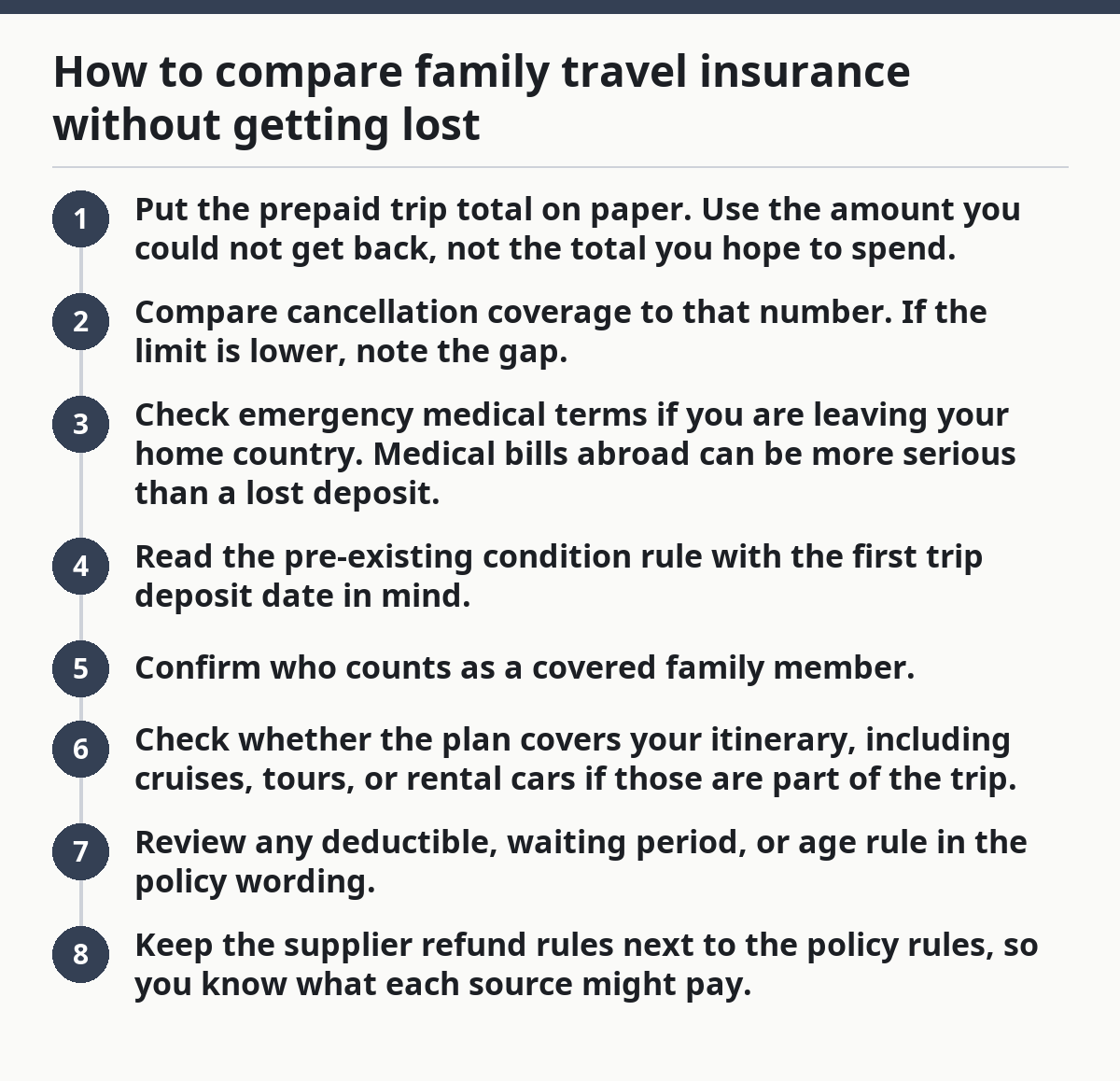
Use this checklist before buying.
- Put the prepaid trip total on paper. Use the amount you could not get back, not the total you hope to spend.
- Compare cancellation coverage to that number. If the limit is lower, note the gap.
- Check emergency medical terms if you are leaving your home country. Medical bills abroad can be more serious than a lost deposit.
- Read the pre-existing condition rule with the first trip deposit date in mind.
- Confirm who counts as a covered family member.
- Check whether the plan covers your itinerary, including cruises, tours, or rental cars if those are part of the trip.
- Review any deductible, waiting period, or age rule in the policy wording.
- Keep the supplier refund rules next to the policy rules, so you know what each source might pay.
For readers working on a broader budget plan, this fits neatly with the budget family trip planning hub. The insurance question only makes sense once the booking timing and pricing are already clear.
The best part is that you do not need a perfect forecast. You only need a clear view of the downside.
When the standard rules do not apply
The standard rules need adjustment when the trip is international, the family has health issues, or the trip includes a nonstandard activity. Those cases do not make insurance automatically worth it; they just change which part of the policy matters most.
Drafted with AI; not yet reviewed by a person.