
Last updated: November 19, 2026
Family trip planning gets expensive fast, but the right points, perks, and memberships can cut hotel nights, meals, parking, and transit without turning the trip into a coupon hunt. Budget family trip planning with points, perks, and memberships — The Complete Guide starts with a simple rule: use one travel card, one loyalty program, and one membership that matches the trip. The sections below settle what to keep, what to skip, and where the real savings show up.
I’ve spent years writing about travel rewards, hotel status, and family trip budgets, so I know where the hidden costs hide and where the easy wins usually are. For a family of four, small charges can add up quickly, which is why budget family trip planning with points, perks, and memberships works best when the savings are clear and repeated.
Key Takeaways
- Pick the trip first, then choose the points strategy around it.
- One strong hotel program can beat three weak loyalty sign-ups.
- Memberships matter most when they replace repeat cash costs, like parking, museum tickets, or road-trip fuel discounts.
- Family travel savings come from boring details: free breakfast, late checkout, waived resort fees, and baggage rules.
- The wrong setup can cost more in annual fees, blackout dates, and wasted points than it saves.
What actually saves money on a family trip?
The biggest savings come from three places: nights, meals, and transit. Points are best for hotel stays or flights you were already going to book. Perks handle the daily bleed—breakfast, parking, baggage, and check-in flexibility. Memberships help when they give repeat discounts on things a family buys over and over.
Because family budgets are usually squeezed in more than one place, budget family trip planning with points, perks, and memberships works best when each tool has a clear job. A $35 breakfast, a $25 parking fee, and a $40 baggage charge can erase the value of a cheap room fast. That is why a simple setup often beats a crowded wallet full of unused accounts.
Here’s the catch: not every “free” perk is worth chasing.
- Points help most when the cash rate is high or the room is the same price in points and cash value.
- Perks help most when they reduce daily out-of-pocket spending.
- Memberships help most when your family uses them more than once a year.
A simple test: if a perk only saves money on a trip you may never repeat, it’s a weak fit. If it saves on every road trip, weekend stay, or museum day, it’s a keeper. In budget family trip planning with points, perks, and memberships, repeated savings matter more than flashy one-time wins.
How should a family stack points without making the trip complicated?
A family should stack one flexible points source, one hotel program, and one backup membership. That keeps the plan simple enough to use and broad enough to fit different trips. A mile in the wrong program is just a coupon with an expiration date.
Start with a flexible rewards card or points currency that can move to several travel partners or erase travel charges as statement credits. Then choose a hotel brand that has family-friendly room types, breakfast value, or properties where your points go far. After that, add a membership that covers a recurring need, such as car rentals, warehouse fuel, or theme-park admission. Budget family trip planning with points, perks, and memberships works best when each layer covers a different kind of cost.
When the trip is fixed and the price is high, flexibility matters even more. A flexible points pool helps because it lets you move where the value is best instead of locking into one chain. That matters when traveling with kids, because dates are fixed and you can’t wait for the “perfect” award chart.
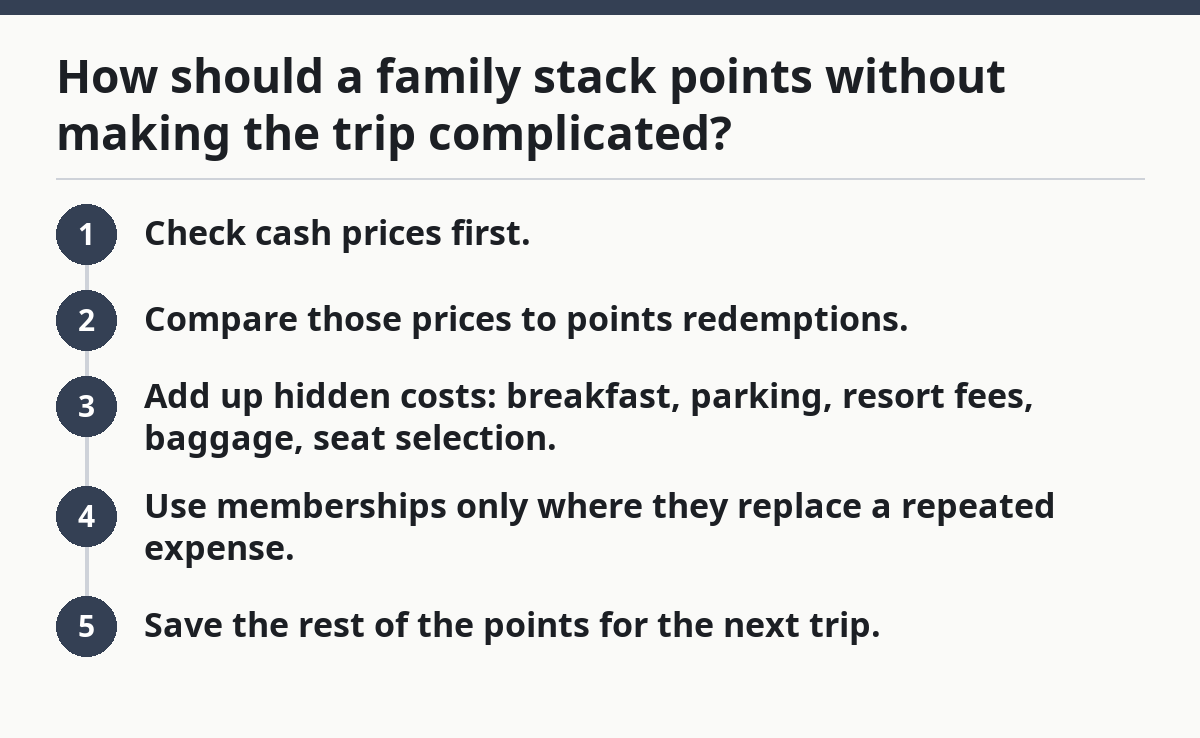
Use this order:
- Check cash prices first.
- Compare those prices to points redemptions.
- Add up hidden costs: breakfast, parking, resort fees, baggage, seat selection.
- Use memberships only where they replace a repeated expense.
- Save the rest of the points for the next trip.
A rigid setup fails fast.
- A hotel-specific card can be great if you always stay in that chain.
- A general travel card is better if your family’s trips change city, season, and length.
- A membership with a narrow benefit is only useful when your route or destination lines up.
The most practical setup is often the one with the fewest moving parts. Two or three well-chosen accounts often beat a drawer full of plastic and logins. For budget family trip planning with points, perks, and memberships, less clutter usually means better follow-through.
Which points are worth using for flights, and which are better for hotels?
Hotel points are usually easier for families, while flight points are more situational. That’s because hotel rooms can often fit the whole group more predictably, while award flight space for four seats on the same plane can be hard to find.
When a family is comparing flight and hotel value, budget family trip planning with points, perks, and memberships usually tilts toward hotels first. Hotel programs often let you move more of the cost at once, especially when the room already includes breakfast or has suites and adjoining options. A family can use one booking to cover several costs, not just the room rate.
For flights, points work best when:
- The route is expensive in cash.
- The dates are fixed.
- You can book early.
- The program charges reasonable taxes and fees.
For hotels, points work best when:
- The destination has many chain properties.
- Breakfast would otherwise cost real money every morning.
- You need a larger room or family suite.
- The points price stays steady relative to the cash rate.
A hotel award can be a better budget win than a flight award if it removes several costs at once. A family staying four nights can save on room rate, breakfast, and parking in one booking. A flight redemption only replaces airfare; the trip still has to absorb food and ground transport.
One caution: points are not cash.
- Award charts can change.
- Properties can sell out.
- Transfer partners can devalue suddenly.
- Family schedules are less flexible than solo travel.
If the award booking forces awkward flights, a late arrival, or a tiny room, it’s not really a bargain. It’s a trade.
The real value of hotel perks for families
Hotel perks are worth more than points when they remove daily costs and friction. Free breakfast, parking waivers, and late checkout can save more on a short family stay than a slightly lower room rate.
Since families usually notice the extra costs first, budget family trip planning with points, perks, and memberships should treat hotel perks as part of the budget, not an afterthought. A family-friendly perk package turns the stay from “cheap on paper” to actually budget-safe. The room rate is one line item; the hidden savings are another.
The perks that matter most:
- Free breakfast: one of the cleanest family savings, because it replaces a daily meal.
- Parking included or discounted: especially in cities, theme-park zones, and airport hotels.
- Late checkout: useful when nap schedules or flights make the day messy.
- Suite upgrades or larger rooms: less glamorous than lounge access, but often more useful for families.
- Bottled water, snacks, or lounge access: good only when the family actually uses them.
Now, you might be wondering whether elite status is worth chasing just for a family trip. Sometimes yes, but only if the status is realistic to earn and the brand has the right properties in the places you go. A mid-tier status that gives breakfast, a room bump, or parking savings can pay off. A top-tier chase that takes years usually does not.
The downside is that perks are brand- and property-dependent.
- Not every hotel honors them well.
- Not every property offers the same breakfast.
- Resort and city fees can still linger.
- “Included” breakfast may be basic, not a full hot spread.
That’s why I’d rather have a reliable breakfast and parking benefit than a flashy but uncertain room upgrade. A family budget likes certainty, and budget family trip planning with points, perks, and memberships works better when the savings are easy to predict.
Which memberships are actually worth paying for?
The memberships that work best are the ones that hit a recurring family cost at least a few times a year. That usually means warehouse clubs, auto clubs, museum passes, attraction passes, and a few hotel or airline programs with free enrollment and meaningful member pricing.
If your family makes the same kinds of purchases again and again, budget family trip planning with points, perks, and memberships can turn a modest fee into useful savings. A membership that saves on gas, hotel rates, or admission can work across several trips, while a niche pass might pay off only once.
Strong membership types for family travel:
- Warehouse club membership: useful for road snacks, car fuel, and travel supplies.
- Auto club membership: helpful for towing, roadside help, and some travel discounts.
- Museum or attraction pass: best when the family visits the same region more than once.
- Theme park or destination membership: worth it only if the family returns.
- Rental car or airline memberships: useful mainly when the route and loyalty line up.
Here’s the catch: a membership is not savings by itself.
It only pays if the family uses the discount enough to outrun the fee. That means you need to count real trips, not hopeful ones.
Use this rule:
- If the membership saves on repeat costs like gas, tickets, or hotels, it may be worth it.
- If it saves on one trip you may never take again, skip it.
- If it needs complicated booking rules, it’s usually too fussy for family life.
A warehouse club with travel-related spending can beat a flashy vacation pass if it works all year. The boring choice can still be the smarter one when the numbers are steady.
The honest side-by-side: points, perks, or memberships?
Points win for big-ticket travel, perks win for daily expenses, and memberships win for repeat behavior. The right choice depends on whether your family spends more on rooms, meals, transportation, or admission.
Criteria | Points | Perks | Memberships | Winner for this condition
|—|—|—|—|—|
| Best use case | Large travel purchases | Everyday trip savings | Repeat family habits | Depends on the trip |
| Cash-like flexibility | Higher with flexible points | Low | Low to medium | Points |
| Easy to understand | Medium | High | Medium | Perks |
| Best for breakfast and parking | Weak | Strong | Medium | Perks |
| Best for flights | Strong when award space exists | Weak | Weak | Points |
| Best for hotel stays | Strong | Strong if status applies | Medium | Points or perks |
| Best for road trips | Weak | Medium | Strong | Memberships |
| Risk of wasted value | High if unused | Low if used | High if not used | Perks |
| Family-friendliness | Medium | High | Medium | Perks |
| Annual upkeep | Medium to high | Low to medium | Low to medium | Perks |
When you line them up this way, budget family trip planning with points, perks, and memberships becomes easier to sort. If your family takes one big trip and several small outings, perks and memberships may do more work than points. If you fly a few times a year and can book smart award space, points matter more.
The real answer is not “all of them.” It’s the smallest set that covers your real travel habits. That usually means one points source, one hotel program, and one membership that gets used often enough to matter.
What’s the best budget setup for a real family travel plan?
The best budget setup is one flexible travel card, one family-friendly hotel program, and one membership that matches your route. That gives you the most coverage with the least clutter, which matters when you’re booking around school breaks and weekend soccer.
With that structure in place, budget family trip planning with points, perks, and memberships becomes a simple assignment task. Start with the trips you already know about—one summer trip, one holiday visit, one short break. Then assign each cost to a tool: points for the biggest chunk, perks for the recurring costs, membership for the repeat expense.
A practical setup looks like this:
- Flexible points source for flights or hotels when cash prices spike.
- Hotel loyalty program for breakfast, parking, and occasional room upgrades.
- One membership for fuel, admission, roadside help, or recurring discounts.
- Backup cash card for bookings where points don’t stretch.
You do not need to optimize every trip. That mindset burns time and often saves less than it costs. A family budget does better with a few reliable wins than a perfect system that nobody remembers to use.
Watch for these mistakes:
- Joining too many loyalty programs.
- Hoarding points until they lose value.
- Paying for memberships the family uses twice a year.
- Booking a “free” award stay that still carries high taxes or fees.
- Ignoring breakfast, parking, and baggage when comparing prices.
A good family travel plan is not about collecting. It’s about cutting the total trip bill without making the trip harder to enjoy. Budget family trip planning with points, perks, and memberships should reduce stress as much as it reduces cost.
When should you skip the points-and-perks plan entirely?
You should skip a points-heavy plan when your family trips are rare, unpredictable, or too small to justify the setup. If you only travel once a year and don’t use hotels or airlines often, cash pricing and a simple discount strategy may beat any rewards system.
If the trips are limited, budget family trip planning with points, perks, and memberships can be more work than it is worth. One long weekend and two day trips do not always justify a stack of programs. In that case, a basic cash-back card, a few direct-booking discounts, and one useful membership may be enough.
Skip the points-and-perks approach when:
- Your travel dates are fixed but the family schedule changes often.
- You do not stay with the same hotel brand more than once or twice a year.
- You hate tracking terms, blackout dates, and transfer partners.
- The annual fee would outrun the savings.
- The membership is for a benefit you rarely use.
On the flip side, skip simple cash-only planning when you already spend enough to earn real hotel nights, flight credits, or recurring travel perks. The difference is volume. If travel is a regular part of family life, rewards can do real work. If it is a one-off, keep it simple.
Which setup wins for most families?
Choose points if your family can book flexible travel and wants the biggest savings on flights or hotel stays. Choose perks if your trips get crushed by breakfast, parking, baggage, or checkout hassles. Choose memberships if your family repeats the same routes, attractions, or fuel stops all year. Neither if you travel too rarely to use any of them before the value fades.
That is the clean verdict. Most families do best with a hybrid: points for the biggest ticket, perks for the hidden daily costs, and one membership for repeat expenses. The wrong setup is the one that adds fees, logins, and complexity without replacing real spending.
If the family takes multiple trips each year, the hybrid plan wins. If the family takes one short trip and stops, cash pricing plus one useful discount is usually enough. If the family has no patience for rules, skip the whole points chase.
FAQ
How do I know if a travel perk is worth it?
A travel perk is worth it if it saves more than it costs on a trip you would book anyway. Breakfast, parking, and baggage savings are easy to measure because they replace cash you’d spend on the spot.
Should I use points for flights or hotels first?
Use points for the option with the highest cash price and the best fit for your family’s dates. For many families, hotels are easier because one booking can cover several travelers and remove breakfast or parking costs too.
Are memberships worth it for one family vacation?
Usually not unless the trip uses the membership in a direct way, like roadside help, attraction discounts, or a hotel brand you already use. A one-time vacation rarely justifies a membership on its own unless the savings are obvious and immediate.
What’s the biggest mistake families make with travel rewards?
The biggest mistake is collecting points and memberships before checking whether the family actually uses them. A reward that sits unused for a year is not savings; it is a fee with a nice label.
Can I mix points, perks, and memberships on the same trip?
Yes, and that’s usually the best move. Use points for the hotel or flight, perks for breakfast and parking, and one membership for a repeated expense like fuel, admissions, or roadside support.
Drafted with AI; not yet reviewed by a person.