
Last updated: November 19, 2026
Key Takeaways
- Compare the final total, not the headline fare, to see whether the discount really saves money.
- Use the same trip details and total up every cost before choosing between options.
- Restrictions can wipe out savings even when the price cut looks large.
- Fees can weaken a decent discount in less than a minute.
A family trip discount can save money, but only if the lower fare survives fees, restrictions, and flexibility limits. Quick Answer: the discount is worth using only when the real total is lower than the best cash alternative. This guide on How to Check Whether a Travel Discount Is Actually Worth Using for a Family Trip shows how to compare the final price before you book.
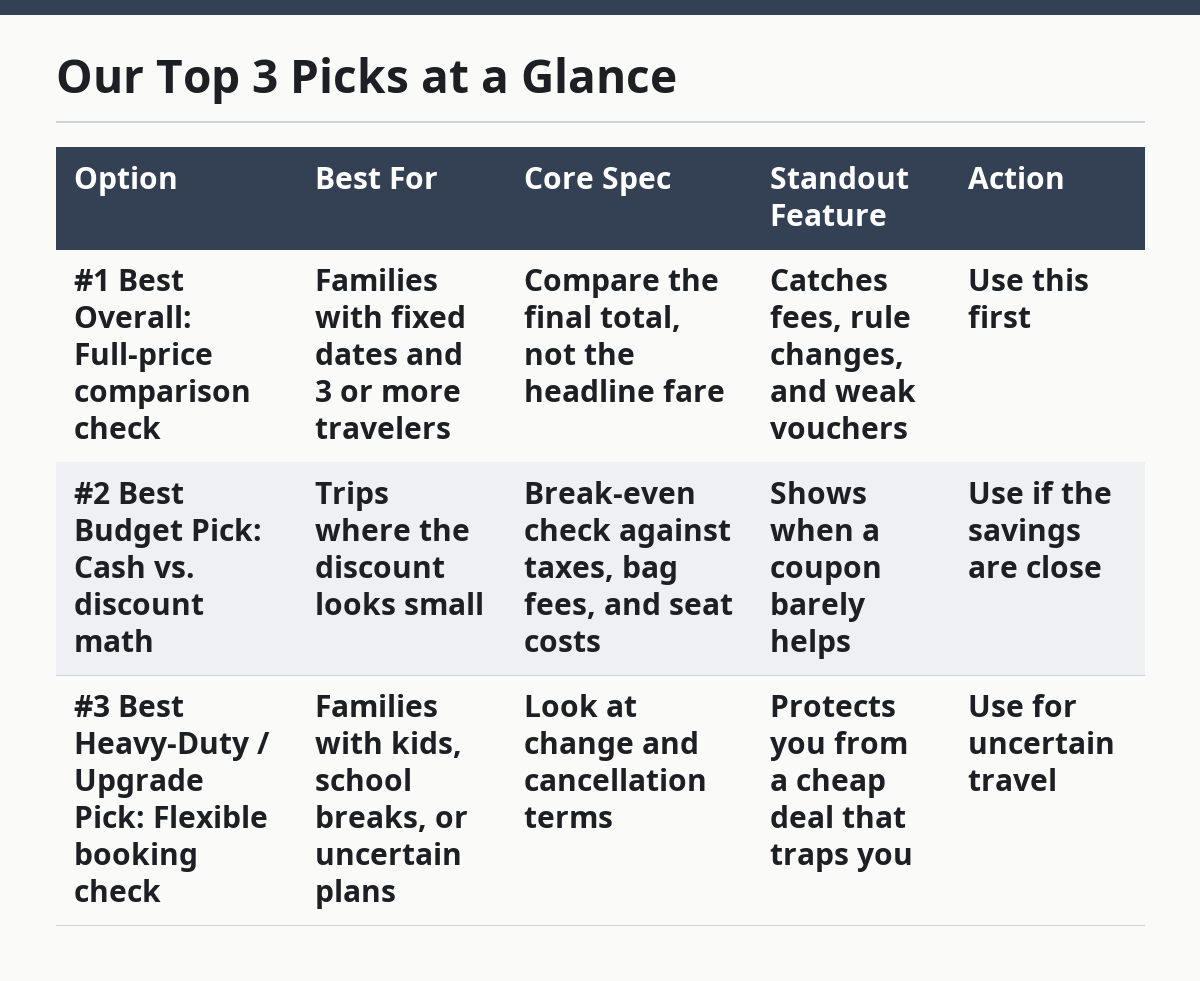
Our Top 3 Picks at a Glance
| Option | Best For | Core Spec | Standout Feature | Action |
|---|---|---|---|---|
| #1 Best Overall: Full-price comparison check | Families with fixed dates and 3 or more travelers | Compare the final total, not the headline fare | Catches fees, rule changes, and weak vouchers | Use this first |
| #2 Best Budget Pick: Cash vs. discount math | Trips where the discount looks small | Break-even check against taxes, bag fees, and seat costs | Shows when a coupon barely helps | Use if the savings are close |
| #3 Best Heavy-Duty / Upgrade Pick: Flexible booking check | Families with kids, school breaks, or uncertain plans | Look at change and cancellation terms | Protects you from a cheap deal that traps you | Use for uncertain travel |
| Product / Option | Best For | Core Spec | Standout Feature | Action |
|---|---|---|---|---|
| Full-price comparison check | Families who want the clearest answer | Compare final totals | Looks at the whole booking, not just the discount code | Start here before you book |
| Cash vs. discount math | People deciding between a code and a plain fare | Subtract all added fees | Shows the break-even point fast | Use when the price gap is small |
| Flexible booking check | Trips that may move by a day or two | Read cancellation terms | Exposes the cost of changing plans | Use for family trips with uncertainty |
Picture this: you’re booking for four people, the discount code knocks money off the headline fare, and the total still climbs once fees show up. The answer is to compare the final trip cost, not the advertised discount. Therefore, the cheaper-looking offer is not always the cheaper one.
Start with the number that matters: the final total
The discount is worth using only if the final total is lower than your best cash price.
That means every coupon, voucher, loyalty redemption, bag fee, seat fee, and change fee has to sit in the same pile before you decide.
- Write down the base fare or room rate before the discount.
- Add taxes and mandatory fees.
- Add any family extras you know you’ll need, such as checked bags, seats together, resort fees, or stroller-related charges where they apply.
- Apply the discount code, voucher, or loyalty points.
- Compare that new total against the plain cash booking.
- Keep the lower option only if it still leaves enough flexibility for your trip.
When this works, you can point to a single dollar figure and say, “This one is cheaper.”
That’s the point.
A family trip often changes the math because you’re not buying one seat or one room. Three or four tickets can magnify a small fee quickly, and a “$25 off” offer may disappear under a couple of added charges. A discount that saves 8% on paper can still lose to a no-discount fare with fewer add-ons.
Use the same standard every time: compare same dates, same travelers, same room type, same baggage plan. If one option includes one checked bag and the other does not, the comparison is already crooked.
How do you compare a discount with a cash price?
You compare them by using the same trip details and calculating the all-in total for each option.
That is the cleanest way to tell whether a travel discount helps or just changes the label.
Start with the cash booking, then build the discount booking the same way. If a family of four gets a discount code on a flight, but the fare class adds seat fees or denies free changes, the headline saving may vanish. The same idea applies to hotel vouchers and package discounts.
Use this simple break-even check:
- If the discount total is lower, the discount has real value.
- If the totals are nearly the same, the cash fare usually wins because it keeps more options open.
- If the discount total is higher after fees, skip it.
A quick example helps. Suppose a voucher cuts $80 off a room, but it can’t be used on the dates you need, or it forces a nonrefundable rate with a higher cleaning fee. The real value may be close to zero. The discount is not “bad”; it is just weaker than the cash alternative.
Now, you might be wondering what counts as a fair comparison. Use the exact same number of travelers, the same room occupancy, and the same baggage plan. If you are comparing a refundable fare to a nonrefundable discounted fare, note that they are not equal products. Cheap is not always cheaper.
Check restrictions before the savings fool you
Restrictions can erase the benefit of a discount even when the number looks good.
This is where travel vouchers, promo codes, and loyalty redemptions often get tricky.
Picture this: you find a deal that saves money today, then the fine print blocks the exact dates your kids can travel. Or the voucher expires in 30 days and your family cannot use it without changing school plans. The price may be lower, but the deal may be unusable in real life.
Look for these limits:
- Blackout dates during school holidays or peak weekends
- Minimum spend rules that force you to buy more than you need
- Room or fare class limits that exclude the cheapest options
- Single-use rules that waste value if you can’t use the full amount
- Name or traveler restrictions that prevent transfer to another family member
- Booking channel limits that only work on a specific app or website
This matters most with travel vouchers and promo codes because the value often sits behind a wall of conditions. A voucher worth $100 is not worth $100 if it only applies to a fare you would never choose. The same is true for loyalty points that look generous but can’t be used on your dates or route.
The best way to read restrictions is to ask whether you would still book the trip if the discount disappeared. If the answer is no, the deal may be steering you into a booking you do not actually want.
What fees can turn a good deal into a bad one?
Fees can turn a decent discount into a weak deal in less than a minute.
That is why the headline price is not the finish line.
For family travel, the usual fee traps are easy to miss:
- Checked bag fees on flights
- Seat selection fees if you want the family together
- Resort fees at hotels
- Parking charges
- Cleaning fees on vacation rentals
- Service fees on booking platforms
- Change fees or fare differences if your plans move
A discount code that saves $60 is not strong if seat selection and baggage add more than $60 back onto the booking. The same is true for a hotel coupon that drops the room rate but leaves a resort fee untouched.
The truth is, family bookings are more exposed to add-ons because you need more than the base product. Two adults and two kids may need two bags, four seats, and a hotel setup that actually fits the family. If the discount only touches the base price, the savings may be smaller than you think.
Watch the order of the math too. Some booking sites show the discount before taxes and fees, which makes the offer look cleaner than it is. Ignore the marketing line and look for the final payment screen. If the site makes you create an account before it shows the total, treat that as a warning sign and keep a second tab open with a plain cash price.
Is a loyalty points redemption better than a discount code?
A loyalty points redemption is better than a discount code only when the points buy more value than the cash savings you’d get elsewhere.
If the point use is weak, the discount code may leave you better off.
This comparison is about value per unit. If a voucher takes $50 off the total today, but your loyalty points could cover a much larger chunk of a future stay, the code may be the weaker choice. On the other hand, if the points can only be used on a tightly restricted fare or room, the code may be simpler and more useful.
For a family trip, ask three questions:
- Does the points booking still include the dates and room type you need?
- Does it leave enough flexibility for changes or cancellations?
- Would you rather save cash now or keep the points for a trip with better value?
Loyalty points often look free, but they are still part of the deal math. If a redemption forces you into a poor flight time, a cramped room, or a nonrefundable rate, the “free” booking may cost you convenience and backup options. That can matter more on a family trip than on a solo trip.
If you are choosing between points and a discount code, compare the final out-of-pocket total for both. The better choice is the one that gives you the lowest real cost without locking you into a trip you may need to change. For more planning help, see the family travel budget planning guide, the booking timing and pricing hub, and our travel rewards comparison guide.
Family booking flexibility matters more than a tiny discount
Flexibility matters more than a tiny discount when your family schedule can move by a day, a nap, or a school event.
A fare that saves $30 but charges a huge change penalty is often the wrong bargain.
Picture this: you book a low-price fare because it looks smart, then one child gets sick or a school calendar shifts. Suddenly the nonrefundable deal is not a deal at all. The cheap booking now carries a second price tag.
Use these checks before you say yes:
- Can you cancel for a credit, refund, or nothing at all?
- How much does it cost to change dates or names?
- Does the discount force a strict check-in window or arrival time?
- Will you lose the whole amount if plans change?
- Are there penalties that apply to every traveler, or only one?
Flexibility has a cash value. Even without a neat dollar figure, it protects you from paying twice—once for the booking, and again for the change. If your family trip is tied to school holidays, medical appointments, or a long drive with kids, that value rises fast.
A discount can still be worth using on a flexible booking. The point is not to avoid discounts. The point is to avoid cheap bookings that turn expensive the moment life gets in the way.
For timing and pricing support, this fits neatly with the broader budget family trip planning by booking timing and pricing hub, which helps you decide when to buy without mixing that choice up with discount math.
Common mistakes that make a discount look better than it is
The most common mistake is comparing a discounted fare to the wrong cash fare.
That can hide the real cost by 20% or more if the other offer includes fewer fees or better change terms.
The second mistake is using a voucher just because it is there. A travel voucher can feel like found money, but it may force a rushed booking, a bad date, or a room your family will outgrow. The third mistake is forgetting that some discounts only work for one part of the trip, like the base room rate or the base ticket, not the full booking.
Avoid these traps:
- Comparing different room types or different fare classes
- Ignoring the fee screen at checkout
- Spending extra just to “use up” a voucher
- Redeeming points on a weak value date
- Choosing a nonrefundable deal for an uncertain trip
A good rule: if the discount makes you add things you would not otherwise buy, it is probably weaker than it looks. If it only works when you stretch your trip beyond your real plan, it is not a clean win.
A family trip gives you fewer chances to recover from a bad booking choice. The savings need to survive the whole checkout path, not just the first price you see.
When should you skip a travel discount?
You should skip a travel discount when the restrictions, fees, or cancellation terms erase the savings.
If the deal only works by changing your family’s dates, room needs, or comfort level, it is not worth it.
Skip it when:
- The discount applies only to a nonrefundable rate and your plans are still loose
- The final total is the same as, or higher than, the cash booking
- The voucher expires before your family can use it
- The booking terms block the dates, room, or route you actually need
- The fee structure makes the savings too small to matter
A discount is also a poor choice if it pushes you into a booking you may need to change later. A cheap rate with a stiff penalty is a bad fit for many family trips, especially around school breaks. The savings can disappear with one change call.
The answer is simple: if the deal only works on paper, skip it. If it works in the checkout total and still gives you enough room to change plans, use it.
How do you compare a discount with a cash price?
You compare the final total for each option, using the same dates, the same travelers, and the same add-ons.
That means taxes, fees, baggage, seats, cancellation rules, and voucher limits all go into the math before you choose.
If the discounted total is lower and the restrictions still fit your trip, the discount is worth using. If the cash price is close, the cash option is usually safer because it gives you more flexibility.
When should you skip a travel discount?
You should skip a travel discount when the savings disappear after fees and the booking terms no longer fit your trip.
Drafted with AI; not yet reviewed by a person.