Last updated: November 19, 2026
Quick Answer: In most bookings, you can stack 3 layers safely only if the fare rules, coupon terms, and cashback terms all allow it.
Key Takeaways
- Read fare rules first; stacking only works when each discount is allowed by the site terms.
- Stacking is possible when offers apply to different trip costs or different booking stages.
- Try the cheapest valid fare first, then the code, then cashback if the terms allow it.
- Coupon codes stop stacking when they replace the public fare instead of adding to it.
Family travel discount stacking works when you apply savings in the right order and stop the moment a rule says “one offer per booking.” The safe rule is to check each discount against the fare rules before you pay. In How to Stack Family Travel Discounts Without Breaking the Booking Rules, the steps below show what to try first, what blocks the stack, and what you should see when it works. This guide focuses on the rules that matter on the checkout page.
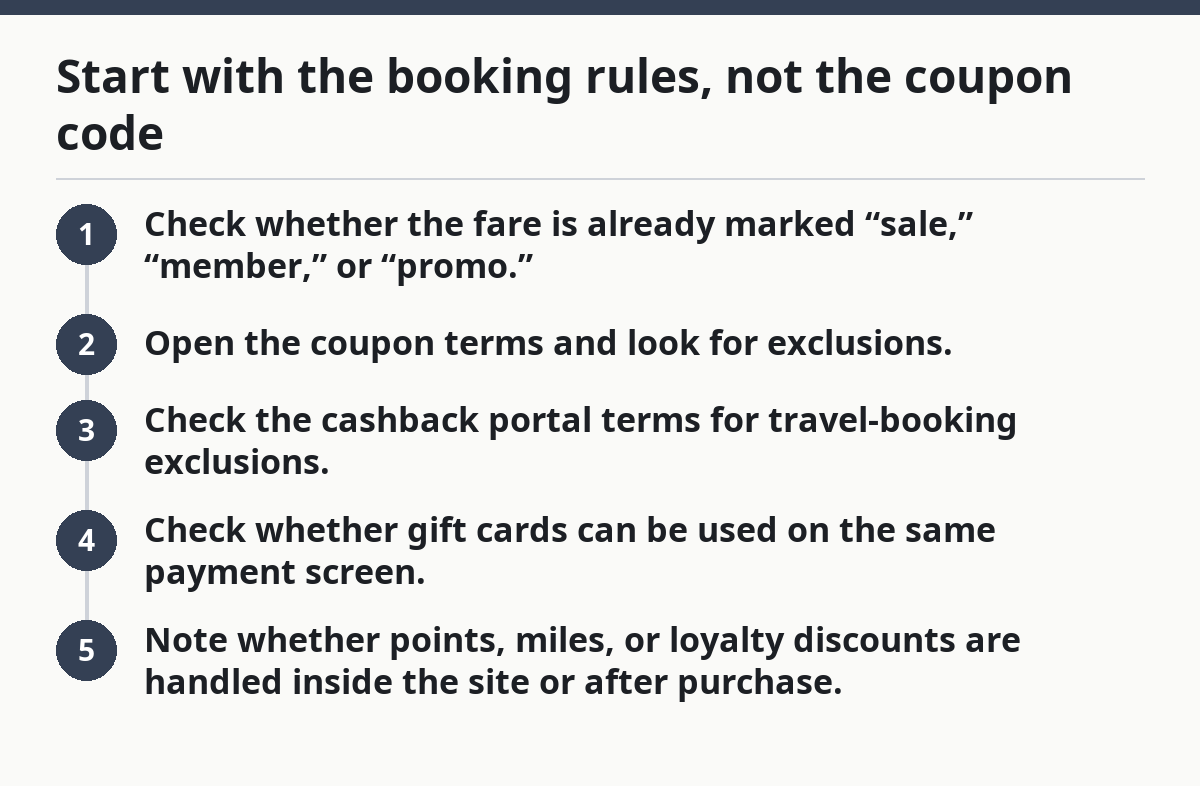
Start with the booking rules, not the coupon code
Picture this: you’re about to book 4 seats and the site shows a sale fare, a code box, a member price, and a cash-back offer. The right move is to read the fare rules first, because stacking only works when each discount is allowed by the site terms.
Begin on the booking page and open the rules near the fare name, not the home page banner. Look for phrases like “cannot be combined,” “valid on base fare only,” “one coupon per reservation,” or “not eligible on sale fares.” If you see those, that’s your first stop sign. In many cases, the rule appears in a terms block or fare rules link, not the headline price.
Use this quick scan before you try to stack anything:
- Check whether the fare is already marked “sale,” “member,” or “promo.”
- Open the coupon terms and look for exclusions.
- Check the cashback portal terms for travel-booking exclusions.
- Check whether gift cards can be used on the same payment screen.
- Note whether points, miles, or loyalty discounts are handled inside the site or after purchase.
A stack is clean when each layer does a different job. For example, a sale fare may lower the price, a coupon code may knock off a fixed amount, and cashback may return a percentage later. A blocked stack usually fails because two offers try to cut the same part of the price.
For a deeper planning layer on timing and price drops, the hub on budget family trip planning by booking timing and pricing is the right companion piece. For related strategy on choosing the right booking window, see our family travel booking timing guide and hotel deal comparison checklist.
How do I know which family travel discounts can stack?
You know they can stack when the terms say they can apply to different parts of the trip or at different stages. If the rules say the discount is for the room rate, the payment method, or the post-purchase rebate, that’s a good sign.
Here’s the catch: travel sites rarely say “stack this with that” in plain language. They write narrow rules instead. The reader has to translate them into a simple question: does this offer reduce the same dollar twice, or does it touch a separate layer?
A clean stacking path often looks like this:
- Coupon code: lowers the base fare or room rate at checkout.
- Cashback portal: pays after the purchase, if the booking qualifies.
- Gift card: changes how you pay, not the listed price.
- Membership discount: may replace the public fare instead of stacking with it.
- Loyalty points: often sit in their own lane and may block cash-back tracking on some sites.
A bad sign is a phrase like “cannot be used with any other promotion.” That usually means the code replaces the sale price, not adds to it. Another red flag is a portal that excludes “gift card purchases, taxes, fees, and airline ancillary charges.” That means the rebate may be smaller than the headline rate.
If the site has a fare rules PDF or a terms page, read the exact language on combinability. A 2-minute read can save a 20-minute checkout fight. That is a small effort with a real payoff.
For broader booking-rule checks, the U.S. Department of Transportation and the booking site’s own terms page are the most useful references for what is promised and what is actually sold. See the DOT’s consumer page at https://www.transportation.gov/airconsumer and the FTC’s guidance on online offers at https://consumer.ftc.gov/.
Stack family travel discounts in this order
Picture this: you have a 3-night hotel stay, a coupon code, and a cashback portal open in another tab. The safest order is to make the cheapest valid fare appear first, then apply the code, then route the final purchase through the cashback path if the terms allow it.
Use this order because it helps you see which discount gets blocked. If you start with the wrong layer, you may lose the better offer without noticing.
- Open the fare or room that already matches your dates and family size. If the rate changes when you add children or extra guests, lock that part in first.
- Enter the coupon code before you hit the final pay button. If the price changes, the code worked. If the site rejects it, stop and read the exclusion line before trying a second code.
- Choose the payment method that the terms allow. Some sites accept gift cards, some do not, and some only let you use one card plus a small balance.
- Click through the cashback portal only after you confirm the booking page shows the correct final rate. If the portal tracks, you should land back on the same travel site with a tracking click in place.
- Finish the purchase and save the confirmation page or email. If you used a portal, keep the tracking ID in a note or screenshot in case the rebate fails.
The order matters because portals and coupon fields behave differently. A coupon can change the displayed price right away. Cashback usually happens later and may disappear if you open new tabs, switch devices, or use a browser extension that breaks tracking.
On some travel booking sites, the best result is not the biggest list of discounts. It is the one that still qualifies for the cashback portal and keeps the room or fare you want. That is the real win.
Why coupon codes break stacking at checkout
Coupon codes break stacking when they replace the public fare instead of sitting beside it. The code may look harmless, but the terms can say “one promotional code per reservation,” which means no second code, no sale fare plus code, and no extra member coupon on top.
The most common failure is a code that works on the headline page but dies at payment. That usually means the rate changed underneath you. Travel sites often separate fare families, and a code may apply only to one family, one route, one hotel brand, or one room type.
Watch for these blockers:
- “Not valid on already discounted rates”
- “Not combinable with membership pricing”
- “Valid on new bookings only”
- “Applies to base rate only”
- “Maximum one code per transaction”
A second problem is hidden math. A coupon might shave $25 off the room rate, but not the resort fee, taxes, or parking. That still counts as a real saving, but it may look weaker than the banner promised. Read what part of the price is actually being cut.
If the site lets you enter more than one code box, don’t assume they stack. Some sites just let you try multiple formats, then honor only the first valid one. That is not a bonus. It is a trap for hurried shoppers.
The best move is to test one code at a time on a fresh booking screen and note the total after each step. If the total does not change, the code did nothing.
Can cashback portals stack with family travel discounts?
Yes, cashback portals can stack with family travel discounts when the portal allows the booking site, the fare type, and the payment path. The portal rebate is usually separate from the sale price, so it can sit on top of a coupon or public discount if the rules permit it.
That said, cashback is the easiest layer to lose. A portal may exclude bookings paid with gift cards, bookings made in-app, bookings using coupon codes from outside the portal, or bookings changed after the click. The exact terms matter more than the banner rate.
A clean cashback setup looks like this:
- Open the cashback portal first.
- Search the travel site through the portal, not by typing the address later.
- Keep the same browser session from click-through to checkout.
- Do not open extra tabs for the same reservation.
- Save the order number and the portal tracking screen.
If a family travel deal asks you to move between devices, stop. Portal tracking can break when the session changes. If you must compare on a laptop and buy on a phone, expect trouble unless the portal says cross-device tracking is supported.
One more catch: cashback can be denied after the trip if the reservation is canceled, changed, or paid in a way the portal did not allow. A rebate is not the same as an instant discount. It is a follow-up claim, and that means paperwork.
On the flip side, portal stacking is often the easiest extra savings for families because it does not change the fare you see. It lowers the net cost later, which can make a plain-looking deal better than a flashy code.
For comparison shopping, see our cashback booking checklist and the airfare rules explainer before you click through. The more exact the booking path, the less likely the rebate is to fail.
Gift cards and membership discounts: when they help and when they kill the deal
Gift cards help when the travel site treats them as payment, not as a promo layer. Membership discounts help when the site gives you a lower rate without blocking the coupon or cashback path. Because rules vary by site and booking type, readers should consult the booking terms or a travel adviser before relying on a stack that includes either one. For background on offer terms, see the FTC’s guidance at https://consumer.ftc.gov/.
Gift cards are simple in one way and annoying in another. They can reduce what comes off your bank card, but some portals exclude bookings paid partly or fully with gift cards. Some sites also refuse split payments past a certain point. That can stop the stack even if the fare itself is valid.
Membership pricing can work like a better base rate. It can also be a dead end if the terms say “member rate not combinable with other offers.” In that case, the membership price is the deal, not a layer on top of it.
Use this check before you combine them:
- Read whether the gift card counts as a payment method or a promotional credit.
- Check whether the member fare is marked “exclusive” or “best available.”
- Look for a separate line that says taxes and fees are excluded from discounting.
- Confirm whether the travel site lets you pay part by gift card and part by card.
- Check if the cashback portal requires the full charge to a credit or debit card.
A family of five booking two rooms will hit these limits faster than a couple booking one room. More travelers mean more moving parts. More moving parts mean more ways for the site to refuse the stack.
Common mistakes that cost real money
Picture this: you’ve found a good fare, but the final price is higher than expected and the cashback never posts. The usual reason is not “bad luck.” It is one of three mistakes: mixing incompatible offers, changing the booking after checkout, or skipping the fine print.
The cost is real. You may lose the coupon, the portal credit, or both. In the worst case, you spend an hour chasing support for a rebate that may not have been eligible.
Avoid these mistakes:
- Using a coupon on a rate that already says “non-combinable.”
- Starting the cashback portal and then opening a new tab to compare prices.
- Paying with a gift card when the portal excludes gift-card transactions.
- Changing dates or room types after clicking through the portal.
- Assuming a membership price can sit on top of every code.
Instead, do a 30-second rule check before you pay. If the offer page, portal page, and checkout page do not agree, the stack is shaky. If they all point to the same rate and the same eligible booking type, you’re in better shape.
Two authoritative places to verify how rebate programs and portal claims are handled are the travel site’s own terms page and the cashback portal’s terms and exclusions page. If the booking is through a major travel brand, its help center usually spells out combinability in plain terms. That is the page to trust, not the banner ad. For airline-related bookings, the DOT consumer page at https://www.transportation.gov/airconsumer is another useful reference.
The safest way to compare deals before you pay
The safest way is to compare the final total, not the headline discount. A $40 coupon can be worse than a smaller sale if the sale still qualifies for cashback and the coupon does not.
Build a simple side-by-side check with the same family dates and the same room or fare:
- Sale fare only
- Sale fare plus coupon code
- Sale fare through cashback portal
- Sale fare plus coupon through portal, if allowed
- Member rate, if it clearly says it can combine
Then compare the total due today and the rebate due later. If the site shows resort fees, baggage fees, or service charges, include those in the comparison. Those charges can wipe out the headline win.
You do not need to chase every possible discount. You only need the one stack that survives the rules and still gives you the lowest real cost. That is often a sale fare plus cashback, or a gift card plus a valid public rate, not a pile of codes.
If the numbers are close, choose the cleaner booking. A family trip with fewer moving parts is easier to change, refund, or rebook if plans shift by a day.
Can you combine coupons with loyalty points on family travel bookings?
Sometimes, but not by default. Many travel sites treat loyalty points as a separate payment or redemption layer, and that can block a coupon or change the eligible fare. Read the booking terms before you mix them, and check whether the coupon applies to the cash portion only. If the site has a loyalty program FAQ, use that page as the first source.
Which travel discounts usually stack?
A coupon code, a cashback portal, and a gift card sometimes stack because they touch different parts of the purchase. A sale fare plus a member rate usually does not stack unless the site says so. The rule to watch is whether both offers reduce the same base price. For related examples, see the site’s terms page and the cashback portal’s exclusions.
How do you know if a discount code cancels other savings?
The terms will say it plainly if you know where to look. Phrases like “cannot be combined,” “one offer per booking,” or “not valid on promotional rates” mean the code likely cancels other savings. If the total changes but the portal or member rate disappears, the code replaced the other offer.
Drafted with AI; not yet reviewed by a person.