

Last updated: November 19, 2026
Quick answer: use a 3-point crowd check before you book. For How to Pick a Family Vacation Destination Based on Crowd Levels, compare peak travel periods, reservation rules, and how many “must-do” sights sit in one area; that gives you a practical read on whether the trip will feel relaxed or rushed. Family vacation destination crowd selection starts with one question: how much waiting can your kids handle before the trip stops being fun? Pick the destination whose crowd level matches your family’s tolerance for lines, reservations, and shoulder-to-shoulder spaces. The sections below show how to compare peak travel periods, attraction lines, walkable downtowns, and quieter alternatives without guessing.
Key Takeaways
- Crowd level is not one thing. It shows up in parking lots, attraction lines, restaurant waits, and sold-out nights.
- A place can feel crowded even when it is not packed all day if its peak season is short and intense.
- Families with young kids usually do better with easy exits, short waits, and fewer timed reservations.
- Walkable downtowns help some families and wear out others fast, especially when sidewalks are narrow and busy.
- If you hate planning every meal 30 days ahead, skip reservation-heavy destinations and choose places with more open access.
What crowd levels should you compare first?
To start with How to Pick a Family Vacation Destination Based on Crowd Levels, picture this: you’re choosing between a beach town, a mountain town, and a big city, and each one looks perfect on paper. The crowd problem is not the number of people alone; it’s where and when they cluster, especially during peak season and holiday weekends.
Start by comparing four pressure points: lodging demand, attraction lines, restaurant access, and walking congestion. A destination with a calm hotel zone can still be a headache if every major sight needs a reservation and every meal has a 60-minute wait. Here’s the catch: families feel crowd pressure at different times of day, so look at the whole rhythm, not just the daytime image.
Use this quick screen before you fall in love with a place:
- Do the main sights require reservations or timed entry?
- Are the big draws all in one small district?
- Do families report long waits for breakfast, shuttles, or parking?
- Does the town empty out after dinner, or stay jammed until 9 p.m.?
Now, you might be wondering which signal matters most. For most families, the strongest warning is the combo of line-heavy attractions and scarce restaurant seats. A destination with one or the other can still work. A destination with both often turns into a patience test.
How do you tell if a destination gets too crowded for kids?
A destination gets too crowded for kids when the day starts to revolve around waiting, not doing. If your family must book around 30 days ahead, stand in multiple lines before lunch, and keep a child happy in a tight space for long stretches, the trip will feel harder than it looked on the map.
The real clue is not a number from a brochure. It’s the amount of friction between one activity and the next. Kids usually notice crowd pressure faster than adults because they care less about “the destination” and more about the next snack, bathroom, and rest stop.
Watch for these signs:
- The main attraction uses timed entry and sells out fast.
- Restaurants near the center take walk-ins only at off-hours.
- The walk from parking to the fun part is long, hot, or packed.
- The “family-friendly” core is also the busiest pedestrian area.
- Every backup plan is just another line.
A quieter alternative often works better than a famous name. A smaller museum district, a state park near a tourist city, or a town with one busy center and several low-key neighborhoods can save the day. The point is not to avoid people entirely. It’s to avoid a destination where every plan depends on beating the crowd.
Who this is not for: families who love a full schedule and don’t mind timed tickets for half the day should not overreact to one busy attraction. For them, a crowded destination can still be a fit if the rest of the trip is flexible.
Which crowd signals matter most before you book?
Because of that, if you’ve found a place with the right weather, the right price, and a photo-friendly main street, check one more thing: the top zoo, museum, and ferry may all need reservations, and the closest dinner seat may be at 8:15 p.m. The crowd problem is already showing itself.
The best screen is simple: look at peak travel periods, reservation rules, and how many “must-do” spots sit in a small radius. If a destination concentrates its biggest draws within a 1-mile core, the streets can feel jammed even when the region outside that core is quiet.
Use the following order of checks:
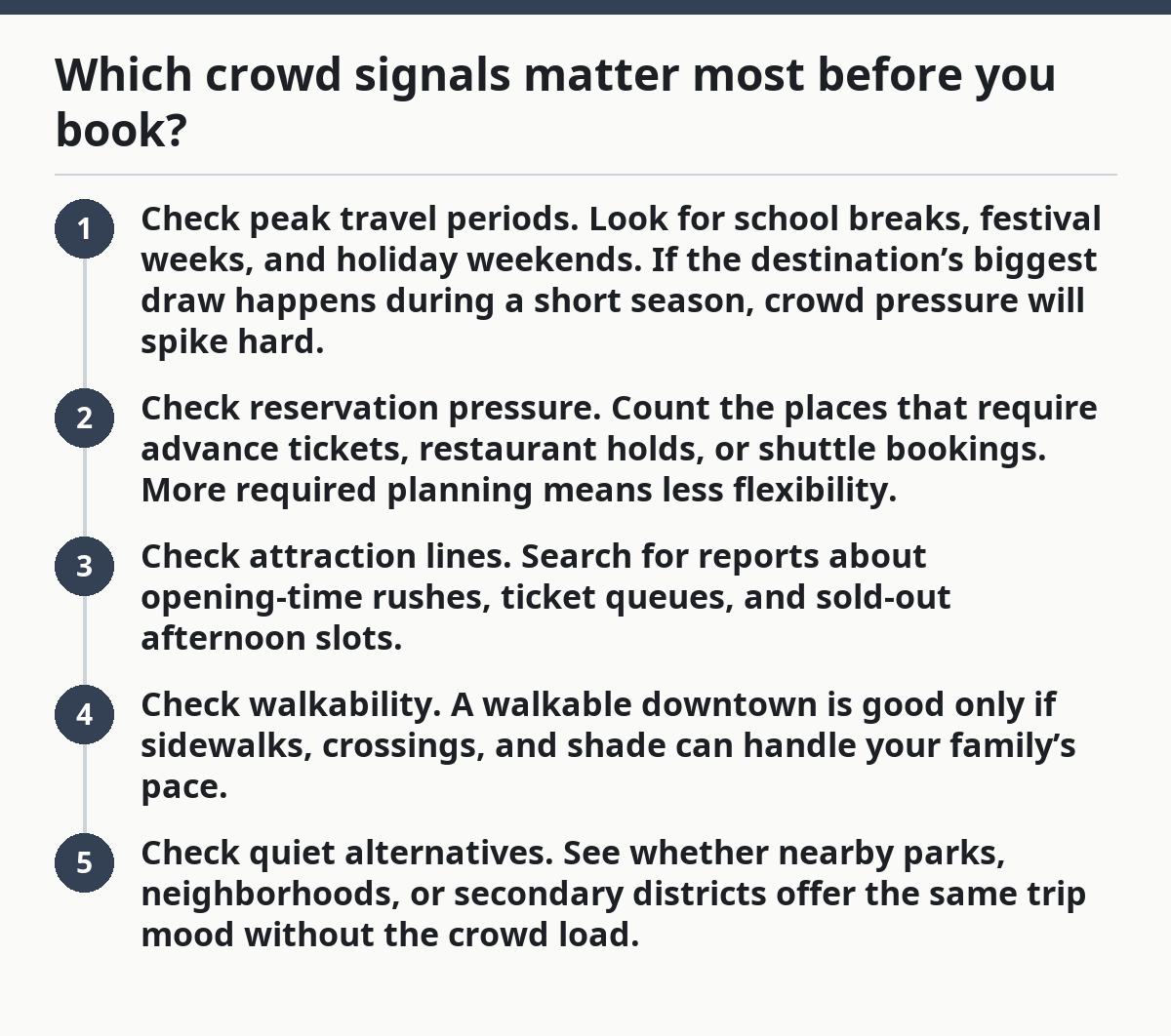
- Check peak travel periods. Look for school breaks, festival weeks, and holiday weekends. If the destination’s biggest draw happens during a short season, crowd pressure will spike hard.
- Check reservation pressure. Count the places that require advance tickets, restaurant holds, or shuttle bookings. More required planning means less flexibility.
- Check attraction lines. Search for reports about opening-time rushes, ticket queues, and sold-out afternoon slots.
- Check walkability. A walkable downtown is good only if sidewalks, crossings, and shade can handle your family’s pace.
- Check quiet alternatives. See whether nearby parks, neighborhoods, or secondary districts offer the same trip mood without the crowd load.
This is where many generic travel lists fail. They name places that sound family-friendly but ignore the way crowd pressure changes the trip. A compact downtown with 20 attractions can be easier than a huge resort zone with one overloaded signature site. Or it can be worse. The difference is how many people are funneled into the same blocks.
A better trip usually comes from a destination where the busiest parts of the day still leave room to breathe. A family that hates waiting should favor destinations with multiple activity clusters, not one crowded center.
For trip-planning context, a broader family travel hub can help you compare timing, budget, and booking pressure before you choose. That keeps crowd level tied to the rest of the trip instead of treated as a side note.
How do walkable downtowns change the crowd picture?
In contrast, walkable downtowns can either reduce stress or multiply it, depending on how narrow, busy, and concentrated they are. A walkable downtown is helpful when it replaces driving and parking hassles. It becomes a problem when every family is funneled into the same 6 or 8 blocks.
Picture this: you’re pushing a stroller past patios, street performers, and souvenir shops while your kids are hungry and the next restroom is three blocks away. That setting can feel lively in a brochure and tiring in real life. The issue is not walking itself. It’s crowd density plus small infrastructure.
Use these signs to judge a downtown:
- Sidewalks are wide enough for two adults and a stroller to pass.
- Crosswalks are frequent enough that you are not trapped on one side.
- Restaurants have indoor and outdoor seating, not just one packed patio strip.
- There are parks, alleys, or side streets that let you reset for 10 minutes.
- The downtown has more than one lunch zone, not a single choke point.
A walkable core usually works best for families with older kids or teens who enjoy wandering. It is less friendly for toddlers, nap schedules, or anyone who needs a quick escape. On the flip side, a car-dependent destination can be calmer at the center but harder when you need to shuttle between meals and activities.
If you’re comparing destinations, ask one blunt question: does walking replace crowds, or just move them closer together? The answer usually tells you enough.
What kind of family does a crowded destination suit?
Likewise, a crowded destination suits families that value energy, choice, and easy access to big-name sights more than quiet space. If your kids thrive on street activity, and adults don’t mind planning around reservations and attraction lines, a busy place can feel exciting instead of draining.
Picture this: you want one trip where the museum, pizza spot, and sunset view are all within a short walk. That setup can be great if your group can handle a packed afternoon and a slower dinner flow. It is not great if you need naps, early bedtimes, or a low-stimulation day.
Crowded destinations tend to fit:
- Families with older kids who can wait 20 to 40 minutes without melting down.
- Trips built around one major event or landmark.
- Travelers who like restaurants, shows, and street life in the same area.
- Parents who are fine preplanning several parts of the day.
They do not fit:
- Families with very young children and fragile schedules.
- Travelers who want to decide meals on the fly.
- Anyone who gets stressed when parking, entry, and dining all feel competitive.
Here’s the catch: crowd level is not the same as quality. A packed place can still be the right place if the family wants that buzz. The mistake is assuming busy automatically means better. For some kids, busy means exhausted by noon. For others, it means memorable.
If you need a calmer trip, look for a destination with more spread-out sights, fewer required bookings, and secondary neighborhoods or parks that give you room to reset.
How should you compare two destinations side by side?
Therefore, when you have two places left on the shortlist and both look good on photos, compare their crowd pressure across the whole trip. One may have famous attractions that sell out early; the other may have fewer big-name sights but more open space and easier dinners.
Use this side-by-side method when you need a clear answer:
- List the top 3 things your family wants to do.
- Mark whether each one needs a reservation, a timed ticket, or a long queue.
- Check whether those 3 things sit in one busy district or across several areas.
- Estimate the wait cost of lunch, parking, and bathroom breaks.
- Decide how much waiting your children can handle before the trip feels flat.
This is where many families overvalue famous places. A destination with one huge attraction can look perfect until you realize everything around it runs on the same schedule. A lesser-known place with good walkability, flexible dining, and one quiet alternative often gives you a better trip.
A useful rule: choose the place that gives you the most freedom after your first plan fails. That may sound small, but it is not. When a child is tired or weather shifts, the destination with a second park, a quieter district, or easier meal access wins fast.
For a broader planning frame, link this choice back to the site’s hub on budget family trip planning by destination timing and crowd conditions. That keeps crowd level tied to the rest of the trip instead of treated as a side note.
What mistakes make a family trip feel more crowded than it is?
After that, a destination feels overcrowded faster when the family picks the right place for the wrong rhythm. The most common mistake is choosing a spot during its peak season and then expecting off-season ease, which almost never happens. Another is packing too many famous stops into one day.
Picture this: you’ve planned three headline attractions, one popular lunch spot, and a sunset view everyone wants at the same hour. That schedule creates crowd pressure even in a medium-traffic destination. The family is not just visiting the place; it is also competing with the place’s busiest habits.
Avoid these mistakes:
- Arriving after breakfast rush and before check-in, when lobbies and cafés are jammed.
- Treating every major sight as a must-do.
- Ignoring the walk between activity clusters.
- Picking a destination with only one dinner district.
- Assuming a quieter neighborhood means the whole trip will feel quiet.
The fix is simple but not glamorous. Space out the day, choose a place with a few backup options, and favor destinations where the fun is not trapped in one corridor. A family that wants lower crowd pressure needs range, not just a pretty center.
FAQs
How do you tell if a destination gets too crowded for kids?
A destination gets too crowded for kids when waiting, walking, and planning take over the day. If the main sights need timed tickets, lunch needs a long hold, and the shortest walk is through packed blocks, the trip will feel heavy fast.
What makes one destination less crowded than another?
One destination feels less crowded when its attractions are spread out, its busy season is shorter, and daily plans do not depend on a single narrow center. More open access, fewer required reservations, and easier fallback choices usually lower the crowd load.
How do reservation-heavy destinations affect families?
Reservation-heavy destinations reduce flexibility and make the whole trip hinge on advance planning. That can work for organized families, but it gets old fast when kids are tired, weather changes, or a meal runs late.
Drafted with AI; not yet reviewed by a person.
