
Last updated: November 19, 2026
Quick Answer: In most family trips, the cheapest travel window is the one that avoids school breaks, major holidays, and peak weekend departures. Family trips get expensive fast when you pick the wrong dates. This guide to budget family trip planning by travel windows and timing — The Complete Guide shows which travel windows usually save the most, which ones are traps, and how to plan around them without guessing.
If you’ve ever stared at fares that jump by hundreds in a week, the sections below will help you choose the right month, day, and booking window. The topic of budget family trip planning by travel windows and timing — The Complete Guide is simple: timing can change the total trip cost by a lot.
Key Takeaways
- The biggest savings usually come from shifting dates, not from squeezing every line item.
- Midweek departures and shoulder seasons often beat Friday-to-Sunday travel for families.
- School holidays raise both airfare and hotel pressure because everyone else is chasing the same dates.
- The best window depends on your kids’ school calendar, your destination, and how flexible your work schedule is.
- A cheap trip can still turn expensive if you ignore baggage, car rental, and meal costs.
The best travel windows for family trips

Picture this: you want one break that fits school, work, and a tight budget, but every date you check looks expensive. A practical approach is to aim for shoulder season first, then build around midweek travel and non-holiday weekends. That mix usually gives you lower fares, calmer crowds, and more room choices without needing a perfect deal.
The truth is, not every “cheap” window is cheap for a family. A fare that looks low on paper can be wiped out by a hotel surcharge, a Sunday return, or a missed school day that forces a longer trip. Shoulder season usually means the weeks just before or after the main rush at a destination.
Here’s the catch:
- Avoid school breaks if you can. Spring break, summer vacation, and major holiday weeks tend to push up both air and hotel demand.
- Prefer Tuesday, Wednesday, or Saturday departures when your schedule allows it. These days often have less demand than Friday and Sunday.
- Use shoulder months for your destination, not just your own calendar. A beach trip in late spring can be cheaper than the same beach in midsummer.
- Check local events. A city with a festival or big sports weekend can act like peak season even in a quiet month.
For families, the sweet spot is often a 5- to 7-night stay in a shoulder window, with a flight that avoids Friday evening and Sunday afternoon. That combination often lowers the total trip cost more than hunting for the absolute cheapest one-way fare.
When school calendars beat flight deals
Picture this: the airfare looks fine, but the only dates that work land squarely inside a school holiday. That’s where many family budgets break. School calendars can shrink your options before you even see the best fares, and that usually means paying a premium for convenience.
If your children are in school, the calendar may be your hardest constraint. In many districts, the expensive dates are easy to spot: one-week spring breaks, the last week of July, Thanksgiving week, and the stretch around Christmas and New Year’s. Those are the same windows most other families want.
The best move is to plan around the school year, not against it.
- Shorten the trip instead of shifting into peak time if you only have one open weekend.
- Use teacher workdays, long weekends, or early-release periods if your district offers them.
- Book a trip that starts right after school ends and ends before the next peak rush begins.
- Watch district calendars from nearby suburbs too. A destination can get crowded when several school systems overlap.
One useful rule: if your dates sit inside a school break, compare those fares against a different destination before you commit. A city trip in a non-peak week can beat a beach trip during a holiday rush on total cost, even if the base airfare looks similar.
Which season is cheapest for families?

Picture this: you’re choosing between summer vacation and a quieter month, and you need to know which one protects your budget. The cheaper season is usually the one that falls outside the destination’s weather sweet spot and outside family vacation peaks, especially late winter, early spring, and fall in many places.
That doesn’t mean every fall trip is cheap or every summer trip is expensive. It means the crowd pattern matters. A mountain town may be busy in ski season and quiet in late spring. A beach town may flip the pattern completely. The lowest-cost season is the one with less demand and fewer must-travel dates.
A simple way to think about it:
- Summer is convenient but often pricey for family travel because school is out.
- Early fall can be a strong value if the destination still has good weather and fewer crowds.
- Late winter can be cheap for city trips, theme-park alternatives, and indoor destinations.
- Holiday weeks are usually the worst value unless you can book very early or go somewhere less obvious.
You do not need to know the whole year in advance. Start with the destination’s high season, then move one shoulder period earlier or later. That single shift often changes both your flight cost and your hotel options.
If you’re traveling with younger kids, the best season is often the one that keeps daily logistics simple. If you’re traveling with teens, the better season may be the one that avoids extreme heat, huge crowds, and long lines.
What timing saves the most money: booking date or travel date?
Picture this: you’re trying to decide whether to book early or wait for a better fare, and the numbers keep changing. The travel date usually matters more than the booking date, but the booking date still matters when you’re chasing limited rooms, holiday weeks, or a hard school schedule.
For family trips, timing has two separate jobs. One is choosing when to travel. The other is choosing when to commit. People often focus on the second and ignore the first. That’s how they end up paying more for a bad week.
So, in practical terms:
- Travel date first, booking date second. A good travel window often beats a perfect booking moment.
- Peak dates punish late planners. Holiday and school-break travel usually gets less forgiving as time goes on.
- Off-peak dates give you more room. If your trip is in a shoulder season, you can usually compare more options without panic.
- Hotels and vacation rentals can tighten earlier than flights. Family rooms and connected rooms are limited, so the best fit may disappear before the fare looks alarming.
If you need a hard rule, here it is: pick your trip window before you chase deals. Then set alerts, compare nearby airports if that makes sense, and watch the total price, not just the base fare.
A simple timing order that works
- Pick the month range that avoids your top school conflicts.
- Find the cheapest 3- to 5-day blocks inside that range.
- Compare midweek vs weekend departures.
- Check hotel and car rental totals for those same dates.
- Lock in the date that gives the best total, not the lowest single line item.
The honest side-by-side: peak dates vs shoulder dates
Picture this: two trips look almost the same on paper, but one lands in peak season and the other lands just outside it. The shoulder-date trip usually wins because it reduces pressure on flights, hotels, and attractions at the same time.
| Criteria | Peak Dates | Shoulder Dates | Winner for families on a budget |
|---|---|---|---|
| Airfare pressure | High demand pushes prices up | Less demand often leaves more choices | Shoulder dates |
| Hotel availability | Fewer family rooms left | Better room selection | Shoulder dates |
| Crowd levels | Longer lines, more stress | Manageable crowds | Shoulder dates |
| School fit | Often matches breaks | May require schedule juggling | Peak dates for school-first families |
| Weather reliability | Often the most predictable | Can be more variable | Peak dates in weather-sensitive trips |
| Dining and activity costs | Often higher during rush periods | More discounts and off-peak offers | Shoulder dates |
| Flexibility to change plans | Lower, because inventory is tight | Higher, because more inventory remains | Shoulder dates |
| Best for multi-generational travel | Harder on kids and grandparents | Easier pace and shorter waits | Shoulder dates |
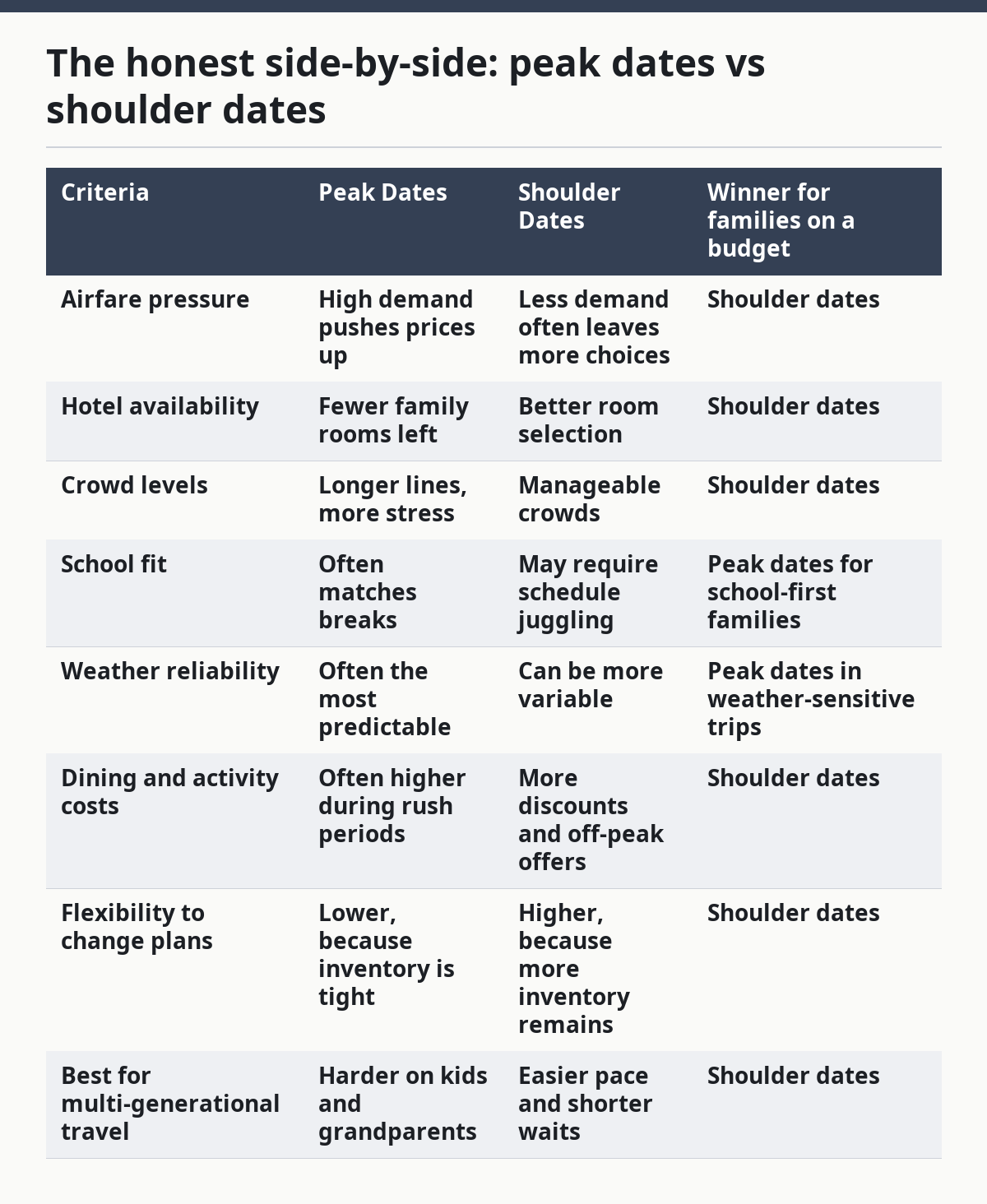
The table points to a clear answer: shoulder dates win for most budget family trips. Peak dates only make sense when school calendars or weather force your hand. If you can move even one week off the most popular period, the trip usually gets easier to plan and cheaper to execute.
The downside is real, though. Shoulder weather can be less predictable, and some attractions trim hours outside the peak season. That matters for beach destinations, seasonal theme parks, and places that depend on warm evenings.
How to build a budget around the right window
Picture this: you’ve picked a smart travel window, but you still need the trip to fit your cash limit. That’s where the budget either holds or cracks. A good window does most of the work, but you still need to plan the rest of the cost stack around it.
Start with the parts that change the most by date: flights, hotel nights, and car rental. Then add the family-specific costs that balloon when you travel at the wrong time, like breakfast, airport parking, and attraction tickets. The goal is a full-trip total, not a cheap headline fare.
The best order is simple:
- Lock the window first. If you have school limits, build around them.
- Compare trip length options. Sometimes 4 nights costs almost as much as 5, which makes the longer stay better value.
- Price the whole stay. Include taxes, resort fees, bag fees, parking, and ground transport.
- Plan one money-saving daily habit. Breakfast from a grocery stop or one picnic lunch can cut a lot more than a tiny fare difference.
A simple budget check helps here. If a slightly later shoulder window lowers your hotel rate and cuts the need for a rental car, that date may be better even if the flight is not the absolute cheapest. Total cost matters more than any single ticket.
Costs that change with timing
- Flights: higher on Friday, Sunday, and holiday departures.
- Hotels: higher during school breaks and event weekends.
- Rental cars: tighter around major travel waves and local events.
- Food: pricier in crowded tourist windows.
- Entertainment: sometimes discounted midweek or off-peak.
When the cheapest window is the wrong choice
Picture this: the fare is low, the dates are open, and the trip looks like a win — until the details start piling up. The cheapest window is the wrong choice when it creates costs you can’t see at first glance, or when it makes the trip harder on your family than it needs to be.
The most common mistake is chasing a bargain that breaks the rest of the plan. A destination with cheap flights but expensive transport can cost more overall than a place with moderate airfare and easy transit. The same is true for tiny hotel savings that come with a long commute or no breakfast.
Watch for these red flags:
- Arriving late at night with kids can force an extra meal, a taxi, or a lost first day.
- Too-short trips can make the per-day cost worse, even if the fare is low.
- Remote hotels may need a car, parking, and more meals out.
- Too-cheap shoulder weather can mean indoor-only days if your plans depend on sun or heat.
- Peak event overlap can erase the savings from choosing an “off” month.
If the cheapest window creates a miserable schedule, it is not really cheap. A family trip needs usable time, not just a low fare.
What to do if your dates are fixed
Picture this: you only have one week, one school break, or one vacation block from work. That’s still workable. Fixed dates don’t kill budget travel; they just force you to move the savings somewhere else.
If your dates are locked, focus on the parts you can still control. Shift the destination, the airport, the length, and the daily spend. Those four levers can rescue a trip that looks overpriced at first.
Then use this order:
- Choose a less obvious destination that has the same type of experience.
- Use a nearby airport if the drive is short and the difference is real.
- Cut the trip by one night only if it avoids an extra expensive weekend night.
- Pick lodging with breakfast or a kitchen if that reduces restaurant costs.
- Buy tickets only after you price the entire trip so one cheap item doesn’t disguise the total.
This is also the point where flexibility beats perfect timing. A family that can leave Tuesday instead of Friday often gets a better deal than a family that spends weeks searching for a magical price on peak dates.
Fixed-date fallback plan
- Keep the dates.
- Change the destination before changing the budget.
- Compare nearby airports or departure days.
- Price lodging with breakfast or kitchen access.
- Recheck the total against your ceiling.
Where to check before you book
Picture this: you’ve got a promising week, but you want one last sanity check before you commit. The answer is to look at authoritative calendars and crowd drivers, not just the fare box. That’s how you avoid booking into a school break, holiday surge, or event weekend by accident.
A few reliable places can help you confirm timing patterns:
- The U.S. Department of Transportation’s air travel consumer pages can help explain rights and timing issues on flights: https://www.transportation.gov/airconsumer
- The U.S. Department of Education has guidance and resources that can help you understand school-related timing constraints: https://www.ed.gov/
- The World Tourism Organization tracks broad travel season trends and destination pressure points: https://www.unwto.org/
You do not need a data rabbit hole. You need enough confirmation to know whether your chosen week is a smart budget window or a crowded trap. For U.S. travel timing, the Federal Aviation Administration also offers traveler and aviation guidance at https://www.faa.gov/ and the National Weather Service can help with season-specific trip risk at https://www.weather.gov/.
The verdict: which window to choose
Picture this: you’ve narrowed your options to two or three travel windows, and one of them is clearly easier on your wallet. Choose the shoulder-season, midweek window if your dates are flexible and your goal is the lowest total family cost. Choose the school-break or holiday window only if your calendar leaves no real alternative. Neither is a good fit if the trip depends on peak weather, peak events, or a destination that shuts down outside its busy season.
That’s the clean call. For most budget family trips, the winning move is not a magic booking trick. It’s a better date.
FAQs
What is the cheapest time of year for a family trip?
The cheapest time is usually outside school breaks and outside the destination’s busiest weather season. For many places, that means shoulder periods in late winter, spring, or fall. The exact cheap window changes by destination, so the local season matters more than a general rule.
Are weekday flights always cheaper for families?
No, but midweek flights often give you a better shot at lower fares and fewer crowds. Tuesday and Wednesday are commonly easier on the budget than Friday or Sunday. If the savings are small, the easier airport experience may still be worth it with kids.
Should I book early or wait for a deal?
Book early when your dates are fixed, your family needs one room type, or you’re traveling in a peak week. Waiting can work in shoulder season, but it becomes risky as the trip gets closer and inventory shrinks. The best approach is to choose the right window first, then watch fares.
Is it worth changing the destination instead of the dates?
Yes, if your dates are locked and the first-choice destination is in its peak season. A different city, park, or beach may give you a far better total cost on the same week. That’s often smarter than forcing an expensive trip into a crowded calendar slot.
What should I check besides airfare?
Check hotel rates, taxes, resort fees, baggage, parking, airport transport, and daily food costs. A cheap fare can hide an expensive stay, especially for families. The total trip cost is the number that matters.
Drafted with AI; not yet reviewed by a person.