Last updated: November 19, 2026
Quick Answer: The Best Budget Family Vacation Destinations for Large Families are usually places where one multi-bedroom stay, low-cost meals, and free activities can fit together. A good trip often works best when the lodging, food, and daily logistics stay under control at the same time.
Key Takeaways
- A budget-friendly destination for a large family keeps lodging, food, and logistics manageable together.
- Good options include Myrtle Beach, Gatlinburg, San Antonio, Branson, Orlando’s off-park areas, and park gateways with campground or cabin inventory.
- Flexible lodging for big groups usually means multi-bedroom rentals, suite hotels, cabins, campgrounds, or larger apartments.
- The biggest mistake is booking by nightly rate instead of the full family setup.
The Best Budget Family Vacation Destinations for Large Families are places where you can rent one multi-bedroom stay, cook or assemble meals without paying restaurant prices for every meal, and find free or low-cost activities within a short drive. The winners are usually destinations with apartments, vacation rentals, cabins, campgrounds, or suite hotels that fit a group without forcing you into separate rooms.
For large households, the destination matters less than the layout. A cheap flight to the wrong place can cost more than a reachable spot with a kitchen, laundry, and room to spread out. In practice, one good setup can save 2 rooms, 2 meals, and hours of coordination.
What makes a destination budget-friendly for a large family?
A budget-friendly destination for a large family is one where lodging, food, and daily logistics stay under control at the same time. That usually means a place with plenty of vacation rentals, apartment stays, cabin clusters, campgrounds, or suite hotels, plus grocery stores, public beaches, parks, museums with family pricing, or neighborhoods where you can walk to dinner.
The biggest trap is chasing a low nightly rate and ignoring the shape of the trip. Two standard rooms at a beach resort can cost less per night than a huge house, but the house may win if it gives you a kitchen, a washer, and one shared living room. For a group of 5, 6, or 8, those details often save more than the headline rate.
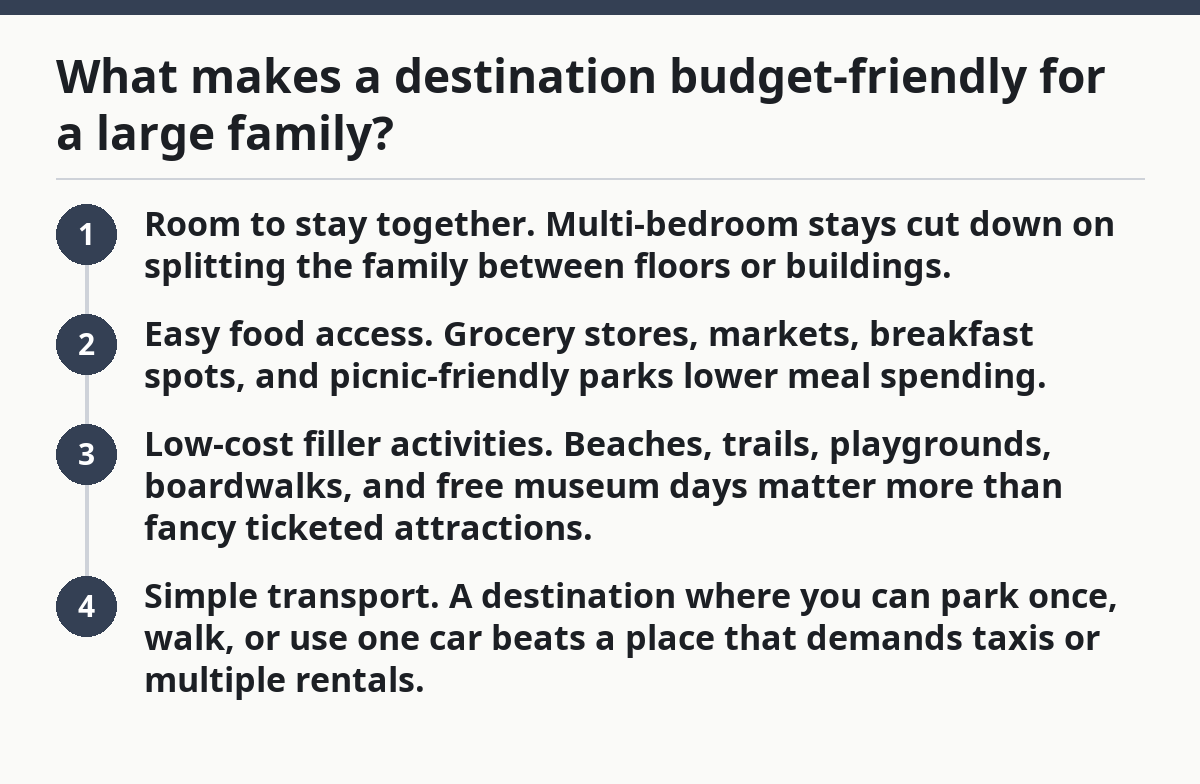
The best large-family destinations tend to share four traits:
- Room to stay together. Multi-bedroom stays cut down on splitting the family between floors or buildings.
- Easy food access. Grocery stores, markets, breakfast spots, and picnic-friendly parks lower meal spending.
- Low-cost filler activities. Beaches, trails, playgrounds, boardwalks, and free museum days matter more than fancy ticketed attractions.
- Simple transport. A destination where you can park once, walk, or use one car beats a place that demands taxis or multiple rentals.
I would not pick a destination that requires every outing to be a paid excursion. That model punishes families with more mouths to feed and more tickets to buy. It is also a poor fit if your group includes toddlers, teens, and grandparents, because the pace gets expensive fast. Instead, look for a place where the default day is already affordable.
This is the planning logic behind the broader budget family travel destination planning hub: choose places that make the daily math easier before you compare hotels.
Best budget family vacation destinations for large families
The Best Budget Family Vacation Destinations for Large Families are places like Myrtle Beach, Gatlinburg, San Antonio, Branson, Orlando’s off-park areas, and national-park gateways with campground or cabin inventory. These destinations give you a mix of large-group lodging, family dining, and low-cost activities without making every day a ticketed event.
Myrtle Beach, South Carolina
Myrtle Beach works because it has a huge supply of condos, vacation rentals, and suite hotels along with a lot of free beach time. A family can spend the morning on the sand, grab groceries for lunch, and save the paid attractions for one or two days. It is not the quietest choice, and peak season can bring traffic and crowded beaches, so it is wrong for families who want a calm, secluded trip. For a beach-focused group, though, the free shoreline is the main value.
Gatlinburg, Tennessee
Gatlinburg fits large families that want cabins, mountain access, and a lot of low-cost outdoor time. Cabin rentals can make shared meals easier, and the nearby national park gives you a strong base of free activities. The trade-off is congestion in town and the risk of paying for tourist-trap attractions if the group has no plan. It is a better fit for families who like a busy base camp than for families seeking a resort-style stay.
San Antonio, Texas
San Antonio is strong for budget family trips because you can pair apartment or suite hotel stays with walkable, mostly low-cost sightseeing. The River Walk, parks, markets, and mission sites help fill several days without requiring constant admission fees. It is not ideal if your family expects a beach vacation or wants everything in one enclosed resort district. Still, the city gives you enough variety to stretch a 3-day or 4-day trip.
Branson, Missouri
Branson is a practical choice for multi-generation or reunion trips because it offers cabins, larger vacation rentals, and family-oriented entertainment. You can keep a group together more easily here than in many major cities, and the surrounding lakes and outdoor areas help balance out ticketed shows. The downside is that some of the big-name attractions are not cheap, so the budget only works if you choose a few anchor activities and skip the rest. That mix makes it better for selective spenders than for impulse planners.
Orlando, Florida, outside the theme-park core
Orlando can work for budget-minded large families if the plan is not “park every day.” Apartment-style stays, extended-stay hotels, and off-park vacation rentals can make the lodging math easier, especially for groups that need a kitchen and multiple sleeping zones. The city is not naturally cheap once you add theme-park admission and parking, so this is the wrong destination if the trip is built around daily park tickets. Outside the park core, the key advantage is flexibility.
National-park gateways and campground towns
Gateway towns near major parks, especially those with campgrounds and cabin inventory, are often the cheapest way to put a big group near outdoor activities. When the main plan is hiking, wildlife viewing, and picnic meals, the budget stretches farther than it does in a resort area. The drawback is weather risk and less privacy if you choose camping, so it is not the right pick for families that need hotel-style comfort every night. For outdoor-first trips, the value is often in the setting, not the amenities.
Which lodging types work best for big groups?
The best lodging types for big groups are multi-bedroom vacation rentals, suite hotels, cabins, campgrounds, and larger apartments, in that order of flexibility for most families. The right choice depends on whether your main cost pressure is sleeping space, meal prep, or keeping everyone in one place.
A vacation rental is often the easiest answer when three things matter at once: 2 or more bedrooms, a common living area, and a kitchen. That setup helps with breakfast, late-night snacks, and putting little kids to bed while older kids still have space to talk or play cards. The drawback is that cleaning rules, fees, and check-in logistics can be less forgiving than a hotel.
A suite hotel can be a smart middle ground if you want fewer chores than a rental and still need a separate sleeping area. This is useful for one- or two-night stays, or for families who want daily housekeeping and breakfast included in the rate. The downside is that “suite” can mean a small room division rather than true privacy, so it is not the best fit for noise-sensitive sleepers.
A cabin makes sense when the destination itself is part of the vacation. Cabins often work well for reunions and multi-family trips because they can cluster everybody near a shared porch, fire ring, or kitchen table. The trade-off is that cabins may be more remote, which raises transportation and grocery-planning needs.
A campground is the cheapest route on paper, especially if your family already owns tents or a trailer. It is a strong option for outdoor-heavy destinations and reunion-style trips where the goal is time together, not room service. It is wrong for families with severe weather sensitivity, mobility limitations, or sleep schedules that collapse around shared bathrooms.
An apartment can be surprisingly useful in cities, especially when you want laundry and a kitchen but do not need a sprawling house. Apartments are often the most practical choice for urban destinations where parking and restaurant meals would otherwise eat the budget. The weak point is space: some apartments are efficient, not generous, so read the layout carefully.
A simple booking order that saves money
- Choose the destination first by activity mix, not by hotel deal. A family that wants beaches should not book a mountain town just because the nightly rate looks low.
- Sort by sleeping layout before price. Look for 2-bedroom, 3-bedroom, or loft-style options if the group includes more than four people. That usually reduces the need for two separate units.
- Check for a full kitchen or at least a kitchenette. A fridge, microwave, and sink can turn breakfast and lunch into the cheapest meals of the trip.
- Compare total stay cost, not just nightly rate. Cleaning fees, parking, resort fees, and extra-person charges can change the real total.
- Map grocery access and group dining. A nearby supermarket or casual chain restaurant can matter more than a scenic lobby.
- Pick one splurge day and one no-spend day. That balance keeps the trip from drifting into “vacation inflation” after day one.
How do large families keep food and activity costs down?
Large families keep food and activity costs down by planning around 2 or 3 anchor meals, using grocery stores for the rest, and building the itinerary around free or split-cost activities. This is the fastest way to stop a good destination from turning into an expensive one.
The food side is simple: if you have a kitchen, use it for breakfast and at least one other meal. Cereal, eggs, oatmeal, sandwich fixings, yogurt, fruit, and pasta can cover a lot of ground without turning every morning into a restaurant line. Even in a suite hotel or apartment, a 15-minute grocery run on day one often saves more than hunting for a “cheap” diner every morning.
Group dining works best when you choose places that tolerate a larger table and a slightly slower pace. Family-style restaurants, pizzerias, barbecue spots, taco counters, and casual diners usually work better than fine dining. If your party is 6 or more, call ahead or book ahead when you can; waiting 45 minutes with tired kids is its own hidden cost. That is especially true on busy mornings and evenings.
For activities, aim for at least one free option per day. Beaches, playgrounds, nature centers, boardwalks, public splash pads, hiking trails, and self-guided city walks are reliable fillers. A good destination also gives you split-cost activities: maybe one museum admission day, one mini-golf outing, and one boat ride, rather than three expensive tickets every day.
A useful rule is to choose destinations where the “default day” costs almost nothing. If your cheapest day still requires paid parking, expensive transit, and three admissions, the location is working against the budget. That is why places with parks, waterfronts, and walkable districts usually beat high-price resort cores for larger households.
What mistakes make a cheap trip expensive?
The most common mistake is booking for the nightly rate instead of the full family setup, and that mistake usually costs extra rooms, extra meals out, or a second car. A destination can look affordable until the family starts paying for all the missing pieces one by one.
Another mistake is ignoring the distance between lodging and activities. A $180-per-night rental that sits 25 minutes from everything may be more expensive than a $230-per-night stay in the right zone once fuel, parking, and time are counted. Large families feel this more sharply because every simple errand takes longer.
A third mistake is picking a place with no backup plan for weather. Beach towns, mountain towns, and campground-heavy destinations can all become expensive if rain removes your free activities. I would always check whether the area has at least one indoor option that is still affordable, such as a public library, children’s museum, aquarium on a discount day, or covered market.
The last mistake is overestimating how much everyone wants the same thing. One child may want pools, another wants hiking, and a teen may want shopping or Wi-Fi. The best budget destinations are flexible enough to absorb those differences without adding a new ticket for each person. If a place forces the family into separate expensive interests, it is probably not a real budget choice.
How I would choose among these destinations
I would choose the destination that solves the lodging problem first and the entertainment problem second. For most large families, that means starting with a place that has multi-bedroom stays, grocery access, and at least two days of free or low-cost activities already built in.
If the family wants beach time, Myrtle Beach is often the strongest budget pick because the free part of the trip is obvious. If the family wants mountains and shared cabin time, Gatlinburg is hard to beat. If the family wants city walking, casual food, and a lot of mixed-age options, San Antonio is a smart fit. If the trip is a reunion, Branson and some national-park gateway towns make the group logistics easier than many big cities.
The wrong choice is the destination that sounds cheapest before the family arrives. If the whole trip depends on paid attractions, valet parking, and restaurant meals, the budget will slip fast. A good large-family destination gives the group room to stay together, places to eat without full service, and enough free activities that the trip still feels like a vacation after the first invoice.
What destinations work best for families of 5 or more?
The best destinations for families of 5 or more are places with apartment stays, vacation rentals, cabins, campgrounds, or suite hotels close to free activities. That combination matters more than the city name itself. I would prioritize beach towns, cabin regions, and family-oriented cities with grocery stores and walkable districts before considering high-cost resort areas. A group of 5 or more benefits most from one shared kitchen and one shared base.
How can large families keep lodging and food costs manageable?
Large families keep lodging and food costs manageable by booking one multi-bedroom stay, using a kitchen for at least two meals a day, and choosing destinations with cheap or free activities. It also helps to compare the full stay cost, not just the nightly rate, because fees and parking can erase a bargain quickly. A simple plan usually beats a cheaper-looking deal.
Drafted with AI; not yet reviewed by a person.