
Last updated: November 19, 2026
Key Takeaways
- Easy airport access can keep the first 90 minutes after landing simple.
- The best family trips often pair major airports with direct transit and central, family-friendly stays.
- Skipping a car, or using one only once, often lowers the total cost after arrival.
- Transit-friendly arrival can keep a family trip from starting with parking and extra receipts.
The best budget family vacation destinations with easy airport access are often places where the airport is close to family-friendly neighborhoods, downtown hotels, and transit, so arrival day does not turn into an expensive transfer day. If I had to narrow the field fast, I would look first at cities with major airports, short train or shuttle rides, and car-free stays that let a family skip rental cars entirely.
What makes a destination easy on a family budget after you land

Easy airport access means the first 90 minutes after landing are simple, not cheap in theory. The winning destinations usually have one or more of these traits: a major airport with direct transit into the city, airport shuttles to hotel clusters, downtown hotels near rail or bus lines, and enough kid-friendly attractions to avoid renting a car for every errand.
The budget trap is ground transportation. A destination can look affordable on airfare and still become expensive if a family needs a rental car, parking, tolls, and a long transfer from the airport. That is why airport access matters as much as nightly room rates.
A quick filter helps:
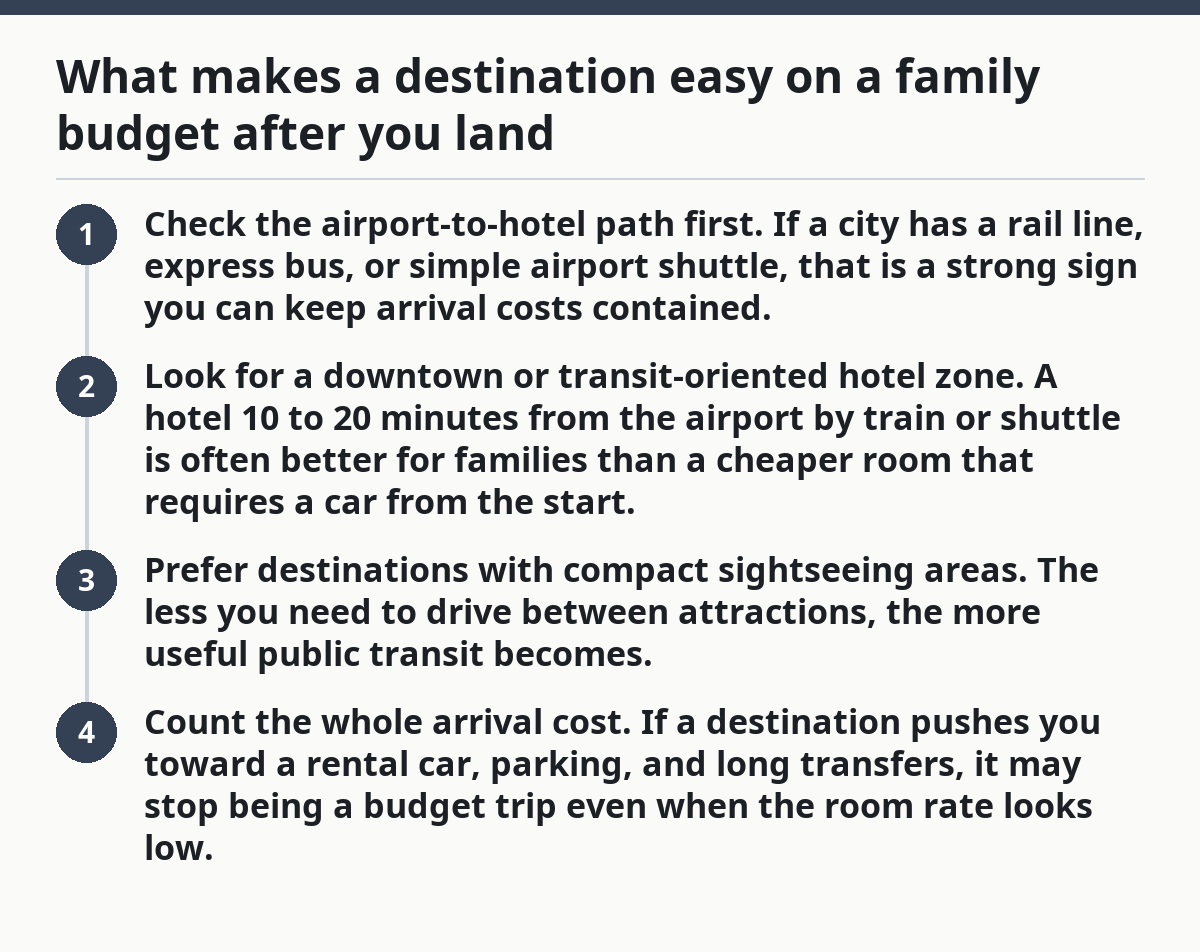
- Check the airport-to-hotel path first. If a city has a rail line, express bus, or simple airport shuttle, that is a strong sign you can keep arrival costs contained.
- Look for a downtown or transit-oriented hotel zone. A hotel 10 to 20 minutes from the airport by train or shuttle is often better for families than a cheaper room that requires a car from the start.
- Prefer destinations with compact sightseeing areas. The less you need to drive between attractions, the more useful public transit becomes.
- Count the whole arrival cost. If a destination pushes you toward a rental car, parking, and long transfers, it may stop being a budget trip even when the room rate looks low.
This is not the right lens for a road-trip-heavy vacation. It is for families who want to fly in, drop bags, and get moving without a half-day of logistics.
For planning around this kind of trip, the hub on budget family travel destination planning is the right next stop.
Which budget family destinations are easiest for families arriving by plane?
The easiest budget family destinations are the ones with major airports, direct transit, and enough family-friendly stays near the center that a car is optional. A few stand out because they reduce arrival-day friction without forcing luxury pricing.
Orlando, Florida
Orlando is one of the clearest choices if the goal is a family trip built around a major airport and a lot of budget lodging. Orlando International Airport has straightforward access to the city’s hotel zones, and many family resorts run airport shuttles or have shuttle arrangements to major attractions. That can keep the first leg of the trip simple.
The trade-off is obvious: Orlando can still become a car-heavy destination depending on where you stay and what you want to see. If you book a hotel far from the main attraction areas, ride costs and parking can eat into the budget. Orlando works best for families staying near a theme park corridor or in a hotel that clearly offers shuttle service.
San Diego, California
San Diego is strong for families because the airport is close to central neighborhoods, which reduces transfer time and car dependence. A downtown hotel, a bayfront stay, or a place near transit can make arrival day quick. Families can also combine public transit, walkable districts, and short rideshare hops instead of relying on a rental car for every outing.
The drawback is price pressure. San Diego is not the cheapest city on this list, so the budget case depends on staying disciplined with hotel choice and attraction selection. It is a better fit for families who can use transit well than for families who want a large suburban resort with lots of parking.
Vancouver, British Columbia
Vancouver is one of the strongest car-free family bases because the airport is linked to downtown by transit, and the city’s core is compact enough for families to use trains, buses, and walking. For many visitors, a downtown hotel near the SkyTrain is more practical than a distant cheaper property that requires a car.
The limitation is lodging cost. Vancouver rewards families who book early and stay focused on transit access rather than chasing the lowest room rate outside the core. It is not the easiest place to make a big rental-car plan pencil out.
Chicago, Illinois
Chicago is useful for families because both major airports give you options, and the city’s transit network makes downtown stays practical. A family can land, take rail into the city, and use public transit for a lot of sightseeing. That matters when the goal is to avoid a rental car and the extra charges that come with it.
Chicago is less ideal if your family wants a resort feel or a short hop to beaches and theme parks. It is best for families comfortable with urban travel and a hotel near a rail line.
Washington, D.C.
Washington, D.C. is a strong example of a destination where airport access and family budget planning work together. The airport connections are good, the central sightseeing area is compact, and many attractions are clustered along transit lines and walkable stretches.
The downside is that families who want to stay outside the central area may spend the savings on taxis or extra transit time. D.C. is strongest for families who stay near Metro access and do not mind a city break rather than a resort break.
San Juan, Puerto Rico
San Juan can be a smart budget family choice because the airport is close to tourist areas, and many stays do not require a rental car for a short visit. Beach time, walkable districts, and short transfers make it attractive when the priority is less moving around, more relaxing.
The trade-off is that if you want to explore widely beyond the city, a car can become useful. For a short stay built around one area, San Juan is much easier than destinations that force long transfers from the airport.
How do I pick a destination that stays cheap after landing?
The cheapest destination after landing is often the one that lets you skip a car or cut the car to a single use. For a family, that is usually more important than shaving a few dollars off airfare.
Use this selection process:
- Start with the airport map. Choose destinations where the airport sits close to the main family hotel zones. A city with a major airport and a 20- to 30-minute transit ride into the center is usually simpler than one that looks cheaper but needs a long car transfer.
- Check hotel clusters near transit. Look for downtown hotels, waterfront districts, or attraction zones with rail or bus access. That way, you are not paying for a ride every time the family wants lunch or a museum visit.
- Look for airport shuttle language. Many family hotels advertise airport shuttles, but the details matter. Some run on fixed schedules, some require advance booking, and some cover only certain terminals. If shuttle timing is uncertain, plan as if you may need a backup taxi or rideshare.
- Match the destination to your family’s energy. A city that is great on public transit may still be wrong for a family with very young children, heavy strollers, or a lot of luggage. In that case, a simpler transfer may be worth paying for.
- Avoid remote “deals.” A cheaper room 45 minutes from the airport is not a deal if it forces a rental car and parking every day. The budget win is a place where the first and last miles are easy.
A useful rule: if you cannot describe the airport-to-hotel path in one sentence, the destination may be more complicated than it looks.
For route and cost planning, the U.S. Department of Transportation’s general consumer guidance on air travel and airport ground access is a sensible reference point, and the Transportation Research Board has long documented how access to transit shapes travel behavior. Both are useful background when you are weighing airport-to-city connections, not just room rates.
Transit-friendly arrival: what to book so the first day stays calm
Transit-friendly arrival is the simplest way to keep a family trip from starting with a parking garage and a receipt pile. The best setup is a hotel near the airport rail line, a direct shuttle stop, or a walkable downtown area with grocery stores and dinner options within a few blocks.
A strong arrival plan usually looks like this:
- Book the hotel before you choose extras. A central hotel with a clean airport connection can save more than a slightly cheaper room outside the core.
- Pick one arrival method and keep a backup. For example, use the airport train if it runs early enough; keep a rideshare or taxi as the fallback if your flight lands late.
- Travel light enough for transit. Two checked bags, one stroller, and several carry-ons can make stairs and platform changes miserable. A family that can move with fewer bags has more destination options.
- Ask about the hotel’s luggage policy. If check-in is late, you want a place that will hold bags without drama so you can go straight to lunch or a park.
- Prefer compact first-day plans. A city with a central park, promenade, or museum district within 15 minutes of the hotel gives children a chance to decompress after the flight.
This is also where families get into trouble by over-optimizing for the room rate. A hotel that is $20 cheaper per night but adds two transfers and a long walk is often not budget-friendly in practice. If the children are tired and the airport train is crowded, the “cheap” option can cost a lot in time and energy.
Where rental cars help, and where they just drain the budget
Rental cars help when the destination spreads out beyond a single walkable core, but they are often unnecessary in the best airport-accessible family destinations. The goal is not to ban cars; it is to use them only when they solve a real problem.
A car can make sense if:
- You are visiting beaches, suburbs, or parks far from the city center.
- You have multiple children, heavy luggage, or mobility needs that make transit awkward.
- Your hotel includes parking and you plan to do several long day trips.
A car usually hurts the budget if:
- Your family is staying downtown and mainly moving between attractions on transit.
- Parking charges are high or hard to predict.
- The airport is close enough to make a shuttle, train, or taxi cheaper than owning the whole trip around a car.
The biggest mistake is assuming a rental car makes any family city easier. In places like Chicago, Washington, D.C., or Vancouver, a car can actually add stress because it replaces short transit rides with parking searches, traffic, and extra fees. In places like Orlando, it may help if your plans are spread across a wide area, but it is still worth checking whether your hotel offers airport shuttles or attraction shuttles first.
A practical test: if your daily plan involves one hotel, one attraction district, and one grocery stop, public transit or a shuttle is usually enough. If you need three separate neighborhoods and a late-night return, a rental car may be the better fit.
Best picks by family travel style
The best destination depends on how your family travels, not just on the airport code. A destination that is perfect for one group can be a poor fit for another.
- Best for a true car-free city break: Washington, D.C. and Vancouver. Both reward families who want transit, walking, and a central hotel.
- Best for airport-shuttle convenience: Orlando and San Juan. These work well when you want a simpler arrival and a stay centered on one area.
- Best for urban sightseeing with transit: Chicago and San Diego. Both offer major airports and enough compact neighborhoods to make a car optional.
- Best if the family wants the least airport-to-hotel friction: San Juan and San Diego, because the airport-to-center move is relatively manageable and the trip can start quickly.
The wrong choice is the destination that looks cheap only because it pushes the real costs into ground transportation. A family vacation should be easy to start, not just cheap to book.
What matters most when I compare airport-accessible family destinations?
The fastest way to compare them is to rank airport transfer, hotel location, and car needs before anything else. If a destination needs a long transfer, a car to function, and a non-central hotel to stay affordable, it is probably not the best budget family pick.
I would compare four things: how close the airport is to the main hotel zones, whether airport shuttles or public transit are realistic, whether downtown hotels are available at family sizes, and how much the destination rewards a car-free stay. That gives you a cleaner answer than looking at airfare alone.
How do I avoid expensive transfers after landing with kids?
I avoid them by choosing a hotel near the airport train, shuttle route, or central transit line before I lock in the trip. A family that can ride 20 to 30 minutes into the city usually spends less and arrives calmer than a family that books a cheap room 45 minutes away and then pays for a car anyway.
The other trick is to plan the first day around one compact area. If the hotel, dinner, and first activity are all within a short ride or walk, you do not need to rent a car just to survive the first evening.
Drafted with AI; not yet reviewed by a person.