
Last updated: November 20, 2026
Quick Answer: for 1–3 nights, a hotel is often the cheapest family lodging, while 5 nights or more can favor a vacation rental or cabin. Short trips usually favor hotels, while long trips often turn cheaper in vacation rentals or cabins once kitchen use, laundry access, and weekly discounts matter. I write about How to Choose the Cheapest Family Lodging for a Short Trip Versus a Long Trip for travelers who need the cheapest fit, not the prettiest listing. The comparison below settles what to book for 1–3 nights versus a week or more.
Key Takeaways
- Hotels can be the lowest-total option for 1–3 nights.
- Short stays often favor hotels once fees are counted.
- Rentals can cut total trip costs when kitchen and laundry use matter.
- Cabins may work best on longer, simpler stays.
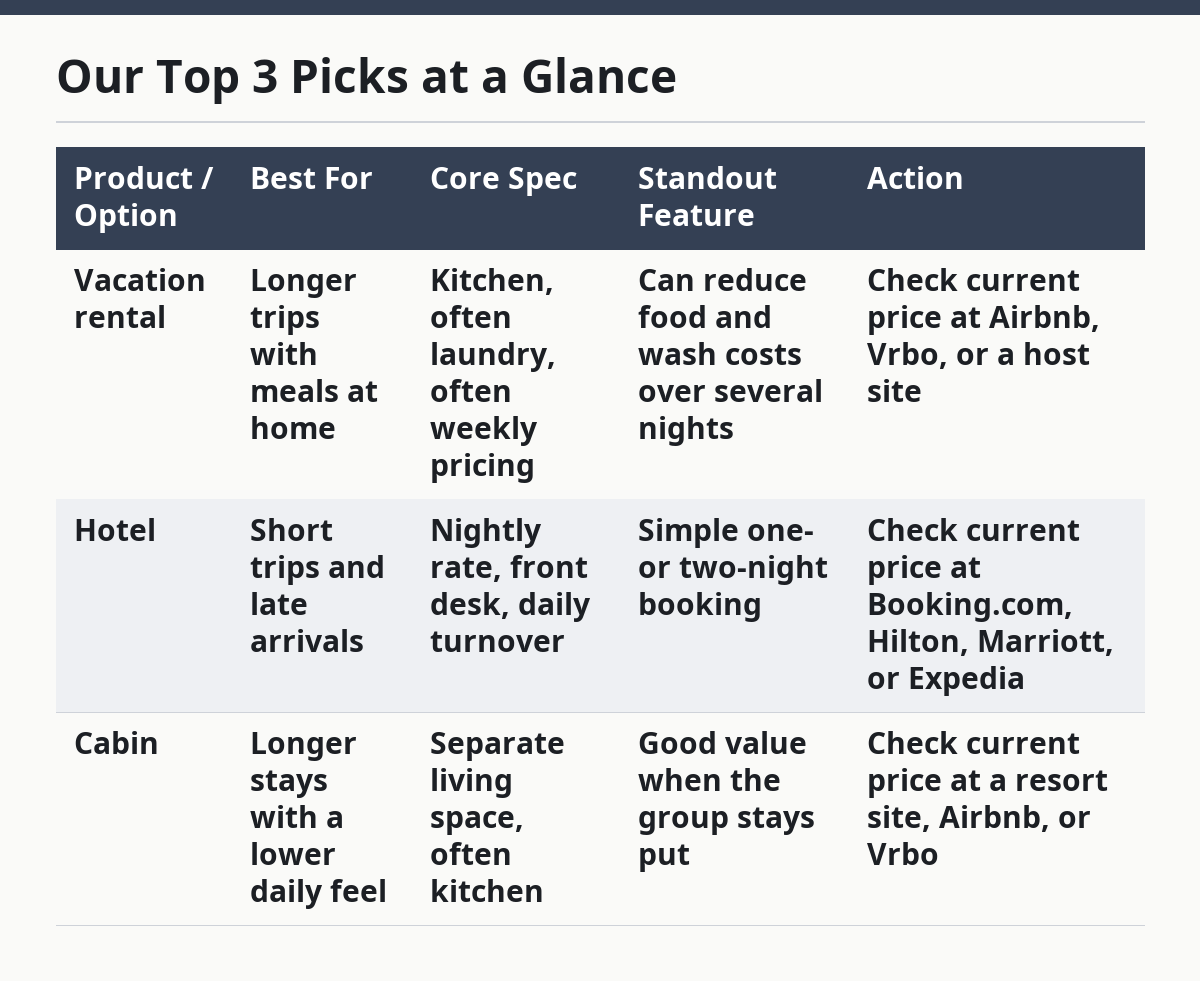
Our Top 3 Picks at a Glance
#1 Best Overall: Vacation rental — Best when your trip runs long enough for a kitchen and laundry to cut outside spending.
#2 Best Budget Pick: Hotel — Best for a short stay when you mainly need one clean night and easy check-in.
#3 Best Heavy-Duty / Upgrade Pick: Cabin — Best when a longer stay needs more space, a full kitchen, and a slower pace.
| Product / Option | Best For | Core Spec | Standout Feature | Action |
|---|---|---|---|---|
| Vacation rental | Longer trips with meals at home | Kitchen, often laundry, often weekly pricing | Can reduce food and wash costs over several nights | Check current price at Airbnb, Vrbo, or a host site |
| Hotel | Short trips and late arrivals | Nightly rate, front desk, daily turnover | Simple one- or two-night booking | Check current price at Booking.com, Hilton, Marriott, or Expedia |
| Cabin | Longer stays with a lower daily feel | Separate living space, often kitchen | Good value when the group stays put | Check current price at a resort site, Airbnb, or Vrbo |
Picture this: you’re booking for two adults and kids, and the total matters more than the sticker price. The cheapest choice can be hotel for a short trip and vacation rental for a longer trip, with cabins winning when the stay is longer and meals stay on-site. Here’s the catch: the lowest nightly rate is not always the lowest trip total.
I’ve spent years writing about budget lodging, room setup, and trip math, so this is the same question I’d ask before paying. The link below supports the broader planning path for this topic: budget family trip planning by lodging style and room setup. See also the related guide on family trip planning, room setup, and lodging fees.
| Criteria | Hotel | Vacation rental | Winner for [condition] |
|---|---|---|---|
| 1–2 nights | Often the lower total | Fees can raise the total fast | Hotel for a quick stop |
| 4–7 nights | Nightly charges add up | Weekly discounts can help | Vacation rental for a longer stay |
| Meals | Usually outside food | Kitchen cuts restaurant spending | Vacation rental when you cook |
| Laundry | Rare or shared | More common in full homes | Vacation rental for dirty clothes |
| Check-in timing | Late arrival is easier | Hosts may need stricter timing | Hotel for travel-day flexibility |
| Meal storage | Mini-fridge only, if listed | Fridge and cabinets are common | Vacation rental for snacks and milk |
| One-night use | Simple and efficient | Extra setup can feel wasteful | Hotel for one night |
| Long-stay comfort | Less space for spread-out living | More room to reset each day | Vacation rental for 5+ nights |
The real cost difference between a hotel and a rental
Picture this: you land at 9 p.m., need sleep, and leave the next morning. A hotel usually wins on total cost because one night has fewer moving parts. You’re paying for the room, not a kitchen you won’t use.
On the flip side, a vacation rental can look cheaper on the listing and still cost more after cleaning fees, service fees, and parking. That is why the nightly rate alone is a trap. A one-night stay rarely gives enough time to earn back those extras.
What changes the math:
- Nightly rate: hotels often stay cleaner on price for 1–3 nights.
- Fees: rentals can add fixed charges that hit short stays hardest.
- Kitchen use: if you skip breakfast out and one dinner, the gap narrows.
- Laundry access: the savings grow when you pack light for a week.
- Check-in timing: hotels are easier when your arrival time is messy.
A generic article would stop there. The useful version says this plainly: if your stay is short and your meals are mostly bought outside, the hotel is usually the cheaper total. If your stay is long enough to use the kitchen and laundry, the rental starts to pull ahead. The same apartment, cabin, or condo can be a bad deal for two nights and a smart deal for seven.
Why hotels usually win on short trips
Picture this: you only need a place for Friday and Saturday, and you’re out most of the day. A hotel is often the cheapest family lodging for that kind of trip because you pay for convenience you can actually use.
Hotels work best when the trip is short, the schedule is tight, and the room is mostly a sleep base. You get a front desk, easy late arrival, and no need to stock a kitchen. That matters if your kids arrive tired and you don’t want to think about groceries or key codes.
Pros of hotels for short trips
- Fewer fees to spread across a tiny stay
- Easier check-in after a late drive or flight
- No shopping for breakfast supplies
- Simple if you’ll be gone all day
Cons of hotels for short trips
- Meals usually cost more because you eat out
- Laundry is uncommon
- Small rooms can feel cramped if you stay inside much
- Parking may be extra in city areas
Who should skip this: a group staying 4 nights or more and planning to cook; a vacation rental or cabin may beat it once food and laundry costs matter.
Buy this if: you are a parent booking 1–3 nights and you need the lowest-friction option after a long drive.
Skip this if: you are staying a full week and your main dealbreaker is paying for every meal outside the room.
A hotel booking is easiest to compare across major sellers. For room rules and meal limits, look for whether the listing names a mini-fridge, microwave, or breakfast. If it doesn’t, assume you are paying outside the room.
For broader comparison, consult the U.S. Travel Association and the FTC on fee disclosure and trip budgeting before you book. https://www.ustravel.org/ https://consumer.ftc.gov/
Why vacation rentals start winning on longer stays
Picture this: you’re arriving for a wedding, a tournament, or a long school break, and the group will be in town several nights. A vacation rental often becomes the cheapest choice because its kitchen, laundry, and weekly discount can chip away at the total.
The truth is, a rental wins by reducing repeat spending. Breakfast at home, leftovers in the fridge, and one load of laundry can matter more than a lower nightly rate on a hotel. That is why long trips often shift the winner. The longer you stay, the more the fixed fee gets diluted.
Pros of vacation rentals for longer trips
- Kitchen lets you store milk, fruit, snacks, and leftovers
- Laundry helps if you pack fewer clothes
- Weekly discounts can lower the average nightly cost
- Living space helps when kids need a break from each other
- Cleaning fees and service fees can hurt short stays
- Check-in can be stricter than a hotel desk
- Some rentals have stairs, parking limits, or house rules
- Listings may not clearly say what kitchen gear is included
Who should skip this: travelers staying one or two nights, or anyone arriving late and leaving early; a hotel usually costs less in that case.
Buy this if: you are a parent staying 5 nights or more and you plan to cook at least part of the time.
Skip this if: you want the cheapest overnight stop and do not want to think about hosts, locks, or cleaning rules.
For long stays, compare listings on Airbnb and Vrbo, and also check local property managers or resort sites. The current price matters less than the full total: nightly rate, fees, kitchen access, laundry, and parking.
Where cabins fit in the cheap-stay equation
Picture this: you want lower daily cost, a kitchen, and less hotel traffic around the kids. A cabin can beat both a hotel and a rental apartment when the stay is longer and the space is simple.
Cabins are not magic. They win when they give you the basics a long trip needs: a place to sleep, meal storage, and enough room to stop buying every snack outside. Some cabins are bare-bones; others sit inside resort settings with higher fees.
Pros of cabins
- More separate space than a standard hotel room
- Often better for shared meals and early bedtimes
- Can support a longer stay without a restaurant every day
- Good middle ground for families who want less city noise
Cons of cabins
- Some lack full laundry
- Remote locations can raise gas and food costs
- Housekeeping may be limited
- Not every cabin is truly budget-friendly once fees appear
Who should skip this: short-trip travelers who need simple overnight convenience; a hotel usually stays cheaper for 1–3 nights.
Buy this if: you are a family staying a week and want a quieter place with room to cook and spread out.
Skip this if: you are flying in late, staying one night, and need instant front-desk help.
Cabins are worth a look on resort sites, Airbnb, and Vrbo. Check whether the listing names a full kitchen, laundry facilities, and the exact check-in rules. If those details are vague, the total can climb fast.
How trip length changes the cheapest choice
Picture this: you are comparing three listings, and one looks cheaper only because it hides the extra costs in the fine print. Trip length changes the cheapest lodging choice because fixed fees hurt short trips and convenience costs hurt long trips.
Here’s the clean rule:
- 1–3 nights: hotel usually wins.
- 4 nights: the gap gets close.
- 5–7 nights: vacation rental often wins if you cook.
- A week or more: rental or cabin usually pulls ahead if laundry and meal storage are included.
The biggest cost shift comes from what you do in the room. If you eat out every meal, the hotel stays strong. If you buy groceries, store leftovers, and wash clothes on-site, the long-trip math tilts the other way. That’s why “cheapest” is not a fixed answer. It changes with nights, food, and laundry.
A quick way to compare:
- Add the nightly rate.
- Add cleaning, service, parking, and resort fees.
- Estimate food you would buy outside.
- Check whether laundry is free, shared, or unavailable.
- See whether the booking allows a later check-in without extra stress.
On long stays, a rental with a kitchen can beat a hotel that looks cheaper at first glance. On short stays, the reverse is usually true. That’s the whole decision.
Exceptions that flip the verdict
Picture this: you think the rule is simple, then one detail changes everything. A vacation rental can beat a hotel on a short trip if the rental has no extra fees and includes a kitchen you will use right away.
That said, here are the main flip cases:
- The hotel adds parking and resort fees. A short trip can stop being cheap once those charges pile on.
- The rental has no real fees. A tiny stay can work if the total stays clean and the location saves on transport.
- The trip is food-heavy. If everyone needs special snacks, breakfast, and late-night storage, a kitchen wins sooner.
- The group has laundry needs. Sports gear, beach clothes, or infant items can make a long stay in a hotel feel expensive fast.
These exceptions are easy to spot before you book. Read the fee line, the kitchen line, and the laundry line. If two of those are missing, the “cheap” option may be a trap. A short trip with high hidden fees is not cheap at all. A long trip without meal storage is not either.
The Verdict: which one to choose and why
Choose a hotel if you are staying 1–3 nights, arriving late, and planning to eat most meals outside. Choose a vacation rental if you are staying 5 nights or more and will use a kitchen, meal storage, or laundry facilities. Choose neither if the listing hides fees, lacks clear check-in rules, or cannot show the basics in writing.
That is the clean answer. Short trip: hotel. Long trip: vacation rental. Cabin sits in the middle and can win for longer stays, but only when the kitchen and fees make sense.
What to check before you book
Picture this: the listing looks cheap until checkout. A current total is the only number that matters, and it should include fees, parking, and the cost of eating if there’s no kitchen.
Before you click book, check these details:
- Does the room or rental have a kitchen or microwave?
- What are the cleaning fees and service fees?
- Is parking included?
- Is there laundry in the unit or on site?
- What is the check-in window?
- Are there any house rules that add cost or limit flexibility?
For quick verification, compare the same stay on at least two booking sites and one brand or host site. Then use the total, not the headline rate, to decide.
Drafted with AI; not yet reviewed by a person.