Last updated: November 20, 2026
Key Takeaways
- Choose the stop by timing, not distance, so arrival, dinner, and kid fatigue all line up.
- Stop overnight when driving starts to crowd out dinner, wind-down time, or a normal bedtime.
- Pick a busy interstate exit hotel cluster for easier food, parking, and a smoother morning.
- Plan meals before irritability and rest before exhaustion so the day stays manageable.
A family road trip overnight stop works best when it matches kids’ fatigue, arrival hour, and meal timing—not when it lands on a neat midpoint. In this guide to How to Plan a Family Trip With a Long Drive Break That Actually Makes Sense, the right break is the one that gets everyone out of the car before tempers snap and gets you to the hotel before bedtime turns into a second shift. The steps below settle where to stop, how long to drive, and how to make a one-night stopover feel planned instead of chaotic.
The quickest way to choose a stop that makes sense
Picture this: you’re 5 hours into the day, the back seat is gone quiet in a bad way, and you still have 3 more hours to go before sleep. Therefore, choose the stop from the clock, not the map—plan around arrival hour, meal break timing, and the children’s real driving limit.
A good overnight stop is usually near an interstate exit hotel with easy in-and-out access, a dinner option within a short walk or drive, and a clean next-day departure. According to the U.S. Department of Transportation, the goal is to reduce fatigue and keep travel predictable; that sounds simple because it is. The mistake is picking a place that looks neat on the route but forces a late check-in, a long hunt for food, or a groggy 7 a.m. departure. For route planning basics, see the Federal Highway Administration.
Here’s the catch: the “best place” is often not the geographic midpoint. It’s the place where the trip can split into a travel day itinerary that still leaves room for a meal, a bathroom break, and a decent sleep window.
Use these filters first:
- Arrival target: aim to reach the hotel by early evening, not near midnight.
- Meal timing: stop for dinner before everyone is starving.
- Kid limit: plan the day so the longest stretch matches your children’s tolerance, not yours.
- Exit quality: pick an exit with services, not a lonely ramp and a gas station.
If the day only works by driving until everyone is wrecked, it does not work.
How long should a family drive before stopping overnight?
A family should stop overnight when the day’s drive starts to crowd out dinner, wind-down time, or a normal bedtime. That usually means the break should be built around the day’s rhythm, not a fixed number on a map.
The first thing I plan is the longest continuous stretch before the hotel. For younger kids, a 2- to 3-hour block may be the practical ceiling before a real pause. For older kids, 4-hour blocks can work if there is a meal, a stretch stop, and a destination that doesn’t require a late check-in. A solid travel day itinerary often uses two shorter legs and one hotel stop, not one heroic push. The American Academy of Pediatrics also emphasizes planning around child comfort and fatigue; when in doubt, HealthyChildren.org is a useful place to start.
Use this order of operations:
- Start with bedtime. Work backward from when everyone needs sleep.
- Set the hotel arrival window. Early evening is the sweet spot.
- Count the meal break. Add 45 to 90 minutes for dinner, depending on the place.
- Place the rest stop. Put it before the mood drops, not after.
- Check the next morning. Make sure departure time won’t turn the room into a rushed breakfast line.
The truth is, a long drive becomes manageable when the overnight stop breaks the day into honest pieces. If a “midpoint” hotel makes you arrive at 10 p.m., skip it.
Common drive-length mistakes that cost you the evening
The biggest mistake is waiting until the first bad stretch to stop. By then, kids are overstimulated, the driver is tired, and the meal break turns into a late, expensive rescue mission.
A few traps show up again and again:
- Driving past dinner time. You pay for it in bad moods and slow check-in.
- Choosing a hotel far from the exit. Ten extra minutes matters when everyone is done.
- Planning one giant stop. One long pause often feels worse than two short ones.
- Assuming the youngest child sets the limit alone. The whole car matters, including the driver.
The better move is to choose a stop that keeps the day inside a sane 12-hour travel envelope, including breaks, without pretending the car is a living room. That number is not magic. It is just a warning sign when the day starts to feel too long for one push.
If the route only works with a very late arrival, split the drive differently or pick a closer overnight stop.
Where should you stop on a long family road trip?
You should stop near a busy interstate exit hotel cluster, not in the middle of nowhere and not in a downtown that adds parking stress. The best stop is usually the one with a clean exit, enough food nearby, and a simple next-morning return to the route.
Picture this: you’re choosing between a scenic town and a plain exit with a chain hotel, and only one of them lets you unload bags in 10 minutes and get dinner without a detour. That plain exit usually wins. This is a logistics decision, not a vacation photo contest.
Use this checklist when comparing stop points:
- Easy exit and re-entry: one turn from the interstate is better than a maze.
- Food within 10 minutes: a sit-down spot or a reliable takeout option.
- Fuel nearby: fill up before you park for the night.
- Quiet enough to sleep: avoid an exit with highway noise, truck traffic, or a late-night crowd.
- Basic services: pharmacy, snack shop, and a simple breakfast option help the morning move faster.
A good stop often sits just after a major city or just before a long rural stretch. That gives you dinner choices and keeps the next morning from starting with a dead zone.
A simple stopover comparison
| Option | Best For | Core Spec | Standout Feature | Action |
|---|---|---|---|---|
| Interstate exit hotel | Families who need quick check-in, dinner nearby, and an early start | Easy highway access, nearby food, one-night use | Fast in, fast out | Choose this when arrival time matters more than scenery |
| Rest stop only | Short pauses for bathroom, stretch, and snack breaks | Usually 15 to 30 minutes | Cheap and simple | Use this inside the travel day, not as the overnight plan |
| Downtown hotel | Travelers who want restaurants and walking access | More traffic, parking, and route friction | More dining choices | Skip this if you want a quick departure the next morning |
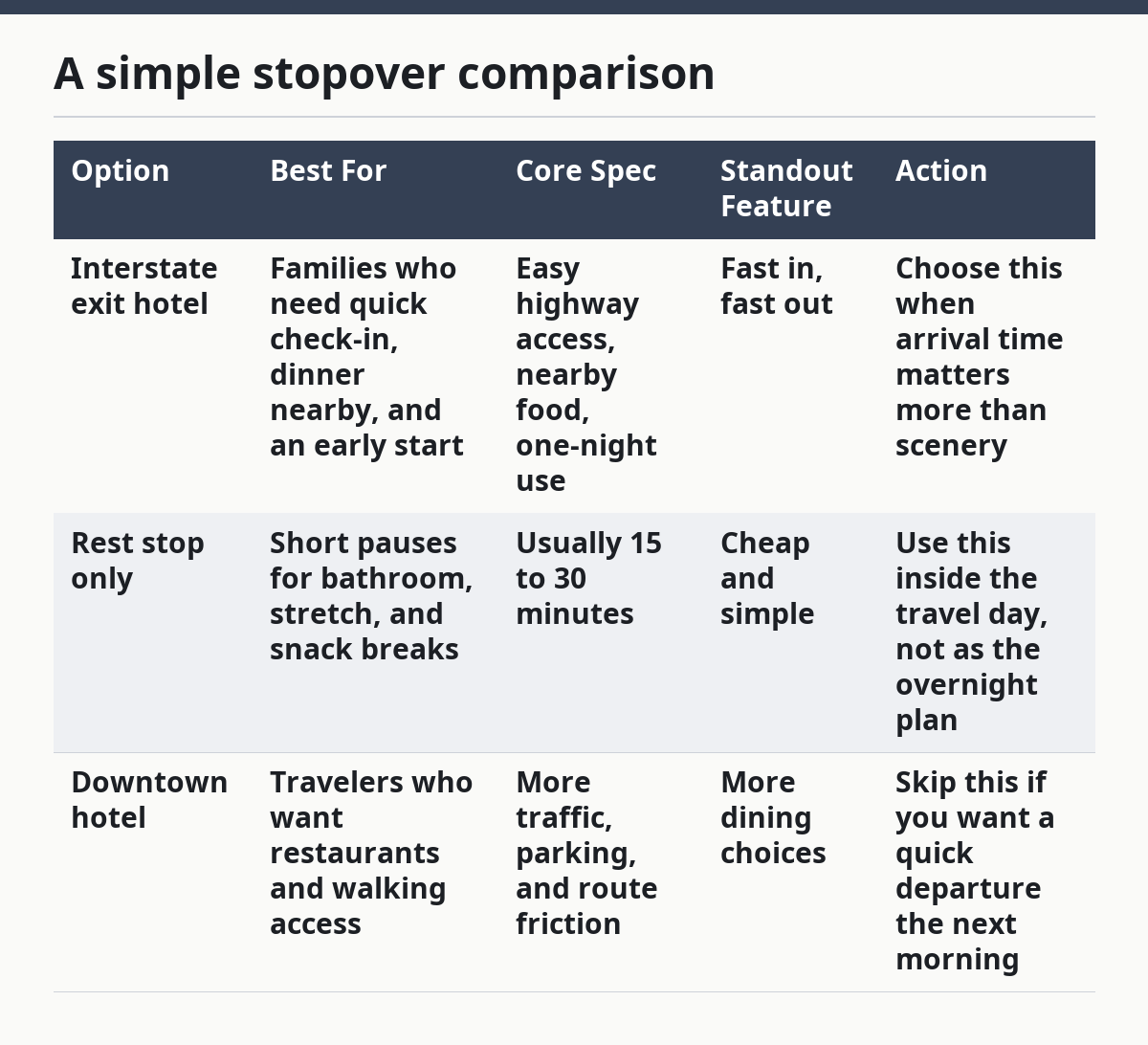
The winner for most road-trip overnights is the interstate exit hotel. It does the dull job well, and dull is exactly what you want at 8 p.m.
How do you build the travel day itinerary around food and fatigue?
You build the travel day itinerary by placing food before irritability and rest before exhaustion. So the first meal break should be planned, not improvised at the point where snacks are already gone and everyone is annoyed.
Picture this: you’re watching the clock, the kids are asking for food, and the nearest place is another 40 minutes away. That is how a normal travel day turns into a miserable one. The fix is to treat meals like part of the route, just like fuel and bathroom stops; if a child has medical, nutritional, or behavioral needs, consult a pediatrician or other qualified professional and use guidance from HealthyChildren.org.
A practical travel day itinerary usually looks like this:
- Morning start: leave after breakfast or with breakfast packed in the car.
- First stretch stop: 2 to 3 hours in, for a restroom break and movement.
- Meal break: around lunchtime or early dinner, depending on departure time.
- Long drive block: the largest block goes before the evening crash.
- Hotel arrival: leave enough room for unloading, check-in, and 30 minutes of calm.
If you are driving with toddlers or kids who melt down fast, plan a meal before the hard edge shows up. If you wait until hunger gets loud, the stop will take longer and cost more in patience.
The best part is that a planned meal break can make the rest of the day easier. Even a simple food stop gives the trip a reset point. That reset matters more than whether the restaurant is famous.
A few meal rules help:
- Don’t make dinner the last task of the day.
- Don’t assume a gas station snack will carry the whole evening.
- Don’t put the hotel after a late, heavy meal unless bedtime can slide.
- Do keep water handy so hunger and thirst don’t blur together.
What one-night stopover logistics actually matter?
One-night stopover logistics matter because the wrong hotel can erase the benefit of stopping at all. A stopover only works if check-in, sleep, breakfast, and departure are all simple enough that nobody feels trapped in transit.
Picture this: you arrive tired, the room is fine, but there’s no elevator, no nearby food, and checkout starts the morning in a rush. That is not rest. It’s a different kind of driving.
The details that matter most are small:
- Ground-floor access or elevator access if you have heavy bags, a stroller, or sleeping kids.
- Late arrival policy so a delayed drive doesn’t become a problem.
- Parking near the room if you’re unloading a lot of gear.
- Breakfast timing that fits your departure, even if it’s just coffee and fruit.
- Quiet room placement away from ice machines, highway noise, and the front desk.
A simple one-night stopover also needs a loose evening plan. Let the kids move around for 15 to 20 minutes after arrival, then keep the rest of the evening boring. Boring is the point. The next day will go better if nobody treats the hotel like a second destination.
Here’s where a lot of trips go sideways: people book a hotel as if they’ll spend the night there. On a road trip, you are not staying to enjoy the hotel. You are using it to protect the drive.
Skip hotels that demand a complicated arrival, a long walk to food, or a morning scramble. Pick the place that makes the next leg easier.
The simple planning method I use first
The easiest way to choose the stop is to plan backward from the night, then forward from the morning. That gives you one honest route instead of a hopeful one.
Start with this order:
- Set the bedtime target. Decide what time the car needs to stop for the day.
- Choose the hotel window. Aim for arrival with enough time to check in, eat, and settle.
- Map the meal break. Put dinner where it will still feel like dinner.
- Place rest stop timing. Add one or two bathroom and stretch breaks before the mood dips.
- Choose the exit cluster. Look for a hotel near food, fuel, and easy re-entry.
- Check the next morning’s drive. Make sure the first leg after checkout is short enough to feel manageable.
This method works because it respects the real limits of a travel day: attention, hunger, and sleep. It also keeps the family trip overnight stop from becoming a random dot on the map.
For a deeper route framework, the hub on budget family trip routing and connection planning can help with the larger trip structure. This page is about the overnight stop itself—the place where the day ends without a fight.
When is one overnight stop not enough?
One overnight stop is not enough when the route forces a late arrival, a short sleep, and a hard next morning. If the plan only works by stacking a long final leg on top of a drained day, the trip is trying to do too much.
Picture this: you’re calling a hotel at 9:30 p.m., the children are done, and tomorrow’s first leg is already long. That’s the sign to split the drive differently or add another stop. A single overnight can work for a long family drive, but not every route deserves one.
Watch for these warning signs:
- The hotel arrival would be after bedtime.
- Dinner would happen too late to enjoy.
- The driver would start the next morning already tired.
- The first leg after checkout would be another big push.
- The route depends on “just one more hour” more than once.
This is the honest trade-off: a one-night stop saves hotel hassle, but it can’t fix a route that is simply too long for one reset. If the day becomes a march from breakfast to midnight, the stop is too ambitious.
Choose the simpler plan. The right overnight stop should make the trip feel shorter, not make the map look clever.
Drafted with AI; not yet reviewed by a person.