
Last updated: November 20, 2026
Quick answer: for most families, a middle floor like the 2nd or 3rd floor is the best starting point for a budget family hotel room floor level because it balances noise, safety, and convenience. The right hotel room floor level can make a cheap stay feel calm or chaotic. This guide to How to Pick a Budget Family Hotel Room Floor Level for Noise, Safety, and Convenience focuses on the room floor, the noise around it, and how your family will actually move through the hotel.
Key takeaways
- Ground floor rooms are easiest for strollers, luggage, and late arrivals, but they often sit closer to lobby noise and foot traffic.
- Upper floors usually cut down hallway noise and street noise, but they add elevator waits and a harder escape if you need to move fast.
- A room far from the elevator can be quieter, yet it can also mean longer walks with tired kids and bags.
- Pool-facing, lobby-facing, and entrance-facing rooms are the ones most likely to carry noise into nap time.
- A middle floor often fits the biggest number of family trips, but the best floor is the one that matches your real day: naps, stroller use, luggage load, and how often you expect to come and go.
Which floor level fits your trip?

The best floor level is often the one that matches how your group will move through the hotel in the first 12 hours. If you expect several trips with a stroller, cooler, diapers, or a toddler who cannot wait for an elevator, a ground floor room can save a lot of friction. If sleep is fragile, a middle floor is often the better bet because it keeps you farther from the lobby, entrance, and pool area.
Think in trade-offs, not rules. A room on the 2nd or 3rd floor may feel quieter than the ground floor, but it also makes every exit, snack run, and bedtime return depend on the elevator. That matters more in a budget hotel, where hallways are often narrow and elevators can be slow at checkout time.
The main question is not “What floor is best?” It is “What problem hurts most if this room is wrong?” If you care most about naps, avoid the noisiest spots even if the floor number looks good. If you care most about ease, choose the floor that cuts stairs and walking. For a broader planning framework, see the related guide on budget family hotel booking tips.
Ground floor or upper floor?
Ground floor rooms are best for convenience, while upper floors are usually better for noise control. That simple split helps with most budget hotel stays, but the details matter. A ground floor room near the lobby door, vending area, or pool can carry more sound than a 4th-floor room at the end of a hallway.
Here is the trade-off in plain terms.
| Floor choice | Main upside | Main downside | Best for |
|---|---|---|---|
| Ground floor | Fast access, easier stroller use, less elevator dependence | More lobby, entrance, and foot traffic noise | Late arrivals, heavy luggage, frequent in-and-out trips |
| Middle floor | Better balance of quiet and convenience | Still depends on elevator | Most short family stays |
| Upper floor | Usually less noise from public areas | Longer elevator waits, more steps if elevators fail | Light sleepers, nap schedules, rooms away from pool or lobby |
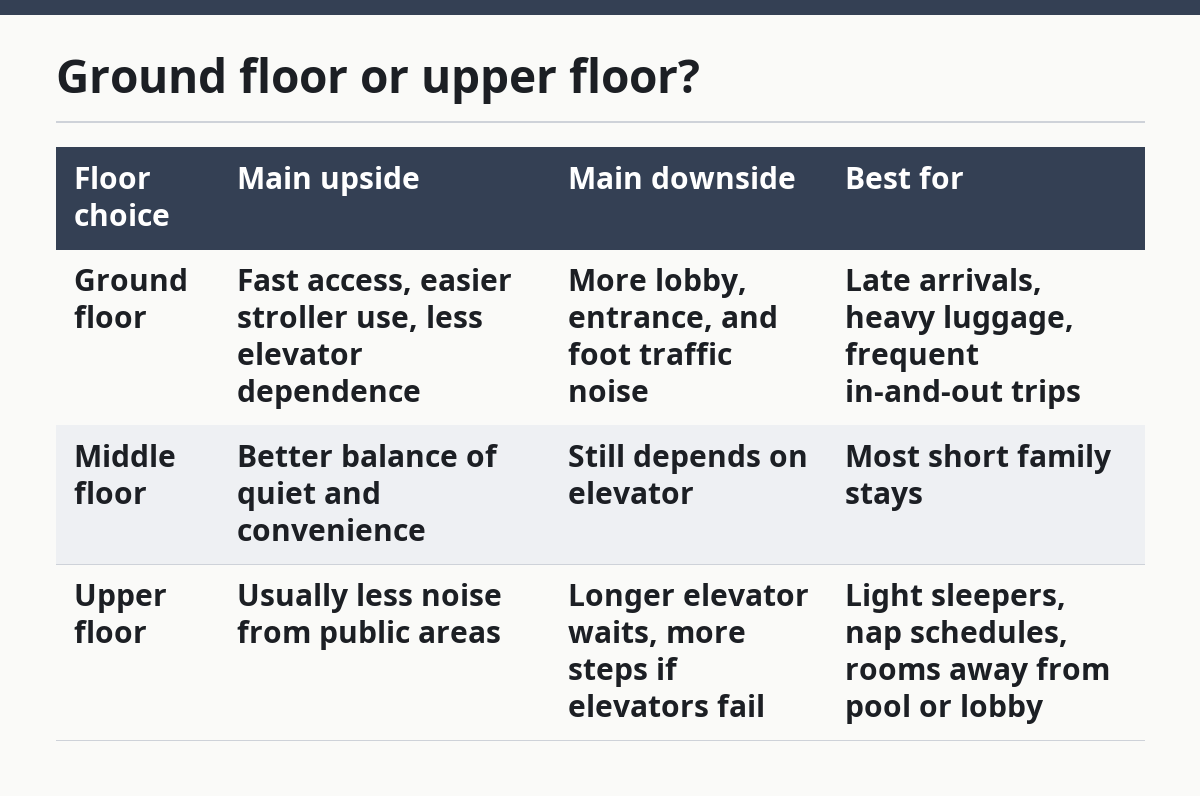
The floor number alone does not tell the whole story. A ground floor room at the far end of a quiet corridor may work better than an upper floor room above the lobby. A room on the 5th floor can still be noisy if it sits next to the elevator or ice machine. Ask where the room sits within the floor, not just which floor it is on. For a deeper room-location checklist, use the related page on quiet hotel room requests.
This choice is not ideal for every trip. If you have a baby who wakes at every hallway sound, skip the ground floor unless access is the top priority. If your group includes a wheelchair user or someone who cannot handle stairs well, a high floor with uncertain elevator access can be a poor match.
How do noise and sleep change by floor?
Noise usually gets easier to manage as you move away from the lobby, entrance, and pool area. A room near the lobby can hear door swings, rolling bags, and check-in chatter. A room near the pool area can pick up splashing, voices, and late-afternoon traffic from guests coming and going. If a child naps at set times, those sounds can matter more than the view from the window.
That said, upper floors are not automatically quiet. Elevator banks, ice machines, housekeeping carts, and shared hallways can still break up sleep. A room one door away from the elevator can be louder than a room on a lower floor that is tucked at the end of the hall. That is why the room position matters as much as the floor count.
When you book, use a simple request: ask for “the quietest room away from the elevator, lobby, pool area, and stairs.” That phrase gives the desk agent a map of what you mean. It is better than asking for “a nice room,” which says nothing about noise.
A good rule is to protect the sleep window first. If bedtime is 8 p.m. and nap time matters, choose the floor and room location that reduce public traffic, even if that means a longer elevator ride. Sleep loss costs more than a few extra minutes of convenience. For more on timing around sleep, see how to plan a family hotel stay.
What should you do if you use a stroller?
If you use a stroller, choose a floor that keeps elevator trips short and predictable. A ground floor room usually works best when you need to move a stroller, a diaper bag, and one tired child at the same time. It cuts the number of times you have to wait for an elevator with other guests and bags.
The problem with a higher floor is not only the ride itself. It is the extra step of folding or steering the stroller in and out of the elevator, then repeating it every time you leave the room. That can be fine for one outing, but not for three or four trips in a day. If the hotel has only one elevator, delays can stack up fast around checkout, breakfast, and pool time.
A practical approach looks like this:
- Ask if the hotel has an elevator before you book. If it does not, avoid any floor above the ground level with a stroller.
- Ask whether the room is near the elevator or far from it. A short walk helps when the stroller is loaded.
- Check whether the route from the lobby to the room uses stairs anywhere. One hidden stair step can be a real problem with wheels.
- If you need naps on the go, pick a floor that makes fast returns easy, not just one that sounds quiet.
- If you travel with a large stroller, favor the simplest path over the prettiest view.
This is where a higher floor can become the wrong choice. A parent who needs hands free for a child, bag, and stroller may lose more time than expected on a cheap stay. On the other hand, if the stroller stays folded in the car and the room is mostly for sleep, a middle floor may be fine.
Is the elevator a deal-breaker?
The elevator becomes a deal-breaker when your trip depends on it every few hours. A hotel with one slow elevator can turn a 2-floor difference into a daily hassle, especially during checkout, breakfast, and pool rushes. If the room is on a high floor and the elevator is busy or out of service, the whole stay feels harder.
The hidden cost is time, not just effort. Every round trip means waiting, loading, and sometimes sharing space with strangers and luggage. That is manageable once or twice. It gets old fast if you are carrying a child, a cooler, and bags after a long day.
Ask these questions before you book or at check-in:
- How many elevators are there?
- Is one elevator enough for the building size?
- Is there a stair option for a short descent in an emergency?
- Can you assign a room close to the elevator if you end up on an upper floor?
This does not mean upper floors are bad. It means they work best when elevator access is steady and the hotel is not built around one bottleneck. If your group has a baby, mobility limits, or a lot of luggage, treat the elevator like part of the room choice, not a separate detail. If you are unsure how much elevator access matters for your group, it can help to consult a travel professional or accessibility specialist, and you can also review the ADA Standards for Accessible Design and the U.S. Fire Administration hotel and motel safety guidance.
How do safety and balcony concerns change the choice?
Safety usually favors the simplest floor that still works for your group, not the tallest one. Ground floor rooms can be easier to leave quickly, which helps if a child is sick, a bag is heavy, or you need fast access to the car. Upper floors can feel more controlled because fewer strangers pass the room door, but they also make exits slower.
Balcony rooms need extra caution with kids. If a budget hotel room has a balcony, that feature changes the floor-level decision because the higher the floor, the more careful you want to be about the edge. A balcony is not a reason to avoid every upper floor, but it is a reason to ask about locking hardware, door height, and how much direct access a child can get. If you are unsure whether a balcony setup is secure enough for your child, ask the hotel directly and, if needed, consult a child safety professional.
One more safety point: it is not always true that a low floor is safer. A ground floor room near an exit door, parking area, or busy walkway can create more unplanned contact with strangers. A room one or two floors up, with a clear hall and working elevator, may be a better balance for many trips.
This is the place to be honest about who a higher floor is not for. If anyone in the room cannot handle stairs and the hotel’s elevator is unreliable, a high floor is a poor choice. If a child is a climber and the room has a balcony, the safer answer may be a room without one.
What should you ask before you book?
You should ask for the exact room position, not just the floor number. A quiet 3rd-floor room at the end of the hall can be a better pick than a 1st-floor room over the lobby or pool. The few extra questions you ask can save a night of bad sleep.
Use this short script:
- “Can you give me a quiet room away from the elevator, lobby, pool area, and stairs?”
- “Is the room on the ground floor or an upper floor?”
- “How many elevators does the hotel have?”
- “Is the room close to the elevator or far down the hall?”
- “If the room has a balcony, can it be locked or secured easily, and should I check that with the hotel directly?”
If you are deciding between two floor levels, pick the one that solves your biggest travel problem. For stroller-heavy trips, that may mean ground floor. For nap-sensitive trips, that may mean a middle or upper floor. For mixed trips, a middle floor is often the safest compromise because it cuts some noise without making every trip feel like a stair or elevator test.
For broader budget trip planning, the hub on Budget family lodging planning — The Complete Guide can help connect this decision to the rest of your stay.
Is a higher floor better for families?
A higher floor is often better for noise, but not always better for the whole stay. It can help if you want less lobby traffic and fewer people walking past your door, yet it adds more elevator dependence and more time getting in and out. If sleep is the main problem, a higher floor can help. If convenience is the main problem, it may not.
Should families ask for a ground-floor room?
Families should ask for a ground-floor room when stroller access, fast loading, or frequent trips matter more than quiet. It is a strong choice for late arrivals, heavy bags, and children who are tired before the room door even opens. The trade-off is more noise from the lobby, entrance, and other guests moving through public space.
What floor is safest for kids in a hotel?
The safest floor is the one that matches the child’s age, behavior, and the hotel’s layout. A ground floor can be safer for quick exits and easier supervision, while an upper floor can be better if it keeps a child farther from lobby traffic. If the room has a balcony or the elevator is unreliable, the safer choice may shift toward the simplest room with the fewest hazards.
Drafted with AI; not yet reviewed by a person.