
Last updated: November 19, 2026
Key Takeaways
- Shoulder season often offers the best mix of lower demand, calmer weather, and fewer holiday-priced dates.
- Using nap time as a planning filter can cut costs and make the first day easier.
- Under age 3 can be a strong value if your child still sleeps well in motion and needs simple days.
- An early bedtime can protect the next day and help you avoid costly schedule recovery.
- The best timing for value is usually the shoulder season
- When does nap time make a trip cheaper or easier?
- Should you travel before age 3 or wait until preschool?
- How do early bedtimes change the value of a family trip?
- What weather should make you change the dates?
- Which trip length gives the best value with toddlers and preschoolers?
- What families miss when chasing the lowest price
- The simplest timing rule to use right now
Trip timing for families with young children is about When to Take a Family Trip for the Best Value With Young Kids in school-free shoulder seasons, not peak holiday weeks, because the best value usually comes when crowds and rates cool off but nap schedules still hold. For families comparing dates, the When to Take a Family Trip for the Best Value With Young Kids question is usually less about finding one perfect month and more about matching the trip to sleep, weather, and budget.
The sections below settle the trade-off between lower prices, easier naps, and the kind of short travel window toddlers and preschoolers can actually handle. The topic, When to Take a Family Trip for the Best Value With Young Kids, comes down to a few timing choices that matter more than a headline deal.
The best timing for value is usually the shoulder season
The best timing for value is often the shoulder season, especially late spring or early fall, when weather is calmer, demand is lower, and you’re not paying holiday premium pricing.
That answer works because young kids change the math. A trip that is “cheap” on paper can get expensive fast if it sits in the hottest week of July or the most crowded weekend of the year. Shoulder season often gives you better room rates, shorter lines, and a better shot at keeping nap time intact.
The catch is that “shoulder season” is not one exact month for every place. In warm-weather spots, April, May, September, and early October are often friendlier than midsummer. In places with harsh winters, late spring may beat early fall. The point is to avoid the most expensive weather window. For broader trip planning, see Family vacation planning tips, best family vacation destinations, and budget family trip ideas.
- Better value: lower demand, less packed attractions, and fewer weather extremes.
- Better for kids: easier stroller use, less overheating, and more predictable routines.
- Worst value: holiday weeks, spring break, and the hottest part of summer.
Here’s a simple rule: if you can go when other families are still in school and the weather is mild, you usually get more for the same money. Not perfect. Just timing.
When does nap time make a trip cheaper or easier?
Nap time makes a trip cheaper and easier when you use it as a travel filter, not as an afterthought. If your child still naps once a day, choosing a 4- to 6-hour driving window or a flight that lines up with sleep can save you from paying for extra nights, extra snacks, and a ruined first day.
Picture this: you leave after breakfast, your toddler falls asleep in the car or stroller, and you arrive with enough daylight left for an early dinner and a bath. That’s the kind of trip day that keeps the rest of the stay from spiraling.
The truth is, nap schedules are a money issue too. A child who skips a nap often needs a calmer afternoon, which can mean more time in the room, fewer paid activities, and a higher chance you’ll spend on convenience food just to keep things moving.
Use this nap-based timing checklist:
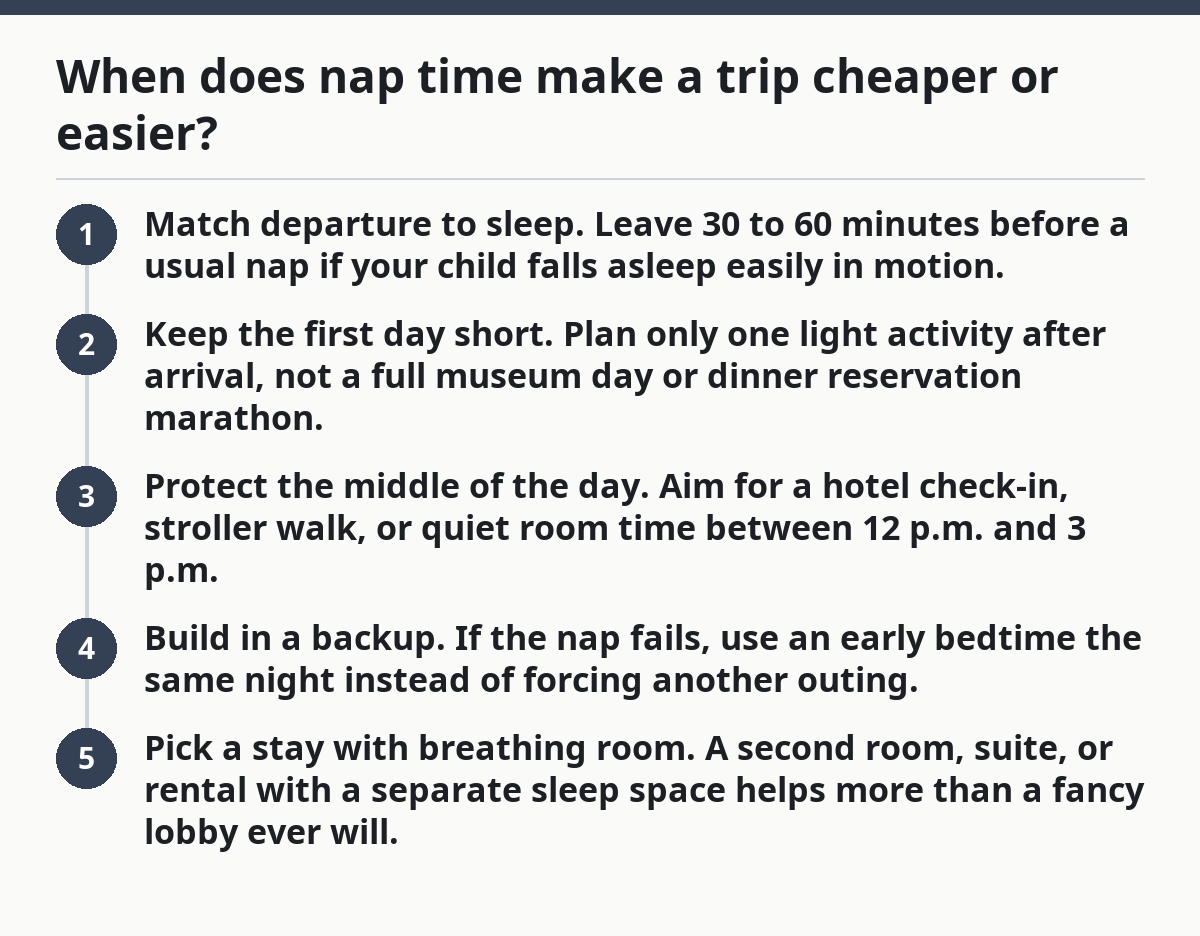
- Match departure to sleep. Leave 30 to 60 minutes before a usual nap if your child falls asleep easily in motion.
- Keep the first day short. Plan only one light activity after arrival, not a full museum day or dinner reservation marathon.
- Protect the middle of the day. Aim for a hotel check-in, stroller walk, or quiet room time between 12 p.m. and 3 p.m.
- Build in a backup. If the nap fails, use an early bedtime the same night instead of forcing another outing.
- Pick a stay with breathing room. A second room, suite, or rental with a separate sleep space helps more than a fancy lobby ever will.
This is where a generic travel article gets it wrong: it talks about “flexibility” but ignores that nap timing is the thing that buys you flexibility. For sleep guidance, see the American Academy of Pediatrics and NHS sleep advice for children.
Should you travel before age 3 or wait until preschool?
Travel before age 3 can be the better value if your child still sleeps well in a stroller, carrier, or car seat and doesn’t need a full day of activities. Preschoolers are easier in one way and harder in another: they can handle more, but they also notice more and ask for more.
Picture this: a 2-year-old may nap once and then crash early, while a 4-year-old may stay awake longer but push back harder when plans change. That difference matters. Under age 3, the main value is routine control. Around ages 3 to 5, the value shifts to having a child who can enjoy more of the trip itself.
That said, preschool years can be a strong balance for many families. Kids that age can usually handle short outings, tolerate a stroller for part of the day, and participate in simple activities. The trade-off is that they also have stronger opinions, which can make a “cheap” day feel long if you cram too much into it.
- Travel sooner if your child sleeps easily, still takes a daily nap, and is fine with a small itinerary.
- Wait a bit if your child fights naps hard, needs a rigid bedtime routine, or melts down when schedules shift.
- Choose preschool age if you want more interest and participation, not just lower hassle.
On the flip side, waiting too long can make some trips more expensive because your child may need more separate tickets, more meals out, and more structured entertainment. Value is not just price per night. It’s how much of the trip your child can actually use. For age-specific planning, see toddler travel tips and preschooler travel tips.
How do early bedtimes change the value of a family trip?
Early bedtime changes the value of a family trip because it protects the next day, and that can save money you would otherwise spend fixing a bad schedule. If your child usually sleeps at 7 p.m. or 7:30 p.m., plan around it instead of treating bedtime like a nuisance.
The American Academy of Pediatrics recommends consistent sleep routines for young children, so it is worth checking with a pediatrician if your child’s sleep schedule is unusually hard to manage or bedtime problems are ongoing. Picture this: you stay out late for one “special” dinner, your child short-sleeps, and the next morning starts with tears, a skipped breakfast, and an expensive emergency snack run. That’s a bad trade. A trip with young kids is often better when you act like bedtime is part of the itinerary.
This matters most for toddlers and preschoolers. Late nights usually lead to shorter attention spans, more impulse buys, and fewer useful hours the next day. If you compare two trips with the same hotel price, the one that preserves bedtime usually gives you more value because you waste less energy recovering from the schedule.
A better evening routine looks like this:
- Eat dinner early, often before the usual home time.
- Keep bath, pajamas, and books simple.
- Return to the room before the child is overtired.
- Save long meals and late shows for older kids.
A 30-minute early walk after dinner can beat a 2-hour late outing every time. The first keeps the routine intact. The second often costs you the next morning.
What weather should make you change the dates?
Mild weather can improve value because it lowers the number of things that can go wrong. If the forecast looks likely to be too hot, too cold, or too wet for long stretches outside, the trip becomes more dependent on paid indoor stops, taxis, or room time.
Picture this: you’ve got a stroller, a tired child, and a sidewalk that’s either blazing hot or slick with rain. That’s when even a good deal stops feeling like one. Young kids do better when the weather lets you move slowly and stay outdoors without fighting the elements.
For families with small children, heat is often the biggest budget trap. Heat pushes you toward more breaks, more drinks, more shade, and more indoor time. Cold can be just as annoying if it means bundling up for short outings and cutting activities short. Rain adds another cost if you need backup plans on the fly. For climate trends and weather history, see the NOAA Climate.gov and the U.S. National Weather Service.
The best value often comes from weather windows that are comfortable enough for:
- stroller walks without overheating,
- naps that happen naturally,
- short outdoor breaks between meals,
- and early bedtime without a fight.
If your only travel window is peak summer, go early in the season or later in the day. If winter is your only option, choose a place where most activities are indoors and short distances are easy. The value comes from reducing friction, not chasing perfect conditions.
Which trip length gives the best value with toddlers and preschoolers?
A 3- to 5-day trip is often the best value with toddlers and preschoolers, because it is long enough to settle in but short enough to avoid routine breakdown. Longer trips can be good, but only if the child handles naps, meals, and bedtime without constant resets.
Picture this: day one is arrival, day two is the real outing, day three is a slower repeat, and by day four everyone is ready for the home routine again. That’s the sweet spot for many young families. You get the trip feeling without paying for too many days of exhaustion.
Short trips can be expensive if all the fixed costs stay the same. You still pay for packing time, transit, and setup, but you get fewer usable hours. Very long trips can drift the other way. Once the child’s schedule frays, the extra days stop feeling like value and start feeling like damage control.
A useful planning test:
- If your child still naps daily, 3 to 5 days usually covers the useful window.
- If your child has dropped naps, a longer trip may work better because the schedule is less fragile.
- If the first day always disappears into recovery, avoid trips shorter than 3 days.
This is why “longer is always better” is wrong for young kids. You’re not buying more fun by the day. You’re buying more chances for the routine to break. For route and lodging planning, see family road trip planner and family hotel booking guide.
What families miss when chasing the lowest price
Families miss the hidden costs of bad timing when they focus on the nightly rate alone. A cheaper date can be worse value if it lands during a nap regression, a weather spike, or a holiday crowd surge that makes every errand slower.
Picture this: the room rate looks great, but the pool is packed, the restaurant wait is long, and your child’s nap is gone by 1:15 p.m. Cheap can get expensive in the form of extra snacks, extra rides, and shortened days. The real question is not “What is the lowest fare?” It is “What dates let the whole family function?”
These are the common mistakes:
- Booking around adult convenience only. That can cost you sleep and make the trip feel twice as long.
- Choosing peak holidays for a “special” trip. The room may cost more and the crowds may be worse.
- Ignoring local weather. A stroller-friendly trip can become a sweaty or soggy mess.
- Packing too many big days back to back. That usually ends in an early bedtime rescue mission.
If you want the best value, look for dates that preserve at least one daily nap, allow an early dinner, and give you a way to leave the room without a long trek. That is the same logic behind the broader budget family trip planning by travel windows and timing hub, but this page is the part that answers the timing question first. For saving money on family travel, see family travel budget tips and how to save money on vacations.
The simplest timing rule to use right now
The simplest timing rule is to choose a shoulder-season window that fits the child’s nap and bedtime schedule. If you can travel when weather is mild, crowds are lighter, and the first day can stay short, you usually get better value than you would from a peak holiday date.
Picture this: you choose a week when your toddler can nap in motion, your preschooler can handle an early dinner, and nobody has to battle a packed attraction at noon. That’s the trip that gives you more useful hours per dollar.
Use this final filter:
- Pick late spring or early fall if the climate allows.
- Keep the stay to 3 to 5 days for most families with naps.
- Guard 7 p.m. to 7:30 p.m. bedtime if that is the home routine.
- Favor dates that let you build in quiet midday breaks.
If a date only looks cheap because it ignores naps, weather, or bedtime, it is not really a good value. It’s just a lower number on the booking page.
When is the easiest time to travel with toddlers?
The easiest time is usually when toddlers can keep their normal nap and bedtime rhythm. A date in the shoulder season helps because the day is less likely to be ruined by extreme heat, big crowds, or too many late-night temptations.
A simple weekday departure often works better than a weekend one. You get lighter traffic, quieter lobbies, and more room to keep the day slow.
Do young kids do better on shorter or longer trips?
Young kids usually do better on shorter trips first, then moderate ones, because their routines are easier to protect. A 3- to 5-day trip often hits the best balance between enough time to settle in and not enough time for fatigue to take over.
Longer trips can still work, but only if naps, meals, and bedtime stay predictable. If those break down fast, shorter is the smarter value.
How do nap schedules affect travel timing?
Nap schedules shape travel timing because they decide when your best hours happen. If your child naps once a day, travel that lines up with that window often gives you a calmer arrival and fewer expensive mistakes.
The safest move is to treat nap time like a fixed appointment. Choose departure, check-in, and the first activity around it, not against it.
Drafted with AI; not yet reviewed by a person.