
Last updated: November 20, 2026
Key Takeaways
- A vacation rental can be the better buy when the full stay total ends up lower after fees, parking, and meal savings.
- A vacation rental saves money when the total stay cost stays below the hotel total after service fees, cleaning fees, parking, food, and taxes.
- A rental can look cheap at first and get expensive once the fee stack appears.
- A kitchen can lower the cost, but only if it replaces enough restaurant meals to matter.
A vacation rental saves money for a family only when the nightly rate, service fee, cleaning fee, parking, and kitchen savings beat the hotel total.
This guide shows you how to check that before you book. It settles when a rental wins, when it doesn’t, and what to add up line by line. How to Tell Whether a Vacation Rental Will Actually Save Money for Your Family is the question this article answers.
Our Top 3 Picks at a Glance
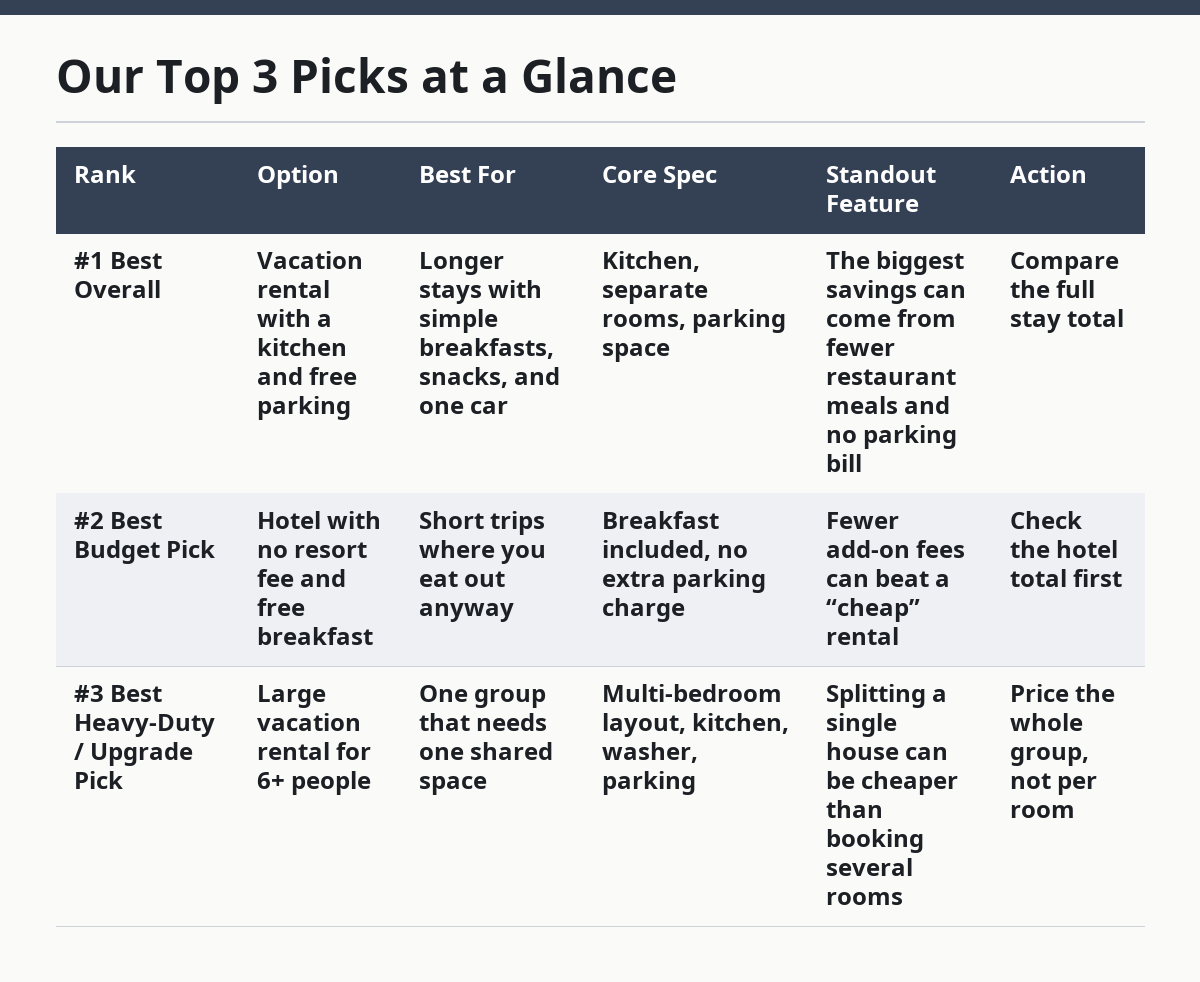
How to Tell Whether a Vacation Rental Will Actually Save Money for Your Family comes down to full-stay cost, not the headline rate. A vacation rental is the better buy when the full stay cost comes out lower after fees, parking, and meal savings; a hotel wins when those extras erase the gap. The list below gives the quickest way to sort the choice before you go deep on math.
| Rank | Option | Best For | Core Spec | Standout Feature | Action |
|---|---|---|---|---|---|
| #1 Best Overall | Vacation rental with a kitchen and free parking | Longer stays with simple breakfasts, snacks, and one car | Kitchen, separate rooms, parking space | The biggest savings can come from fewer restaurant meals and no parking bill | Compare the full stay total |
| #2 Best Budget Pick | Hotel with no resort fee and free breakfast | Short trips where you eat out anyway | Breakfast included, no extra parking charge | Fewer add-on fees can beat a “cheap” rental | Check the hotel total first |
| #3 Best Heavy-Duty / Upgrade Pick | Large vacation rental for 6+ people | One group that needs one shared space | Multi-bedroom layout, kitchen, washer, parking | Splitting a single house can be cheaper than booking several rooms | Price the whole group, not per room |
The quick answer: when does a vacation rental save money?
A vacation rental saves money when the total stay cost stays below the hotel total after you add service fees, cleaning fees, parking, food, and taxes. That means the listed nightly rate is only the starting point, not the final number.
Picture this: you’re comparing a rental on one tab and a hotel on another, and the “cheap” option keeps getting more expensive as you click. The truth is, the winner often changes when you add one cleaning fee, one parking space, and three restaurant meals.
Here’s the catch:
- A rental with a kitchen can trim food costs, but only if you actually cook or reheat meals.
- A hotel with free breakfast and free parking can beat a rental with a lower nightly rate.
- A stay of one or two nights gives many fixed fees less time to spread out.
If you want the short version, use this rule: a rental is more likely to save money for larger groups, longer stays, and car trips. It is less likely to save money for a short visit, a small group, or a place that charges a high service fee and separate parking.
For a broader trip-planning view, the hub on [budget family trip planning by lodging style and room setup] helps connect this decision to room layout and lodging type.
What fees make a rental look cheap but cost more?
A rental looks cheap on the first screen, then gets expensive when the fee stack shows up. The biggest offenders are service fees, cleaning fees, and parking costs, because they can turn a low nightly rate into a high total fast.
Picture this: the listing shows a rate that feels manageable, then the checkout page adds charges you didn’t budget for. The direct answer is this — if the rental’s extras are fixed and your stay is short, the savings can disappear.
Common fees to check:
- Service fee: often the biggest add-on on booking sites.
- Cleaning fee: usually fixed, so it hurts more on short stays.
- Parking fee: easy to miss if your hotel would have included parking.
- Occupancy taxes: usually unavoidable and often similar across lodging types.
- House rules costs: extra guest charges, linen fees, or late check-out penalties if the listing allows them.
The way to read a rental listing is to ignore the headline rate for a moment and ask, “What is the real total for my exact dates?” If the site doesn’t show that clearly, open the checkout page before you compare anything else.
A rental is often a bad financial deal when the cleaning fee is high and the stay is brief. Not even close.
Do kitchens really lower the cost?
Yes, a kitchen can lower the cost, but only if it replaces enough restaurant meals to matter. A kitchen helps most on breakfast, snacks, and one or two simple dinners; it helps less if your group still eats out for every meal.
Picture this: you wake up with kids who want cereal, fruit, and toast, not a café breakfast for four. The kitchen becomes money-saving space because it cuts the number of paid meals, not because it is fancy.
What to count as kitchen savings:
- Breakfast bought at a store instead of a diner
- Coffee made in the rental instead of purchased daily
- Leftovers saved from a restaurant dinner
- Simple lunches for a beach day or road trip day
What a kitchen does not guarantee:
- Lower total cost if you still order takeout three times a day
- Lower cost if you need to stock a full pantry for a very short stay
- Lower cost if the kitchen is tiny, poorly equipped, or missing basics
A useful check: estimate how many meals you’d eat in the rental during a 2-night stay versus a 7-night stay. The longer the trip, the more a kitchen can matter. If you’re only there one night, the savings usually stay small.
The best part is that kitchen savings show up in plain food receipts, not hidden math. That makes them easier to track than many travel “deals.”
How parking changes the real price
Parking can flip the whole comparison, especially in city centers, beach towns, and busy resort areas. A rental with a free space can beat a hotel with a nightly parking charge even when the room rate is higher.
Picture this: you’ve found a rental that looks pricier on paper, but it includes one parking space and the hotel wants a separate fee each night. The real answer may be hiding in the parking line.
Check these parking questions before you book:
- Is parking included or extra?
- Is it one space only, even if you have two cars?
- Is the space on-site, in a garage, or street parking only?
- Is parking guaranteed, or simply “available nearby”?
Parking matters most when you:
- Drive to the destination
- Need a guaranteed spot near the property
- Would otherwise pay nightly hotel parking
Parking matters less when:
- You arrive by train or plane and won’t use a car
- You can park free on the street and the area is safe and legal
- The trip is walkable and you won’t move the car much
If a rental includes parking and a kitchen, it has two built-in savings channels. That combination is often where the math starts to favor the rental. If neither one applies, the rental has a harder job.
Vacation rental vs hotel: the numbers that actually change the result
How to Tell Whether a Vacation Rental Will Actually Save Money for Your Family gets easier when you compare the numbers that change the bill. A vacation rental wins when its fixed fees are small enough and its savings fit your trip pattern. A hotel wins when the rental’s cleaning fee, service fee, and parking wipe out the lower nightly rate.
Picture this: you’re trying to compare a two-bedroom rental with a standard hotel room, and the rate alone is misleading. The table below shows the cost factors that actually move the final bill.
| Criteria | Vacation rental | Hotel | Winner for this condition |
|---|---|---|---|
| Nightly rate | Can look lower at first glance | Can look higher on the listing | Rental if the rate gap is real |
| Service fees | Often added separately | Usually built into the room rate | Hotel if the rental fee is large |
| Cleaning fees | Often fixed and unavoidable | Usually not charged as a separate line | Hotel on short stays |
| Kitchen access | Usually yes | Usually no or limited | Rental if you will cook meals |
| Parking | May be included or extra | May be included or extra | Either — check the exact property |
| Sleeping space | Often more space in one unit | Often less space unless you book more rooms | Rental for one group in one place |
| House rules | Can be strict on guests, noise, and trash | Usually handled by front desk policies | Hotel if you want fewer chores |
| Stay length | Better over several nights | Better for brief stays | Rental for longer trips |
| Meal costs | Can fall with a kitchen | Can stay high without breakfast | Rental if you cook some meals |
The rental wins this table when you stay long enough to spread out the fixed fees. The hotel wins when you need a short, simple stay with fewer chores and fewer surprise add-ons.
House rules can erase the savings
Strict house rules can make a rental less useful, even if the math looks good. If the rules force you to clean, sort trash, limit guests, or avoid common family habits, the “cheap” stay starts to cost you time and stress.
Picture this: you’ve booked a place with a full kitchen and good parking, but the listing also asks for quiet hours, trash sorting, shoes off, and a long checkout list. The direct answer is that the savings can still be real — but the trip may no longer be worth the trade.
Watch for rules that affect cost or convenience:
- Extra charges for more guests
- Requirements to strip beds or start laundry
- Strict checkout times that force a rushed morning
- Quiet-hour rules that matter for a baby or older child
- Limited use of shared spaces
These rules matter most on short stays. A single-night or two-night trip can feel more like a chore list than a bargain. On a longer stay, the same rules may be easier to live with because the savings have more time to add up.
A hotel can be the better deal when you want to drop your bags, sleep, and leave. That is not about luxury. It is about labor.
When a vacation rental is the wrong choice
A vacation rental is the wrong choice when the fee stack, meal pattern, and trip length don’t support it. If you’re staying briefly, eating out anyway, and paying for parking, the hotel often wins on total cost and ease.
Picture this: you’re headed out for a two-night city trip and expect to be gone most of the day. The rental may still look appealing, but the financial edge can vanish fast once you include cleaning and service fees.
These are the main flip cases:
- Short stay, high cleaning fee: the fixed fee gets spread over too few nights.
- No kitchen use: if you eat every meal out, kitchen value disappears.
- Free hotel breakfast and parking: the hotel may beat the rental even with a higher sticker price.
- One car, one night, one room: the extra space in a rental may not pay for itself.
A rental is also a poor fit if your group wants predictable service and no chores. Some travelers value privacy more than convenience, and that’s fine. But if the goal is saving money, the budget case gets weak fast when the rental is “cheap” only before checkout.
The verdict: which one to choose and why
Choose a vacation rental if your stay is several nights long, you’ll use the kitchen, and the property includes parking or keeps fees modest. Choose a hotel if the trip is short, you won’t cook, or the rental’s cleaning and service fees erase the rate gap. Neither if you need a deal and the listing hides its real total until checkout.
Picture this: you’re one click away from booking, and the choice feels fuzzy because both options look affordable on the surface. The answer becomes clear when you compare the full total, not the headline rate.
The simplest decision rule is this:
- Rental wins for longer, car-based trips with meal savings.
- Hotel wins for short, simple trips with free breakfast or free parking.
- Neither wins if you haven’t compared the checkout total for both.
A vacation rental is not automatically cheaper. It is cheaper only when the extras stay tame and the kitchen does real work.
When is a vacation rental cheaper than a hotel for families?
A vacation rental is usually cheaper when the stay is long enough to spread out fixed fees and the kitchen cuts food costs. That happens most often on trips of several nights, especially when the hotel would charge for parking or breakfast. Short stays can go the other way fast.
What fees make a rental less affordable than it looks?
Service fees, cleaning fees, parking charges, and guest rules that create extra costs can change the math. The listed nightly rate may look low, but the checkout total is the number that matters. A fixed cleaning fee hurts most on a one- or two-night stay.
How do kitchens affect the real cost of a vacation rental?
A kitchen lowers cost only when it replaces meals you would have bought elsewhere. It helps most with breakfast, snacks, and a few simple dinners. If you still eat out for every meal, the kitchen adds convenience more than savings.
Sources worth checking before you book
The Consumer Financial Protection Bureau has plain-language guidance on comparing fees before you commit, and the U.S. General Services Administration explains how lodging charges can change a travel total. Both are useful reminders that the first price is not the whole price.
For booking terms, the Federal Trade Commission’s guidance on hidden fees is also worth a read. That advice applies well to travel listings because fees can show up late in the checkout flow and change the final number.
Drafted with AI; not yet reviewed by a person.
