
Last updated: November 20, 2026
Key Takeaways
- Build the trip around the route and timetable, then fit sleep, meals, and transfers around it.
- Transfer points work best when they are simple, indoor, and close to the next departure.
- Flexible tickets can protect a family budget when delays or full departures force a change.
- Planning for water, snacks, bathrooms, and seating can reduce stress and extra spending.
A budget family trip around bus or shuttle routes works best when you build the whole plan around the timetable, not around a hotel first. Plan a Budget Family Trip Around Bus or Shuttle Routes by choosing the route first, then fitting sleep, meals, and transfer buffers around it. The steps below show how to avoid missed connections, long station waits, and ticket-change headaches. For trip timing, route choices, and family logistics, resources from the U.S. Department of Transportation, the FTC, and the FAA can help you check the rules before you book.
What a bus or shuttle trip needs to work on a budget
A bus or shuttle trip needs three things to line up: a route that fits your arrival window, a place to wait that won’t drain a child’s energy, and tickets that can survive one small delay. Picture this: you’re sorting out a weekend trip with two kids, one backpack, and a departure that leaves at 7:10 a.m.
The budget trap is not the fare. It’s the extra taxi, the extra snack stop, the extra hour in a terminal because the connection was too tight. A cheap seat can turn expensive fast if the route drops you 2 miles from your hotel or lands you at 11:40 p.m. with no shuttle left. That’s the real math, and it is why route planning matters before you book lodging. Related planning pages on family travel budgets and transport choice can help you compare those tradeoffs early.
For this kind of trip, I start with the route map and the timetable, then I build the rest around that. Intercity buses, coach lines, airport shuttles, hotel shuttles, and bus terminals all work differently, so the plan has to match the system you’re using. If you are deciding between a coach line and a shuttle, the airport transfer guide and the family transport planning guide are useful next stops.
- Route-first planning keeps costs visible.
- Buffer time protects against delays.
- Transfer points decide whether the trip feels easy or chaotic.
One useful habit: look at the full chain, not just the main ride. A family can save on transport and still waste money if the last mile takes a rideshare every time. The same is true when you compare a bus route with a shuttle route that looks simple on paper but adds hidden steps at the end.
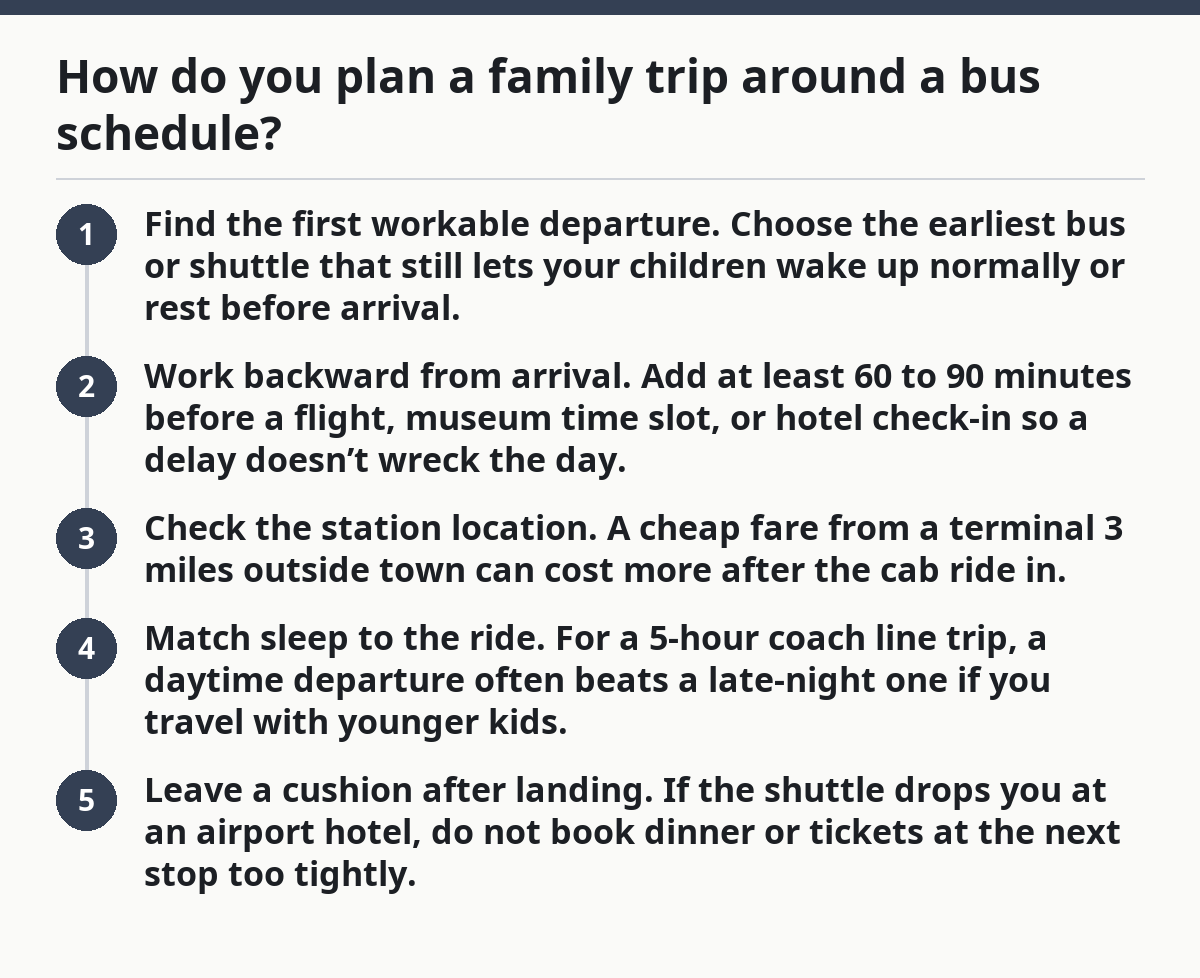
How do you plan a family trip around a bus schedule?
You plan a family trip around a bus schedule by choosing the route, then building the day around the bus times that already exist. Picture this: you’ve found a coach line that gets into town before dinner, but the next one after lunch doesn’t leave until the next morning.
Start with the timetable for the exact day of travel, not a generic weekday. Many bus routes run differently on Friday, Sunday, and holiday dates, and some shuttle routes cut back after 6 p.m. If the route only runs every 2 to 4 hours, your whole day needs to bend around that gap.
Use this order:
- Find the first workable departure. Choose the earliest bus or shuttle that still lets your children wake up normally or rest before arrival.
- Work backward from arrival. Add at least 60 to 90 minutes before a flight, museum time slot, or hotel check-in so a delay doesn’t wreck the day.
- Check the station location. A cheap fare from a terminal 3 miles outside town can cost more after the cab ride in.
- Match sleep to the ride. For a 5-hour coach line trip, a daytime departure often beats a late-night one if you travel with younger kids.
- Leave a cushion after landing. If the shuttle drops you at an airport hotel, do not book dinner or tickets at the next stop too tightly.
Once the route is fixed, the rest gets simpler. You only need to solve meals, bags, and transfer timing—not every transport option in the city. If you’re still deciding how this fits into the bigger picture, the hub on budget family trip planning by trip format and transport choice gives the wider map. For families who want a more detailed route-first method, the family trip planning page and the airport shuttle guide can narrow the choices.
- Aim for departures that match your child’s sleep window.
- Treat short layovers as risky unless a qualified travel professional says the timing is realistic; the U.S. Department of Transportation recommends checking carrier policies and connection details before you commit.
- Pick one backup plan for a missed bus, not three.
What are the safest transfer points for kids and bags?
Transfer points for kids and bags are safest when they are simple: one obvious exit, indoor seating, and a second bus or shuttle that leaves from the same terminal. Picture this: you’re arriving at a bus terminal at 4:20 p.m. with a stroller, two carry-ons, and a connection in 28 minutes.
A good transfer point saves time because it cuts walking, searching, and re-checking tickets. A bad one burns time in the wrong way: long sidewalks, confusing platform numbers, and a line at the wrong desk. If the transfer requires crossing a street, changing buildings, or taking a separate local bus, the risk goes up.
Here’s the catch: “direct” on a booking page can still mean a hard transfer in real life. Some routes use the same company but different stations. Others list a hotel shuttle that runs every 30 minutes but stops before midnight, which matters if your flight lands late.
When you compare transfer points, look for these signs:
- The next vehicle leaves from the same terminal or the same curb.
- The wait is under 45 minutes for young children.
- Bathrooms are clearly marked and open during your arrival window.
- Food is available without leaving the station.
- The platform change is simple enough to do with one adult and one child at a time.
If the transfer turns the station into a 2-hour wait, a cheaper fare may not be the better choice. A family with bags, tired kids, or a stroller often does better with a slightly dearer ticket and one fewer handoff. A hotel shuttle with a clear pickup desk can be worth more than a slightly cheaper airport bus that lands you across a parking lot.
Ticket changes, delays, and the fine print that matters
Ticket changes matter because one delay can cost more than the fare if the ticket is locked and the next departure is full. Picture this: you booked an intercity bus at the lowest price, then a school pickup line or a late train makes the connection impossible.
Before you buy, read the change rules on the exact route. Some coach lines allow changes for a fee, some only for a fare difference, and some no longer allow flexible swaps close to departure. Airport shuttles can be even trickier because the return may be tied to one pickup time or one hotel address. The FTC advises checking cancellation and refund terms before purchase, and the carrier’s own policy should be the final word.
This is where budget travelers get burned: the first ticket looks cheap, then a change fee, a new seat, or a no-show rule wipes out the savings. A ticket that costs a little more but allows a same-day change can be the better family choice if your trip has school schedules, traffic, or a flight connection. For families using a bus route with a shuttle connection, the extra flexibility can prevent a missed transfer from becoming a full rebooking.
Use these checks before you pay:
- Confirm whether the fare is changeable.
- Find the cutoff for changes, often 1 to 24 hours before departure.
- See whether a no-show cancels the return too.
- Save the booking code in two places: phone and email.
- Check whether the carrier uses a mobile ticket, printed voucher, or both.
One practical rule: if the return leg matters more than the outgoing leg, buy the more flexible ticket for the return. That is the leg most likely to get hit by weather, a late museum visit, or a child who needs a break. The FAA also reminds travelers that weather and operational delays can ripple through a whole itinerary.
- Cheap tickets can be rigid.
- Flexible tickets can save a whole day.
- A printed backup helps when phones die.
Child logistics that make the route cheaper, not harder
Child logistics make the route cheaper when you plan for water, snacks, bathroom stops, and seating before the trip starts. Picture this: you’re on a 3-hour shuttle with a toddler who has already used up the one bathroom break you assumed you had.
The cheapest transport is often the one that prevents emergency spending. A 15-minute snack stop keeps you from buying overpriced food at the station. A seat near the aisle helps with quick bathroom trips. A compact stroller or carrier can matter more than a bigger suitcase if the transfer point has stairs, and that matters even more on a bus route with only one or two easy boarding windows.
Age and energy change the whole plan. A teenager might be fine with a 90-minute wait in a terminal, but a 4-year-old may not. If your route includes a long layover, build in a meal, a stretch break, and one quiet activity that works offline. Screens help, but a dead battery at the exact wrong time does not.
Pack for the route, not the destination:
- 1 refillable water bottle per person if the route allows it.
- 2 snack types: one quick, one filling.
- Wipes, tissues, and a spare shirt.
- A small charger or power bank.
- One paper backup with the route, terminal name, and pickup time.
Good child planning cuts stress and waste at once. When everyone has a role and one small bag, the transfer moves faster and you’re less likely to miss the vehicle because someone is still hunting for a charger. That is especially useful on a shuttle route where boarding windows are tight and the next departure may not be for hours.
Station waiting time can make or break the budget
Station waiting time can make or break the budget because a 20-minute gap is manageable, while a 2-hour gap usually means food, drinks, and tired kids. Picture this: you arrive at a bus terminal at 11:15 a.m., but the next bus does not leave until 1:40 p.m.
The goal is not to eliminate waiting. It’s to choose the kind of waiting you can handle. A hotel shuttle with a lobby nearby is easier than a curbside pickup with no restroom. A covered station with seating is easier than an open curb with no shade in July.
Here’s the useful test: if the wait is long enough that you’d normally buy a meal, read a book, or unpack a stroller, treat it as a real part of the trip cost. That extra cost can be small, but it is still part of the route choice. If the route saves $18 but you spend $22 on lunch and drinks during the wait, the savings are gone.
Use these tactics to keep station time under control:
- Book departures that land close to hotel check-in or check-out.
- Avoid the 60- to 120-minute dead zone between breakfast and midday departures if kids get restless.
- Choose terminals with seating and toilets inside the waiting area.
- Pack one quiet activity per child, not a whole toy bag.
- If possible, use a hotel shuttle that runs on a published schedule rather than guessing at curbside pickups.
Waiting time is part of the transport price. A family trip that looks cheap on paper can still be tiring and expensive if the station plan is weak. For that reason, bus and shuttle routes work best when the timetable, station layout, and family routine all fit together.
A simple way to build the whole trip around one route
A simple way to build the whole trip around one route is to choose the transport first, then pin down sleep, meals, and arrival windows with one calendar. Picture this: you’ve chosen a coach line for Saturday morning and need the rest of the weekend to stop fighting that choice.
Use this 5-step planning pass:
- Pick the route and write down the exact departure time, arrival time, and terminal name.
- Add a buffer of 30 to 60 minutes on each side for local travel, tickets, and boarding.
- Choose lodging that matches the route, not the other way around—especially if a hotel shuttle runs every half hour.
- Place meals where the timetable naturally opens a gap of at least 45 minutes.
- Mark one backup option for the return leg in case the bus is late or the connection changes.
This works because it puts the route at the center of the trip instead of treating it like a side detail. That matters most on low-cost family travel, where small delays create the biggest friction. A plan built around one bus or shuttle route is easier to manage than a plan built around ten “maybes,” and it is usually easier to explain to children too.
- One route.
- One buffer.
- One backup.
The biggest mistakes on bus-and-shuttle trips
The biggest mistakes on bus-and-shuttle trips are booking the cheapest fare, ignoring transfer risk, and assuming the station will be easy once you arrive. Picture this: you saved money on the ticket, then spent it on a rushed taxi, a station snack, and a same-day change fee.
The first mistake is booking a tight connection because the timetable looks neat. A 12-minute transfer on paper is not a transfer with children and bags. The second mistake is choosing a late departure that lands after hotel shuttle hours or after the last easy meal stop. The third mistake is forgetting that ticket rules can turn a small delay into a full rebooking.
Avoid these by comparing total trip friction, not just fare:
- If the station is far from your hotel, factor in the last-mile ride.
- If the route uses different terminals, treat it like two trips.
- If your kids need routine, skip routes that force a midnight arrival.
- If a ticket cannot be changed, don’t buy it unless the schedule is very stable.
The right move is not always the absolute cheapest route. It’s the route that leaves enough room for real life, especially when you are planning a family trip around a bus or shuttle route.
How to use bus and shuttle planning without losing the savings
You use bus and shuttle planning without losing the savings by treating timing as part of the fare. Picture this: you’ve got a cheap coach line, a hotel with a shuttle, and one day that has to stay calm.
The winning plan is usually simple: choose a route with a realistic transfer, pay a little attention to ticket flexibility, and keep waiting time short enough that you don’t buy your way out of the problem later. That is how a budget trip stays a budget trip.
If you want the broader framework, the hub on budget family trip planning by trip format and transport choice ties this route-based method to the rest of the trip. The airport shuttle guide and the family transport planning guide can also help if your trip mixes a coach line with a final shuttle ride.
How do you plan a family trip around a bus schedule?
You plan a family trip around a bus schedule by choosing the route first and then building the rest of the day around the published departure and arrival times. Start with the exact day’s timetable, not a generic route page. Leave enough buffer for station time, bags, and one delay, especially if the bus runs only every few hours.
What are the tradeoffs of using a shuttle on a family vacation?
A shuttle can cut stress and taxi cost, but it also limits your timing and location choices. Many airport shuttles and hotel shuttles run on fixed windows, so a late flight or early checkout can mean a longer wait. That tradeoff is less flexibility in exchange for simpler transfers and fewer moving parts.
How do you avoid missed connections with kids on a bus trip?
You avoid missed connections with kids on a bus trip by padding the transfer, picking simple terminals, and keeping the boarding routine short. A clear plan helps because the route, the timing, and the family routine all work together instead of competing with each other.
Drafted with AI; not yet reviewed by a person.