
Last updated: November 19, 2026
Quick Answer: For family trips, hotel loyalty programs usually work best when you redeem points for 1 expensive night, not the whole stay. Start with the room size, then compare cash and award rates for the exact dates. This guide to How to Use Hotel Loyalty Programs for Family Trips Without Wasting Points shows how to make those choices without burning points on a bad fit.
Hotel loyalty programs can cut the cost of a family trip, but only if you redeem points for the right nights, in the right room, at the right hotel chain. The trick is to use loyalty points for high-value stays and protect them from low-value redemptions that look cheap but waste your balance. For a deeper overview, see the World of Hyatt program rules and Marriott’s terms and conditions before you book.
Key takeaways
- Use hotel loyalty programs for nights where cash prices are high and award prices stay flat.
- Start by checking family room needs first: beds, occupancy rules, breakfast, and cancellation terms.
- Free night certificates work best for a one-night gap or a pricey weekend stay, not as a filler for every trip.
- Points pooling can help families reach an award night faster, but it is not worth the hassle if transfer rules are strict.
- Status perks matter most when they remove charges you would otherwise pay on every stay, such as parking, breakfast, or late checkout.
- A bad redemption is usually one that saves a little cash but burns a large chunk of points you could use for a better room later.
Start with the room your family actually needs

Hotel loyalty programs only help when the award room fits the trip, because 2 adults and 2 children need more than a standard king room at many hotel chains. Start by checking the property’s award room options, the maximum occupancy, and whether the hotel sells or releases 2-queen rooms, suites, or connecting rooms on points. The Hilton Honors and IHG One Rewards booking pages can help you compare room types quickly.
If the search result only shows a standard room and your family needs an extra bed, stop there and compare other hotels. A points stay that forces a second cash room is usually a poor use of loyalty points. The same goes for family trips that may need a crib, a rollaway bed, or a guaranteed sleeper sofa; those details can matter more than the points price alone.
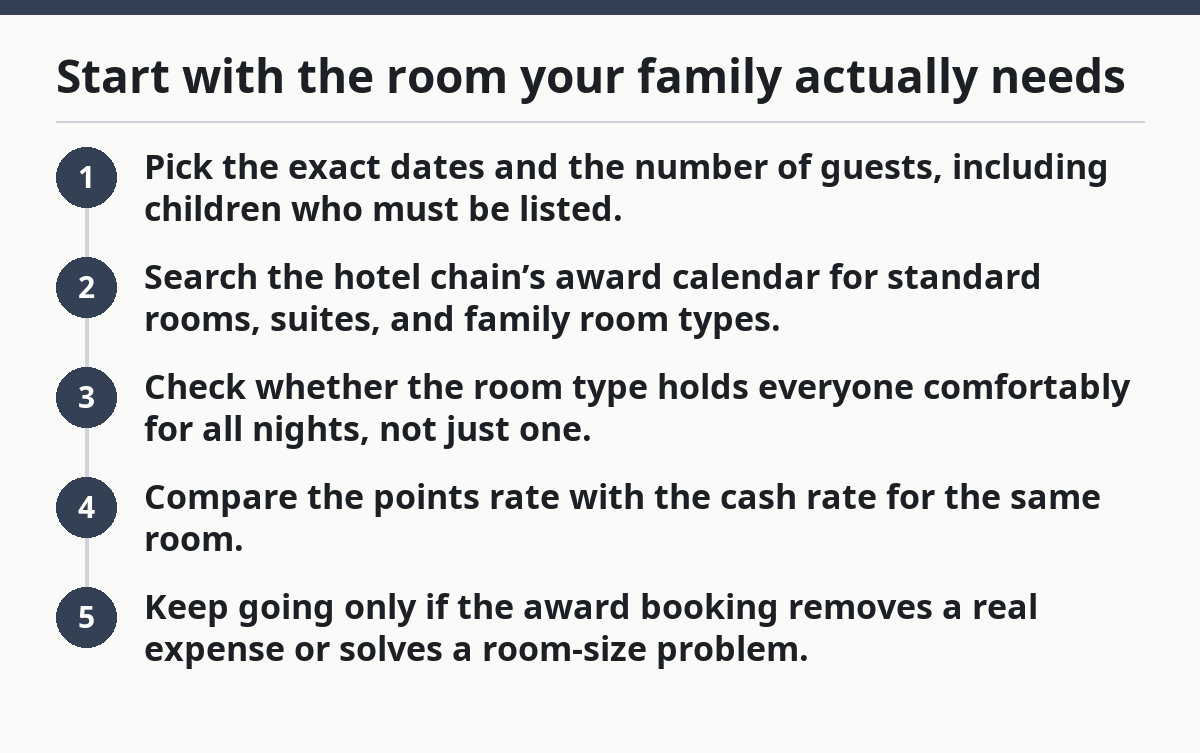
Here is the first filter I would use before touching the redemption screen:
- Pick the exact dates and the number of guests, including children who must be listed.
- Search the hotel chain’s award calendar for standard rooms, suites, and family room types.
- Check whether the room type holds everyone comfortably for all nights, not just one.
- Compare the points rate with the cash rate for the same room.
- Keep going only if the award booking removes a real expense or solves a room-size problem.
When this works, you see a room that fits the family without forcing a second booking or a downgrade. When it does not, the points stay is probably a false bargain.
How do I tell if an award night is worth the points?
An award night is worth it when the cash rate is high enough that the points buy meaningful savings, or when the room type is hard to find with money alone. For family travel, redemptions can be strongest on a 1-night weekend stay, a holiday date, an airport hotel during a peak period, or a larger room that cash booking engines price aggressively.
Do not compare points to the sticker price only. Compare them to the total value you would otherwise pay for that exact family setup: extra bed charges, resort fees, parking, and breakfast if those come with cash rates but disappear on award stays. A Hyatt, Marriott, Hilton, or IHG points redemption can look average on paper and still be smart if it avoids 2 nights of parking at a city hotel.
A simple test helps:
- If the hotel charges a high cash rate and the award rate stays within a normal range for that chain, keep the points booking in play.
- If the hotel is cheap in cash, save the points for a more expensive date.
- If the booking uses a rare suite award or a free night certificate for a room you could have bought cheaply, skip it.
The mistake here is treating points like discount coupons. They are inventory, not cash. If that framework is affecting a big family budget decision, review the program terms and, if needed, consult a travel professional or tax professional. Once you use points on a low-value room, you cannot move them into a better one later. A source for the general redemption rules is your hotel program’s official terms, such as Marriott’s loyalty terms or World of Hyatt.
Use free night certificates where they do the most work

Free night certificates work best when they replace a single expensive night, not when they are forced into a low-value stay. Most hotel chains attach a ceiling to the certificate, such as a one-night standard room award or a category cap, so the value depends on where you place it.
For family trips, the strongest use cases are usually these:
- A Friday or Saturday night in a city where cash rates jump.
- An airport hotel before an early flight.
- A one-night stop on a road trip where you need a predictable room.
- A night that bridges two paid stays and keeps the family in one hotel.
If the certificate expires in 6 to 12 months, plan around that date rather than letting it drift until the last week. Use it before it expires on a night you would otherwise pay cash for, not on a cheap weekday just to be done with it.
A certificate can be a poor fit when the hotel’s family rooms exceed the certificate rules or when taxes and fees still make the “free” night expensive enough that you would rather use points. Read the certificate terms before you start the search, because some certificates cover only standard rooms while others allow broader use on specific programs or card benefits. The IHG free night certificate rules and World of Hyatt redemption pages are good starting points.
Pool points only when the family actually needs the boost
Points pooling helps when 2 adults are sitting on small balances and one award night is just out of reach. It is less useful when the hotel chain has strict transfer rules, approval steps, or account limits that slow the booking down.
Use pooling in these cases:
- One family member has enough points for the room, but the booking sits just above the balance.
- You need to combine balances for a 2- or 3-night stay instead of booking separate single nights.
- You want to avoid paying cash for one more night because the whole trip depends on a single award reservation.
This is where families often waste points: they transfer balances around to book a mediocre room because the points are available, not because the room is the right one. If the chain lets you book multiple rooms with points from one account, that can be useful for families traveling with grandparents or older children. If the chain requires each guest name, each account, or a transfer fee, the value drops fast. Check the rules on the program site before you move anything; World of Hyatt and Marriott Bonvoy both spell out transfer and redemption terms.
Before you pool, check 3 things: whether the transfer is instant, whether the points can be returned if the reservation changes, and whether the program limits how often you can move points. If any of those answers are awkward, keep the balances where they are until you know the booking will stick.
For some families, the smarter move is to keep separate balances and use them for separate hotel chains rather than trying to force one program to do everything.
How to use hotel loyalty programs for family trips without wasting points
The best way to use hotel loyalty programs for family trips is to book the hardest night with points and pay cash for the easier nights. That usually means saving award nights for the most expensive dates, the room type you need most, or the hotel where status perks remove the biggest extra charges.
Follow this sequence:
-
List the trip by night, not by trip.
Break the stay into each date and note which nights are weekend nights, school-break nights, or event nights. The result should be a simple calendar view, because a 3-night stay can hide one very expensive night and 2 cheap ones. -
Check the family room first.
Search for the room type that fits everyone: 2 queens, a king plus sofa bed, suite, or connecting rooms. If the family needs one room for 4 people and the hotel only sells it at a premium, that is where points may be strongest. -
Compare cash price, points price, and certificate use for the same room.
Look at the exact room type when possible. The right result is not the lowest number on the screen; it is the booking that saves the most real money while keeping the family comfortable. -
Use points for the night that is hardest to replace.
Put loyalty points on the peak night or the night with the worst cash rate. Keep paid nights on the dates the hotel prices normally. This often gives better value than redeeming points across every night. -
Add status perks before you pay for extras.
If your elite status or credit-card-linked status includes breakfast, parking discounts, or late checkout, check those benefits before booking a second room or buying add-ons. A family trip can change fast when breakfast is included and checkout extends to 2 p.m. or later. -
Book only after reading the cancellation and modification rules.
Award stays and certificates can have different change rules than paid rates. If your trip may shift by a day, the reservation that allows changes without losing points is the safer choice.
What you should see when this method works: one room, one family, and a points total that feels hard to spend but easy to justify. If you end up with split bookings, hidden fees, or a room that does not fit, the redemption is wrong.
Use status perks to stretch every stay
Status perks are often more useful for families than the room upgrade itself. Breakfast, lounge access, parking credits, and late checkout can remove the kind of small charges that add up across a 4-night trip.
A family with hotel elite status should pay attention to 4 common benefits:
- Breakfast access: This can replace a separate morning meal for everyone.
- Late checkout: This reduces the need to buy lunch or leave storage bags in the car.
- Parking perks: In city hotels, parking can be one of the highest extra charges.
- Room upgrades: A larger room or a sofa bed may matter more than a higher floor.
Not every program grants the same value, and not every property honors perks in the same way. A resort, an airport hotel, and a downtown business hotel can treat status very differently even within the same chain, so consult the program terms and property rules if the trip depends on those benefits. That is why families should treat perks as part of the redemption math, not as a bonus after the fact.
This is also where generic advice goes wrong. A points chart alone does not tell you whether the stay is a good family deal. A chain that gives free breakfast and late checkout may be worth more than a cheaper-looking award at a hotel that charges for every small convenience.
If you already have status, use it on the trip where the family will feel it the most: the long weekend, the drive-through stop, or the city stay with expensive parking. That is where the perk turns into a real savings.
Avoid the 5 redemption mistakes that burn points fast
Most wasted points come from 5 predictable mistakes, and every one of them costs either cash or flexibility.
-
Booking the cheapest award night instead of the priciest one.
This burns points on a date you could have paid for easily. Use points on the night with the worst cash rate. -
Ignoring room size and occupancy rules.
This can force a second room, which wipes out the value of the redemption. Always match the room to the family first. -
Spending a free night certificate on a low-cost stay.
Certificates are usually best on a night with a sharp rate spike. Use them where they replace the most expensive single night. -
Transferring points before checking availability.
A transfer that cannot be undone can strand points in the wrong account. Confirm the room first. -
Assuming all perks apply at every property.
Franchise hotels may handle breakfast, parking, and upgrades differently. Read the property-level terms before you count the savings.
The fix is simple: decide what the points are buying before you book. If they are buying a larger room, a peak night, or a fee-heavy stay, the redemption has a job. If they are just leaving your account because they exist, that is how families waste hotel loyalty value.
FAQ
Are hotel points worth it for family travel?
Yes, when the points replace an expensive family room or a peak-night stay. They are less valuable when the cash rate is low or when the award room does not fit everyone, because a second room or extra fee can erase the savings.
How can families redeem hotel points efficiently?
Families redeem hotel points efficiently by matching the points to the hardest night to replace, not the cheapest night to book. Start with room size, then compare cash rates, award rates, free night certificates, and status perks for the exact dates and room type.
Drafted with AI; not yet reviewed by a person.