
Last updated: November 27, 2026
Quick Answer: for a 2- or 3-stop family trip, plan on 1 main base plus at most 1 shorter secondary stay, and budget every move as a travel day with its own cost. To plan a budget family trip to a multi-stop region instead of one base, count lodging, intercity transport, food, and lost time together before you book anything else. A trip with 2 or 3 places can cost less than a single-base stay only when the extra transfers do not eat the savings from cheaper lodging or shorter stays.
Key takeaways
- A multi-stop trip works best when the region is compact and the travel days are short.
- One base can still make sense for part of the trip, even if the route includes more than one place.
- The hidden cost is rarely the hotel rate; it is the time, transfers, and extra packing that come with each move.
- Put intercity transport, not just lodging, into the budget before you compare trip plans.
- If the group has small children, one long transfer day can erase the benefit of a cheaper room.
What makes a multi-stop region worth it?
A multi-stop region is worth it when each stop gives a different payoff and the transfers stay simple enough for children and bags. That usually means a region with rail, coach, or short road links between places, not a chain of far-flung cities that needs a flight for every move.
The biggest budget mistake is comparing hotel prices without counting moving days. A room that is cheaper by a visible amount can stop being a deal once the trip needs 2 extra transfers, 1 more meal on the road, and a lost morning of sightseeing. The value comes from fitting the route to the region, not from collecting stops. For route planning, the U.S. Department of Transportation’s family travel guidance is a useful reminder that transit time and rest needs affect the whole trip, not just the ticket price: https://www.transportation.gov/.
This is also where base camp strategy matters. A base camp is one main place you sleep more than once while making day trips or short hops from it. For many budget trips, a practical plan is a 2-part shape: one base for the busiest stretch, then one shorter stay elsewhere. That keeps the pack-out count low while still letting the trip cover more than one place.
A multi-stop plan is usually wrong for families who need a very simple trip. If every move means checking out by 10 a.m., handling luggage, and getting everyone fed in transit, the trip can become tiring fast. The pattern works best when the region has short links and the stops are close enough that the travel itself does not become the main event. AAA’s travel planning resources also stress that driving time, stops, and route length change the real cost of a road trip: https://www.aaa.com/.
If the budget is tight, start by asking a plain question: which stops are essential, and which are just nice to have? That cuts the plan down before money gets wasted on a route that looks good on paper but feels crowded in real life.
Which stops should be your base camp?
Your base camp should be the place that gives the broadest access for the longest stretch of the trip. In a multi-stop region, the best base is often the stop with the best mix of transit links, grocery access, and room options, not the most famous name.
The goal is to reduce the number of times the whole group has to move luggage. One base camp for 3 or 4 nights, then a second stop for 1 or 2 nights, is often easier to manage than 4 separate one-night stays. That does not mean every region should be forced into that pattern; it means the first base should do the most work.
Choose the base by asking what it saves:
- Does it cut an intercity transfer?
- Does it let you buy groceries once and use them for 2 or 3 meals?
- Does it make at least one day trip possible without another hotel change?
If the answer is no, it is probably not the right base. A family trip should not pay for a “main” stop that still requires daily packing and long transfers.
A common error is picking the cheapest room in the region as the base. The room rate alone can mislead you. A place that saves money per night but sits far from rail, bus, or the other stops can add transport costs and drain time. The better base is the one that lowers the total cost of moving, eating, and sleeping.
How do you budget the moving days?
Because move days have real costs, you budget them by treating each move like a travel day with its own cost, not like a free gap between hotels. That cost includes intercity transport, food bought away from a kitchen, and the half-day that usually disappears while the group checks out, moves, and settles in.

Use this simple planning order:
- List the stops in order of need, not of distance. Put the must-see place first, then the one that only matters if time remains. This keeps the route honest and stops the plan from growing into a wish list.
- Mark every move on the calendar. A move day should have a visible start, travel block, and arrival time. If the group changes lodging 3 times, then 3 days need to be written off as lighter days.
- Assign a transport mode to each link. Rail, coach, ferry, or car all change the cost picture. A short rail hop might save a night in a pricier base; a long car leg might erase that gain through fuel, tolls, or a tired late arrival.
- Compare the stay length to the move cost. If a stop is only 1 night and the transfer is long, that stop may be too expensive in time, even if the room rate looks fine.
- Budget one buffer meal per move day. A simple sandwich lunch or station snack plan is cheaper than deciding meals on the fly when everyone is hungry.
- Choose arrival times that protect the evening. Getting in before dinner usually works better than late-night arrivals with sleepy children and an unfamiliar room.
The point is not to make move days glamorous. The point is to keep them from becoming invisible budget leaks. If a move day costs one of the best mornings of the trip, the family is paying twice: once in money and once in time. For trip planning that depends on timing and arrival windows, the CDC’s travel guidance is a practical reference point: https://wwwnc.cdc.gov/travel.
What should go in the transport budget?
The transport budget should include the fare and the friction around the fare. Intercity transport is not just the ticket or fuel; it is also the extra handling that comes with changing places, especially when the trip has bags, snacks, and young children.
Put these items on the same line before booking:
- transport fare or fuel
- seat or baggage fees, if they apply
- extra local transfers at the start or end of the move
- food bought in transit
- any parking or station access cost
- the cost of a slower but simpler option, if that saves a hotel night
The cheapest-looking option is not always the cheapest total. A region with 3 stops can have very different budget profiles depending on whether the links are direct or require backtracking. Short links and direct routes usually keep the trip calmer, but they can still be pricey if they are the only choice at busy times.
A good budgeting habit is to compare two versions of the trip:
- Base-heavy plan: 1 main base and fewer moves
- Move-heavy plan: more stops and shorter stays
| Trip shape | What it usually saves | What it usually costs | Best for |
|---|---|---|---|
| Base-heavy | Fewer transfers, less packing, simpler meals | More back-and-forth from one place | Younger children or very tight energy budgets |
| Move-heavy | More variety in overnight stays | More moving time, more transport lines, more packing | Compact regions with short direct links |
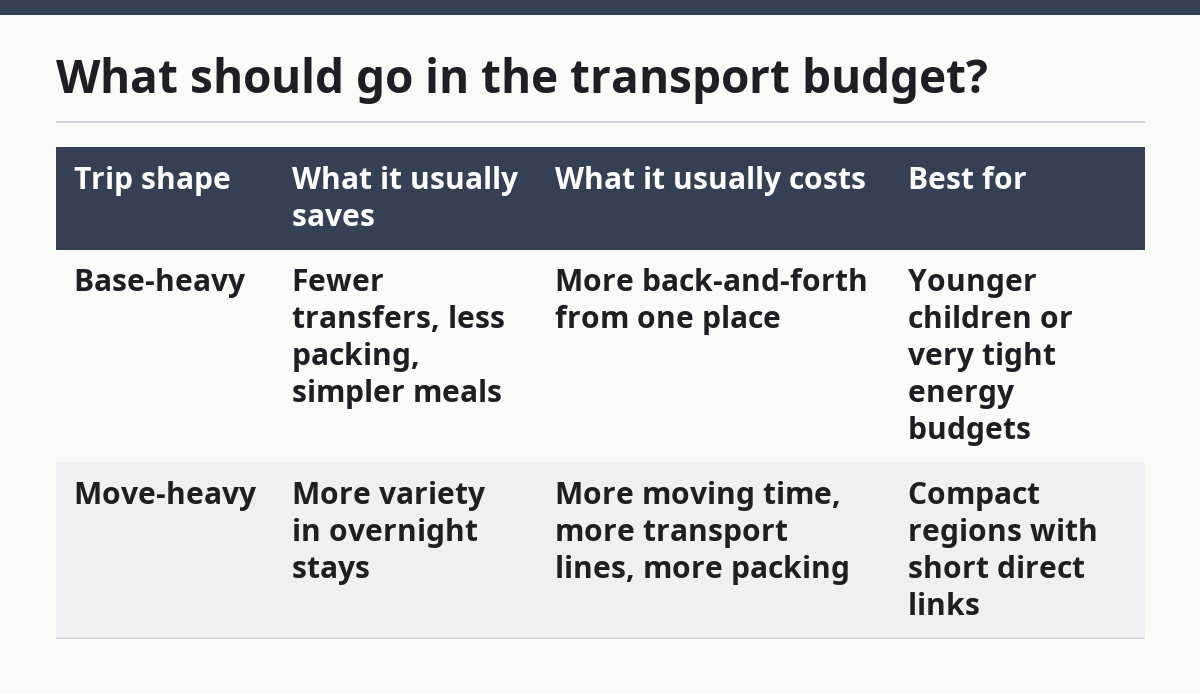
A family on a strict budget should not assume the move-heavy plan is always worse. If 2 stops let the trip skip a long daily commute or a costly day-trip pattern, the extra transfer can still make sense. The key is to compare the full price of the route, not just the room rates. For fare planning and route comparison, public transit agencies and rail operators often publish the clearest direct-price information.
How do you pack for multiple stops without overpacking?
You pack for multiple stops by building a small, repeatable bag system and refusing to pack for every possible weather change. The more stops a trip has, the more important it becomes to keep each person’s bag easy to lift, repack, and find inside 5 minutes.

Start with one main bag per person and one shared day bag. Keep the day bag for documents, chargers, snacks, wipes, and a change of clothes for younger children. That keeps the essentials reachable even if the main bags are stacked in a trunk or luggage rack.
A simple packing rule helps: one outfit for each travel day, one spare outfit for each child, and a small laundry plan if the trip lasts more than a few nights. That may sound spare, but overpacking causes a different kind of cost. Heavy bags slow down check-in, raise stress on move days, and make the first and last hours of each stop harder.
A few packing mistakes cost money fast:
- Separate bags for each possible weather type. This fills the car or increases baggage weight. Instead, choose layers and one waterproof outer item if needed.
- Too many shoes. Shoes take space and do not help on move days. One extra pair per person is usually enough for a short trip.
- No “first night” bag. If pajamas, toiletries, and chargers are buried, the first evening becomes a scramble.
Keep a simple packing list that repeats from stop to stop. The same 10-item core works better than a different plan for each place. A multi-stop trip is easier when the luggage system is boring and predictable.
Where should you spend and where should you save?
Spend on the parts that protect energy and save on the parts that do not change the trip much. In a multi-stop region, that usually means spending on the best-located base, reliable intercity transport, and any room setup that reduces stress, while saving on room size, fancy extras, and unnecessary upgrades.

One smart place to spend is the first base camp. A central room can cut local transport and make the whole route simpler. Another smart place to spend is the move that would otherwise turn into a long, awkward day. Paying for the easier transfer can protect the rest of the trip.
The best places to save are usually the least visible ones:
- a room view instead of a better location
- a hotel breakfast that is not needed because groceries are nearby
- a private transfer when a direct public option works well
- extra one-night stays that do not add real value
Save where the trip does not feel the cut. Spend where the cut would be felt on every day that follows. That is the real budget test for a multi-stop region.
This page fits the broader budget family trip planning by destination type hub because the destination shape changes the money pattern. A multi-stop region needs a different plan from a single-base city break or a beach stay, and the budget should reflect that difference from the start. For related planning, see the budget family trip planning by destination type guide and the family travel budget checklist.
When is this the wrong plan?
This is the wrong plan when the region is wide, the children are very young, or the group cannot handle repeated packing. It is also the wrong plan when the main reason for moving is a slightly cheaper room that does not actually reduce the total trip cost.
A multi-stop trip adds overhead. Even 2 moves can mean 2 check-outs, 2 unpackings, and 2 chances for delays to spill into the day. If that overhead matters more than variety, a single base is the cleaner choice.
The same warning applies when the stops are only loosely connected. If the transport between places is slow, indirect, or tiring, the route can become a budget trap. A trip that looks broad and efficient on a map can turn into a series of small expenses and long waits. For families comparing airport, rail, and road options, this is where a family travel planning page or trip budgeting template can help keep the tradeoffs visible.
The safest way to decide is to compare the whole trip, not the parts. If the moving days are easy, the route stays compact, and the base camp does real work, the plan can be a strong budget choice. If not, the single-base trip is probably the better fit.
Is it cheaper to stay in one base or move around on a family trip?
It depends on the region, the transport links, and how many nights each stop gets. One base often keeps costs lower because it cuts transfers and packing, but a multi-stop plan can still save money if it avoids long back-and-forth travel or a pricey daily commute. The cheapest answer is the one that counts lodging, intercity transport, and move-day food together.
How many stops are too many for a budget family vacation?
Too many stops is usually the point where the trip spends more time moving than staying put. For many budget trips, each extra stop should earn its place by adding a clear reason to sleep there, not just a new place name. If the group is packing more than it is resting, the plan is probably too split up.
What is the cheapest way to do a multi-stop family trip?
The cheapest way is usually to keep the route compact, use one strong base camp, and choose direct intercity transport where possible. That reduces baggage churn and cuts the number of nights lost to moving. The lowest total cost comes from fewer transfers, simpler meals on move days, and rooms chosen for location instead of extras.
Drafted with AI; not yet reviewed by a person.