
Last updated: November 20, 2026
Quick Answer: Prepay the 3 items most likely to sell out or change price—lodging, timed tickets, and reserved tours—then leave flexible meals and extras unpaid until closer to travel.
Prepaid trip expenses help you lock in lodging, tickets, deposits, tours, and final payments before prices change or spots fill up.
Pay ahead for the parts that protect availability or remove a big risk; wait on the rest.
This guide to How to Decide What to Pay for in Advance on a Family Trip sorts that out so you can decide what to prepay, what to leave flexible, and how to keep cash from getting pinned down too early.
Key Takeaways
- Prepay the items that are hard to replace later: lodging, tickets, and reserved tours.
- Leave day-of spending, meals, and open-ended extras unpaid until travel gets closer.
- A deposit can be worth it when it holds a room or seat you actually need.
- A final payment due 30, 60, or 90 days out can be a sign that you should plan cash flow now.
- If a payment is nonrefundable and the trip is still uncertain, that is a warning light.
- The best decision is usually not “pay everything early” or “pay nothing now.” It is matching the payment date to the risk.
| Option | Best For | Core Spec | Standout Feature | Action |
|---|---|---|---|---|
| Deposits | Trips with limited inventory | Part of the price paid now | Holds a room, seat, or date | Use when losing the spot would hurt more than losing the cash |
| Tickets | Fixed-date outings | Set entry time or seat assignment | Often cheaper or safer to lock early | Prepay if the date is certain and demand is high |
| Final payments | Packages with deadlines | Balance due before arrival | Gives you a clear cash deadline | Put the due date on your budget calendar right away |
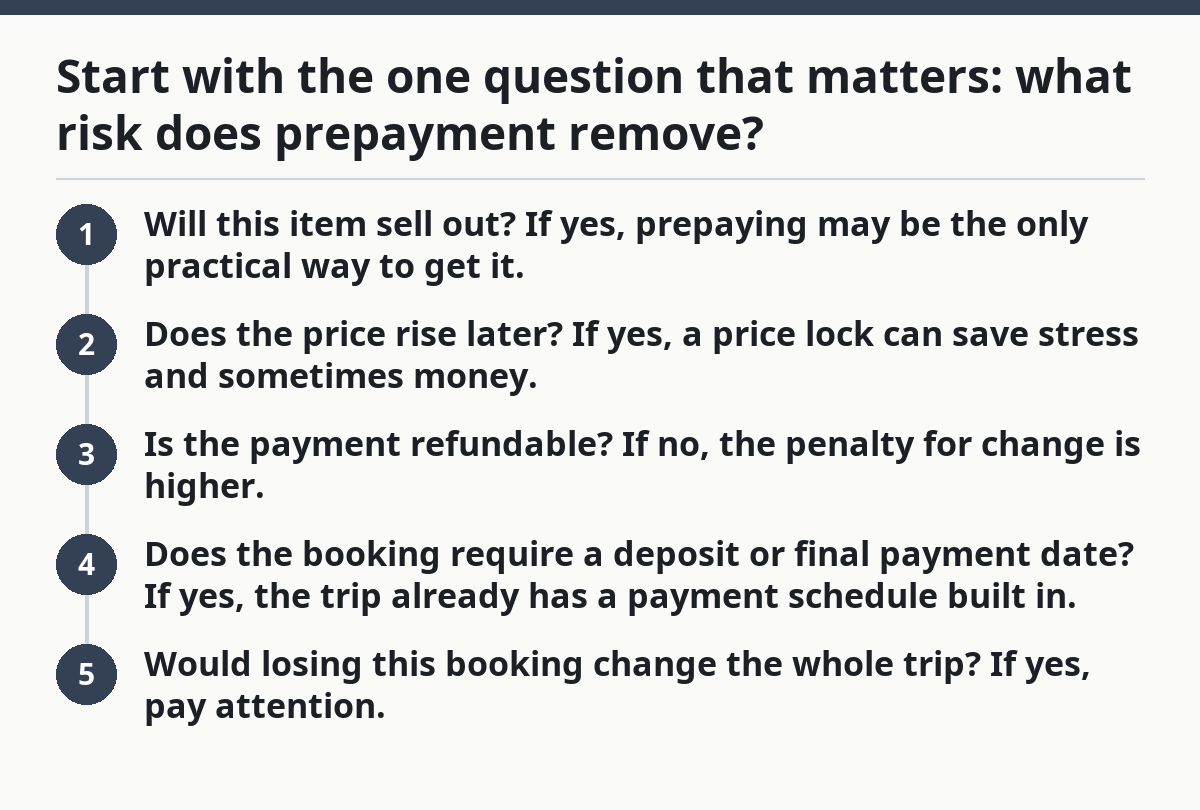
Start with the one question that matters: what risk does prepayment remove?

Prepay only when availability, price, or required timing is at stake. That simple test handles most family trip money decisions before they get messy.
Picture this: you’re booking for four people, and one part of the trip sells out in advance while another part can be bought any day. You do not need the same payment strategy for both. One is about locking a spot. The other is just spending money early.
That is why prepaid trip expenses should be sorted by risk, not by habit. A deposit for a small inn, a train ticket with assigned seats, or a tour with one departure time has real upside. A prepaid lunch or a random souvenir fund does not.
Use this quick filter:
- Will this item sell out? If yes, prepaying may be the only practical way to get it.
- Does the price rise later? If yes, a price lock can save stress and sometimes money.
- Is the payment refundable? If no, the penalty for change is higher.
- Does the booking require a deposit or final payment date? If yes, the trip already has a payment schedule built in.
- Would losing this booking change the whole trip? If yes, pay attention.
The truth is, most people overspend early on things that do not protect anything. They send money out weeks before travel because it feels organized. It only feels that way. Cash sitting in your account is still useful until the trip is close enough that the risk changes.
A good rule: if the item is replaceable in 24 hours, it usually does not need early payment. If the item could force a full plan change, it deserves a harder look.
Which vacation expenses are worth prepaying?
Worth prepaying items are the ones tied to fixed inventory, fixed dates, or a hard deadline. Those are the charges that can become more expensive or impossible to get later.
Picture this: you have one room that fits everyone, one museum slot at 10:00 a.m., and a guided boat trip with a 48-hour cutoff for booking. These are not casual spending choices. They are time-sensitive commitments.
The best candidates are usually:
- Lodging deposits when the room size or location matters.
- Tickets for museums, shows, transit, ferries, or parks that use timed entry.
- Tour reservations for small-group outings, private guides, or seasonal activities.
- Final payments on packages that already have a due date set.
- Reserved transport such as long-distance trains, airport transfers, or limited-seat shuttles.
Here’s the catch: not every prepaid item is wise just because it exists on a booking page. A nonrefundable payment only makes sense when the booking itself is hard to replace. If there are ten similar options left next week, early money is buying convenience, not protection.
Two sources are worth knowing when you compare these choices. The U.S. Federal Trade Commission has plain-language guidance on deposit and refund issues, and the Consumer Financial Protection Bureau has practical material on budgeting for irregular costs and payment timing. I would also look at the specific refund terms from the supplier, because that is the document that controls the deal.
Prepay less when the trip is flexible:
- open-ended meals
- casual day trips
- shopping money
- attractions you can book at the last minute
- any item with no penalty for waiting
Prepay more when the booking can disappear:
- one-off event tickets
- holiday-week lodging
- popular tours
- transportation with assigned seats
- package balances due before departure
How do deposits, final payments, and price locks change the decision?
Deposits, final payments, and price locks each shift the risk in a different way, and that difference decides whether early payment helps or hurts.
Picture this: a resort asks for a deposit now, the balance in 60 days, and a final charge before check-in. That is not just one payment. It is a schedule with three separate moments where the decision changes.
A deposit usually means “hold this booking for me.” It can be a good trade when the spot is hard to replace. The downside is plain: if plans change, that money may be lost or only partly returned.
A final payment is different. It often comes after the trip is already committed. If the due date is 30 or 60 days out, the real question is not “Should I pay early?” but “Will I have the cash ready when the deadline hits?” That is a cash flow issue, not a booking issue.
A price lock can be useful when the rate is likely to rise. The catch is that a locked price is not the same as a flexible booking. A locked rate with a strict cancellation rule can still be expensive if your dates move.
Use this rule of thumb:
- Deposit = buy the right to hold the booking.
- Final payment = finish the deal by the stated due date.
- Price lock = protect against later increases, if the terms still work for you.
If you are comparing two options with the same base cost, favor the one with the better refund terms unless the cheaper one is nonrefundable only because it is much easier to replace. A low rate is not a bargain if it traps your money for 90 days.
A simple way to decide what goes on the card now
Decide in this order: hard-to-replace first, deadline-based second, flexible last. That sequence keeps you from prepaying the easy stuff and starving the urgent stuff.
Picture this: you have five trip items in front of you, each with a different due date. One is due today, one is a deposit, one is a final payment in 45 days, and two can wait until you arrive. Sort them before you pay a cent.
- List every pre-trip charge on one page: lodging deposit, tickets, tours, transport, and any final balance.
- Mark the due date beside each one. Use the exact date, not “soon.”
- Circle the items that sell out or disappear if you wait more than a few days.
- Cross out items that can be bought later with no real downside.
- Compare each remaining payment to your cash on hand for that month.
- Pay the item that has the earliest hard deadline or the highest replacement risk.
- Leave the flexible charges for later unless prepaying gives a real discount or solves a booking problem.
That process works because it separates urgency from convenience. A payment due in 14 days is not always more important than one due in 60 days if the 60-day item is the only room that fits everyone.
Now, you might be wondering if a small discount should change the order. Sometimes it should. But a discount of a few dollars is not enough to justify locking up money for months unless the booking is already high risk to lose.
Use this test before you pay:
- Can you replace it easily?
- Does the prepayment remove a real risk?
- Do the refund terms still leave you with a bad outcome if plans shift?
- Will paying now force you to cut something more important later?
What gets people into trouble with prepaid trip expenses?
The biggest mistake is paying early for things that are easy to buy later, because that drains cash without buying much protection.
Picture this: you have already prepaid the room and the main tickets, but then you also prepay airport snacks, casual outings, and a pile of extras that could have waited. The trip still works, but your wallet is thinner than it needed to be.
Common mistakes and what they cost:
-
Prepaying too many small items
Cost: cash is tied up for 2 to 8 weeks without a real benefit.
Do instead: keep small, flexible purchases for the trip itself. -
Ignoring refund rules
Cost: you may lose the full amount if dates change.
Do instead: read the cancellation line before you click pay. -
Confusing deposit with full safety
Cost: a deposit can still be nonrefundable or only partly refundable.
Do instead: treat the deposit as at-risk money unless the policy says otherwise, and check the policy with the supplier or a consumer-protection source before you assume it is protected. -
Not matching payment timing to payday
Cost: you may pay a balance right before other bills clear.
Do instead: map the due date to the month, even if the booking itself is good. -
Assuming all family trip costs should be prepaid
Cost: you lose flexibility where you needed it most.
Do instead: reserve early payment for the pieces that are hard to replace.
The best part is that this mistake is easy to avoid once you look at the trip as two buckets: fixed commitments and flexible spending. That bucket split is the same idea used in the broader budget approach on the site’s fixed-and-flexible cost guide, and it works here too.
A prepaid item should earn its place by doing one of two jobs: holding scarce inventory or reducing a serious risk. If it does neither, keep your money.
What should stay unpaid until the trip is closer?
Leave unpaid the things you can buy in a day, at the last minute, or after you see what the trip actually needs. That keeps your budget from getting locked too early.
Picture this: you’re three weeks out and still not sure how much walking the day will involve, whether the weather will be good, or which neighborhood you’ll want to eat in. Prepaying every dollar before that point gives you less room to adjust.
Usually, these can wait:
- meals that are easy to find on arrival
- local transit passes you may not use fully
- casual attractions with open ticket windows
- snacks and drinks
- shopping money
- backup activities that depend on weather
There is a real trade-off here. If you wait on too much, you can miss a limited booking. If you prepay too much, you lose the chance to shift money toward the parts of the trip that actually need it.
A practical middle ground is to prepay the fixed core and keep the rest in reserve until the week before travel. If a booking has no deadline before you arrive, no penalty for waiting, and no risk of selling out, the case for early payment is weak.
That does not mean “never prepay.” It means the burden of proof is on the charge, not on your wallet. A payment should have a reason.
If a charge is only there because it feels tidy to get it out of the way, that is not a good reason. If it is there because the room, seat, or tour could disappear, that is a different story.
How should you match prepaid trip expenses to cash flow?
Match prepaid trip expenses to the month they hit your account, not just to the trip date. That keeps a good booking from turning into a cash squeeze.
Picture this: the balance on a tour is due 45 days before travel, the lodging deposit is due now, and a larger payment lands two weeks before your next paycheck cycle. The booking may be fine, but the timing can still hurt.
A simple cash-flow check helps:
- write down the due date
- note the amount
- check which paycheck or savings bucket will cover it
- see what else is due in the same 30-day window
- pay early only if it prevents a bigger problem later
If two prepaid items fall in the same month, choose the one with the tighter refund rule first. If both are equally strict, pay the one that locks the most important part of the trip.
One more thing: do not confuse “can afford it” with “should pay it now.” If you have the money today but will need it for a larger fixed bill next month, early payment can still be the wrong move.
FAQs
what family trip costs should be paid early?
Pay early for costs that can sell out, rise in price, or require a deposit to hold the booking. That usually means lodging, tickets, tour reservations, and other fixed-date items.
should I prepay a deposit if the trip is not final?
Only if losing the spot would be worse than risking the deposit. Review the cancellation terms first and compare them with your chance of changing plans; the FTC’s refund guidance is a useful place to start.
are prepaid trip expenses always cheaper?
No. Some prepaid trip expenses are cheaper, but some are just less flexible. A lower rate can still be a worse deal if it locks your money into a nonrefundable booking.
what should I leave until the last minute?
Leave meals, shopping money, casual attractions, and other flexible costs until closer to travel unless they are likely to sell out or need advance booking.
how do I keep prepaid travel from hurting my budget?
Put each due date on your calendar, match it to your paycheck cycle, and prepay only the items that remove a real risk. If a charge is optional, wait on it.
Drafted with AI; not yet reviewed by a person.
