

Last updated: November 19, 2026
Credit card rewards points can cut the cost of family travel fast, but the simplest win is often one flight or one hotel stay, not a perfect all-points trip. This guide to How to Use Credit Card Points for Family Travel Without Overcomplicating the Trip shows you how to decide where points do the most work, how to avoid messy bookings, and what to do when you need a small points top-up.
Key Takeaways
- Start with one trip goal, not every possible redemption.
- Use points where cash prices hurt most: often long flights or the priciest hotel nights.
- Keep family seating in mind before you transfer points.
- Travel portals are easier; airline and hotel loyalty programs can save more.
- A partial points booking is often better than waiting for a “perfect” redemption.
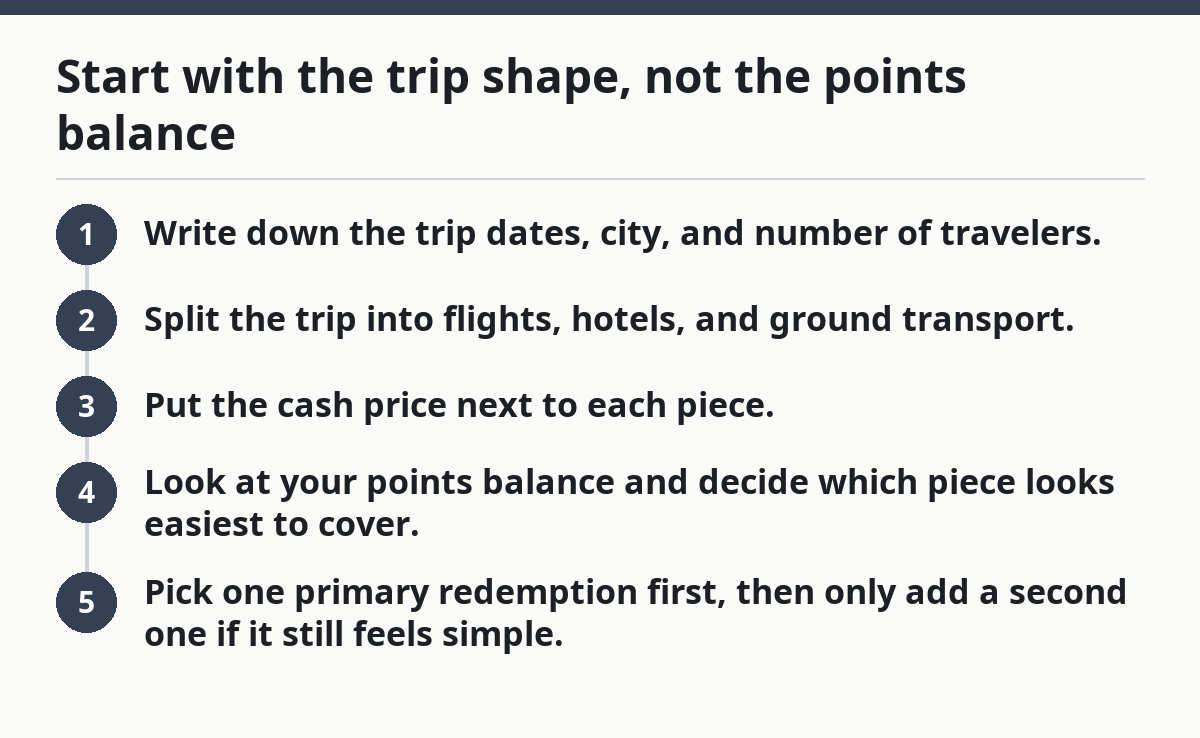
Start with the trip shape, not the points balance
Picture this: you’re planning a 5-day family trip, and you have three different credit card point balances spread across two cards. The right first move is one simple booking target—flights, hotels, or a mix—because that keeps the trip from turning into a puzzle with ten moving parts.
Begin with the parts of the trip that are hardest to pay for in cash. A nonstop flight for four people, a city hotel in peak season, or a room that can hold everyone may be the best use of points. A cheap domestic hop or a roadside hotel on a low-demand night usually is not. The goal is not to “use points somewhere.” The goal is to remove the biggest cash pain.
Use this quick filter:
- Write down the trip dates, city, and number of travelers.
- Split the trip into flights, hotels, and ground transport.
- Put the cash price next to each piece.
- Look at your points balance and decide which piece looks easiest to cover.
- Pick one primary redemption first, then only add a second one if it still feels simple.
When this works, you can name the trip in one sentence: “Flights are covered with points, and the hotel is paid cash,” or the reverse. That is a good sign. If you cannot say that clearly, the booking is probably already too complicated.
The truth is, family travel punishes overplanning. A tiny savings on paper can cost you hours later if it means separate bookings, weird flight times, or a hotel room that will not fit everyone.
How do I decide whether to use points for flights or hotels?
Use points for the part of the trip that is both expensive and awkward to pay cash for. That is usually flights on peak dates, or hotels in expensive cities where the nightly rate jumps hard.
Flights are usually the cleaner place to start when the cash fare is high and you can find seats for every traveler on one itinerary. Hotel points often work better when you need a standard room for a known number of nights and the property has a normal award chart or predictable pricing. Travel portals sit in the middle: they are simpler, but they may not stretch points as far as airline or hotel loyalty programs.
A simple rule helps:
- If the flight is the expensive problem, check airline loyalty programs first.
- If the hotel is the expensive problem, check hotel loyalty programs first.
- If you want one booking and less fuss, compare both against a travel portal.
A family of four may get strong value from using points on one big item instead of scattering them across smaller ones. That can avoid the classic mistake of getting “some discount everywhere” and still paying most of the trip in cash.
Watch for these trade-offs:
- Airline awards can save a lot, but award space may not exist for all four seats on the same flight.
- Hotel awards can remove a big bill, but resort fees, parking, or room capacity can make the stay less straightforward.
- Travel portals are easier to book, but the redemption value may be weaker than booking directly.
On the other hand, a portal can be the smartest move if you need exact dates and do not want to learn a new loyalty program right before departure. Simple is worth money.
Step 1: Find the one booking that matters most
Start by picking the booking that changes the trip from “too expensive” to “doable.” If the flights eat the budget, aim there first. If the hotel is the budget killer, check the room first. This keeps the trip grounded in a single target instead of a scattered search.
Make a short list:
- The total cash cost of flights.
- The total cash cost of hotels.
- Any fixed must-haves, like a room with two beds or a nonstop flight.
- Your current points in each program.
- Whether one person’s card can move points to an airline or hotel partner.
The result you want is a clear priority. For example, “Transfer points to an airline program because the family needs four seats on the same route,” or “Use the portal for the hotel because the room price is high but award space is poor.” That sentence becomes your booking plan.
Do not start by transferring points. That is the mistake. Once points move into an airline loyalty program or hotel loyalty program, they can be hard to get back, and you lose flexibility. Instead, search first, then move points only when you see a real booking you can grab.
If your family trip has split needs—say, cheap flights but pricey lodging—there is no rule that says points must cover everything. A mix is often the least annoying answer.
Step 2: Check award space before you move a single point
Check award space first so you do not strand points in the wrong program. That means looking for actual seats or rooms before you transfer points from a card to an airline loyalty program or hotel loyalty program.
For flights, search the exact route and dates you want. For a family, search for the number of seats you need together, not just one award seat. One seat showing up is not the same as four seats available. For hotels, search the property on the exact nights and look at room type, not just the base room if your family needs more space.
A few practical checks save pain:
- Search for all travelers, not one adult at a time.
- Confirm whether the award is bookable online or needs a phone call.
- Look at taxes and fees before you transfer.
- Check whether the room fits your family without a separate extra booking.
If you cannot see enough award space for the whole group, stop and rethink. Maybe you book one leg with points and pay cash for the rest. Maybe you switch dates by a day. Maybe the travel portal is cleaner because it lets you buy the needed seats or room without hunting for award inventory.
Here is the catch: airline loyalty programs can look generous right up until you need a family-size block of seats. Two saver seats are not a family solution. They are a fragment.
Step 3: Use points where family seating will still work
Use points only when the trip still works for real people who have to sit together, sleep in one room, and carry bags through the airport. That sounds obvious, but it is where a lot of award bookings fall apart.
Family seating changes the value of a redemption. A cheap award flight that splits the family across the plane may not be worth it if one adult ends up seated far away from young kids. A hotel award that saves cash but gives you a room too small for everyone can make the stay worse, not better.
Check these details before booking:
- Can you select seats during the award booking?
- Does the airline charge for seat selection on award tickets?
- Does the hotel room allow your group size?
- Are there sofa beds, two queens, or a suite option?
- Will you need a second room if you use points here?
If the answer to any of those is “maybe,” slow down. The best redemption is often the one that keeps the trip easy on arrival day.
A plain example helps. If a hotel award covers a standard room but your family of five needs two rooms, the savings may shrink fast. In that case, it may be better to put points toward flights and keep the hotel booking simple. That is practical.
Big mistake: using points to create a booking that saves money but increases stress every day of the trip. Family travel has enough friction already.
Step 4: Decide when to transfer points and when to stay in the portal
Transfer points only when the partner award is clearly better than the portal, and stay in the portal when convenience matters more than squeezing out the last bit of value. That is the trade-off in plain English.
A travel portal is easier because it usually behaves more like a normal booking site. You can often book the exact flight or hotel you want, use points like cash, and avoid hunting for award space. That can be a huge relief on a family trip with school schedules, sports, or fixed vacation days.
Transferring points can be smarter when:
- The airline award is much cheaper than the cash fare.
- The hotel award price is well below the cash rate.
- You find exactly the itinerary or room you need.
- You are sure the family can travel on the award inventory available.
Stay with the portal when:
- You need exact dates and exact family seating.
- Award space is thin.
- You do not want to juggle two loyalty programs before the trip.
- The savings from transferring are small.
One useful habit: compare both options on the same day. Look at the portal price, then the direct award price, then the cash price. If the transfer saves only a little and adds complexity, skip it. A family trip is not the place to chase a marginal win that forces extra calls or split bookings.
If you want a broader money-and-timing framework for the rest of the trip, the hub on budget family trip planning by booking timing and pricing fits well with this step.
Step 5: Top up only when the shortfall is small and the trip is already ready
Top up points only when the missing amount is small enough that the booking is still simple and the award is already available. If you are short by a little, a top-up can make sense. If you are short by a lot, the math usually gets ugly fast.
This is where many people make the wrong move. They see a nearly complete award and buy or move extra points just to finish it. That can work if the gap is modest and the booking is strong. It can also lock you into a weak redemption because you were impatient.
A better way:
- Price the award in points and cash.
- Compare the gap to the total family trip cost.
- Decide whether the missing points are small enough to justify the extra step.
- Only then transfer or buy the top-up.
The safest top-up is one that finishes a good booking, not one that rescues a bad one. A family trip with a 7-day hotel stay and 4 flights should not depend on a last-minute scramble for a tiny points gap if it forces a worse route, a worse room, or extra fees.
Use this rule of thumb: if the top-up creates a new decision tree, it probably is not worth it. If it just completes an already good booking, it may be fine.
Step 6: Keep the booking simple after you redeem
Keep the booking simple after you redeem so you do not lose the value you just earned. The easiest way to waste points is not a bad redemption. It is a complicated trip that creates extra fees, extra changes, or extra confusion.
After booking, save the confirmation numbers in one place. Make sure the lead traveler name matches the airline or hotel account. Check seat assignments, baggage rules, and cancellation terms right away. If there is a hotel stay, confirm how many guests are listed on the reservation.
A short post-booking checklist helps:
- Save the airline and hotel confirmation emails.
- Write down the cancellation deadline.
- Check whether the room or fare includes the basics you expected.
- Keep the cash part of the trip visible so you do not accidentally overspend elsewhere.
The real goal is not just cheaper travel. It is a cheaper trip that still feels easy when you are tired, carrying bags, and trying to keep everyone fed. That is where points earn their keep.
FAQ
Is it better to use points for flights or hotels for a family trip?
It depends on which part of the trip is the bigger cash problem. Flights are often the better use when airfare is high and you can find enough award seats together. Hotels can be the better use when the nightly rate is expensive and the room works for your whole family.
How many points do you need for a family vacation?
It depends on the route, hotel, season, and the loyalty program. A family vacation can take a small points balance if you only cover one flight or one hotel stay, or a much larger one if you want to cover several nights or multiple flights.
Can you combine points from multiple cards for one family trip?
Yes, sometimes, but the method depends on the program rules. You may be able to transfer points from one card issuer to an airline loyalty program or hotel loyalty program, or pool points inside a single program if that program allows it. Check the rules before moving points.
What is the easiest way to avoid overcomplicating family travel with points?
Pick one booking to cover first and ignore the rest until that part is confirmed. That keeps you from juggling flights, hotels, transfers, and top-ups all at once. If a redemption needs extra calls or splits the family badly, it is usually not the easiest choice.
Drafted with AI; not yet reviewed by a person.
