

Last updated: November 19, 2026
Quick answer: for the Best Time to Book Family Flights for the Lowest Price, start watching as soon as your dates are roughly set and book once the fare is reasonable, especially if you are buying 3, 4, or more seats together. For many family trips, that means acting months ahead rather than waiting until the trip feels close.
The best time to book family flights for the lowest price is usually after you can see a workable fare but before school-break demand tightens the plane. For many trips, that means booking earlier than you would for a solo ticket, because family travel needs more seats together and fewer date options. Google Flights shows date-by-date fare changes, and the U.S. Department of Transportation notes that airfare can change often as seats sell.
Book too early and you may miss a price drop; wait too long and you may lose the seats, the nonstop flight, or the return time that keeps bedtime from turning into a meltdown.
Key takeaways
- Families need a different booking window because they are buying 3, 4, or more seats at once, not one seat.
- The sweet spot is usually “watch early, book once the fare is reasonable,” not “wait until the last minute.”
- School breaks, holiday weekends, and nonstop flights raise the risk of waiting.
- Flexible-date searches on Google Flights and airline websites help show whether a fare is normal or inflated.
- Fare alerts are useful, but they work best when you already know the month, route, and airport pair you want.
Why family flights need an earlier booking window

Family flights usually need earlier booking than a solo trip because the problem is not just price; it is seat availability across several tickets at once. A fare that looks fine for one traveler can become expensive or impossible when you need 3 adjacent seats, a stroller, and a sane departure time.
Airlines sell inventory in fare buckets, and those cheaper buckets can disappear unevenly. That matters more when you are traveling with children, because one missing seat can force a split booking or a different itinerary. If you are flying during a school break, the window tightens even more. A Tuesday in February is one thing; the Friday before spring break is another.
The practical rule is simple: start tracking flights as soon as your dates are roughly set, then book once the fare looks acceptable for your route and family size. For many domestic family trips, that means months ahead rather than days ahead. For international trips, the planning window is usually even wider.
This is the part generic flight advice gets wrong: it often assumes flexibility that families do not have. A parent can move a solo trip by a day. A family often cannot move a child’s school calendar, a work schedule, and a hotel check-in all at once.
If you want a broader planning framework, this guide sits under the site’s budget family travel planning by booking timing and pricing hub.
How far ahead should you start watching fares?
You should start watching fares as soon as your trip month is known, then book when the price and schedule stop looking risky. That gives you time to compare several dates, not just one.
A useful way to think about it is in three stages:
- Early watch period: Put the route into Google Flights or the airline’s own fare calendar once you know the month. The goal is not to buy immediately. The goal is to learn the normal range for that route and see which days carry a cheaper fare.
- Decision period: Once you see a fare that fits the trip and the schedule is family-friendly, book it. For family travel, the value of getting everyone on the same flight often beats squeezing out a small extra drop.
- Risk period: If the route is getting close to a school break, holiday, or peak weekend, waiting becomes more dangerous. That is especially true for nonstop flights and early-morning departures, which families often want most.
Google Flights is a useful comparison starting point because its calendar view makes date differences obvious. Airline websites matter too, especially if you want to confirm carry-on rules, basic economy limits, or whether a carrier shows family seating options on the same itinerary.
A common mistake is waiting for a “perfect” price. The cost of that gamble is not just a higher fare later; it can also be split seats, odd connections, or a red-eye that looks cheap but ruins the first day of the trip. If the fare is already acceptable and the itinerary fits your family, that is often the right moment to stop watching.
Which departure days are easier on families and usually easier on the wallet?

Midweek departures are often easier on both the budget and the family schedule, while peak departure days tend to cost more and feel harder. That does not mean every Tuesday is cheap or every Saturday is expensive, but the pattern is strong enough to use as a starting point.
For family travel, the day question has two parts:
- Price: Flights that avoid the most popular leaving days are often less crowded and can price lower.
- Sanity: A slightly cheaper fare is not a win if it lands you at 10:30 p.m. with overtired children and a long ground transfer.
The most useful move is to compare at least 3 nearby departure days and 3 return days. That is a 9-cell search grid, and it often shows you where the real savings are. If one date is only slightly cheaper than the others, choose the one that reduces stress. If the lower fare is tied to a 5 a.m. departure or a long connection, that “deal” may not be a deal for a family.
School breaks complicate this. When many families are trying to leave on the same Friday afternoon, the cheaper days can disappear first. That is why departure-day flexibility matters more for family flights than for many other trips. A one-day shift can sometimes change the whole fare picture.
The biggest mistake is chasing the cheapest weekday without checking the whole itinerary. A fare that looks low can hide an extra layover, a long overnight gap, or a return time that forces a missed day of school or work. Compare the total trip, not just the headline number.
How to use fare alerts and airfare calendars without waiting too long
Fare alerts help you spot a good booking moment, but they should not replace a decision date. Set them early, check them often, and use them as a signal rather than a command.
A practical process looks like this:
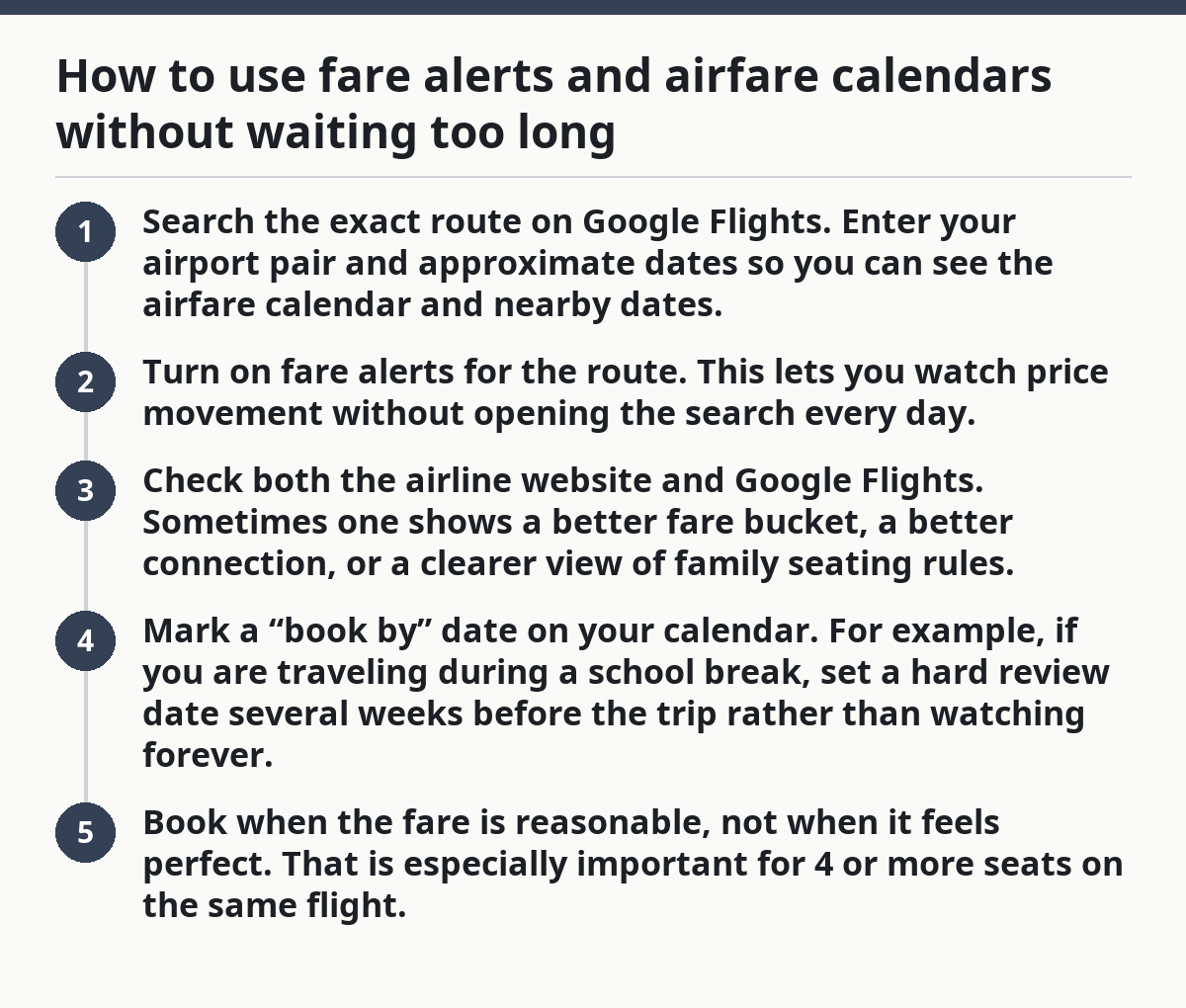
- Search the exact route on Google Flights. Enter your airport pair and approximate dates so you can see the airfare calendar and nearby dates.
- Turn on fare alerts for the route. This lets you watch price movement without opening the search every day.
- Check both the airline website and Google Flights. Sometimes one shows a better fare bucket, a better connection, or a clearer view of family seating rules.
- Mark a “book by” date on your calendar. For example, if you are traveling during a school break, set a hard review date several weeks before the trip rather than watching forever.
- Book when the fare is reasonable, not when it feels perfect. That is especially important for 4 or more seats on the same flight.
Fare alerts are most useful when the trip is still flexible by a few days. They are less useful when the route is already tight, the flight is a nonstop, or your family needs a specific schedule. In those cases, waiting for a magical dip can backfire.
The trade-off is clear: alerts can help you avoid overpaying, but they can also tempt you into stalling. If the itinerary you want is available and the price is within your comfort range, a fare alert is no reason to delay a family booking that already works.
For general flight hunting, Google Flights is a strong comparison tool to start with, then verify the final booking details on the airline site before paying.
When waiting pays off, and when it usually does not
Waiting pays off when your dates are flexible, your route is not peak-demand, and you are not chasing a specific nonstop or holiday itinerary. In those cases, a short watch period can reveal a better fare or a better departure time.
Waiting usually does not pay off when one or more of these are true:
- You are flying during school breaks.
- You need 3 or more seats together.
- You want a nonstop flight.
- Your return date is fixed by work or school.
- The trip is near a major holiday weekend.
That last point matters because holiday travel changes the game. Thanksgiving week, winter break, spring break, and long summer weekends can all create a booking race. On those trips, the cheapest seats are often among the first to go, and family flights are affected more sharply because several seats need to line up at once.
A useful rule is to ask, “What is the cost of waiting?” If the answer is only a few dollars, waiting may be fine. If the answer could be a split itinerary, a late-night arrival, or a full fare jump, the risk is higher than the possible reward.
This is where a lot of generic advice breaks down. It treats every route as if it behaves the same. If you are unsure, consult an airline agent, a trusted travel advisor, or a route-specific source before assuming the fare pattern will follow the usual rule. It does not. A family flying from a large hub on an off-peak Tuesday has more room to wait than a family trying to leave on the Friday before Christmas.
I would not wait for a price drop if the flight already solves the family logistics and the dates are known. I would wait only when the trip is still loose enough to absorb the risk.
Holiday travel timing: the one case where earlier usually wins
Holiday travel usually rewards earlier booking because demand is concentrated into a few dates and travelers are competing for the same flight windows. That is especially true for family flights, where school calendars and vacation schedules pile into the same days.
The safest move is to treat holiday flights as a separate category from ordinary leisure travel, because the supply and demand pattern is different. If the trip includes Thanksgiving, Christmas, New Year’s, spring break, or a major school holiday, start monitoring earlier than you would for a summer weekend getaway. The best fares and best departure times often disappear first, not last.
A holiday search should include:
- at least 2 nearby airports if your family can realistically use them,
- 3 or 4 date options around the target departure day,
- both nonstop and one-stop results,
- and a quick check of the airline’s own calendar for the same week.
The drawback of booking early is obvious: you may commit before the market settles. But holiday travel has a different downside if you wait too long. You may end up paying more for worse flight times, and that is hard to fix after the family schedule is locked.
This is where school breaks matter most. A flight that looks ordinary in March can become one of the most expensive family travel periods on the calendar because every other family has the same idea.
A simple booking plan that works for most family trips
The best plan is to search early, compare a few nearby dates, and book once the fare stops being comfortably replaceable. That approach is better for families than chasing the absolute bottom price, because the lowest fare often disappears before the family-friendly one does.
Here is the short version:
- Start with Google Flights and the airfare calendar.
- Watch the route as soon as your month is known.
- Compare at least 3 departure days and 3 return days.
- Use fare alerts, but do not let them postpone a good booking.
- Move faster for school breaks and holidays.
- Favor the itinerary that keeps the trip manageable, not just cheap.
The point is not to buy at the first price you see. The point is to buy while the flight is still available at a fare and schedule your family can live with. For family flights, that is usually the lowest-risk way to keep both cost and stress under control.
Should I book family flights as soon as I see a decent fare?
Yes, if the fare is already reasonable for your route and the schedule works for your family. The cheapest possible price is not always worth the wait, especially when you need multiple seats together. If the trip falls near a school break or holiday, waiting usually carries more downside than upside.
What if the fare drops after I book?
That can happen, but it is not a reason to delay every booking. Some airlines and fare types are more flexible than others, so the final move depends on the ticket rules you buy. If the itinerary matters more than squeezing out a small drop, booking sooner is still the safer choice.
Are weekday flights cheaper for families?
Often, yes, but only sometimes enough to matter. Midweek flights can be easier to price and less crowded than peak weekend departures, yet the savings may disappear if the route is tied to school breaks or a popular nonstop. Compare a few nearby days before deciding.
Should I book separate one-way tickets for a family trip?
Sometimes, but only if the total fare and connection risk make sense. Separate one-way tickets can help when pricing is uneven, yet they can also make the trip harder to manage if one segment changes or if you need all travelers on the same schedule. Always compare the full round trip first.
Drafted with AI; not yet reviewed by a person.
