
Last updated: November 19, 2026
Key Takeaways
- The lowest total bill for your exact stay matters more than the lowest-looking nightly rate.
- For one night, hotels, private-room hostels, or simple apartments can be cheapest if fees stay low.
- Weekend stays often narrow the gap between rentals and hotels because fixed fees spread over 2 or 3 nights.
- For a week, apartments and vacation rentals often deliver the best value when kitchens lower meal costs.
Quick Answer
For How to Choose the Cheapest Family Lodging for Your Trip Length, the cheapest option is the one with the lowest total bill for your exact stay, and that can change by trip length. A one-night stay often favors a hotel, hostel private room, or simple apartment if fees stay low. A weekend can make a vacation rental more competitive. A 7-night stay often shifts value toward apartments and vacation rentals because fixed fees spread out over more nights.
The cheapest family lodging changes by trip length because fixed fees spread out differently over one night, a weekend, a week, or a longer stay. To pick the lowest total cost, compare the full bill for the same dates, not just the nightly rate, and match the lodging type to how many nights you will actually stay.
Start with the one number that matters: your total trip cost
The lowest total bill for your exact stay is the number that matters most, not the lowest-looking nightly rate. Start by listing the stay length, the number of people, and the unavoidable charges for each option: nightly rate, cleaning fee, resort fee, parking, taxes, and any extra bed or guest fee.
If a vacation rental shows a low nightly rate but adds a one-time cleaning fee, it may be cheaper for 5 or 7 nights and worse for 1 night. If a hotel includes breakfast and parking, its sticker rate may look higher while the real total lands lower for a family. That is why the first filter should be the full stay cost, then the room fit.
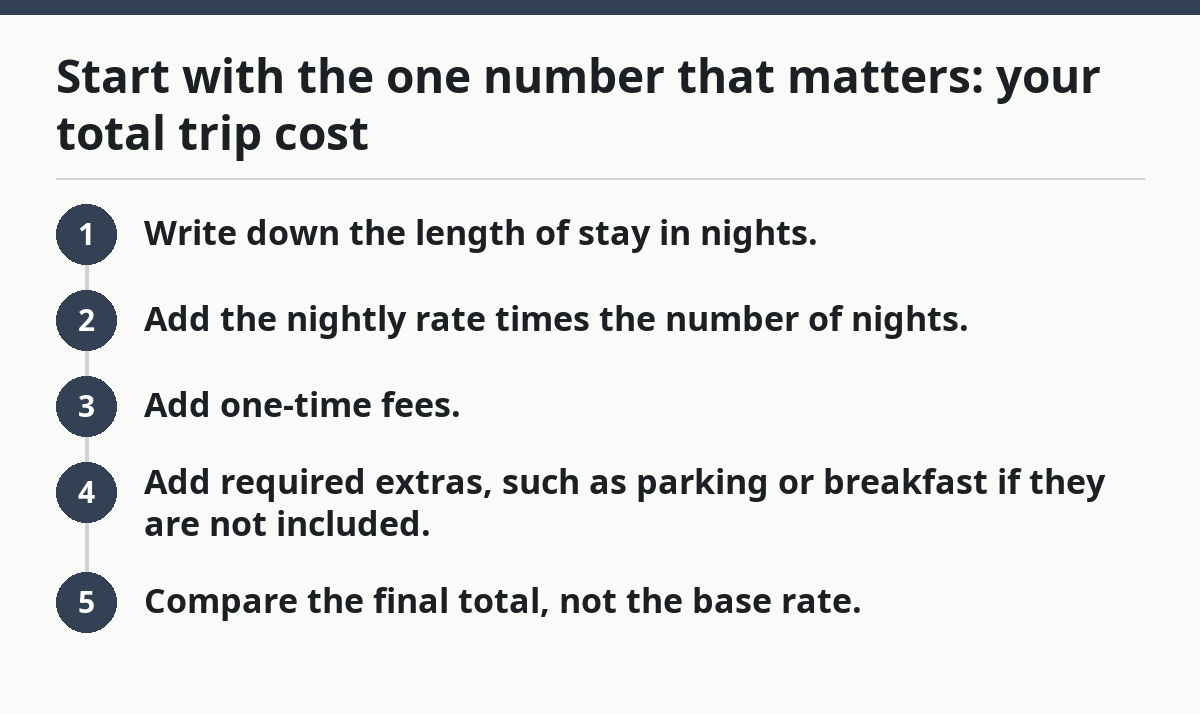
A simple comparison works well:
- Write down the length of stay in nights.
- Add the nightly rate times the number of nights.
- Add one-time fees.
- Add required extras, such as parking or breakfast if they are not included.
- Compare the final total, not the base rate.
When this step works, you can point to one option and say, “This is the lowest total for this trip.” That matters more than any claim that one lodging type is always cheapest. It is not.
For budget planning across trip types, the budget family lodging planning hub should sit alongside this decision, because trip length changes the math more than most travelers expect.
How do I choose the cheapest family lodging for a one-night stay?
For a one-night stay, the cheapest family lodging is often a hotel, hostel private room, or a simple apartment only if the added fees stay low. The reason is simple: short stays punish places with large cleaning fees, minimum-night rules, or check-in friction that does not buy you much value for a single night.
Start with hotels because they are usually the easiest way to get one room, one bill, and no separate cleanup charge. A hostel can be even cheaper if it offers a family room or private room, but many families will not want shared bathrooms or shared sleeping space. Apartments and vacation rentals can look inexpensive until a cleaning fee turns a short stay into an expensive one-night purchase. Cabins and campgrounds often have the same problem: setup time, minimum stays, or add-on fees that make them poor value for a single night.
Use this order for a one-night search:
- Filter for one-night availability first.
- Compare hotels, hostels with private rooms, and apartments that allow single-night bookings.
- Check for cleaning fees, parking, and late check-in charges.
- Only then look at vacation rentals, cabins, or campgrounds.
- Pick the option with the lowest final bill that still fits your family.
What this money usually buys is convenience, a private bed, and less hassle. What it does not buy is kitchen space, a large living area, or much room to spread out. If your family needs those things for a one-night stop, the cheaper option on paper may cost more in stress.
This approach is wrong for travelers who need a full kitchen, separate bedrooms, or an early sleep schedule that will be ruined by a tiny room. In that case, a slightly higher total may still be the better buy.
Weekend stays change the math in a very specific way
A weekend stay is where vacation rentals and apartments start to catch up to hotels because fixed fees spread across 2 or 3 nights. If a rental charges one cleaning fee, that fee hurts less over a Friday-to-Sunday stay than it does over a single night, and the same is true for a cabin with a minimum stay.
For a family, a weekend is often long enough that space starts to matter. A hotel room can still be cheapest if you only need two beds and a place to sleep. But if two adults and children will spend daylight hours in the lodging, a small apartment or vacation rental may become better value even when its nightly rate is higher.
The key is to compare the total cost per night, not just the sticker rate. A lodging type with a kitchen can cut food spending for 2 days, but only if you will actually cook. If you plan to eat every meal out, that kitchen may not help the budget at all.
A weekend comparison should include these details:
- 2 or 3 nights only, not “per stay” assumptions
- Cleaning or service fees
- Parking for 1 car
- Extra guest charges
- Kitchen access and whether it is full or partial
- Bedroom count and sleeping setup
For many families, the cheapest weekend option is the one that avoids a second room. One apartment or one suite can cost less than two hotel rooms even if the base rate is not the lowest. That is especially true for families with older children who need separate sleeping space but can share a living area.
The drawback is flexibility. Many rentals and cabins have stricter check-in times than hotels, and that can cost you a useful first afternoon or force an awkward arrival. If your weekend is short and your schedule is tight, the cheapest lodging on paper may create costs in time and convenience that do not show up in the booking total.
What is usually cheapest for a one-week family stay?
For a one-week family stay, apartments and vacation rentals usually become the strongest value because fixed fees are spread across 7 nights and a kitchen can cut meal costs. This is where the nightly rate matters less than the full stay cost and the amount of space your family gets for the money.
A week changes the equation in three ways. First, one-time cleaning fees become less painful. Second, a kitchen starts to pay back if you cook breakfast or several dinners. Third, laundry access can reduce the number of clothes you need to pack, which matters for families traveling with children. Hotels can still win if they include breakfast, parking, and enough room for everyone to sleep comfortably, but the average family often gets more space from an apartment-style stay.
Cabins can also make sense for a week, especially if the trip is about nature and you will spend most of the day outside. Campgrounds can be the lowest-cost lodging overall, but the savings only hold if you already own or can cheaply rent what you need for sleeping, cooking, and weather protection. A campground without the right gear can stop being cheap very quickly.
For a 7-night stay, compare these items before booking:
- Total stay cost for 7 nights.
- Number of bedrooms or sleeping zones.
- Kitchen quality, not just “kitchenette” in the listing.
- Laundry access.
- Distance to the places you will visit daily.
A good rule: if the lodging has a kitchen and at least one separate sleeping area, it often beats a hotel for a week even when the nightly rate is higher. If the family will eat out every day and spend little time inside, a hotel may still come out cheaper.
This option is wrong for families who want daily housekeeping, a front desk, and no chores. A weekly rental can be cheaper but more work, and that trade-off is real.
How trip length changes the cheapest lodging type
Trip length changes the cheapest lodging type because some costs are fixed while others grow with each night. The longer the stay, the more a one-time fee gets diluted; the shorter the stay, the more that same fee dominates the bill.
Here is the pattern that usually holds:
- 1 night: hotel or private-room hostel often wins on total cost.
- 2 to 3 nights: hotel, apartment, or rental can win depending on cleaning fees.
- 4 to 7 nights: apartment or vacation rental often becomes the better value.
- More than 7 nights: apartments and longer-stay rentals usually pull ahead if they offer kitchen and laundry access.
This is not a rigid rule. A hotel with free breakfast, free parking, and a family suite can beat a rental for a 3-night city trip. A campground can beat everything else for a long outdoor trip if you already have your own setup. The point is to stop assuming the same lodging type stays cheapest as the calendar grows.
The cleanest way to compare is to divide the total by nights after adding every required fee. That gives you an apples-to-apples nightly figure for your exact trip. For example, a place that looks cheap on a per-night basis can become expensive once a fixed $ fee is spread across only 1 or 2 nights; the reverse happens on a week-long stay.
If you need a quick decision rule, use this: short trips favor convenience, medium trips favor rentals with modest fees, and long trips favor space plus kitchen access. That rule is especially useful for families because food, laundry, and extra sleeping space affect the budget as much as the room rate does.
Which family lodging types are best when the budget is tight?
The cheapest family lodging type depends on the trip length, but the usual budget order shifts with the stay. Hotels tend to be strongest for one or two nights, vacation rentals and apartments for a week or longer, and campgrounds only when you already have the gear and the trip matches outdoor living.
Hostels can be the lowest-cost option in some cities if they offer family-private rooms, but they are not a fit for every family. Shared bathrooms, limited privacy, and noise make them a bad choice for many parents with small children. That drawback matters more on shorter trips, when you have less time to settle in.
Here is how I would think about each type:
- Hotels: best for short stays, easy arrivals, and bundled services; not ideal if you need a kitchen or a lot of space.
- Vacation rentals: strong for 3 nights or more, especially if cleaning fees are modest; not ideal if you need flexible check-in or daily service.
- Apartments: often the best value for a week or longer, especially for families who cook; not ideal if you want a resort-style experience.
- Cabins: can be good for longer leisure stays or outdoor trips; not ideal if you want central city access.
- Campgrounds: cheapest only when the family is already equipped for camping; not ideal for a comfort-first trip.
- Hostels: cheapest in some urban cases; not ideal if privacy and quiet matter.
The cheapest option is the one that removes the fewest must-have comforts for the least money. If a family needs a kitchen, a parking spot, and separate sleeping space, the cheapest room rate alone will mislead you. If the family only needs a bed and a shower, more basic lodging can save real money.
This section is also where many generic guides go wrong: they rank lodging types as if one is always cheapest. That shortcut fails the moment trip length changes.
Common mistakes that make family lodging more expensive
The most expensive mistake is comparing nightly rates and ignoring fees, because it hides the real cost of a 1-night or 2-night stay. A room that looks cheaper by the night can lose once cleaning, parking, taxes, and guest charges are added.
Three other mistakes show up often:
-
Booking a large rental for a short stay.
The cleaning fee and setup time can outweigh the space benefit. A family may pay more for the privilege of using a kitchen they never use. -
Choosing a hotel without checking family setup.
Two adults and two children in one standard room can be cheap, but it can also be cramped and noisy. If sleep quality matters, a slightly pricier suite may be better value than a bargain room that ruins the trip. -
Ignoring food costs.
A stay with a kitchen can reduce restaurant spending, especially on a 5-night or 7-night trip. A lower room rate without kitchen access can still cost more overall once meals are added.
The fix is simple: compare the complete trip, not the room alone. Use the same date range, the same number of guests, and the same parking need for each option. If one place includes breakfast or laundry and another does not, those differences belong in the math.
A good checkpoint is this: if the “cheapest” lodging forces you to add a second room, eat every meal out, or lose a day to awkward check-in rules, it is probably not actually the cheapest. It is just the lowest sticker price.
For more detail on fee-heavy bookings, see hotel resort fees explained and how to compare vacation rental fees. The family hotel room guide also helps when one room or two rooms changes the total.
FAQ
Which lodging type is cheapest for a family trip?
The cheapest lodging type changes with trip length and fees. For one night, hotels and private-room hostels often win; for 3 nights or more, apartments and vacation rentals can become cheaper once fixed fees are spread out. Campgrounds can be lowest overall if you already have the right gear.
How does trip length change lodging value?
Trip length changes value because fixed charges get diluted over more nights. A cleaning fee hurts on a one-night stay but matters much less on a week-long stay. Longer trips also make kitchens and laundry more valuable, since they can reduce food and packing costs over 5 to 7 nights.
What official sources help compare lodging costs?
For U.S. travelers, the Consumer Financial Protection Bureau has guidance on comparing total costs, and the Federal Trade Commission explains how fees affect advertised prices. The U.S. Department of Transportation also covers comparing price disclosures and add-on charges in travel bookings.
Drafted with AI; not yet reviewed by a person.