
Last updated: November 19, 2026
Key Takeaways
- Variable costs rise or fall with travelers, distance, timing, or activity choices.
- Price each bucket by person, day, or mile, then multiply across the trip.
- Food estimates work best when you match them to the trip’s actual meal pattern.
- Transport costs shift most when distance, timing, and mode all change.
Variable travel costs are the trip expenses that change with people, distance, meals, tickets, and parking, and you can estimate them before booking by pricing each one separately, then multiplying by the number of travelers and days.
The steps below show how to turn a rough idea into a usable number before you buy anything.
Who this is for, and what you need first
This applies if you already know the trip length, the destination, and who is going, but you do not yet know the final spend. It works best for a 2-night city break, a 1-week beach trip, or any itinerary where costs rise with each extra person or stop.
If you have dates, a route, and a rough shortlist, the total can still look fuzzy because one child eats less, one drive is longer, and one museum charges by age. That is the exact problem How to Estimate Variable Costs for a Family Trip Before You Book solves.
You need three things before you start: the number of travelers, the number of travel days, and a note of the major spending buckets. For money topics, this is information rather than financial advice, and a qualified adviser should be consulted for your own situation.
Sources that help with categories and definitions include the U.S. Bureau of Labor Statistics on household spending patterns and the Consumer Financial Protection Bureau’s budgeting guidance. Those sources won’t price your trip, but they do back the idea that spending varies by household and category.
What counts as a variable cost on a trip?
Variable costs are the parts of a trip that rise or fall with headcount, route, timing, or activity choice. Fixed costs are the same no matter what; this page is about the moving parts.
If you have one hotel rate, the rest of the bill can still shift because lunch, gas, baggage fees, theme park tickets, and garage parking all depend on what you do next. That is why this category matters.
The big items on this page are meals, local transit, rideshares, tickets, and parking. Those are the usual surprise makers because they change by age, distance, city, and whether you eat out three times a day or once.
A practical test is simple: if the amount changes when you add one person, one extra stop, or one more day, treat it as variable and check the pricing rules or a travel professional before you rely on it. If it stays the same whether you are two people or six, it is not the part you are estimating here.
How do you estimate variable travel costs before you book?
You estimate them by pricing each cost bucket per person, per day, or per mile, then multiplying those unit costs across the trip. That method is more honest than one lump sum because it shows which line items rise fast.
If you are staring at an airline fare and a room rate, but you still need a number that covers breakfast, a cab from the station, and the museum day, the answer is to build the trip from the ground up.
- List every variable bucket first. Write down meals, local transit, rideshares, tickets, parking, baggage, and any paid activities. Verify that each item can change by traveler or by day. If a cost does not vary, leave it out of this estimate.
- Set the unit for each line. Use per person, per day, per ride, per mile, or per vehicle. Verify that the unit matches the way the vendor charges. If a restaurant charge is per meal but you use per day, your estimate will drift.
- Count travelers by age group. Split adults, teens, and younger children if prices differ. Verify age rules for tickets and transport, since many attractions use child, youth, or senior bands. A mismatch here can throw off the total by a full day of spending.
- Estimate meal spend by meal, not by day. Price breakfast, lunch, and dinner separately if the trip has different meal types. Verify whether one meal is covered by lodging or a ticket. If you skip this step, lunch often gets undercounted.
- Price transport by trip segment. Add airport transfers, daily local transit, and any rideshare legs you expect. Verify distance and trip count. If you are using a car, include parking per day or per entry, not just the garage on arrival.
- Add activities one by one. List each ticketed event, museum, tour, or rental and price the real number of entries. Verify whether the attraction charges per person, per family, or per time slot. A bundle may look cheap until you count the extra add-ons.
- Build a low and high range. Give each line a conservative figure and a stress figure, then total both. Verify that the gap is wide enough to catch surprise fees. If the two totals are nearly the same, your inputs are probably too vague.
- Add a buffer for small misses. Use a separate cushion line for tips, extra drinks, tolls, or a second taxi. Verify that you are not hiding normal spend in the cushion. If the buffer becomes the biggest line, your estimate needs another pass.
For a clean check, compare your totals against one or two trusted sources: the CFPB for budget structure and your destination transit agency or attraction website for actual fares. For transport rules and ticket categories, the local operator beats guesswork every time. For broader trip planning, a travel budget calculator and a family vacation budget guide can help you compare the totals.
How do you estimate food costs for a family vacation?
You estimate food costs by pricing meals in the form the trip will actually use: groceries, quick-service meals, sit-down meals, snacks, and drinks. That method works because food is usually the widest range on the whole trip.
If one day has a free breakfast, a packed lunch, and a dinner out, while the next day has three restaurant meals and two snack runs, the total changes fast, even on the same itinerary.
Start with meal count, not a daily average. If you will be away for 4 days and 3 nights, count the number of breakfasts, lunches, dinners, and snack stops you expect to buy. Then assign a price to each type using current menus, grocery flyers, or restaurant websites.
Use these checks:
- Breakfast: Is it included with lodging, or will you buy it?
- Lunch: Is this a quick stop or a full sit-down meal?
- Dinner: Will it be the most expensive meal of the day?
- Snacks and drinks: Are these one shared purchase or several single items?
A common mistake is pricing food as one flat number per person per day. That can work for a rough pass, but it can hide the real split between a $12 lunch, a $28 dinner, and snacks that add up across four people. If the trip includes kids, price child portions and shared plates separately when that is realistic.
What changes the transport number the most?
Transport changes the most when the trip mixes distance, timing, and mode. A short ride in a city can cost less than a long transfer in a tourist area, and the same route can shift a lot between transit, rideshare, and a rental car.
If you land at 9 p.m. and the train has stopped, the route can force a rideshare plus a parking fee later in the trip. The route has not changed, but the cost has.
Split transport into four buckets:
- Getting there and back: airport, rail station, ferry, or long-distance bus transfer.
- Local transit: subway, bus, tram, or day pass.
- Rideshares and taxis: useful for late arrivals, luggage, or short hops.
- Parking and tolls: hotel garage, attraction parking, street meters, road tolls.
Then check the trip pattern. A city with frequent transit may make parking irrelevant, while a road trip with several stops makes parking and tolls part of the core estimate. If you are traveling with small children or a lot of luggage, the cheapest route on paper may not be the cheapest route in practice once you add extra legs.
A useful comparison is to price two transport plans: one using the cheapest practical option and one using the easiest option. If the difference is large, you have found a decision point, not just a cost.
When does the standard estimate break down?
The standard estimate breaks down when the trip has price rules that change by day, by age, by vehicle, or by booking window. In those cases, a simple per-day average can hide the real cost.
If you are planning around a holiday week, a stadium event, or a city with surge pricing, the usual estimate starts to wobble because the price no longer behaves like a normal weekday trip.
School holidays or event dates: Prices can shift sharply — check live fares and ticket calendars before you lock anything in.
Mixed ages in the group: Children, teens, and adults may face different rates — split the estimate by age band instead of averaging everyone together.
Multiple transport modes: A car plus transit plus one rideshare leg can create a misleading low estimate — price each mode on its own.
Free meals or credits: Included breakfast, meal vouchers, or resort credits change the food line — subtract them before you total the trip.
Heavy parking needs: City garages and resort lots can add a daily charge — treat parking as its own line, not a side note, and check the property’s own rules or a travel professional if the fee structure is unclear.
If any of those apply, the range matters more than the exact middle. A range protects you from pretending that an easy Tuesday rate will still apply on Friday night.
The mistakes that throw the total off
The biggest errors are not math mistakes; they are missing categories and bad units. Those are the ones that make a trip look affordable until the final card bill shows up.
If the airfare looked fine, the room rate looked fine, and then three small charges turned into a real gap, that gap usually comes from one of these errors.
- Using one daily food number for every day. This hides the difference between a grocery day and a restaurant day. The fix is to price meals by type, then total them.
- Ignoring local transit. Even a short trip can have multiple paid rides. The fix is to add every transfer, not just the airport leg.
- Forgetting parking until the end. Garage fees can be daily and easy to miss. The fix is to list parking beside lodging before you compare options.
- Averaging all ages together. One child ticket and one adult ticket are not the same. The fix is to split the group by fare class.
- Leaving out snacks and drinks. These look small but repeat often. The fix is to give them a separate line, even if it is modest.
- Counting only booked costs. Not all variable spend is prepaid. The fix is to include pay-on-arrival items like tolls, tips, and street parking.
If your estimate keeps changing by a lot after each pass, the problem is usually missing detail, not bad arithmetic.
What a useful estimate looks like before you book
A useful estimate gives you a range, not a fantasy number. It should show one low total, one higher total, and the main drivers behind the gap.
If you have a figure that tells you what happens if meals stay simple and transit is cheap, and another if the trip leans more on rideshares and paid attractions, that is enough to compare options without guessing.
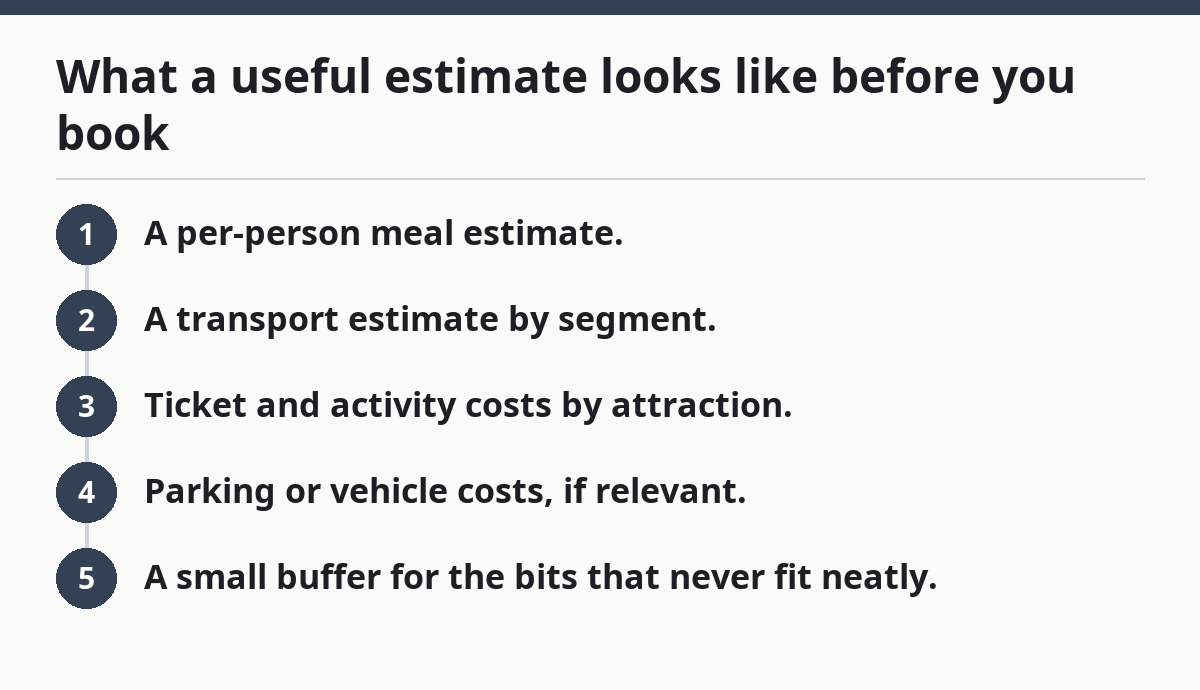
A strong estimate usually has five parts:
- A per-person meal estimate.
- A transport estimate by segment.
- Ticket and activity costs by attraction.
- Parking or vehicle costs, if relevant.
- A small buffer for the bits that never fit neatly.
If one line is much larger than the others, that line deserves a second look. The point is not to make the number look tidy. The point is to know where the money can move before you book.
For a fuller planning system, this page fits inside the broader budget family trip planning hub.
FAQ
Which trip costs are easiest to underestimate?
Food, local transport, and parking are usually the easiest to miss. They repeat in small amounts and feel minor in the moment, but they add up fast over 3 to 7 days. Tickets and rideshares can also jump if the trip includes a late arrival or a popular event.
How do I estimate food costs for a family vacation?
Price food by meal type, not by one flat daily number. Count breakfasts, lunches, dinners, snacks, and drinks separately, then multiply by the number of travelers and days. Check whether any meals are included with lodging or tickets so you do not double count them.
What is a variable cost in travel budgeting?
A variable cost is an expense that changes with the trip’s size, route, timing, or activities. Meals, local transit, rideshares, tickets, and parking are common examples. If the amount changes when you add one person or one more stop, it belongs in the variable bucket.
Drafted with AI; not yet reviewed by a person.