
Last updated: November 19, 2026
Key Takeaways
- Assign each payment method a role, then check every spend against a daily cap.
- Use cash for small repeat buys and cards for bigger or less frequent charges.
- Withdraw only enough cash for the next short stretch, then reassess.
- Set card rules before the trip and verify them before each purchase.
A family trip budget slips fastest when cash and cards blur together. Use cash envelopes for small daily spending, put bigger purchases on one card, and set a daily stop line before you leave. For the topic of How to Keep a Family Trip Budget Under Control When Traveling With Cash and Cards, the goal is simple: keep spending visible, and use one payment method at a time. The sections below show how to do that without guessing, drifting, or coming home to a surprise balance.
Who this is for — and what it assumes you already know
This is for a parent or planner who is paying for a family trip with a mix of cash, debit card, credit card, mobile wallet, and ATM withdrawals. It assumes you already have a rough trip budget and now need live spending control on the road, not a spreadsheet lesson. For your own situation, a qualified adviser can help.
The method works best when one adult is the spending gatekeeper. If four adults are all swiping different cards with no shared rule, the budget will leak through the cracks. That is not a cash problem alone. It is a control problem.
It also assumes the trip is short enough that you can reset each day or every 2 days. A 10-day road trip needs tighter checks than a weekend city break. The same rule still applies: money for the day stays in the day. Here’s the catch:
- Cash envelopes work well for food trucks, tips, parking meters, and low-cost extras.
- Debit cards are useful for ATM withdrawals and ordinary purchases, but they draw from a bank account fast.
- Credit cards are better for bookings and larger charges you want in one place.
- Mobile wallets can help if you want fewer physical cards in your pocket, but they still spend real money.
The best part is that you do not need a fancy tool. A paper envelope, one debit card, one credit card, and a firm rule can do most of the work.
How do I keep a family trip budget under control with cash and cards?
You keep it under control by assigning each payment method a job, then checking every spend against a daily cap before the card or envelope moves. The core rule is simple: cash for small variable costs, card for bigger or preplanned charges, and no “I’ll sort it out later” purchases.
Use this travel spending controls setup before the first meal:
- Set one daily spending cap for the family. Write it on paper and keep it in your wallet or phone notes. Use a simple number you can track across meals, parking, snacks, and extras. Verify that it covers the day’s planned basics. If you can’t name the cap in one sentence, it’s too vague to work. For trip budgeting basics, the Consumer Financial Protection Bureau recommends setting limits you can track as you go.
- Split the cap into categories. Put cash envelopes for food, parking, tips, and incidentals. Keep card spending for hotel, fuel, tickets, and emergency backup. Verify each category has a job. If an envelope is doing a card’s job, the system is already drifting.
- Withdraw only the cash you expect to spend in the next 1 to 3 days. Use an ATM withdrawal from a debit card, not a blind top-up every time cash runs low. Verify the amount is tied to real planned spending. If you keep withdrawing “just in case,” you lose the signal that you are overspending. The CFPB and FDIC both advise tracking withdrawals and balances closely so cash decisions stay tied to the budget.
- Carry one main credit card and one backup card. Keep them in separate places. Verify both cards work online and in person before leaving home. If the backup is expired, locked, or tied to the same account only, it is not a backup.
- Use mobile wallet only as a mirror of the card you already chose. Treat it as a payment tool, not a separate budget, and if you are unsure how your linked account is set up, check with your bank or card issuer. Verify the linked card is the one you want to spend from. If you tap without checking, the spending rule disappears.
- Check the running total before every nonessential purchase. That means souvenirs, dessert, arcade time, snacks at a gas station, and unplanned rides. Verify the purchase fits the category left for the day. If not, skip it or move it to the next day’s envelope.
- Stop card spending once the cap is hit. Use cash only for the categories you already assigned. Verify that “card is done for today” is a real rule, not a mood. If the card stays active after the cap is gone, the limit is theater.
- Reset the plan at night. Count remaining cash, note card charges, and decide the next day’s envelope amounts. Verify the next day still has enough for the basics. If you cannot account for yesterday in 5 minutes, the system is too loose.
The point is not to be perfect. It is to make overspending obvious before it grows. That is what cash and cards do well together when they have separate jobs. Not even close to random.
What should go in cash envelopes, and what should stay on cards?
Cash envelopes should hold the small, repeat purchases that are easiest to forget, while cards should handle larger or less frequent charges. A cash envelope is just a labeled pile of bills or coins for one purpose, such as snacks, parking, or tips. It works because the physical money runs out.
Put these in envelopes:
- meals where you want a hard daily ceiling
- tolls, parking, and transit with small charges
- tips, street vendors, and low-cost activities
- emergency pocket money for one adult
Keep these on cards:
- hotel deposits and final lodging charges
- car rental and fuel
- higher-ticket tickets, reservations, and online bookings
- backup spending if cash is lost or stolen
Here’s the catch: some places add a card surcharge or only take cards, while others are cash-only. That is why the plan needs both. If you leave all cash at the hotel, you may tap the card for every ice cream and lose the budget faster than you notice. If you carry only cash, one broken ATM or one big purchase can throw the day off.
A simple way to avoid that is to decide the payment method before you walk in. If the item is not in the envelope and not on the approved card list, it waits. That one habit can prevent a lot of “small” spending, though results depend on the family and the trip.
How much cash should I pull from an ATM?
You should withdraw only enough cash for the next short stretch of the trip, then stop and reassess. ATM withdrawals are useful because they turn a loose estimate into a fixed amount, but they also make it easy to pull too much and spend it because it is there.
Start with a 1- to 3-day cash supply, then break it into envelopes the same day you withdraw it. Verify the cash matches what you actually spend in cash-heavy places, not what you hope you’ll spend. If you are still guessing after the second withdrawal, your categories are too broad.
A practical check is this:
- If one envelope empties early, the category is too small.
- If one envelope comes home full, the category was oversized.
- If the debit card is covering everyday meals because the cash ran out, the plan is too tight or too vague.
On the flip side, do not use the ATM as a rescue button every time the cash envelope looks thin. That is how families lose track of daily spending caps. Instead, pause, compare the remaining cash with the rest of the day’s needs, and decide whether the next spend should come from cash, the card, or not at all.
What do I do before a card gets used?
You give every card a rule before the trip starts, then check the rule before each purchase. A credit card and a debit card are not the same tool in a family travel budget, even if both tap at the same terminal. One draws from borrowed credit, the other from a bank balance, and both can erase a budget fast if they are treated like spare change; if that setup feels unclear, check with your bank or a qualified adviser before you travel.
Write these card rules down:
- Credit card: use for hotel, car, and larger booked purchases.
- Debit card: use for ATM withdrawals and only the day-to-day purchases you expect.
- Mobile wallet: use only if it is tied to the correct card.
- Backup card: use only if the primary card fails or is blocked.
Then check three things before swiping or tapping:
- Is this charge already expected?
- Does it fit the category left for today?
- Will this leave enough for the rest of the trip day?
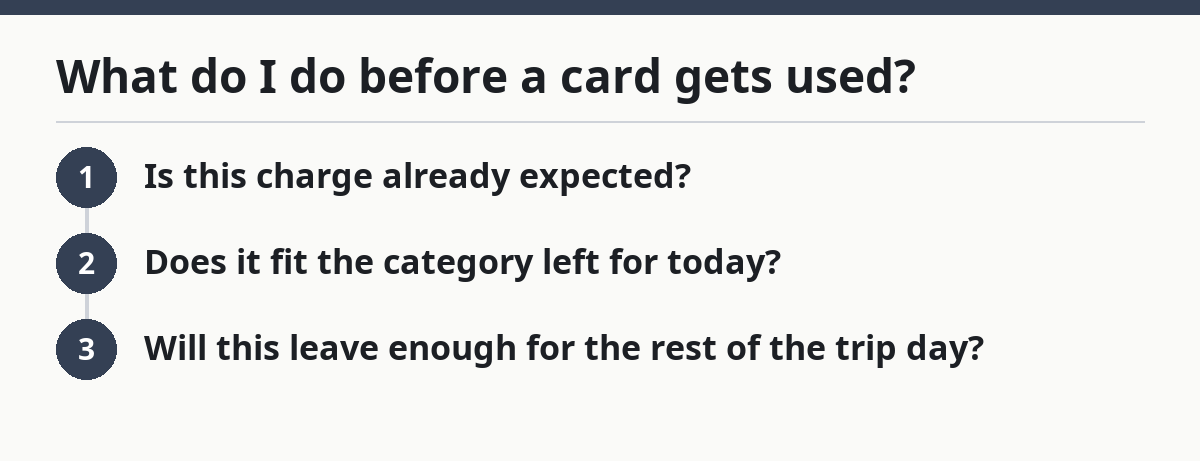
If any answer is no, stop. The consequence of skipping this check is simple: card spending feels frictionless, so the budget gets softer than cash. The correct alternative is not to ban cards. It is to give cards a narrower job than cash has.
You can also set card limits through your bank or card app in some countries and with some providers. Rules and features vary by country and issuer, so check the current settings on the exact account you use. If that feature is not available, use a handwritten limit and a strict “no extra swipe” rule instead.
When should I stop the standard approach and change the plan?
You should change the plan when the trip stops behaving like a normal family outing and starts acting like a high-spend or high-friction trip. Standard cash-and-card control works for many family trips, but it needs adjustment when the shape of the trip changes. The wrong tool creates false comfort.
One adult is paying for several other adults: the budget can drift fast because the payer becomes the default wallet — use stricter category rules and fewer shared purchases.
You are traveling through places with weak card acceptance: cash matters more and ATM access may be limited — carry more small bills and keep card spending for backup.
You expect many small purchases in one day: the envelope system can empty before lunch — split the day into morning and afternoon checks instead of one end-of-day review.
You are crossing borders or using foreign currency: exchange rates, fees, and ATM terms can change the real cost — confirm the current rules with your bank before the trip.
You have already hit the daily cap twice: the plan is too tight or the trip pattern has changed — cut nonessential spending and reduce the next day’s envelope, not the other way around.
A card is lost, blocked, or compromised: the backup system matters more than the budget logic — stop using that card and shift to the safe backup method immediately.
When those situations show up, the answer is not “spend harder.” It is “change the control system.” That may mean fewer card uses, more cash separation, or tighter daily resets.
What mistakes do families make with cash and cards?
Families usually make the same 5 mistakes, and each one has a clear cost. The good news is that each one has a better substitute.
- Mixing all money together. That makes it impossible to tell what is left for food, fuel, or fun. The fix is to separate cash into envelopes and keep card use tied to named categories.
- Using the debit card for every gap. That turns a bank account into a leak. The fix is to reserve the debit card for ATM withdrawals and planned purchases.
- Treating mobile wallet taps as “not real spending.” That mindset hides the charge. The fix is to treat every tap like a card swipe and count it the same day, or ask your bank how the linked account is tracked if you are unsure.
- Withdrawing too much cash at once. That weakens the daily cap because the cash feels like sunk money. The fix is smaller ATM withdrawals tied to the next 1 to 3 days.
- Skipping the night check. The next day starts with no clue where the money went. The fix is a 5-minute reset after dinner or before bed.
The consequence of all five mistakes is the same: the family spends with mood, not with rules. The correct alternative is boring on purpose. Boring is what keeps the trip intact.
What should a good result look like by day 2 or day 3?
A good result looks like money that still has a job when the day ends. By day 2 or day 3, the envelopes should make sense, the card charges should match expected purchases, and no one should be surprised by what is left. That is the real sign the system is working.
You should be able to answer three questions in under 2 minutes:
- How much cash is left in each envelope?
- Which card charges are already planned?
- Is tomorrow’s spending likely to be normal, tight, or heavy?
If you cannot answer those questions, the budget is not under control yet. The problem is usually not the amount of money. It is the absence of a clear rule for where each dollar goes.
A solid result does not mean you spend less than everyone else. It means every spend has a home before you spend it. That is the whole point of cash envelopes, debit card use, credit card rules, mobile wallet limits, and ATM withdrawals working together.
Which families should not use this method as written?
This method should not be used as written by families who need one person to manage all spending without any review, or by trips with many shared adult payers and no single gatekeeper. It also breaks down when the trip is mostly online-booked, luxury-heavy, or spread across many currencies and payment apps.
In those cases, the control problem is bigger than envelopes. A stricter card rule, a bank app limit, or a different payment setup may fit better. If the trip has special money rules, use those instead of forcing a simple system into a complex one.
The method also fits poorly if the family refuses to pause before purchases. If nobody will wait 30 seconds to check the category, cash and cards will both get abused. The system only works when the pause is real.
For a broader planning framework, the hub on budget family trip planning can help connect this spending control step to the rest of the trip budget.
Should I use cash or cards on a family vacation?
Use both, but give each one a job. Cash works well for small, everyday spending like snacks, parking, tips, and transit because you can see it leave the envelope.
Drafted with AI; not yet reviewed by a person.