
Last updated: November 19, 2026
Quick Answer: In many cases, AAA, AARP, and other membership discounts can save a family about $5 to $20 per night on hotels, but the exact amount depends on the date, room type, taxes, and fees. AAA, AARP, and other membership discounts can trim family travel costs on hotels, car rentals, and some attractions. This guide to How to Use AAA, AARP, and Membership Discounts for Family Travel shows where those discounts usually apply and when they are too small to matter.
Key Takeaways
- AAA and AARP discounts are most useful on hotel nights, car rentals, and a few tickets.
- Age rules matter: AAA is membership-based, while AARP is tied to membership and age eligibility.
- The same room or car can look cheaper with a discount code, but taxes, fees, or a better public offer can change the total.
- Membership perks help most on midweek stays, chain hotels, and standard car classes.
- For some trips, the discount is real but too small to beat a sale rate or package deal.
What AAA and AARP discounts actually cover for a family trip
AAA and AARP discounts usually cut prices on hotels, car rentals, and select attractions, not on every part of a trip. Picture this: you’re planning a 3-night family stay, a rental car for the airport, and one museum stop, and you want to know which membership card saves money without wasting time. The answer is to check the travel pieces one by one, because the best rate on one item may be weak on the others.
Membership rates are common in chain hotels, especially standard rooms and midweek dates. Car rental companies also use these discounts often, but the rate can change by location, car class, and pickup day. Theme parks and smaller attractions sometimes offer member pricing, yet those deals are less consistent and often tied to a named partner.
Here’s the catch: a discount that looks good at checkout may be smaller than another public offer. A $20 savings on a hotel night is real, but not if the room is already priced higher than a sale rate elsewhere.
- Check hotel rates first.
- Check car rental rates second.
- Check attraction prices last.
- Compare the member rate to the public rate on the same date.
- Save the booking page or screenshot so you can compare later.
For current program details, start with the AAA travel site and the AARP travel discounts page. You can also review AAA travel discounts and AAA travel to see how the offers are described by the programs themselves.
How do I compare AAA and AARP rates without wasting time?
You compare them by checking the same trip on the same day, with the same room, car, or ticket type, then picking the lowest total price. Picture this: you have a Friday check-in, a compact rental car, and two adult tickets for a family stop, and you need a fast way to spot the real deal. The trick is to compare the whole booking, not just the headline discount.
Start with the member rate from the travel provider, then open the public rate for the exact same item. If the member rate requires a prepaid stay, a nonrefundable car, or a less flexible ticket, that trade-off should be obvious before you click pay. You do not need a spreadsheet—just the same dates, same room type, and same pickup or entry time.
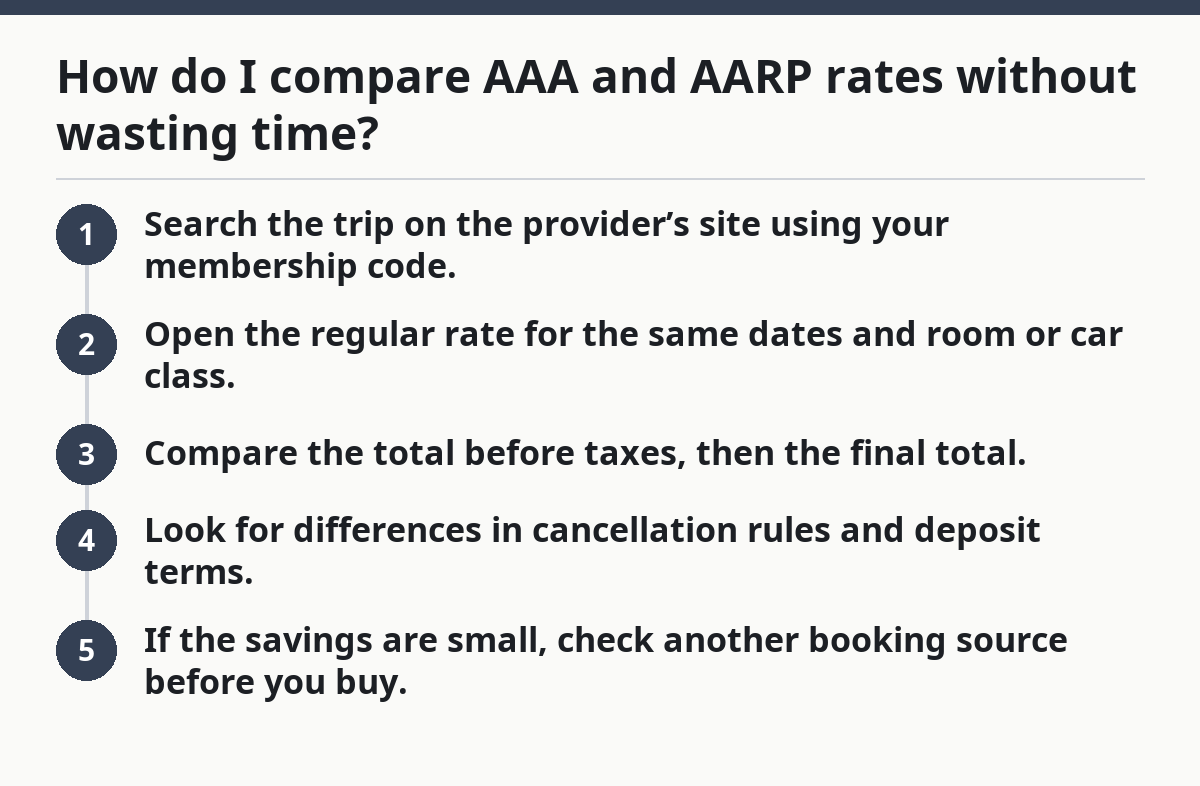
A simple order helps:
- Search the trip on the provider’s site using your membership code.
- Open the regular rate for the same dates and room or car class.
- Compare the total before taxes, then the final total.
- Look for differences in cancellation rules and deposit terms.
- If the savings are small, check another booking source before you buy.
A good rule: if the membership discount does not beat the public rate by a meaningful amount, stop. A $5 or $10 gap on a one-night hotel stay may not justify giving up flexibility.
Use the same comparison rule every time
Use the same comparison rule every time: same date, same category, same cancellation terms. Picture this: you’re staring at two hotel listings that look nearly identical, but one is a “member rate” and the other is a “special offer.” That is where people get burned, because the cheaper headline rate can hide a stricter rule.
Look for these details on the booking page:
- room type
- car class
- cancellation deadline
- prepaid vs. pay-at-property
- membership number required
- blackout dates
If the member rate is tied to a 24-hour cancellation rule while the public rate gives you 48 hours, the cheaper room may not be the better room. On a family trip, that matters when plans shift.
Hotel discounts: where AAA and AARP help most
AAA and AARP hotel discounts help most on chain hotels, standard rooms, and dates that are not already heavily sold out. Picture this: you’re booking a 2-queen room for a family of four and want a lower nightly rate without chasing coupon sites for an hour. That is where member pricing can be useful, because hotel chains often make it easy to apply a code at checkout.
The strongest use case is a straightforward stay: one room, one or two nights, and no special package add-ons. In those cases, the member rate may undercut the standard public rate. It can also be a practical fallback when a hotel sale is gone but the chain still honors member pricing.
The trade-off is that member rates are not always the lowest rate on the site. Some public promos beat them outright, especially during shoulder seasons or on less busy dates. A member rate can also be locked to a specific room type, which means you may not get the family setup you wanted.
- Best fit: standard chain hotels.
- Less useful: boutique hotels with limited inventory.
- Watch for: prepaid rules and stricter change terms.
- Check: whether breakfast, parking, or resort fees are included.
A quick habit helps here: compare the member rate with the public rate and any visible promo code before you enter your card. If a hotel has a 15% public sale and the member rate is only a few dollars lower, the sale may be the better move.
For hotel planning, family travel hotel deals can help you see how member pricing is presented, and hotel cancellation rules matter just as much as the rate itself.
Car rental discounts that matter for families
AAA and AARP car rental discounts matter most when you rent a standard car class and pick up at a major airport or city branch. Picture this: you need a minivan or midsize car for a week, and the booking page shows half a dozen rates that all look similar. The member discount can simplify that mess, but it does not always beat every public rate.
Car rental companies often use membership pricing in the same way hotels do: as one option among many. That means the posted member rate may be better on one location and weaker on another. It can also change if you book a compact car and then switch to a larger class for luggage or child seats.
One mistake is assuming the discount always applies to every vehicle. It may not. Specialty vehicles, one-way rentals, or premium classes can be excluded or priced differently, and a car that looks cheaper at first can climb once you add age-related fees, a second driver, or optional equipment.
- Compare the daily rate and the total.
- Check whether the rate is for a compact, midsize, SUV, or minivan.
- Look at the fuel policy and mileage rules.
- Confirm whether the discount applies at airport and neighborhood locations.
- Read the cancellation rule before booking.
If the member price is only a little lower than the regular price, look at the rental’s full terms. A lower rate with a stricter cancellation rule is not much help if your flight changes by 3 hours or your family plans shift.
For a broader look at rental terms, see car rental discounts and the AARP car rental discounts page.
Can AAA or AARP save money on attractions and theme parks?
Yes, but only on select attractions and only when the partner deal is better than the public ticket price. Picture this: you’re planning one museum visit and one theme park day, and you want to know if the membership card belongs in your wallet or just in your glove box. The answer is that attraction discounts are useful, but they are the least predictable part of membership travel.
Theme parks, museums, zoos, aquariums, and tours may offer member pricing through AAA, AARP, or another partner program. Some discounts are small percentage cuts, while others are bundled with package deals or special entry dates. A few are only available through a local office or member portal, which makes them harder to compare at a glance.
The drawback is obvious: attraction discounts often lose to public promotions, bundled family tickets, or online ticket sellers. A family of four may save more with a timed online sale than with a membership code. That is why you should treat this category as a check, not a default.
- Use membership pricing as one option, not the first option.
- Compare the ticket to the attraction’s own website.
- Check for child, senior, or package pricing.
- Read date limits and entry restrictions.
- Watch for tickets that cannot be refunded or exchanged.
If the attraction is a must-do and the member price is slightly better, take it. If the public site has a family bundle or flash sale that beats it, skip the membership code and move on.
Age-based eligibility: who can use what
AAA and AARP are not the same kind of membership, and age rules can decide which one you can use. Picture this: one parent has AAA, another has AARP, and the family wants to know which card actually opens the better travel rate. The answer depends on who is eligible for the program and whose name is on the booking.
AAA is a membership program, so travel discounts are tied to active membership. AARP is tied to membership and age eligibility, so the discount may be available only to members who qualify under that program’s rules. That difference matters when you’re booking for a household, because the discount usually belongs to the member, not to every traveler in the car or room.
The practical move is simple: use the card that fits the booking and the rate rules. If the hotel or car company asks for the membership number at checkout, enter the one that matches the account. If a partner deal is restricted to the member’s name, the booking should reflect that.
What trips this up:
- booking under a child’s name
- using a member code that does not match the reservation
- assuming the discount applies to everyone in the family
- mixing up age eligibility with family size
If a rate is clearly tied to a member account, put the member in the lead traveler field. That keeps the booking aligned with the discount terms and avoids a check-in headache.
Which discount wins: membership code or public deal?
The public deal wins whenever it beats the membership rate on the same trip details. Picture this: you find a member rate, a promo code, and a sale banner all on one hotel page, and you need the fastest way to choose. The right answer is to compare the total price after the same taxes and fees, then pick the cheaper option with the rules you can live with.
A good rule is to treat membership pricing as one lane in the search, not the answer. Compare the member rate with:
- the regular published rate
- any promo code on the site
- package pricing
- direct public offers from the hotel, rental company, or attraction
If the membership rate saves a few dollars but blocks cancellation, that may not be worth it for family travel. On the other hand, a solid rate on a busy weekend can be worth grabbing quickly.
This is where the page on [budget family trip planning by booking timing and pricing] should sit in your planning stack, because timing often changes which rate is best. A discount is only good if it fits the date you actually need.
Two authoritative places to start reading program rules are the AAA travel site and the AARP travel discounts page. Those pages show how the programs describe eligibility and member offers, which is the cleanest way to check the current terms before you book.
What family travel discounts come with AARP?
AARP commonly offers travel discounts on hotels, car rentals, and some attractions through participating partners. The exact offers change by company, date, and location, so the member rate is not guaranteed to be the cheapest rate every time.
The practical move is to compare the AARP offer with the public rate for the same booking. If the AARP price is lower and the cancellation terms work for your family, it can be a good fit. If a public sale beats it, take the cheaper total and move on.
Is AAA worth it for family travel savings?
AAA is worth it when you use it on hotel nights, car rentals, or a few attraction tickets often enough to matter. If you only travel once in a while, the savings may be too small to justify chasing every member rate.
The real test is simple: compare a few bookings you already need, such as one hotel stay and one car rental. If the member discounts are consistently better or easier to use, AAA can pull its weight.
Can you stack membership discounts with other travel deals?
Sometimes you can, but not always. Many member rates cannot be combined with another promo code, and some sales are exclusive or nonstackable by design.
The safest move is to read the booking terms before paying. If the site allows a promo code plus a member rate, the checkout screen will usually show it. If not, compare the two offers and use the better one instead of assuming both will apply.
Drafted with AI; not yet reviewed by a person.