

Last updated: November 19, 2026
Quick Answer: For How to Plan a Family Trip Around School Breaks Without Overspending, start with the school calendar first and try to shift travel by 1 or 2 days; that small move can help you avoid peak-school-break pricing. School breaks can wreck a travel budget fast if you guess dates and hope for the best. A family trip around school breaks is usually cheaper when it fits the calendar first, then trims the rest. The steps below show how to line up school calendars, holiday weekends, spring break, summer vacation, and winter break without paying for unnecessary peak days.
Key Takeaways
- Start with the school calendar, not the destination.
- The trip often gets cheaper when you move by one or two days.
- Long weekends can work, but only if you avoid the busiest departure and return dates.
- Spring break, summer vacation, and winter break each need a different planning tactic.
- A family trip around school breaks works best when you protect flexibility on dates, not on everything else.
Start with the school calendar, not the destination
Picture this: you’re staring at three possible trips, two kids’ calendars, and a holiday weekend that looks cheap until you add airfare. The answer is to lock the school break first, then build the trip inside the smallest cheap window you can find.
The school calendar is the anchor for a family trip around school breaks. If your child’s district has a Friday-to-Monday holiday and a Monday-to-Friday spring break, those are not the same planning problem. One gives you 3 nights; the other gives you 7 or more. The wrong move is shopping for destinations before you know which dates are actually free.
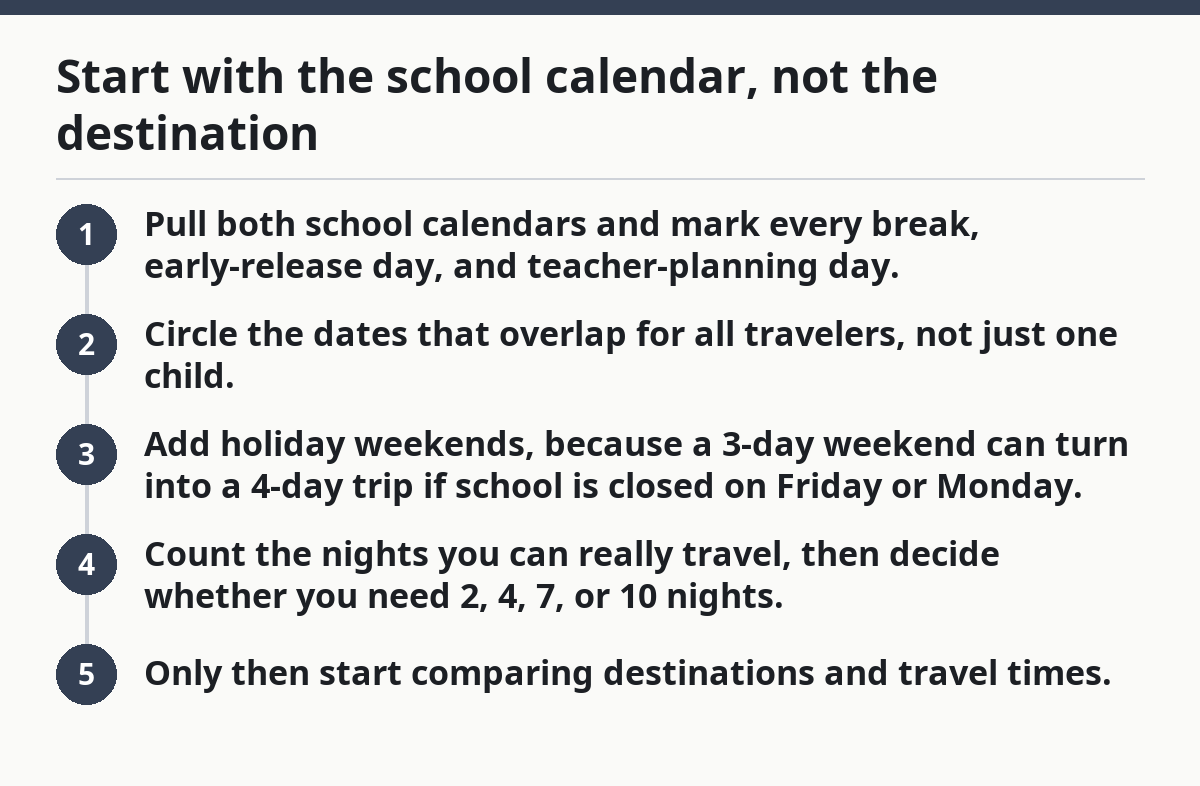
Use this quick order of operations:
- Pull both school calendars and mark every break, early-release day, and teacher-planning day.
- Circle the dates that overlap for all travelers, not just one child.
- Add holiday weekends, because a 3-day weekend can turn into a 4-day trip if school is closed on Friday or Monday.
- Count the nights you can really travel, then decide whether you need 2, 4, 7, or 10 nights.
- Only then start comparing destinations and travel times.
A family with one child in school and one in preschool has more freedom than a family with two different school districts. A family that needs care for a toddler too has another constraint. That is why the calendar comes first in family trip around school breaks planning.
If you want a bigger framework for timing, this page sits under the broader hub on budget family trip planning by travel windows and timing. That hub covers the bigger picture; this page is about the school-break piece. For related planning, see the broader budget family trip planning guide, the school calendar planning checklist, and the family travel budget calculator.
How do I match holiday weekends to family trips without paying peak prices?
You can often match holiday weekends by treating the holiday itself as the expensive center and moving one or two days away from it, but if you are unsure how school rules or travel rules apply, check with your school district or a qualified travel professional. The same advice is reflected in standard travel-demand guidance from the U.S. Department of Transportation and airline industry planning resources. The value may improve when you leave before the rush or return after it.
Holiday weekends are useful because they stretch a short break into a real trip. They are also expensive because everyone else sees the same 3 or 4 days. A Friday departure and Sunday return can look tidy on paper and still cost more than a Thursday-night departure with a Monday return.
A holiday-weekend plan can mean one extra night of lodging, and that extra night may still cost less than peak airfare. That trade-off matters when your school break is tight and your dates are fixed.
A better way to use holiday weekends:
- Leave early, if the school calendar allows it.
- Return on the least crowded day, not the most obvious one.
- Consider nearby airports or rail stations if driving is not your only option.
- Pick destinations where a 2-night stay still feels worth it.
- Avoid stacking a holiday weekend on top of a school break if you can choose another week.
For example, a 4-day weekend can work well for a city trip, a nearby beach, or a cabin within driving distance. It works poorly for a faraway destination if the trip spends half its time in transit. That is not a budget trip. That is a tired trip.
When the holiday calendar is packed, the goal is not “cheap in an absolute sense.” The goal is less expensive than the dates before and after it.
What should I do for spring break, summer vacation, and winter break?
Each school break needs a different plan because the demand curve changes with the season. Spring break is often the easiest to bend by a day or two, summer vacation needs the longest lead time, and winter break punishes last-minute choices the hardest.
Spring break usually lasts about a week, which is long enough for a real trip but short enough that a small date shift can matter. If your district’s spring break sits in the middle of a crowded travel week, consider leaving on the first possible evening and returning after the rush. A midweek departure can be much kinder to your wallet than a Friday start.
Summer vacation gives you the most days but also the most competition for family travel. If school is out for 8 to 10 weeks, the smartest move is not to wait until July and hope. Pick the 1 or 2 weeks with the best mix of school calendars, work schedules, and lower-demand days, then hold those dates early. Families who can leave in late May or late August often find more breathing room than families chasing the middle of summer.
Winter break is the hardest. It is short, it overlaps with major holidays, and every good flight time gets grabbed early. If the school calendar gives you 9 or 10 days, decide fast whether the trip is meant for Christmas week, New Year’s week, or the quieter days in between. Those are not interchangeable.
A simple rule helps:
- Spring break: shift by 1 to 2 days if you can.
- Summer vacation: choose the least crowded week, not just the most convenient.
- Winter break: book around the holiday peak, or expect to pay for it.
The truth is, winter break is often the wrong time for the farthest or fanciest trip. It is a better fit for shorter travel, a driving trip, or a stay that does not depend on the single cheapest flight of the year.
What if my dates are fixed and I barely have flexibility?
Fixed dates are still workable if you control the pieces that can move: departure time, return time, destination distance, and trip length. You may not be able to change the school break, but you can often change the shape of the trip.
Picture a family locked into a Tuesday-to-Sunday school break. The dates are set, but the cost can still swing depending on whether the trip is 2 hours away or 6, whether you fly on the busiest day, and whether you stay for the full break or leave one night early.
Use this 4-part filter when flexibility is thin:
- Move the clock. A very early flight or a late return can be cheaper than the most obvious time.
- Move the route. A direct drive can replace a flight if the trip is short enough.
- Move the stay. A 4-night stay may cost less overall than a 6-night stay, even if the nightly rate is similar.
- Move the destination. Some places are naturally expensive during school breaks because everyone is trying to go there at once.
The goal is not to chase every discount. It is to avoid expensive choices that add little value. A 90-minute layover can be worth it if it saves enough to make the trip possible. A two-night stay in a far-off city may not be worth it if the travel eats up the best days.
This is also where date flexibility matters more than almost anything else. A family that can shift by 2 days has more options than a family shopping only on the break’s center date. Even a tiny change can open a better fare, a better room, or a less crowded itinerary.
If you need a clear rule, use this one: protect the school break, then relax everything else.
How do I keep the trip from becoming a budget mess?
You keep the trip from becoming a budget mess by deciding what the school break is for before you start shopping. If the break is short, a 3-night trip may be the right move. If the break is long, a lower-cost destination may matter more than a fancy one.
This is where many family plans go sideways. The calendar says “school break,” so the mind says “bigger trip.” That is how a manageable plan turns into extra nights, extra meals, and extra transit costs. A school-break trip should fit the time you have, not the fantasy version of the time you wish you had.
The most useful checks are plain:
- Can the trip be done in the number of nights you actually have?
- Does the destination still feel worthwhile if you remove one expensive day?
- Are you paying extra just because the date is a Friday or Sunday?
- Would a different break on the school calendar give you the same fun for less?
For families, the best trips around school breaks are often the ones that feel calm, not the ones that look impressive on paper. A shorter drive, one fewer night, or a quieter departure day can do more for the budget than a long search for the “perfect” deal.
One smart move is to build around the break type, not the destination type. Holiday weekends suit shorter trips. Spring break suits a mid-length trip with some date wiggle room. Summer vacation suits longer planning and more comparison. Winter break suits early decisions and honest limits.
The limit matters. A family who needs every school day accounted for should not plan a trip that depends on a last-second bargain. That is not flexibility; that is stress with a receipt.
The simple planning order that works
Picture this: you have the school calendar open, two possible breaks circled, and a rough idea of where you want to go. The right order is simple — date first, trip length second, destination third, and budget trade-offs last.
Use this sequence every time:
- Mark school breaks, holiday weekends, spring break, summer vacation, and winter break on one calendar.
- Pick the break that gives the best balance of time and demand.
- Decide the shortest trip that still feels worth taking.
- Check whether shifting by 1 or 2 days changes the cost enough to matter.
- Choose the destination only after you know the dates.
- Hold the dates that fit best, then stop shopping for alternatives unless a real issue appears.
That order keeps you from chasing shiny options that do not fit the school year. It also keeps the trip grounded in reality. A family travel plan that ignores the calendar usually costs more because it fights the calendar instead of using it.
The best part? You do not need a perfect stretch of free time. You need a break that is big enough for the trip you can actually afford.
Common mistakes that waste money around school breaks
The most expensive mistake is assuming all school breaks are equal. They are not, and treating them that way leads to bad timing, crowded travel days, and trip plans that are too long for the break you have.
A few errors show up again and again:
- Waiting too long for winter break. That often leaves only the priciest dates and the worst flight times.
- Ignoring holiday weekends inside the school calendar. A break that touches a holiday can get costly fast.
- Choosing a long trip for a short break. The travel days eat the value of the trip.
- Looking only at the most obvious dates. A shift of 1 day can change the whole feel of the trip.
- Planning around adults’ schedules only. School calendars are the hard limit, not the preferred one.
What does that cost? Usually it costs time, money, or both. The fix is to treat the school calendar as the hard boundary and to test nearby dates before you commit to the middle of the busiest stretch. If your family can only travel during one crowded week, you want the trip to be shorter, simpler, and closer than your first draft.
A good school-break trip does not need to be fancy. It needs to fit the calendar, respect the demand pattern, and leave enough room in the budget for the parts of the trip that actually matter.
FAQ
How far in advance should I book around school breaks?
Book as early as your dates are clear enough to trust. Spring break and winter break often reward earlier planning because many families are chasing the same window. If your school district publishes its calendar months ahead, use that lead time to settle the dates first and avoid last-minute choices.
How do you travel cheaply during school holidays?
Travel cheaply during school holidays by moving one or two days away from the busiest part of the break and keeping the trip short enough to match the time you have. A 3-night or 4-night plan can work better than stretching the dates just because they are available. Shorter is often cheaper and less tiring.
How can families avoid peak prices on school breaks?
Families avoid peak prices on school breaks by choosing the less crowded edge of the calendar, not the center. Leave early if the school schedule allows it, return after the rush if possible, and compare a few nearby dates before you commit. The cheapest option is often the one that looks slightly inconvenient at first.
Drafted with AI; not yet reviewed by a person.
