
Last updated: November 19, 2026
Quick Answer: Budget family travel planning by family needs and trip logistics is easiest when you start with the family first and the fare second. In practical terms, a 7-year-old, a toddler, or a grandparent can change the best choice by hundreds of dollars, because timing, room layout, food access, and baggage all affect the total trip cost.
Key Takeaways
- Start with ages, sleep, and trip length before comparing fares or rooms.
- Transport, sleeping, food, and baggage are the biggest family budget levers.
- The lowest ticket price may still cost more once logistics are added.
- Budget in layers: transport, lodging, food, local movement, and a stress buffer.
Budget family travel planning works best when the trip is built around your family’s needs first and the logistics second. The cheapest trip on paper can become the most expensive one in stress, so the right plan is the one that matches ages, sleep needs, mobility, luggage, timing, and tolerance for transfers without wasting money on the wrong trade-offs.
I write about travel planning, family budgets, and trip structure, so I can sort the useful money decisions from the traps that only look cheap. For budget family travel planning by family needs and trip logistics, the goal is not just a low fare; it is a trip that still works once the family is on the move.
Start With the Family, Not the Fare

The right budget starts with the children, the adults, and the trip length — not with the first cheap flight or hotel deal. A family with a 7-year-old and a stroller has different needs from a family with teenagers, and those needs change the economics of the whole trip.
The simplest way to plan is to write down five things before comparing prices: ages, sleep habits, mobility limits, feeding needs, and the number of adults who can share the load. A family with a toddler who naps at noon may need a shorter transit day and a hotel room with blackout curtains, even if those choices raise the nightly rate. A family traveling with a grandparent may need fewer stairs, slower movement between stops, and a rental car with easy entry, which can be cheaper than constant rideshares.
This is where many generic budget guides go wrong. They chase the “lowest fare” and ignore the cost of friction. A $120 savings on a flight can vanish when it lands at 11:30 p.m. and forces a hotel stay near the airport. A room with one king bed might be cheaper than two queens, but it can backfire with older children who wake each other up.
The useful question is not “What is the cheapest trip?” It is “What trip lets this family function without paying hidden costs in sleep, transport, food, and meltdowns?” Once that is clear, the budget becomes a tool rather than a trap.
What family logistics change the budget the most?
Family logistics change the budget most through transit timing, room layout, food access, and baggage. A trip with the wrong logistics can easily cost more than a “fancier” itinerary that is better arranged for the family’s real needs.
Transit timing is the first pressure point. Early departures can be cheaper, but a 6:00 a.m. flight may require a pre-dawn ride, airport parking, or a hotel the night before. Late arrivals can be fine for adults, but children often lose one full night of decent sleep when travel ends after 9:00 p.m. If the family needs a rental car, factor in the pickup queue, car-seat setup, and the possibility of paying for two car seats if bringing only one is impractical.
Room layout matters because families pay for space in different ways. A suite with a door separating sleeping areas can cost more than a standard room, but it may prevent a second room from being necessary. For some families, one extra bedroom beats paying for babysitting-like exhaustion. For others, a basic hotel room is enough because the kids are old enough to share and sleep through noise.
Food access is another budget lever. A hotel without breakfast and without a microwave can add a surprising amount to daily spending, especially with small children who eat on schedule. A room with a mini-fridge can save money if the trip includes simple groceries, yogurt, fruit, or sandwich supplies. On the other hand, a self-catering apartment can fail as a budget choice if the family spends every evening cooking after long days out.
Baggage is often undercounted. Strollers, car seats, pack-and-plays, and extra clothing for younger children all add bulk. If airline fees, checked bags, and airport handling become too messy, a road trip or train trip can actually be the better budget move even when the fare looks higher.
Road trip, flight, train, or all-in-one resort?

The cheapest option is not always the one with the lowest ticket price. A road trip wins for mixed-age families who need control, flexibility, and their own gear; flying wins when distance is large and travel time matters; trains win when the route is practical and the family wants fewer transfers; all-in-one resorts win when movement, meals, and activities would otherwise create too many separate purchases.
Here is the real comparison:
| Criteria | Road trip | Flight | Winner for |
|---|---|---|---|
| Control over schedule | High; stops and departure times are flexible | Low; airline times and delays set the pace | Families with nap schedules or special routines |
| Up-front cash outlay | Often spread across fuel, tolls, and lodging | Often concentrated in tickets and baggage fees | Families who need to stagger spending |
| Gear transport | Easiest for strollers, coolers, toys, and car seats | Hardest if bags and seats are limited | Families traveling with children under 6 |
| Fatigue risk | High on long drives, especially over 6–8 hours a day | High at airports, but shorter total travel time | Families who can split driving and keep legs short |
| Food flexibility | Strong; cooler and snack stops are simple | Moderate; airport food is expensive and limited | Picky eaters and families with allergies |
| Weather sensitivity | Moderate; roads can still be affected by storms | High; flights are more likely to shift with weather | Families traveling in shoulder seasons |
| Need for transfers | Low after the car is packed | High if airport, shuttle, and rental car are all involved | Families who want fewer handoffs |
| Value for short stays | Good if the destination is nearby | Often poor for very short trips because travel eats the schedule | Weekend trips within a day’s drive |
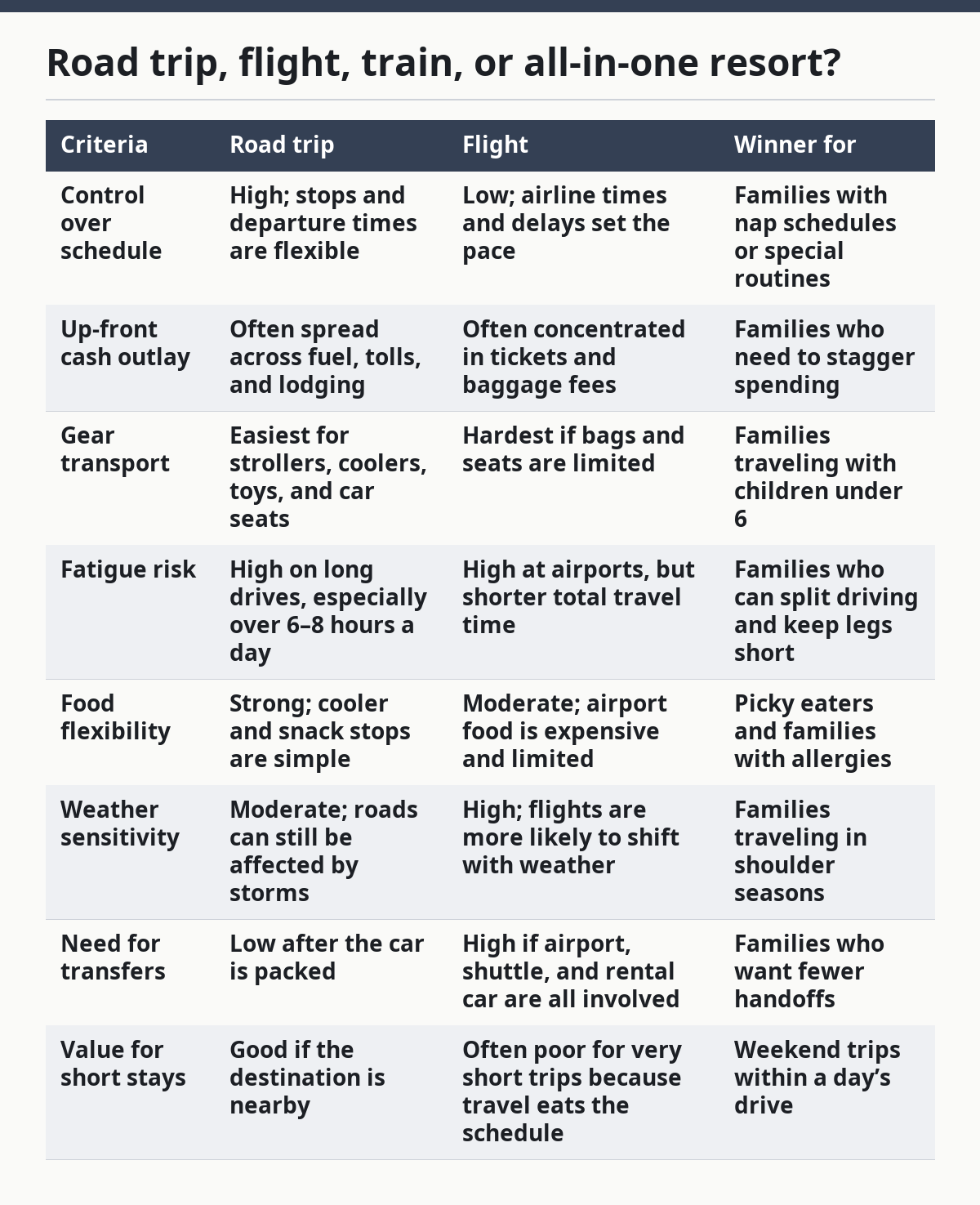
The table hides one needed truth: the “winner” depends on how many extra steps the family can tolerate. A flight may be the best money saver for a long-distance visit, but only if the airport logistics are not brutal. A road trip may look budget-friendly, but if the family needs a hotel stop on the way out and back, the savings shrink fast.
The practical rule is simple. If the destination is within a comfortable drive and the family has younger children or more gear than average, road travel often wins. If the trip is long-haul and the family can manage carry-ons, flights usually win on time. If the route is direct and the family wants low-friction movement, rail can be a strong third option. If the vacation is meant to be simple rather than adventurous, an all-in-one resort can make sense because meals and activities are easier to predict, though that only works when the family will actually use the included amenities.
How should you build the budget around real family needs?
Build the budget in layers: transport, sleeping, food, local movement, and a stress buffer. That order keeps the family from spending the whole budget on a cheap headline deal and then scrambling for the parts that make the trip livable.
Start with transport. Use the actual route, not a vague idea of the route. A family driving 5 hours each way needs fuel, rest stops, and possibly one overnight stay if the children cannot manage a full day in the car. A family flying needs bags, ground transport, and probably a second form of transport at the destination. If the destination is in a city with good public transit, that may reduce costs more than a rental car. If the destination is spread out, the rental car might be the cheaper option once rideshares are counted.
Next, price the sleeping setup. This is where many families underbudget because they compare only nightly rates. A room with two queen beds may be easier than a suite if older children sleep well. A vacation rental may be worth it if the family needs a kitchen, laundry, or separate rooms. The trade-off is cleaning, check-in friction, and the risk that the place is farther from activities than expected.
Then price food honestly. A family trip usually costs less when breakfast is included, lunch can be assembled from groceries or simple takeout, and dinner is planned in advance rather than decided after everyone is hungry. For a family with a child who needs frequent snacks, a grocery stop on day one can save a lot of small purchases that add up. The downside is that grocery-based travel can feel like part-time domestic labor, which matters on a short vacation.
Finally, add a buffer. Families almost always need one unplanned purchase: a refillable bottle, a forgotten charger, a rain poncho, a pharmacy stop, or a last-minute ride. A budget without a buffer is not a budget; it is a guess. A small cushion gives the family room to adapt without turning every surprise into a crisis.
When does a hotel beat a vacation rental for families?
A hotel beats a vacation rental when the family wants lower planning effort, shorter check-in time, and fewer responsibilities during the stay. A vacation rental beats a hotel when the family needs a kitchen, laundry, separate sleeping areas, or a longer stay that makes the extra setup worthwhile.
Hotels win for quick trips, uncertain schedules, and families who will spend most of the day away from the room. If the stay is only two nights, the time saved by not managing laundry, dishes, or a long arrival checklist can matter more than the space. Hotels also tend to work better when the destination itself is the point and the room is mainly for sleep and cleanup. Families with young children may appreciate on-site breakfast or a pool that does not require a separate entry fee.
Vacation rentals win when the family has special food needs, wants to spread out, or stays long enough that the kitchen and laundry earn their keep. A family with a baby or toddler often benefits from a fridge, microwave, and washing machine more than from a lobby and daily housekeeping. For a weeklong trip, those features can reduce food spending and make the schedule easier.
The trade-off is predictable. A rental can lower some daily expenses while creating more planning work before and during the trip. The family may need to buy groceries, arrange check-in, and understand house rules. Some rentals are also located farther from transport and attractions, which means the lower nightly rate can be offset by more rides or driving.
This choice changes again by family size. A couple with one child may find a standard room perfectly fine. A family of five with one bathroom may find a two-bedroom rental worth the extra complexity. The right answer is not about status or trend; it is about whether the layout reduces the number of daily bottlenecks.
What are the budget traps most family travelers miss?
The biggest budget traps are baggage creep, transfer creep, snack creep, and schedule creep. Each one sounds small and each one can quietly turn a tidy plan into a messy bill.
Baggage creep happens when “just one more bag” becomes the norm. Families often pack for comfort but pay for it at the airport, in the car, or in lost time at check-in. A stroller, car seat, and extra suitcase can be worth it for a toddler, but not every child’s gear is equally necessary on every trip. The fix is to decide in advance what must travel and what can be rented, borrowed, or left home.
Transfer creep is the habit of stacking extra movements into the trip: airport to hotel, hotel to attraction, attraction to dinner, dinner back to hotel. A place that looks centrally located can still be a costly slog if the family has to do that pattern every day. Trips with one or two anchor locations reduce this problem.
Snack creep is the budget leak that comes from hungry children and no plan. Airport kiosks, hotel lobby snacks, and convenience-store stops are all expensive compared with a bag of fruit, crackers, or cereal bars packed ahead of time. The cost difference is not always huge per item, but it becomes meaningful across several days.
Schedule creep is what happens when the family tries to fit too many activities into a travel day. Tired children need breaks. Tired adults make expensive choices because they are done thinking. A calmer itinerary can be cheaper because it reduces taxis, impulse food buys, and emergency purchases.
None of these traps is dramatic. That is the point. Budget travel usually fails in tiny leaks, not one giant mistake.
Which family needs points to a specific strategy?
The right strategy depends on which constraint is hardest: sleep, money, mobility, or timing. If sleep is the problem, choose fewer transfers and longer stays in one place. If money is the problem, choose a destination that reduces transport and food costs rather than chasing the lowest fare. If mobility is the problem, minimize stairs, distance between stops, and luggage handling. If timing is the problem, pick the option with the fewest moving parts.
Here is the clearest way to match family type to trip style:
- Families with children under 5 usually do best with simpler transit, a room or rental with food storage, and less daily packing.
- Families with school-age children can tolerate more movement, but still benefit from predictable mealtimes and one major activity per day.
- Families with teenagers can handle longer travel days and are often better suited to flights or rail, especially when the itinerary is less gear-heavy.
- Families traveling with a baby or grandparent should prioritize ease of movement over the lowest fare.
- Families taking a short break of 2 to 3 nights should avoid logistically heavy plans because the travel overhead can swallow the trip.
A generic article might say “save by booking early” and leave it there. That is too blunt to be useful. Early planning helps, but only if the family already knows the shape of the trip. A family that needs adjoining rooms, a flat walk, or a specific bed setup should book earlier than a family that can simply choose the lowest fare when it appears. A family with flexible dates can wait longer, but only if the destination still has the logistics the family needs.
The test is not whether a plan is cheap in isolation. The test is whether it remains cheap after the family’s real-life constraints are added back in.
The Verdict: which budget strategy should you choose?
Choose the most direct, least fragmented trip if the family includes young children, light sleepers, or anyone who struggles with long transitions. Choose the lowest-cost route on paper only if the family can absorb the added friction without paying for it later in food, transfers, or lost rest. Neither works if the trip is so logistically complex that the savings disappear into extra nights, extra bags, or extra transport.
That means a road trip is usually the best budget choice for nearby destinations with lots of family gear and a flexible timeline. A flight is usually the better choice for long distances when the family can keep the airport process contained. A train works best where the route is practical and the family wants fewer transfers. A vacation rental is the smarter stay when the family needs a kitchen, laundry, or more than one sleeping area. A hotel is the better stay when the trip is short and convenience matters more than cooking space.
The wrong choice is the one that ignores the family’s weakest point. A cheap flight with a midnight arrival is wrong for a toddler who needs sleep. A long drive is wrong for a family that cannot tolerate hours in a car. A rental far from the action is wrong for a family that wants to move less, not more.
What should you check before you press buy?
Check the trip in this order: transport timing, sleeping setup, food plan, local movement, and buffer costs. That sequence catches most budget mistakes before money is committed. It also forces the question that matters most: does this trip fit the family that is actually going, not the idealized version of them?
For family travel logistics and consumer protection, the U.S. Department of Transportation’s airline consumer resources explain what to expect from delays, fees, and cancellations. The U.S. Centers for Disease Control and Prevention also gives travel guidance for families and children, which is useful when health, timing, or routine matters to the budget. Those references keep budget family travel planning by family needs and trip logistics grounded in what the family can actually manage.
For a practical family budget, the best plan is usually the one that looks slightly less exciting on a spreadsheet but feels calmer in real life. That calm often saves more money than the flashiest bargain.
Can a family budget trip still feel like a real vacation?
Yes — and it usually feels more like a vacation when the plan is simpler, not when it is packed tighter. A budget trip works when the family can rest, eat without drama, and move through the day without constant decision-making.
The mistake is assuming that saving money requires stripping out every comfort. It does not. It requires spending where friction is highest and cutting where value is lowest. For one family that means a better room and a plain itinerary. For another it means a cheap room and a car. For another it means fewer days away but less chaos.
The best family trips are often the ones that protect sleep, simplify meals, and reduce transitions. Those are not luxury choices. They are logistics choices, and logistics is where family travel budgets are won or lost.
How far in advance should I plan a family trip on a budget?
Plan transport first as soon as the dates are fixed, then build the rest around the family’s constraints. For school holidays, busy weekends, or trips that need adjoining rooms or a specific layout, earlier planning gives more options and usually less scrambling. Flexible families can wait longer, but only if they can tolerate fewer choices.
Is it cheaper to fly or drive with kids?
It depends on distance, baggage, and how many overnights the drive requires. Driving often wins for shorter routes and gear-heavy trips because it avoids baggage fees and gives you control. Flying often wins for longer distances because the time savings can outweigh the extra costs.
Should I book a hotel or a vacation rental for a family trip?
Choose a hotel for short stays, simple schedules, and maximum convenience. Choose a vacation rental when you need a kitchen, laundry, or separate sleeping space for several nights. The rental only stays budget-friendly if the extra setup and cleanup do not create new costs in time, transport, or food.
What is the biggest mistake families make when planning on a budget?
The biggest mistake is ignoring logistics while chasing the lowest headline price. A cheap fare can become expensive once you add bags, transfers, food, and lost sleep. A better plan is to budget for the full trip experience, not just the ticket or nightly rate.
Drafted with AI; not yet reviewed by a person.