

Last updated: November 19, 2026
Quick answer: In how to spot the hidden fees in family travel bookings, the number that matters is the final total, not the first price. Families can often find 3 to 6 extra charges before they pay, including seat selection, baggage, resort fees, cleaning fees, parking, and add-ons that appear after the base price looks low. The fastest way to catch them is to check the full trip path — search result, room or fare details, and checkout — for any charge that changes the price before you pay.
Where hidden fees usually hide in family travel bookings
In how to spot the hidden fees in family travel bookings, hidden fees usually hide in the last screen before payment, not in the headline price. Airlines, hotels, vacation rentals, car rentals, and booking platforms often advertise the base rate first, then add mandatory charges in smaller print, a side panel, or a fare rules link.
The first price you see is often incomplete until you have checked the total price summary. That means looking for words such as “per night,” “per person,” “per bag,” “per stay,” “plus taxes and fees,” and “fees may apply at property.” Those phrases are clues that the number on the search page is not the number your card will see.
Families get surprised because their booking has more moving parts than a solo trip. A room may look cheap until the property adds a resort fee and parking. A flight may look simple until four seats together require paid seat selection. A rental car can start at a low daily rate and end with a much higher total once airport surcharges, insurance, and fuel rules appear. The base fare is rarely the full story.
A useful test is to ask one question at every step: “What must I pay to complete this reservation?” If the answer is not obvious in 10 seconds, the page probably contains a fee trail worth reading more carefully. For a broader timing-and-pricing strategy, this page fits alongside the hub on budget family travel planning by booking timing and pricing.
The exact places to check before you click pay

For how to spot the hidden fees in family travel bookings, the exact places to check are the fare details, room policies, fee disclosures, and final price breakdown. If you only scan the headline price, you miss the line items that change the total by 1 night, 1 bag, 1 vehicle, or 1 stay.
Use this checklist in order:
- Check the search result or listing card first. Look for phrases like “from,” “starting at,” or “before taxes and fees.” The result tells you whether the displayed number is a teaser price or the full amount.
- Open the fare, room, or rate rules. Airlines usually place baggage rules and seat assignment terms behind a “details” or “fare rules” link. Hotels and vacation rentals often split the true cost across room rate, taxes, and property fees.
- Scroll to the price summary before checkout. The total should show base rate, taxes, service charges, and any mandatory add-ons. If the total is not visible until the final page, that is a warning sign, not a convenience.
- Look for charges tied to the number of travelers. Seat selection, extra beds, rollaway beds, children’s meals, and infant items can turn one room or one fare into several fees. A family of 4 should check whether the price is per room or per person.
- Compare the reservation total with the property or carrier policy. Airport parking, late check-in, stroller storage, pet fees, and destination charges may not be paid online but can still be mandatory. If the policy mentions payment at the property or at pickup, include it in the real total.
A simple rule helps here: if a fee is required to use the room, car, or seat, it belongs in the real price, even if the platform hides it in a note. If it is optional, decide whether your family actually needs it. The difference matters because optional extras are where a “cheap” trip quietly becomes expensive.
How do airlines add hidden costs for families?
Airlines add hidden costs for families through seats, bags, and fare rules that look simple until you compare the total. The lowest fare is often only the starting point, especially when 2 adults and 2 children need adjacent seats and checked bags.
Seat selection is the most common surprise. Many airlines sell the fare itself and then charge extra to choose specific seats, including standard aisle or window seats. A family booking can look affordable until the airline shows that sitting together costs more than the ticket difference between two fare types. If the fare does not include seat assignment, check whether the airline allows free seat selection at check-in or only assigns seats automatically.
Baggage fees are another trap. The fare may include a carry-on on one airline and charge for it on another. Some basic economy or light fares limit baggage size, weight, or both, and families traveling with children often end up needing more than one checked bag. A ticket that looks cheaper by a small margin can lose that advantage once you add 2 checked bags and a seat fee for each traveler.
The most reliable place to look is the airline’s baggage page and seat policy page before payment. The U.S. Department of Transportation publishes airline consumer guidance on fee disclosure, and the airline itself must present rules somewhere in the booking flow. If the booking path says “see details,” click it. That extra 30 seconds can save a family from buying four tickets that do not actually travel well together.
One honest drawback: sometimes the lowest fare is still the right choice if your family is flexible, travels with only personal items, and does not care where anyone sits. That is not a hidden-fee problem; it is a comfort trade-off. The mistake is buying the cheapest fare while assuming it already includes the things your family actually needs.
What hotel and vacation rental fees catch families off guard?
Hotel and vacation rental fees catch families off guard because the advertised nightly rate often excludes charges that are mandatory at checkout. Resort fees, cleaning fees, parking fees, and service charges can turn a reasonable-looking stay into a much higher total.
Hotels frequently use resort fees or destination fees. These may cover Wi-Fi, pool access, gym access, or bottled water, but the important point is that they are often required whether your family uses those services or not. If a hotel says the fee is “per night,” multiply it by the number of nights before comparing rates. A 3-night stay can absorb a fee that looked harmless on a one-night search.
Vacation rentals add a different layer. Cleaning fees are common, and they are usually charged once per stay rather than per night. A long weekend can make a cleaning fee feel large relative to the base rate, while a weeklong stay spreads it out more. Service fees from booking platforms can also appear late in the process, after you have already chosen a property and started picturing the trip.
Parking is another frequent surprise. Families road-tripping with a minivan or SUV should look for valet parking, self-parking, and overnight parking costs. The difference between free street parking and paid property parking can change the real room cost enough to affect the entire comparison.
The fee section is the best place to check, not just the room description. Look for the words “mandatory,” “per stay,” “per night,” and “collected at property.” Those phrases usually tell you what is built into the final bill and what is not. If the listing is vague, message the host or property before you reserve. A short written reply is worth more than a vague promise.
For families comparing stay prices, the Consumer Financial Protection Bureau explains that fees can raise the apparent cost, and the FTC warns that hidden charges should be disclosed clearly.
What car rental charges look small but add up fast?
Car rental charges look small at first because the daily rate is only one piece of the bill. Airport surcharges, extra-driver fees, child seat rentals, fuel policies, and toll devices can all raise the total before you leave the lot.
Families should start with the rental total, not the headline rate. A low daily price can be paired with a pickup location that carries extra airport fees or a return policy that charges for after-hours drop-off. The actual cost may also change if the booking platform shows one price and the rental company charges another set of fees at the counter.
Insurance deserves a careful look. Collision coverage, liability coverage, and roadside assistance may be included through a credit card or personal auto policy, but do not assume that without checking the policy terms first. If you already have coverage, buying the rental company’s add-on may be unnecessary. If you do not, the extra charge may still be worth it, especially on a family trip with long driving days.
Child seats are a classic family fee. Some rental companies charge for infant, toddler, or booster seats, and availability can be limited. A family traveling with younger children should compare the rental seat fee against bringing a car seat from home or checking one with the airline. The choice depends on age, luggage space, and the number of transfers.
The same goes for tolls and fuel. Electronic toll passes can be convenient, but the convenience fee can be easy to miss. Fuel plans can also be overpriced if you do not expect to return the car nearly empty. If a fee is optional, decide in advance; if it is mandatory, include it in the trip total before you compare vehicles.
How to compare booking platforms without missing the real total
Booking platforms are useful, but they can make a low price look lower by separating the base rate from the fees until late in the process. The fix is to compare the final total, not the first number shown.
Start by opening the same trip on at least 2 platforms, then move each one to the final pricing screen before entering payment details. That screen is where taxes, service fees, resort fees, and add-ons are most likely to show up together. If one platform only reveals the total after you sign in, treat that as a reason to double-check the property or carrier directly and, if needed, consult a consumer-protection professional or the platform’s support team before booking.
Use the same comparison method every time:
- same dates
- same room type or car class
- same number of travelers
- same cancellation rules
- same bag or seat choices
Those 5 items are enough to make price comparisons meaningful. Without them, a cheaper listing may simply be missing a mandatory charge or a feature your family needs.
A second filter is the wording around “pay now” and “pay at property.” Prepaid rates sometimes look lower because part of the cost is collected later, while flexible rates can look higher because they include more visible taxes and fees. The comparison only works if you know when each charge is due.
This is also where booking platforms can be honest about what they do not include. If the site shows “fees may apply at the property,” do not treat that as a minor footnote. It usually means the platform knows a charge exists but cannot absorb it into the headline price. That is a signal to read the property rules directly.
A simple habit that catches most surprise charges
A simple habit catches most surprise charges: read the total twice, once on the results page and once on the final checkout page. The difference between those two screens tells you whether the trip has hidden fees attached.
Use this 3-minute habit before any family trip purchase:
- Read the displayed price out loud.
- Find every line labeled fee, tax, charge, or service.
- Ask whether each charge is mandatory, per person, per night, per stay, or per item.
- Recalculate the cost for your exact family size and stay length.
- Only then compare it with another option.
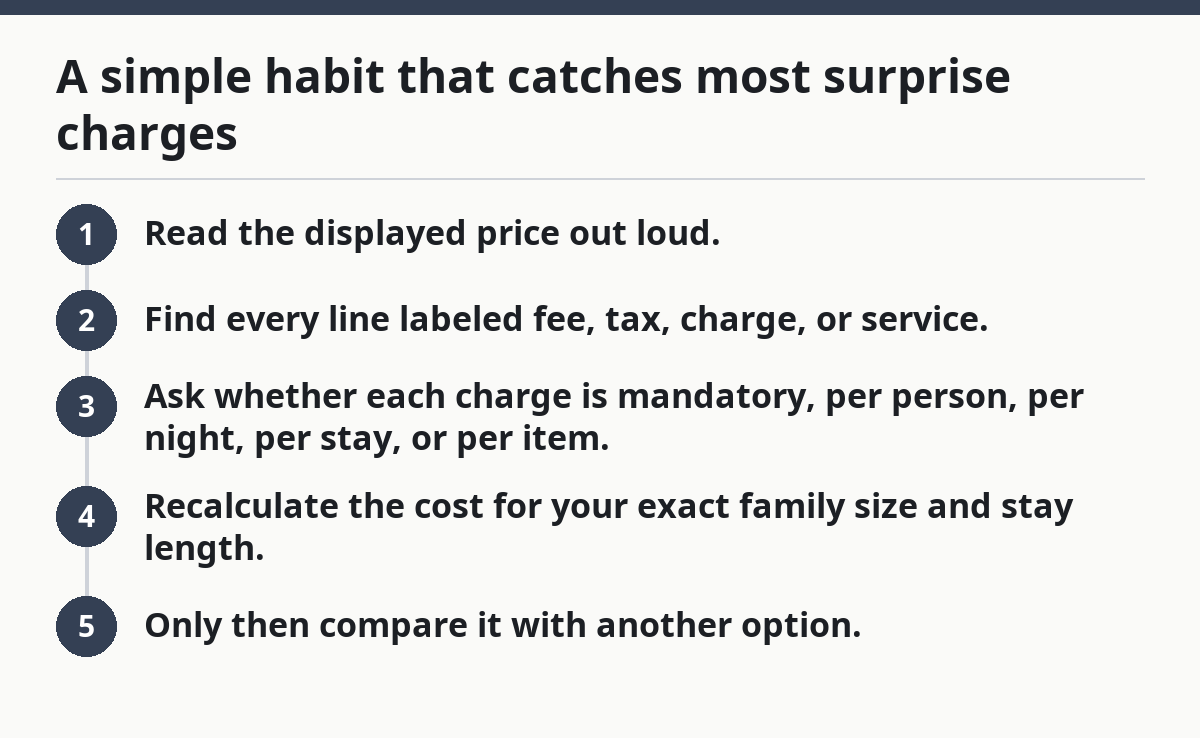
This works because hidden fees rarely appear in one dramatic line. They appear as small separate charges that feel harmless alone. A $25 fee, a $35 parking charge, a seat-selection cost, and a baggage fee do not look alarming separately. Together, they can erase the difference between the cheap option and the honest one.
The one thing this method is not for is pure bargain hunting without comfort requirements. If your family is happy with random seats, one bag, and no car, then the cheapest fare may truly be the best choice. If you need adjacent seats, checked luggage, and a parking space, the cheapest posted price is often the wrong number to trust.
Key Takeaways
- The headline price is usually not the final price.
- Seat selection, baggage, resort fees, cleaning fees, and parking are the most common family trip surprises.
- The only number that matters is the full total for your exact travelers, dates, and add-ons.
- If a fee is required to use the trip component, count it as part of the cost before you compare options.
- A listing that hides charges until the last screen deserves extra caution, not blind trust.
What hidden fees should families watch for when booking travel?
Families should watch for seat selection fees, baggage fees, resort fees, cleaning fees, parking fees, and service charges that appear late in checkout. Airline fares, hotel rates, vacation rentals, and car rentals all use different labels, but the pattern is the same: the advertised price is often only the base amount. The FTC and the U.S. Department of Transportation both warn that fee disclosure matters before you buy.
How do i calculate the real cost of a family booking?
Add the base price, taxes, and every mandatory fee that applies to your exact trip. Then multiply per-night or per-person charges by the number of nights or travelers, and include any one-time charges such as cleaning, parking, or baggage. The real cost is the number you would actually pay to complete the reservation.
Which travel fees are usually refundable?
Refundability depends on the fare or rate rules, not the fee’s name alone. Some optional add-ons can be canceled, while mandatory charges may be nonrefundable once service begins or a stay starts. Check the cancellation policy and the provider’s terms before paying, and if the wording is unclear, ask for it in writing.
Drafted with AI; not yet reviewed by a person.
