
Last updated: November 19, 2026
Quick answer: save money on family flights by comparing the total trip cost, not just the fare. In this guide to how to save money on family flights without making the trip miserable, the winning option is usually the one that balances price, timing, seats, and fees rather than the lowest headline number. Family flights get cheaper when you stop chasing the lowest headline fare and start pricing the whole trip: airfare, airline fees, seats, and the cost of making everyone miserable for six hours. The best savings often come from choosing the right flight times, being flexible on airports, and knowing which extras are worth paying for.
Start by pricing the whole trip, not just the fare
The cheapest fare is not always the cheapest family flight. A $40 difference in airfare can disappear fast if one airline charges for carry-on bags, another charges for seat selection, and a third forces a long connection that turns a 3-hour trip into an 8-hour day.
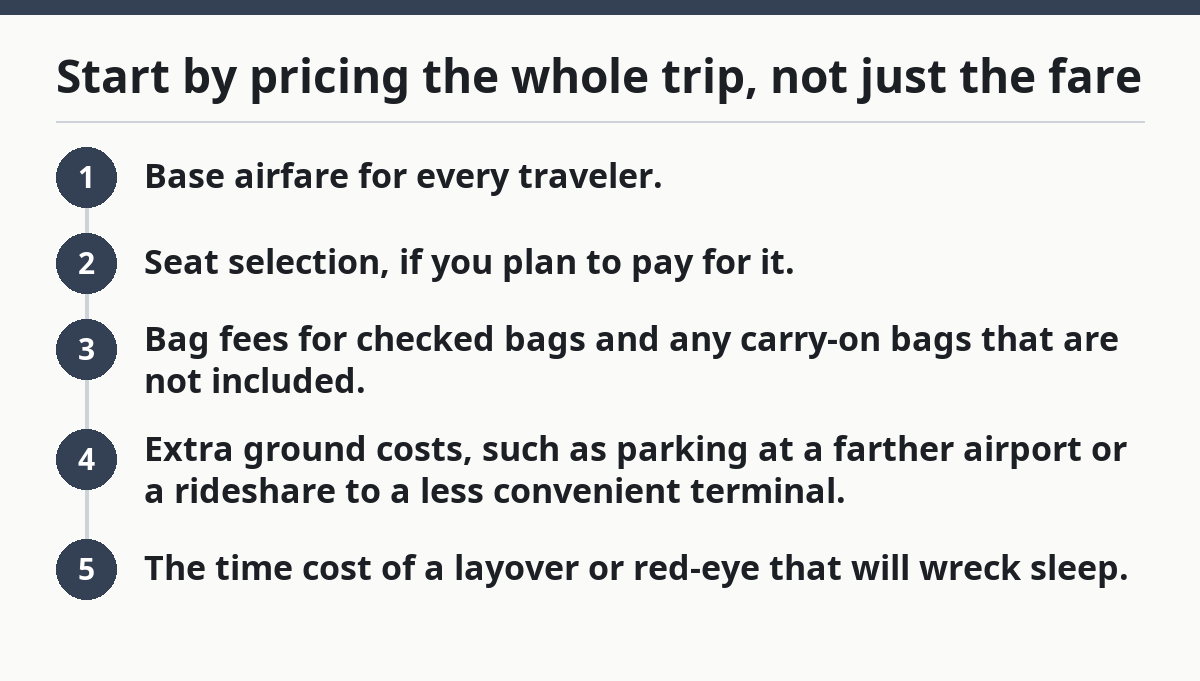
Before you book, write down the total cost for each option:
- Base airfare for every traveler.
- Seat selection, if you plan to pay for it.
- Bag fees for checked bags and any carry-on bags that are not included.
- Extra ground costs, such as parking at a farther airport or a rideshare to a less convenient terminal.
- The time cost of a layover or red-eye that will wreck sleep.
When this step works, the “cheapest” flight is the one with the lowest total number, not the lowest fare tile on the search page. This matters more for families because the same airline fee hits each traveler separately. A $30 seat fee can add up quickly for a family of four before bags even enter the picture.
A lot of generic advice says to “book early” and stop there. That misses the real problem: family travel is a bundle of small charges. A good comparison also includes the airline’s baggage policy page and its seat map. If the carrier’s fare rules are opaque, use a second browser tab and read the fine print before you click through. For background on airline fees and disclosures, the U.S. Department of Transportation’s consumer guidance is useful, and airline-specific baggage pages are worth checking before purchase. For fee context, The Points Guy also tracks how major airlines structure bag and seat charges.
For a broader planning framework, the hub on how to plan a budget family vacation can sit above this article and handle the trip-wide budget pieces this page does not cover.
What should I look for first when booking family flights?

Start with the flight that gives you the best mix of price, timing, and family comfort, then filter out the options that fail on bags or seating. A nonstop on a reasonable departure time is often worth a modest premium over a connection that saves money but adds exhaustion.
Use this order:
- Check the route first. Search nonstop and one-stop options separately. If the nonstop is only slightly more expensive, the time saved often matters more than the fare gap.
- Filter by departure window. For young children, flights that leave near nap time or after breakfast can be easier than very early departures or late-night departures. If the only cheap option leaves at 6 a.m., ask whether the family will actually function that day.
- Read the baggage rules before you get attached. Some basic economy fares on major airlines look cheap until carry-on bags or seat assignments are added.
- Check seat availability. If your family needs 3 seats together, a flight that still has only scattered single seats left is not a bargain.
- Compare the total after fees. If one option is $80 cheaper but adds $120 in seat and bag fees, it is not cheaper.
When this works, the best flight is usually the one that has a tolerable schedule, enough seats left to keep the family together or close together, and a final price that still fits the budget.
This step is where many people make the wrong trade. They pick the lowest fare and then pay later with expensive seat assignments, a checked bag charge they forgot, and a connection that arrives after bedtime. That is not savings. It is a different bill. For a useful comparison point, Google Flights can make route and schedule tradeoffs easier to see at a glance, and the DOT’s air travel consumer pages explain why fees can change the real price.
How can I save money on family flights without ruining the trip?
Save money by accepting some inconvenience, but only the kind your family can actually absorb. A 90-minute layover, an 8 p.m. departure, or one aisle-and-middle seat pair may be a good trade. A 45-minute connection with young kids and checked bags usually is not.
Here is the order that tends to produce the best balance:
- Be flexible on airport, not just airline. If your city has more than one airport, compare both. A secondary airport can have lower fares, but only if the transport cost and extra hassle stay small enough to justify it.
- Look at shoulder times, not peak times. Very early morning and late evening flights are often cheaper because fewer people want them. A 5:45 a.m. departure can save money, but it can also mean waking children in the dark and starting the trip already tired.
- Choose layovers with margin. For a family, a connection around 90 minutes to 2 hours is often more realistic than a tight 35-minute dash across a large airport. The exact number depends on the airport, whether you need to change terminals, and whether your bags are checked through.
- Be willing to split the seating strategy. If sitting everyone in one block is expensive, look for one row with an adult and child together plus another nearby seat. For some families, two adjacent pairs are cheaper than four together and still perfectly workable.
- Use miles or points on the expensive parts. If you have rewards, the biggest value often comes from reducing the total fare on the longest or priciest leg, not from chasing tiny discounts on a short hop.
This is where the topic gets personal. A family with teens may tolerate a 2.5-hour layover and save a real amount. A family with a toddler and a stroller may need to pay more for a nonstop. Neither choice is wrong. The wrong choice is paying less and then spending the whole trip recovering from it. For a broader planning context, the Budget Family Travel hub can help you decide where airfare fits in the rest of the trip budget.
Are layovers worth it for families?

Layovers are worth it when they save real money and still leave enough buffer for kids, bags, and delays. They are not worth it when the connection is tight, the airport is huge, or the price difference is small enough that a nonstop would prevent stress for only a little more.
A layover can work well if:
- The connection is long enough to absorb a delay, usually at least about 75 to 90 minutes for a simple domestic trip.
- The airport is straightforward, with an easy same-terminal transfer.
- Everyone in the family can handle a mid-trip break without melting down.
- The fare difference is large enough to matter after fees.
A layover often fails when:
- You are traveling with a child who still needs naps, diapers, or a lot of supervision.
- You have to collect and recheck baggage.
- The connection is in a winter-weather airport or a hub known for heavy congestion.
- The savings are tiny compared with the risk of a missed connection.
The trade-off is blunt: a layover can lower airfare, but it increases the number of things that can go wrong. That is acceptable when the family can treat the layover as part of the trip. It is a bad bet when the whole itinerary depends on perfect timing.
A smart way to use layovers is to search them on purpose rather than accept them accidentally. Compare a nonstop, a one-stop with a comfortable connection, and the cheapest two-stop option. The two-stop itinerary may be the lowest price on screen and the worst value in real life. For family flights, “cheapest” and “wisest” are not the same thing.
How should I handle seats, bags, and airline fees?
Pay for the extras that reduce chaos, and skip the ones that do not change the trip much. For most families, seat selection and bag fees are the two airline fees that most often turn a cheap fare into an expensive one.
Use this rule of thumb:
- Seat selection: Worth paying for when the family would otherwise be scattered across the cabin, especially with younger children.
- Checked bags: Worth it if carrying everyone’s stuff in cabin bags means dragging bulky items through security and boarding with no room for snacks or essentials.
- Priority boarding: Often not worth paying for unless the family has a specific need, such as extra time to stow a stroller, settle a child, or manage a medical device.
Carry-on bags deserve special attention. Some low-fare tickets allow only a personal item, not a full carry-on. That sounds minor until the family’s backpacks no longer fit and the airline charges at the gate. Read the size rules before you pack. A common personal-item limit is the size of a small backpack or tote that fits under the seat, not a rolling suitcase.
For seat selection, the cheapest approach is usually to buy only what you need. If the airline lets you select seats for a fee, reserve the seats that matter most first: a parent next to a child, or two seats together for the child who cannot sit alone. If the airline’s seat map is nearly full, paying for adjacent seats earlier can be cheaper than trying to fix the problem at the airport.
This is also where many families overspend. They pay for every extra because the site makes each one look small. A few small charges per person can erase the savings from a discounted fare. Read the fee page before booking, and compare the final cost rather than the advertised fare.
For airline fee definitions and baggage rules, the U.S. Department of Transportation’s consumer guidance is useful, and airline-specific baggage pages are worth checking before purchase.
How far ahead should I book family flights?
Book family flights when the price and schedule are acceptable, not when some magic date arrives. For many trips, that means watching fares over several weeks and booking once a reasonable combination appears, rather than waiting for the absolute lowest number.
A useful process looks like this:
- Set a target itinerary. Decide your must-haves first: nonstop if possible, departure window, and bag count.
- Track fares for a short window. Watch the route for a few days or a couple of weeks if your travel dates are flexible.
- Book once the total cost fits. If the price is fair and the seats are still usable, do not gamble on a better deal that may never appear.
- Stop chasing tiny drops. Saving a small amount per ticket is not worth losing the schedule you need.
The real risk in waiting is not only a higher fare. It is losing the better seat map, losing the nonstop, or ending up with the only remaining option being a very early flight nobody in the family wants to take. On family flights, the inventory that matters most is not just price; it is usable seats and workable times.
If your trip lands in a busy school holiday or summer window, waiting is usually riskier because family demand rises and the better choices disappear first. For more flexible dates, a short watch period can help, especially if you can travel midweek instead of on a Friday or Sunday.
The honest limit here is simple: no booking strategy guarantees the lowest fare. The goal is a sensible price on an itinerary the whole family can tolerate.
Common mistakes that make “cheap” family flights expensive
The biggest mistake is buying the lowest fare without checking the total. That mistake can cost you money in seat fees, bag fees, and last-minute airport stress.
Other common errors:
- Assuming children will be seated together automatically. Some airlines do try to help families, but do not assume the policy will solve everything. If sitting together matters, check the seat map before you buy.
- Choosing a 40-minute connection because it is cheaper. A short layover can save money on paper and create a missed-flight problem that costs far more.
- Packing as if every airline has the same rules. A bag that fits one carrier’s standard may trigger fees on another. Check dimensions before departure, not at the gate.
- Ignoring the arrival time. A flight that lands at 11:30 p.m. may be cheap and still ruin the first night of the trip.
- Buying extras too late. Seats and bags often cost less when bought during booking than after you have already checked in.
The fix is not to avoid all low fares. It is to buy the fare that matches the trip. If your family can handle discomfort, great. If not, pay for the version that keeps the day from falling apart. That is still saving money if it prevents a cascade of add-on charges and fatigue. The DOT’s family seating guidance is a useful reference point here, especially when you are deciding whether to pay for seats together.
For airline fee rules and family seating issues, it is worth reading the carrier’s conditions of carriage and the Department of Transportation’s airline consumer information before you pay.
Key Takeaways
- The cheapest family flight is the one with the lowest total cost, not the lowest headline fare.
- Seat fees, bag fees, and tight layovers can erase a savings gap fast.
- Nonstops, sensible departure times, and enough seats together are often worth a modest premium.
- Flexibility on airport and travel day can cut costs without making the trip miserable.
- For families, the best deal is usually the itinerary that balances price, time, and sanity.
FAQs
Is it cheaper to book family flights together or separately?
Booking together is often easier, but it is not always cheaper. Separate bookings can sometimes surface different fare buckets or let you mix fares, yet they also make seat coordination harder. If the family needs to sit together, compare the total price and the seating risk before splitting the reservation.
Are layovers worth it for families?
Layovers are worth it only when the savings are meaningful and the connection is comfortable. A longer layover can reduce airfare, but it also adds delay risk, more walking, and more chances for a child to get tired or frustrated. For many families, one good nonstop is the better value.
When is the best time to book family flights?
The best time to book is when the fare and schedule are both acceptable. Watching a route for a short period can help, but waiting too long can cost you better seats, better departure times, or the nonstop you wanted. If the itinerary works and the price is fair, booking sooner is often the safer move.
Drafted with AI; not yet reviewed by a person.