

Last updated: November 20, 2026
Quick Answer: For many families, the lowest-cost trip format is the one that cuts paid transfers, baggage fees, and extra nights; in practice, that often means choosing the route first and then matching the transport to it. This guide for Budget family trip planning by trip format and transport choice — The Complete Guide settles which format saves money, which transport choice stops waste, and where families quietly overspend.
Key Takeaways
- The cheapest family trip is often the one with the fewest paid transfers and the least luggage drama.
- Road trips favor bulky gear and short hops; train trips favor city stops and one-bag packing; flights favor distance, not sprawl.
- A budget plan falls apart fastest when the transport choice and the daily itinerary fight each other.
- The best savings often come from matching sleep, meals, and sightseeing to the same transport style.
I write family trip plans for a living, and a common budget mistake is choosing a destination first and a transport plan second. For Budget family trip planning by trip format and transport choice — The Complete Guide, that order matters because the route shapes the rest of the cost.
Start With the Trip Format, Not the Destination
The cheapest family trip format is usually the one that matches how your family actually moves, eats, and sleeps. If you force the wrong format, even a low fare can turn into a high total.
Picture this: you’re trying to keep two kids calm, one bag open, and a snack schedule intact while the itinerary keeps changing. The format matters because it decides how many tickets you buy, how much luggage you drag, and how often you pay for convenience.
- Loop trip: start and finish in the same place.
- Hub-and-spoke trip: sleep in one base and take day trips out.
- One-way trip: move from city to city.
- Out-and-back trip: go somewhere and return the same route.
A loop trip is often the easiest budget choice for families because it cuts one-way transport fees and makes car returns simpler. A hub-and-spoke trip often wins for younger kids because unpacking once saves time, but it can waste money if the base is far from the things you want to see. One-way trips can be brilliant for train travel, yet they can punish you with drop fees, extra baggage, and more tired children.
Which format fits which family
- Loop trip: best for road trips and ring routes.
- Hub-and-spoke trip: best for short stays, museum cities, beach weeks, and families with early bedtimes.
- One-way trip: best for rail corridors and long-distance routes with cheap point-to-point tickets.
- Out-and-back trip: best when the destination is the whole point and the transport is simple.
If the group is mixed-age and short on patience, the trip format should reduce packing and transfers before it tries to maximize sights. That is the real budget move.
Road Trip, Train Trip, or Flight: Which One Saves More?

Road trips usually save the most on the transport line item for families with a lot of people or a lot of stuff. Flights usually save time, and trains often sit in the middle when the route is direct and the station is central.
Picture this: you’re choosing between a six-hour drive, a train ride, and a cheap flight that still needs airport parking, bags, and a late arrival. The transport choice shapes not just the fare, but the whole rhythm of the trip.
The truth is, the cheapest option on paper is not always the cheapest once you add the hidden parts. A low airfare can stop being low after seats, bags, airport transfer, food, and a night lost to arrival timing. A car trip can look cheap until fuel, tolls, parking, and tired-driver stops pile up.
Road trip wins when:
- You have 2 or more kids and enough room for snacks, luggage, and a cooler.
- The route is under 6-8 hours between major stops.
- You want to bring bulky items like a stroller, a booster seat, or sports gear.
- Your destination has free or low-cost parking.
Train trip wins when:
- The stations are central and you can skip a car rental.
- You want to avoid airport rules and road fatigue.
- You plan one-way travel with little luggage.
- The line has frequent service, so a delay does not wreck the whole day.
Flight wins when:
- The trip is long enough that driving would eat too many days.
- You can book a direct route and keep the connection count at zero.
- You travel light enough to avoid checked-bag creep.
- You can land at a place with a cheap, simple transfer into town.
A family trip budget gets healthier when the transport choice matches the length of stay. If you’re only somewhere for 2 nights, flying into a remote airport and then paying for transfers can be a bad trade. If you’re staying 7 days, a longer drive can make sense because the trip cost spreads across more nights.
How to build a family budget that actually works
A family budget works when it covers the whole trip, not just the ticket. Transport is one line; the rest is meals, sleeping, local rides, entry fees, and the things kids ask for when they are tired.
Picture this: you have the airfare booked, and then the rest of the trip starts charging you in small pieces. That is where family budgets break — not in the headline fare, but in the hundred little add-ons.
Build the budget in this order:
-
Transport to and from the destination
Include fuel, tolls, parking, train fares, baggage, seat fees, car rental, and airport transfers. -
Sleeping costs
Count the room, resort fees if they exist, extra bedding, laundry, and taxes. -
Food costs
Family trips get expensive fast when every meal is restaurant food. A place with a fridge, microwave, or breakfast included can change the math. -
Local transport
Taxis, rideshares, transit passes, and parking at attractions all belong here. -
Activity costs
Entry tickets, guides, boat rides, rentals, and timed booking fees. -
Buffer
Keep a cushion for late arrivals, weather changes, and one forced meal you did not plan.
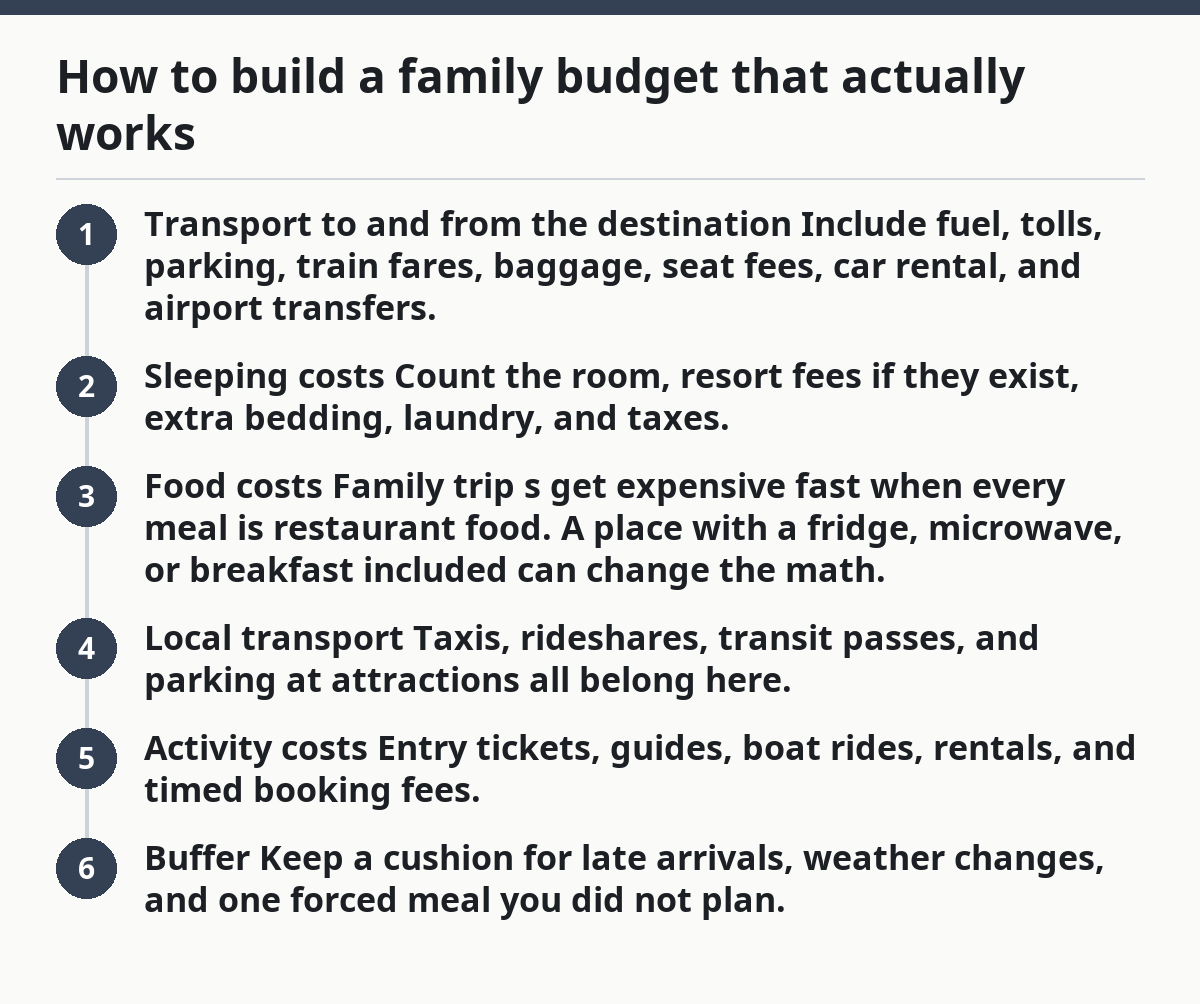
A useful rule is this: if the transport choice forces expensive eating, sleeping, or local rides, it is probably not the cheapest choice anymore. That is why a train into the center of town can beat a cheap flight to a distant airport.
Budget traps that hit families hardest
- Booking a flight that lands after the cheapest food options close.
- Renting a car for an itinerary that only needs transit.
- Choosing a hotel far from the things you will actually visit.
- Packing so much that baggage fees erase the fare savings.
- Building a day-by-day plan with too many long transfers.
If the family can handle one grocery stop after arrival, the trip gets easier to control. A simple breakfast setup can save more than a fancy “deal” on the room.
The best transport choice by trip format

The right transport choice depends on the trip format because the format decides how often you move. A loop trip loves a car. A hub trip can love a train. A one-way trip can love a direct flight or rail line.
Picture this: you’re matching the route to the ride instead of forcing the ride to fit a bad route. That one decision can remove a rental day, a bag fee, or a second hotel night.
Loop trips: car first, then train
A loop trip is usually best by car if the route has several stops and the roads are simple. The car wins because it lets you carry everything once and avoid repeated transfers between stations, hotels, and attractions.
Train can work for a loop trip too, but only when the line is direct and the stations sit near the sights. If the family has small kids, luggage, or a stroller, a train loop with multiple station changes can become a drag.
Best for: scenic routes, national parks, beach towns, multi-stop road loops.
Weak spot: parking and fuel can climb fast in big cities.
Who should skip it: families who hate driving after dark or need a walkable city center on every stop.
Hub-and-spoke trips: train or car, depending on the base
A hub trip is often best by train when the base city has good public transport and the day trips are short. You unpack once, then branch out without renting a car every day.
Car wins if the base is in a place with weak transit or if the day trips are spread out. But that can backfire in a city where parking costs a lot and traffic eats time.
Best for: one-city vacations, museum trips, beach stays, family reunions.
Weak spot: a bad hotel location can force extra transit costs every day.
Who should skip it: families who want a new place every morning.
One-way trips: train or flight, not a rental loop
A one-way trip is usually best by train in regions with strong rail networks. You avoid returning to the start, and the route itself becomes the trip.
Flight wins when the cities are far apart or when the route would take too many ground-travel days. That said, one-way flights can trigger baggage fees, seat fees, and awkward arrival times.
Best for: corridor travel, city chains, long-distance family moves.
Weak spot: one-way car rentals can be expensive and sometimes have poor inventory.
Who should skip it: families with a lot of gear and no interest in packing light.
Out-and-back trips: flight when time matters, car when gear matters
An out-and-back trip is best by flight when the destination is far enough away that driving would cost too much time. It is best by car when you need the room to haul food, gear, and comfort items.
The decision here turns on one question: do you need speed or stuff? If you need both, the budget usually pays for it.
Best for: short escapes, family events, single-destination stays.
Weak spot: round-trip flights to a distant airport can still need an expensive transfer on both ends.
Who should skip it: families who plan to change hotels often.
Transport choice by budget goal
- Lowest cash outlay: car, if fuel and parking stay controlled.
- Lowest stress: train, if stations are central and luggage stays light.
- Shortest total travel time: flight, if the route is direct.
- Best for bulky family gear: car.
The best part? A family that chooses the right format first often finds the transport choice gets much simpler.
How to save on transport without wrecking the trip
The cheapest transport plan is the one that avoids paid fixes later. That means fewer bags, fewer transfers, and fewer “we’ll figure it out when we land” moments.
Picture this: you’re staring at three fares, and the cheapest one looks good until you price the rest of the trip around it. The real savings come from removing add-ons before they start.
Simple ways to cut transport cost
- Keep the route direct whenever possible.
- Book the family on the same departure when split tickets would force extra logistics.
- Choose a destination with central stations or a simple airport link.
- Pack one carry-on system that works for every person.
- Use a car only if it replaces more than it costs.
Where families waste money
- Paying for seats together after choosing a bargain fare that scatters the group.
- Taking a car into a city where parking costs more than transit.
- Booking a hotel far from transit to save on the room and paying that difference back every day.
- Checking bags for items that could be bought or rented after arrival.
A useful check is this: if the transport choice adds one extra hotel night, two airport transfers, or a full day of local rides, it may no longer be the budget option. That matters more than the base fare.
A smarter transport rule by family type
- Families with toddlers: prefer fewer transfers over the lowest fare.
- Families with teens: prioritize direct routes and arrival times that do not wreck the first night.
- Large families: compare car cost against the total of seats, bags, and transfers.
- Grandparent trips: pick comfort and short walking distance before bargain hunting.
Budget travel is not about suffering. It is about removing needless paid friction.
When the cheaper option is actually the worse option
The cheaper option loses when it creates costs that show up later. A low fare with a bad arrival time can force dinner delivery, a rideshare, and a tired first day. That is not savings.
Picture this: you’re proud of the fare you found, then the family lands late, the station is closed, and dinner costs more than you planned. That is how a budget trip leaks.
The cheap option is the wrong one when:
- The family has small children and the route has multiple transfers.
- The stay is only 1-2 nights, so every delay matters.
- The transport puts you far from the place you actually want to be.
- The baggage rules or parking rules are hidden behind extra fees.
- The trip starts so early or ends so late that it burns a whole day.
Better trade-offs to make instead
- Pay more for a direct route if it removes a transfer with kids.
- Use a car if it eliminates repeated taxi rides from a remote base.
- Choose a train if it keeps you in the city center and avoids airport transfer costs.
- Spend a little more on a hotel near the route instead of one that requires daily transport.
A family budget is healthiest when the cheapest line item does not poison the rest of the plan. That sounds obvious. It still gets ignored all the time.
Two authoritative places to sanity-check your plan
- U.S. Department of Transportation consumer guidance on airline fees and passenger rights.
- The Federal Railroad Administration for rail safety and travel information.
- The U.S. Department of Transportation’s airline travel resources for fee and delay basics.
- The European Union’s passenger rights pages if your family trip crosses EU routes.
These are not booking tools. They are the places to verify what the transport system itself is likely to do to your time, fees, and expectations.
What format and transport should you choose?
Choose a loop trip by car if you want the easiest budget control for a family with luggage, snacks, and more than one stop. Choose a hub-and-spoke trip by train if you want one base, few transfers, and a city with strong transit. Neither if your route demands constant moving, because constant moving eats money and energy.
Picture this: you’re ready to book, but the family still needs a plan that fits real life. The answer is blunt because the budget works best when the route stays boring.
Clear picks by situation
- Choose car + loop trip when the family has bulky gear, flexible timing, and several stops within driving range.
- Choose train + hub trip when the destination is walkable, the station is central, and day trips are short.
- Choose flight + one-way or out-and-back trip when the distance is long and a direct route saves more time than ground travel can.
- Skip the whole “cheap fare” hunt when every option requires extra transfers, hidden fees, or a hotel far from the action.
Quick verdict by family profile
- Young kids, lots of gear: car.
- Older kids, one city, few days: train.
- Long distance, limited vacation time: flight.
- Mixed ages, low patience, short stay: whatever gets you directly to the base with the fewest changes.
The verdict is not fancy, but it is useful: the right transport choice is the one that keeps the itinerary simple enough that the budget survives the whole trip.
Exception scenarios that flip the answer
A road trip can lose to rail if the route has expensive parking, heavy traffic, and a central station at the destination. A car is not magic. It only wins when the road is cheaper than the alternatives.
Picture this: you’re staring at an obvious rule, then one odd route breaks it. That happens often enough that the exceptions deserve their own space.
1) The train corridor is unusually strong
If the rail line is fast, frequent, and city-center to city-center, train can beat a car even for families. The savings come from skipped fuel, skipped parking, and less end-of-day fatigue.
2) The car trip crosses expensive parking zones
A loop trip that includes a major city can turn expensive fast when daily parking is high and hotel parking is separate. In that case, park once and use transit, or rethink the base entirely.
3) The flight is the only direct route
If the alternative is a multi-transfer ground trip, the plane can win even after baggage fees. That is especially true when the trip is short and the family would otherwise burn half the vacation in transit.
4) The family can split the route
Sometimes one adult driving with the gear and the rest taking a train or flight makes more sense than forcing everyone into the same plan. That only works when arrival logistics are simple and the family can reunite without extra transfers.
What changes the verdict
- Distance
- Number of stops
- Luggage volume
- Parking cost
- Arrival timing
- Child age and patience
These are the levers that matter. Not the headline fare alone.
FAQ
Is a road trip always cheaper for families?
No, a road trip is not always cheaper for families. It wins when fuel, tolls, and parking stay controlled, but it can lose in cities with costly parking or on routes with long driving days. A cheap flight or train can beat it if the destination is central and the trip is short.
What is the best trip format for a family on a budget?
A loop trip is often the best budget format for a family because it avoids repeated one-way costs and keeps packing simple. It is strongest when the route can be driven or ridden in a circle without backtracking. If the area has strong rail, a hub-and-spoke format can also work well.
How do I know if a flight is really the cheapest option?
A flight is only the cheapest option if you include bags, seats, airport transfers, and the cost of getting from the airport to where you stay. If the arrival is late enough to force dinner, extra transit, or an added night, the “cheap” fare may no longer be cheap.
When should I choose a train instead of a car?
Choose a train when the stations are central, the trip is one-way or hub-based, and you want to avoid parking and driving fatigue. Train travel is also strong when the family can pack light and the route is direct enough that transfers stay low.
What is the biggest budget mistake family travelers make?
A common mistake is picking transport before matching it to the trip format. That is how families buy a cheap ticket and then pay for a bad hotel location, extra transfers, or too much local transport. The route has to fit the ride, not the other way around.
Drafted with AI; not yet reviewed by a person.
