
Last updated: November 20, 2026
Quick Answer: choose the refundable family trip rate if your dates may shift; choose the nonrefundable family trip rate if your plans are fixed. The decision is usually about one question: how much change risk is still left before you travel? How to Choose Between a Refundable and Nonrefundable Family Trip Rate comes down to that tradeoff, and the sections below explain the policy language, the deposit risk, and the family-specific timing issues.
Key Takeaways
- Fixed plans usually favor the nonrefundable rate.
- Refundable rates trade a higher price for flexibility.
- Uncertain dates make the refundable rate stronger.
- Soft travel dates favor the refundable option.
Our Top 3 Picks at a Glance
| Pick | Best For | Core Spec | Standout Feature | Action |
|---|---|---|---|---|
| #1 Best Overall: Refundable rate | Trips with school schedules, kid illness risk, or flights that may change | Lets you cancel under the stated policy and get money back | Better protection when one delay can affect the whole booking | Check the current rate and read the cancellation policy |
| #2 Best Budget Pick: Nonrefundable rate | Tight plans with fixed dates and low chance of change | Lower price in exchange for little or no refund after the deadline | Usually the better value when you are confident the trip will happen | Check the current price and the change fee rules |
| #3 Best Heavy-Duty / Upgrade Pick: Refundable rate with clear deadline | Longer trips with more moving parts | More flexibility before the cutoff date | Gives you a cleaner escape hatch when deposits and room blocks are at stake | Compare the deposit terms before you book |
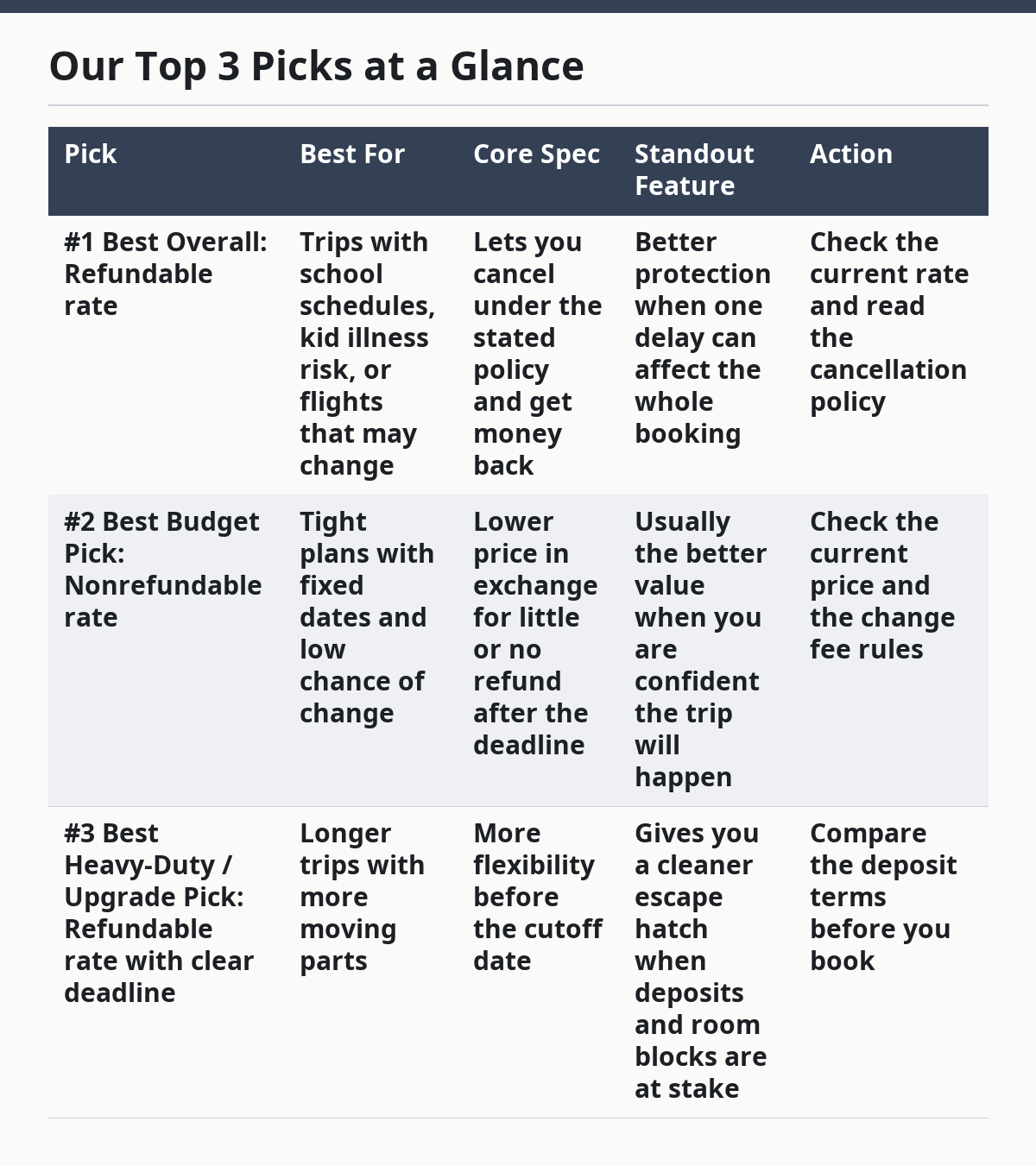
If your dates are shaky, refundably wins. If your plans are locked, nonrefundable wins. The rest of this page shows where that line really falls for a trip with kids, bags, and a calendar that can change overnight.
Refundable vs nonrefundable family trip rate: what actually changes?
A refundable rate buys flexibility; a nonrefundable rate buys a lower commitment. The difference is not just the sticker price — it’s the change fee, the cancellation policy, and whether your deposit can come back if something breaks the plan.
Picture this: you’ve lined up flights, a rental car, and two hotel nights, then school sends home a note about a schedule change. If the booking is refundable, you may still have an exit before the deadline. If it is nonrefundable, the money can be stuck unless the fare rules allow a partial refund or credit.
Here’s the catch: many travelers focus on the nightly rate and ignore the policy text. That text is the real product. A lower price with a strict cutoff can cost more if one child gets sick, one parent’s work trip shifts, or the whole group needs to move dates by 24 hours.
- Refundable rate: higher flexibility, lower loss if plans move
- Nonrefundable rate: lower upfront commitment, higher loss if plans change
- Deposit: may be returned under one policy and kept under the other
- Change fee: may apply on top of any rate difference
For this choice, the right question is simple: how much change risk is still sitting on the calendar?
The real difference between the two rates
The refundable rate wins when uncertainty matters more than the savings. It protects the booking itself, not just the date on a calendar. That matters in family travel because one missed connection, one fever, or one school event can ripple through every part of the trip.
The nonrefundable rate wins when the trip is already locked. It usually comes with less protection, but that is the tradeoff you are paid to accept. If the dates are firm and the lodging is the last major variable, the lower-risk choice can be the smarter spend.
Refundable rates usually cost more because the seller carries more risk.
That is the entire logic in plain English.
A refundable booking often has one of these structures, but the exact terms can vary by seller, so review the policy carefully and, if the wording is unclear, consult the seller or a travel professional before you book:
- Free cancellation up to a stated date
- Refund after a penalty window
- Partial return of the deposit only
- Full refund except for a small processing charge, if the policy says so
A nonrefundable booking usually has one of these:
- No cash refund after a short grace period
- A credit instead of money back
- A higher fee to change dates
- A policy that treats the deposit as lost if you cancel
If the policy says “nonrefundable,” treat that as a real loss risk, not a suggestion. Check the exact deadline, because the last free day matters as much as the room itself.
Refundable rate: who should actually use it?
The refundable rate wins for travelers whose dates are still soft. If you are booking around school calendars, sports schedules, split custody timing, or a relative’s surgery window, that extra protection is doing real work.
Picture this: you need to book now because inventory is thin, but one child’s event could still move the whole week. A refundable rate gives you a buffer. It is also the better fit when the trip has multiple linked parts — hotel, car, and ticketed activity — because one broken piece can make the rest useless.
The cost tradeoff is obvious. You may pay more up front, and that extra amount can sting if the trip happens exactly as planned. But the point of the rate is not to reward certainty. It is to reduce loss when certainty is missing.
Use a refundable rate if you need control over the booking.
That includes:
- Parents waiting on school or sports dates
- Travelers coordinating with relatives across more than one household
- Trips booked far ahead, before schedules settle
- Bookings tied to weather-sensitive or health-sensitive timing
Real drawback: the policy can still be narrow. Some refundable rates only refund before a specific date, and after that, the same booking can become hard to recover. Some also require you to cancel by a precise hour, not just a day.
Who Should Skip This: travelers with fixed dates and no likely change should look at the nonrefundable rate first.
Buy this if: you are booking around an uncertain school calendar and one change would force a rebook.
Skip this if: your dates are already locked and you mainly care about the lowest possible commitment.
Nonrefundable rate: when is it the better deal?
The nonrefundable rate wins when the trip is already committed. If the dates are solid, the school note is already in hand, and the biggest risk is just wanting to save money, this option often makes sense.
Picture this: you have a long weekend, the hotel is the main cost, and nothing on the calendar is likely to move. In that case, paying extra for refund rights you probably will not use can be a waste. The better move is often to keep the rate simple and accept the rule set.
The price tradeoff is the reason people choose it. The seller takes less risk, and that usually shows up in the rate. You are giving up flexibility in exchange for a lower commitment and, in many cases, a cleaner booking path.
Nonrefundable rates work best when the plan is already real.
That means:
- Dates are fixed
- Deposits are affordable to lose if needed
- The trip is short and easy to replace
- You are confident the stay will happen as booked
The weakness is plain: if plans change, the money may not come back. A change fee can make the loss worse, especially if the policy also restricts date changes. Some bookings allow a credit, but that is not the same as a refund, and it may force you back into the same supplier later.
Who Should Skip This: anyone juggling uncertain flights, child care, or a moving schedule should avoid a strict nonrefundable rate unless the price gap is truly worth the risk.
Buy this if: you have fixed dates and want the simpler, lower-commitment rate.
Skip this if: you still expect a schedule shift or need a cleaner exit from the deposit.
The honest side-by-side
The refundable rate wins on flexibility; the nonrefundable rate wins on price discipline. The table below is the quickest way to see which one fits your booking.
| Criteria | Refundable rate | Nonrefundable rate | Winner for this condition |
|---|---|---|---|
| Chance of losing money if plans change | Lower, if you cancel inside the policy window | Higher after the cutoff date | Refundable rate when dates may move |
| Upfront price pressure | Usually higher | Usually lower | Nonrefundable rate when budget is tight |
| Cancellation policy | More forgiving, but still time-bound | Strict, with limited recovery | Refundable rate for uncertain plans |
| Change fee risk | Often lower, sometimes none before deadline | Often higher or paired with a no-refund rule | Refundable rate if rebooking is likely |
| Deposit protection | More likely to come back under the stated rules | More likely to be kept if you cancel | Refundable rate for large deposits |
| Booking confidence needed | Moderate | High | Nonrefundable rate when confidence is high |
| Best fit for family uncertainty | School shifts, illness, split schedules | Fixed dates and stable plans | Refundable rate for moving calendars |
| Risk tolerance | Lower tolerance for loss | Higher tolerance for loss | Refundable rate for cautious buyers |
| Policy reading burden | Still important, but the exit is clearer | Critical, because small print matters more | Refundable rate for simpler exits |
The table makes the main point clear: if the trip is uncertain, flexibility has real value. If the trip is locked, the nonrefundable option is usually the cleaner spend.
How to read fare rules before you book
The refundable rate only helps if you know the deadline. The nonrefundable rate only makes sense if you know what you lose. That is why the fare rules matter more than the headline price.
Picture this: you see a good rate, but the policy says cancellation is free only until a certain date, or the deposit becomes nonrefundable after a short window. That one line can flip the value of the whole booking. Read the rule before you compare the rate to anything else.
Use this short checklist:
- Find the cancellation cutoff.
- Look for the words “refundable,” “nonrefundable,” or “deposit.”
- Check whether a change fee applies in addition to any rate difference.
- See whether the refund is cash, credit, or partial.
- Confirm whether the policy changes after check-in or after ticketing.
A trip can look flexible and still be rigid. A booking can look rigid and still allow some recovery. The difference lives in the terms, not the label.
For general consumer rights and chargeback basics, the Consumer Financial Protection Bureau and your card issuer’s dispute rules are useful references. For travel-specific fine print, the contract language still controls the booking. For airline refund rights, the U.S. Department of Transportation explains when carriers must refund canceled or significantly changed flights.
Exception scenarios: when the verdict flips
The refundable rate usually wins when uncertainty is high. The nonrefundable rate usually wins when plans are set. A few situations flip that answer.
Picture this: the price gap is large, the booking is very short, and the cancellation window is generous only if you act fast. In that case, the better move can change. That is not because the rate type changed — it’s because the rest of the trip changed the math.
Use the nonrefundable rate anyway if:
- The refundable option is priced so much higher that the savings would cover a second short trip
- The trip is only a night or two and easy to replace
- The cancellation deadline is already behind you
- The booking is tied to a nonrecoverable event date, like a concert or tournament, where the stay is secondary
Use the refundable rate anyway if:
- A large deposit is at stake
- The booking covers multiple rooms
- One child’s schedule could affect the whole stay
- The rate difference is small compared with the cost of rebooking
The real test is not “Which rate is better?” It is “Which loss can this booking survive?”
The verdict: which one to choose and why
Choose refundably if your dates may move, your deposit is meaningful, or one school, health, or work change could break the trip. Choose nonrefundable if your dates are fixed, your risk is low, and you want the lower-commitment booking. Neither if the policy text is so strict that one small delay would wipe out the savings.
That is the clean rule. A flexible family trip costs more for a reason. A strict rate is only smart when the plan is already firm enough to carry it.
Two sources worth checking before you book
The Consumer Financial Protection Bureau has plain-language guidance on credit card disputes and travel booking issues, and the U.S. Department of Transportation explains airline refund rules when flights are canceled or significantly changed. Those pages won’t choose the hotel rate for you, but they help you understand what protections exist outside the booking terms.
Drafted with AI; not yet reviewed by a person.