

Last updated: November 19, 2026
Quick Answer: For most families, 2 methods are enough: one person pays for bookings, and a shared ledger or transfer app settles daily costs. This guide to Family trip payment systems — The Complete Guide shows which setup fits which trip, what each one gets wrong, and how to avoid awkward money fights.
Key Takeaways
- Pick a payment system before the first booking, not after the first bill.
- The right setup depends on group size, trip length, and who is willing to hold cash or cards.
- One payer works for short, simple trips; shared-wallet apps are often a better fit when everyone pays in the same currency and uses the same app.
- Cash still matters for split taxis, tips, and places that do not take cards.
- The least effective system is the one nobody agrees to use consistently.
What a family trip payment system actually needs to do
A family trip payment system is just the method you use to collect, track, and settle shared costs. It can be as simple as one parent paying everything and getting paid back, or as formal as a shared digital wallet with itemized balances and reimbursement rules.
Picture this: you’ve booked the rental, bought the train tickets, and paid the museum deposit, then someone asks how much they owe and for what. A good system makes that answer obvious in under a minute. It also helps reduce missed payments, double-paying, and the classic “I thought you were covering that” argument.
A solid setup usually needs to do four things well:
- track who paid for what
- show who owes whom
- handle mixed payment types, including cash
- settle up without a long message thread
The truth is, most bad trip money plans fail because they are improvised. One person pays by card, another pays by cash, the third forgets to send money, and nobody keeps a running total. That is not a payment system. That is a stress generator.
Here is the catch: the right system changes with the shape of the trip.
- A weekend road trip can work with one group card and Venmo-style reimbursement.
- A two-week overseas trip needs cash rules, backup payment methods, and a written split plan.
- A multi-household reunion often needs one shared ledger, not just “I’ll remember who paid.”
A useful benchmark is whether you can answer three questions at any point in the trip: who paid, what it covered, and what remains unsettled. If you cannot, the system is too loose.
The simplest option: one person pays, everyone reimburses later
One-person-pays is a strong fit for short trips with a clear organizer, because it cuts setup time and keeps bookings clean. It also creates the biggest trust burden, so it works only when the payer is comfortable fronting costs and the rest of the group is disciplined about repayment.
Picture this: you are booking a two-night stay, a car, and a few meals, and every reservation wants one card. This system wins when speed matters more than perfect fairness. It is common because it is easy to explain: one person pays, everyone else sends money later through a transfer app, cash, or bank transfer.
The strength is obvious. You avoid payment chaos at checkout, and you can book fast when rates change. It also fits services that want one card on file, like some rentals or hotel deposits.
The weakness is just as obvious. One person carries the cash flow, which can sting on a trip with expensive lodging or long lead times. If the group delays reimbursement, the organizer becomes an unpaid lender.
This system is best for:
- a couple traveling with kids
- a small group that trusts each other
- trips where one person already handles the bookings
- situations where card-only reservations are common
It is not a good fit when money tension already exists. If there is any history of “I will pay you back later” turning into a fight, the system will magnify it.
A practical rule helps: if the upfront total is larger than the person paying can comfortably absorb, stop and switch methods. That is especially true for bookings that lock money up for 7 to 30 days, such as deposits or long-stay rentals.
Who Should Skip This: the organizer who hates chasing people for transfers, and the group that includes one person who always “forgets” to settle up. A shared wallet or prepaid pot fits better.
Buy this if: you are the natural trip planner and the group can reimburse within a day or two. Skip this if: your trip involves large deposits, delayed repayment, or uneven spending habits.
Family trip payment systems for more complex trips
Shared-wallet apps are a strong choice for groups that want a running ledger, because they track balances in one place instead of leaving the math in someone’s head. They work especially well when the same people share most costs, such as food, fuel, and activity tickets.
Picture this: you are splitting gas, groceries, ferry tickets, and one dinner bill across four adults. A shared ledger is the cleanest way to keep score. Apps in this category usually let one person create a trip group, add expenses, and assign shares.
The biggest advantage is clarity. Every charge can be logged as it happens, so nobody has to reconstruct the trip from screenshots later. Many of these tools also show the net balance, which makes settlement simpler than chasing individual reimbursements for every receipt.
The drawback is friction. Everyone has to use the same app, enter expenses correctly, and agree on the split method. That sounds minor until someone forgets to log a cash payment or uses the wrong category. Mixed currencies can also make the balance harder to read unless the app handles exchange rates well.
This option is best when:
- several adults are paying different bills
- you want itemized tracking
- the trip spans multiple days
- you need to settle once at the end instead of after every meal
It is weaker for very simple trips. If three people are going out for lunch and one person buys a tank of gas, an app can be more process than it is worth.
A useful standard here is app discipline. If half the group refuses to log expenses, the ledger becomes noise. That is why shared-wallet systems work better with people who already communicate well and do not mind a little admin.
Who Should Skip This: the group that hates phone apps or includes one traveler who will not enter expenses in real time. A one-person-pays setup fits better for that kind of trip.
Buy this if: you want a written record of every shared cost and can get everyone to use the same tool. Skip this if: your trip is tiny, your group is not tech-comfortable, or one person will refuse to log anything.
Cash, cards, and digital transfers: what each one is good for
Cash is best for small, immediate expenses; cards are best for bookings and larger purchases; digital transfers are best for settling balances after the fact. The smartest trip plan uses all three, not just one.
Picture this: you are at a toll booth, a roadside café, and then a hotel check-in desk on the same day. No single payment method covers every moment of a trip. That is why families get into trouble when they treat one app or one card as the whole system. If the money plan is complicated or the stakes are high, it can help to consult a financial professional before travel and to follow guidance from your card issuer or bank.
Cash has two strengths. First, it still works where digital payments do not. Second, it is easy to split on the spot for low-cost items like snacks, tips, or local transport. Its weakness is that it disappears fast and is hard to track unless you write it down.
Cards are strong for reservations, online bookings, and bigger expenses. They are also easier to dispute than cash if something goes wrong. The downside is fees, holds, and the fact that one declined card can derail a check-in.
Digital transfers are the best settlement layer. They make it easy to reimburse the organizer after the trip or even during it. The weakness is that they depend on both people using compatible services and having reliable internet or mobile data.
For most trips, the best structure looks like this:
- Book major items on one or two cards.
- Keep a small cash pool for low-value purchases.
- Use a transfer app or bank transfer to settle at the end.
- Log any unusual expense the same day.
That structure matters because the cost of forgetting one receipt is often higher than the receipt itself. A $14 lunch can turn into a 20-minute argument if it is not recorded. Small numbers create big friction when nobody knows the running total.
If the destination uses a different currency, cash gets trickier and card fees matter more. In that case, it helps to decide in advance whether expenses will be tracked in local currency or converted to one home currency for settlement.
How to split costs fairly without making it complicated
The fairest system is not always the most detailed one; it is the one everyone can follow. For many trips, a simple equal split is enough, but some costs should be assigned to only the people who used them.
Picture this: some meals are shared by everyone, while one activity is only for the kids or only for the adults. A single split rule will not fit every expense. That is why the best systems separate trip-wide costs from personal add-ons.
A practical split method looks like this:
- shared costs: lodging, common meals, parking, fuel
- personal costs: souvenirs, optional activities, special snacks
- mixed costs: split by headcount or by who participated
- child-related costs: decide before the trip whether children count as full shares
The first decision is whether children count as full participants in every cost. That sounds harsh, but it prevents confusion. If a baby is in a room but does not take a meal, the lodging cost still includes that person, while dinner may not. Say it once and write it down.
The second decision is whether you split by person or by role. Sometimes the cleaner answer is “all adults split lodging, kids are included in food only,” or “parents cover child-specific extras, and everything else is shared.” What matters is consistency.
A useful rule: if a bill would take more than two minutes to argue about, simplify it. Round to the nearest dollar, split evenly, and move on. The cost of perfect fairness is often more time, more tension, and little real gain.
This is also where many generic guides go wrong. They tell you to “split everything evenly” and stop there. That misses the real pain points: who paid the deposit, who bought snacks in cash, and how to handle optional activities that only some people join.
For larger groups, a written note in the trip chat helps more than memory. List the rule in plain language before the first payment goes out.
What goes wrong most often, and how to prevent it
The most common failure is not fraud or tech trouble. It is missing agreement. People assume the same rule and discover at checkout that they were using different ones.
Picture this: one person thinks the rental should be split across all adults, another thinks only the drivers should pay, and a third assumed the teens were free. The fight starts before the receipt is even closed. That is why the best prevention is a plain-money plan before departure.
The usual failure points are easy to name:
- no one writes down who paid the deposit
- cash payments never get logged
- a transfer app is used by only part of the group
- meal splits change mid-trip without warning
- the organizer pays too much upfront and waits too long to collect
A good safeguard is a payment rule sheet with five lines: who books, who fronts cash, how receipts get recorded, how refunds are handled, and when settlement happens. It can live in a notes app or trip chat. It does not need to be fancy.
Another failure point is timing. If you wait until the end of the trip to sort every bill, people forget details. Same-day logging fixes most of that. A receipt photo plus a short note is often enough.
On the flip side, too much tracking can sour the trip. If every coffee is treated like a legal claim, the system becomes heavier than the cost. That is why the right balance matters: enough detail to keep it fair, not so much that the holiday feels like accounting.
A decent standard is this: if a cost is under a casual threshold for your group, log it once and move on. Do not reopen every tiny purchase later.
The honest side-by-side: which family trip payment system fits which trip?
One-person-pays wins for short, simple trips; shared-wallet apps are often a better fit for multi-person trips with lots of shared expenses. Cash-plus-card hybrids win when the destination or merchant mix makes one method impossible.
Picture this: you are trying to choose before anyone books, and three people have already offered three different methods. The right choice depends on trip complexity, not personal preference. That is the real deciding factor.
| Criteria | One Person Pays | Shared-Wallet App | Winner for condition |
|---|---|---|---|
| Setup time before departure | Very fast; one card and one payer | Slower; everyone must join and learn the app | One person pays for a last-minute trip |
| Tracking shared expenses | Manual; often in notes or chat | Built in with itemized logs | Shared-wallet app for longer trips |
| Works with cash | Yes, but depends on the organizer to record it | Yes, if the app supports manual entry | Either, if someone logs expenses daily |
| Best for small group size | 2–4 people | 4+ people with mixed spending | One person pays for small groups |
| Best for multiple payers | Poor fit | Strong fit | Shared-wallet app |
| Risk of repayment friction | Higher if people delay sending money | Lower if balances are settled in one place | Shared-wallet app |
| Best for deposits and bookings | Strong fit | Possible, but still needs a payer on the card | One person pays |
| Best when travelers dislike apps | Strong fit | Poor fit | One person pays |
| Best for detail lovers | Poor unless the organizer is meticulous | Strong fit | Shared-wallet app |
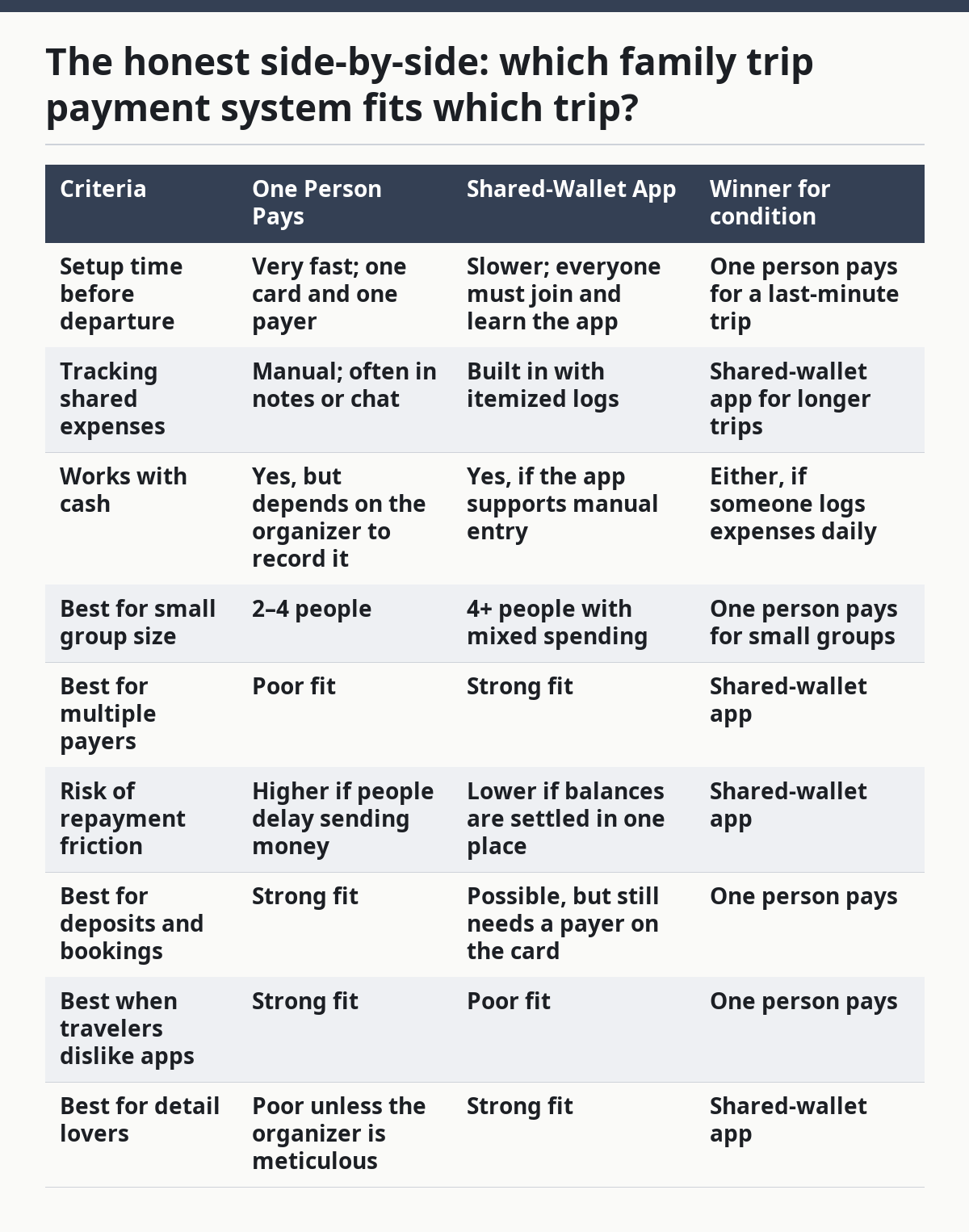
The table is blunt for a reason. A family of six with five shared meals, two bookings, and several cash purchases will usually benefit from a ledger. A small group doing one weekend stay often does not need that much structure.
One detail most guides miss: the winner can change by expense type. You might use one payer for lodging and a shared wallet for food and fuel. That hybrid is often the best answer, especially when bookings require a card but day-to-day spending is split informally.
When should you switch to a hybrid system?
A hybrid system is the best choice when one method cannot cover the whole trip. It keeps the booking process simple while still tracking the messy parts that happen after arrival.
Picture this: you have paid the hotel deposit on one card, but the group is splitting meals, fuel, tickets, and airport transfers. That is the moment to mix methods. Pure systems break down when the trip has both fixed costs and flexible shared spending.
A useful hybrid plan is this:
- one payer handles all reservations
- the group uses cash or a ledger for daily expenses
- settlement happens once per day or once at the end
- optional activities are charged only to participants
This is the most realistic setup for many trips because reservations and day-to-day spending are not the same problem. Bookings need speed and acceptance. Ongoing costs need transparency.
The downside is that hybrids need rules. If the lodging is on one card and dinner is on another and nobody records anything, the trip becomes a blur. The system only works if someone is the designated recorder or if the app logs expenses as they happen.
A hybrid also helps when some travelers prefer cash and others prefer digital transfer. That mixed preference is common, especially across generations. One person may prefer a bank transfer. Another may want to hand over cash at the end. A third may only use card-based bookings. A hybrid can accommodate all three without forcing one behavior on everyone.
The key is to decide which expenses belong in which lane before the trip starts. If you wait until after the first dinner, the process will drift.
Which family trip payment system should you choose, and when is none of them right?
Choose one-person-pays if the trip is short, the group is small, and one traveler is comfortable fronting the main costs. Choose a shared-wallet app if several adults are splitting many shared expenses and you want a clean ledger. Neither if the group cannot agree on rules, because the payment system will not fix a trust problem.
Picture this: you need a choice before the first booking, not a theory after the trip ends. The right answer depends on who pays, how often you split, and how patient the group is with admin. That is the whole decision.
A few simple matches make the call easier:
- Use one-person-pays for a weekend getaway, a tightly organized road trip, or any trip where one planner already handles bookings.
- Use a shared-wallet app for a bigger group, a longer trip, or any situation with many small shared bills.
- Use a hybrid when bookings are centralized but daily spending is mixed.
- Use neither when the group is already tense about money or refuses to follow the same system.
The biggest mistake is choosing the most “fair” method instead of the most usable one. A perfectly fair system that nobody follows is worse than a simpler one everyone accepts.
The second biggest mistake is not naming one rule for repayment. Set the cutoff in advance: end of each day, end of the trip, or right after a major booking. Without a cutoff, settlement drifts.
A strong system also needs a backup. If the transfer app fails, one card declines, or someone loses cash, what then? The answer should be obvious before anyone leaves home.
What a good trip money plan looks like before departure
A good plan is short enough to read in one minute and specific enough to stop arguments. It should name the payer, the split rule, the settlement time, and the backup method.
Picture this: you are one day from departure and the bookings are almost done. This is the last chance to make the money rules visible. Put them in the trip chat or a shared note so nobody has to remember from memory.
Here is a simple pre-trip checklist:
- Decide who pays for lodging and transport bookings.
- Decide whether expenses are split evenly or by role.
- Pick the tool: cash, transfer app, shared ledger, or hybrid.
- Set a repayment time, such as nightly or after the trip.
- Write one backup method for failed cards or missing cash.
That checklist sounds basic because it is. Basic is good when the goal is to avoid conflict. The more complicated the trip, the more valuable plain rules become.
A final tip: keep the system boring. Boring payment systems are the best ones. They disappear into the background, which is exactly what money handling should do on a trip.
Can a family trip payment system work across different ages and habits?
Yes, but only if the rules are simple enough for everyone to follow. The more mixed the group, the more important it is to use one obvious process and avoid special cases.
Picture this: grandparents prefer cash, parents use bank apps, and teens never want to touch the checkout. The answer is not more tools; it is fewer rules. A hybrid system with one payer plus a simple settlement method usually handles mixed age groups best.
Here is why. Older travelers may not want to install another app, while younger travelers may not carry much cash. If you try to force the same behavior on everyone, you add friction before the trip even starts. A shared ledger can still work, but only if one person is willing to manage it.
A better approach for mixed habits is to assign roles:
- one organizer handles bookings
- one person logs shared expenses
- one backup person can pay if the main card fails
- everyone else settles by the agreed method
That keeps the load manageable. It also protects the trip from one person’s preference becoming everyone’s problem.
The best payment system for mixed ages is the one with the fewest steps at the point of payment. A child’s snack, a parent’s taxi fare, and a grandparent’s museum ticket should not require three different arguments.
FAQ
What is the easiest way to split family trip costs?
The easiest way is to let one person pay for bookings and split the rest with a simple transfer at the end. That works best for short trips with a small group and few shared purchases. If the trip has many shared bills, a ledger app is easier to manage than memory.
Should we use cash or an app for shared trip expenses?
Use both if the trip includes places that do not take cards or if the group mixes payment habits. Cash is better for small, immediate costs, while an app is better for tracking who owes what. The cleanest setup is usually card for bookings, cash for small daily costs, and an app for settlement.
How do you handle one person paying for everything?
Write down what that person is covering, how the rest will reimburse them, and when repayment is due. Without that, the organizer becomes an unpaid lender. If the upfront total is too large, switch to a shared ledger or split the bookings across two cards.
What if not everyone uses the same payment app?
Then do not make the app the only system. Use it for tracking if most people are comfortable with it, but keep cash or bank transfer as a backup. A payment plan that depends on one app everyone must install is fragile.
Is there one best system for every family trip?
No. A short trip with a clear organizer is usually fine with one person paying and getting reimbursed. A bigger or messier trip needs a shared ledger or a hybrid. The best system is the one the group will actually use without confusion.
Drafted with AI; not yet reviewed by a person.
