
Last updated: November 19, 2026
Quick Answer: For How to Choose Between Cashback and Points for a Family Vacation, cashback usually wins for families who want a clean, simple reward worth 1:1 against cash, while points can be worth more when you can use them well. This guide shows which one fits your trip, your booking style, and your patience level.
Key Takeaways
- Cashback usually wins for families who want a simple way to cut the bill and move on.
- Cashback is better when you want certainty; points are better when you’re chasing a higher ceiling.
- Cashback fits families who want simple math and broad flexibility.
- Points work best when travel dates and airports are flexible, and you’re willing to search before booking.
Our Top 3 Picks at a Glance
- #1 Best Overall: Cashback if you want easy redemptions and fewer booking surprises.
- #2 Best Budget Pick: Cashback if you need to shave real dollars off a trip without learning award charts.
- #3 Best Heavy-Duty / Upgrade Pick: Points if you can work around blackout dates, transfer rules, and tighter booking windows.
The short answer for family trips
Therefore, cashback usually wins for families who want one clean answer: use the rewards, cut the bill, and move on. Points win when you can line up seats or rooms at the right time and you’re willing to spend more effort on booking. A trip with 2 adults and 2 kids often has more moving parts than a solo getaway, so simplicity matters.
That’s the core trade-off in How to Choose Between Cashback and Points for a Family Vacation: cashback buys flexibility at checkout, points buy upside at booking. One is easy to value because a statement credit is just cash back on your card. The other can beat cash back on a good redemption, but only if the trip dates and booking rules cooperate.
Here’s the catch: families don’t just need value, they need usable value. A reward that saves 50,000 points on paper but won’t cover 4 seats on the same flight is not a win.
Cashback vs points: what actually changes for a family trip?
Because of that, cashback is better when you want certainty; points are better when you’re chasing a higher ceiling. The right choice depends on whether your vacation is planned around a fixed destination and dates, or whether you can shift flights and hotels to fit award space.
For a family, the biggest difference is not theory. It’s friction. Cashback can turn into statement credits or direct savings with almost no planning. Points can require transfer partners, award searches, and booking rules that change the shape of the whole trip. For more on how rewards work, see the Consumer Financial Protection Bureau and The Points Guy.
| Criteria | Cashback | Points | Winner for this condition |
|---|---|---|---|
| Redemption simplicity | Statement credits are easy to understand | Award value depends on the program | Cashback for readers who want no learning curve |
| Booking flexibility | Works on almost any flight, hotel, or rental | Depends on award space and partner rules | Cashback for fixed dates |
| Upside per dollar | Usually more predictable | Can be higher on premium travel redemptions | Points for flexible planners |
| Family-size bookings | Easy to use across multiple charges | Can be harder to find enough seats or rooms | Cashback for larger families |
| Planning time | Very low | Can take real research time | Cashback for busy parents |
| Protection from bad redemption choices | High | Lower if you redeem poorly | Cashback for beginners |
| Chance of outsized value | Limited | Real, if you find good award rates | Points for experienced travelers |
| Cash flow help | Statement credits reduce the bill directly | May not help until after a booking is made | Cashback for tighter budgets |
| Booking complexity | Simple | Higher | Cashback for people who hate hoops |
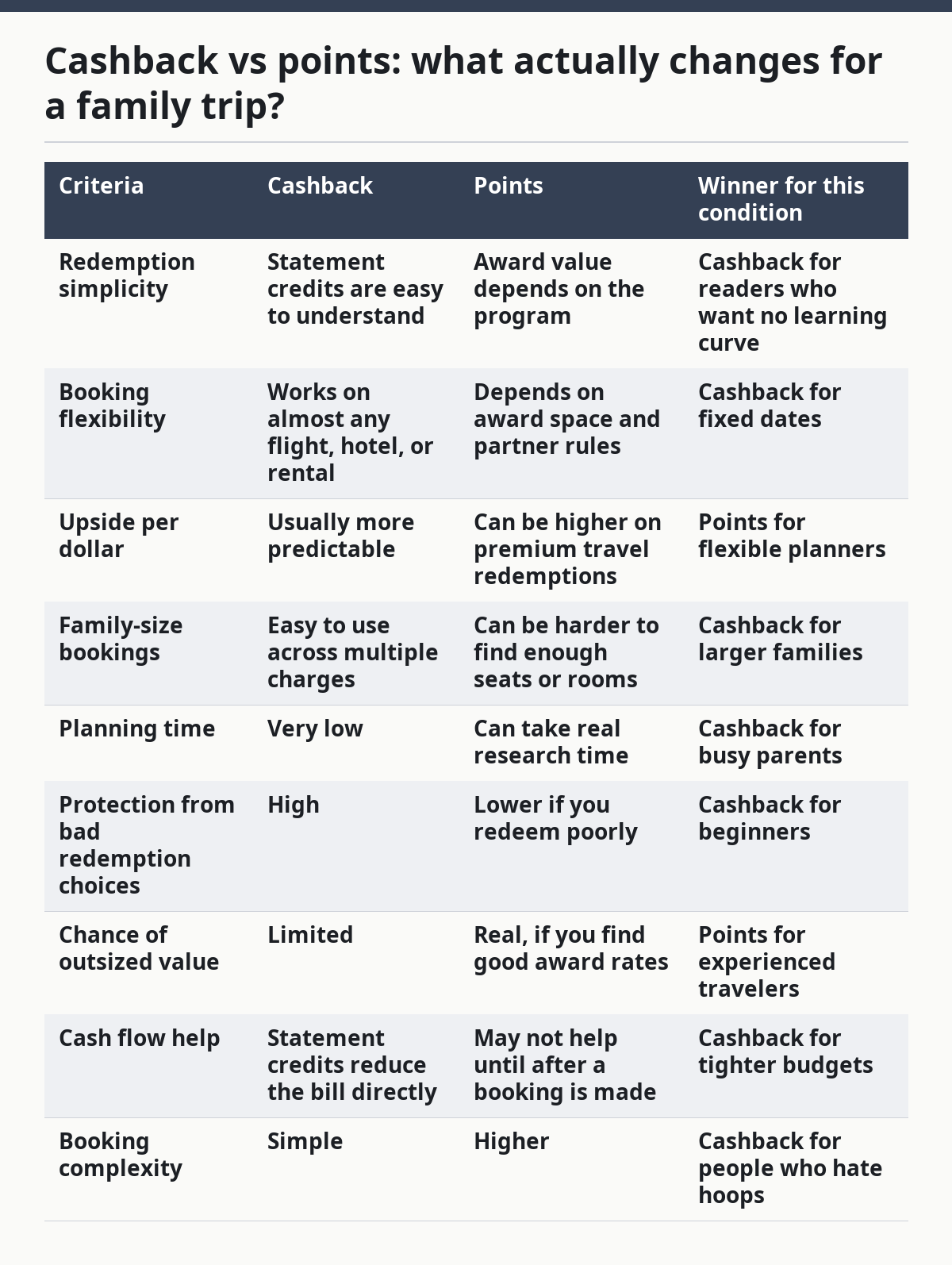
Points only win this table if you can actually use them well. If your travel dates are locked, your hotel needs are specific, or you’re booking for a school break, the program may not show you enough award space to matter.
Cashback cards: who should actually use them?
Cashback is the better fit for families who value simple math and broad flexibility. If you want to book a trip on any site, pay however you like, and then erase part of the charge with a statement credit, cashback does that cleanly.
The strongest case for cashback is family travel with fixed costs. Flights, baggage fees, parking, rental cars, resort fees, and a pile of meals all count as real expenses. A cashback card turns those charges into savings without forcing you into one airline or hotel chain. The NerdWallet rewards guide explains why that flexibility matters for everyday spending.
The weakness is obvious: cashback rarely creates a big headline win. It tends to be steady, not flashy. If a travel rewards card gives you a strong transfer option or a premium hotel stay, cashback may leave money on the table.
That said, many families should prefer the boring answer. Boring is useful when your trip already has enough moving parts.
Who Should Skip This: Families who can book around award space and are willing to track transfer partners should look harder at points, because that’s where the bigger upside lives.
Buy this if: you are a parent who books in cash, wants easy statement credits, and doesn’t want to learn award charts.
Skip this if: you are a flexible traveler with school-break dates that can move and you want a shot at higher-value redemptions.
Points on family vacations: where they win and where they fail
Since points are more work, they reward flexibility. Points work best when your travel dates are flexible, your airport choices are open, and you’re comfortable searching before you book. In the best cases, points can cover a flight or hotel night at a value that is stronger than a simple cashback redemption.
The strength of points is not just “more value.” It’s targeted value. A travel rewards card can be pointed at a specific redemption that matters: a long-haul flight, a family suite, or a hotel stay that would otherwise be too expensive for cash. That matters most when the trip is large enough that a 2% or 3% cashback return does not move the needle enough.
The weakness is that points can be trapped by rules. Some programs use transfer partners. Some have blackout dates. Some make you search a calendar that looks generous until you try to book 4 seats at once. If the family trip is tied to a holiday week, points can disappoint fast. See Airline Reporting Corporation data on how flight booking behavior can affect availability.
Points are best for travelers who think in calendars and award charts, not just receipts. They are a poor fit for anyone who wants the fastest route from “earned” to “spent.”
Who Should Skip This: Families who need to book the exact same dates every year and hate checking multiple award calendars should stick with cashback, because points can turn into a second job.
Buy this if: you are a parent who can move dates by a few days and wants a chance at a bigger redemption.
Skip this if: you need 4 seats or 2 rooms on a hard deadline and you want the money back with no booking games.
The honest side-by-side for family travelers
However, cashback is the safer default, but points can beat it when the trip fits the program. The decision comes down to how much time you want to spend for a possible gain.
The table below shows the practical difference, not the marketing version.
| Criteria | Cashback | Points | Winner for this condition |
|---|---|---|---|
| Family vacation simplicity | Easier to apply to any trip expense | Requires more planning | Cashback |
| School-break travel | No award calendar to fight | Award space can be scarce | Cashback |
| International flights | Savings are predictable | Can produce stronger redemptions | Points |
| Hotel stays | Works anywhere cash is accepted | Can be strong with the right program | Points |
| Rental cars and extras | Easy to use | Often poor value | Cashback |
| Booking speed | Fast | Slower | Cashback |
| Value hunting | Modest but clear | Higher ceiling, lower certainty | Points |
| Risk of wasted rewards | Low | Higher if you redeem poorly | Cashback |
| Best for beginners | Yes | Usually not | Cashback |
| Best for power users | Less exciting | More room for upside | Points |
The truth is, families usually feel the downside of points before they feel the upside. You notice the limited seats, the odd taxes and fees, and the extra search time first. The big savings show up only when the trip lines up with the program.
When does points beat cashback on a family vacation?
Therefore, points beat cashback when the trip has enough flexibility to let you shop for award space instead of just buying the first available fare. That usually means your dates can move, your destination is not fixed, or you’re willing to split travel plans slightly to make the numbers work.
This is where points can shine for bigger family trips. If you’re booking a flight that would cost a lot in cash, or a hotel stay that would eat most of the vacation budget, points can create real relief. The upside is strongest when you redeem for travel at a better rate than a basic statement credit would give you.
But there’s a trade-off: points are only as good as the booking you can actually make. A trip that looks perfect on a rewards chart can still fail if there aren’t enough seats or rooms together. For families, that can matter more than raw value.
On the flip side, cashback is unbeatable when the trip is already expensive and you need the reward to work anywhere. It can go toward whatever the family actually needs, not just what the program allows.
Exception scenarios where the verdict flips
- You can move the trip by 2 or 3 days. Points often become more attractive because award space opens up.
- You’re booking a short domestic trip with cheap fares. Cashback usually wins because the points upside is too small to justify the hassle.
- You need to pay for extras like baggage, parking, or car rental. Cashback is better because those charges don’t reward award-chart gymnastics.
- You have a large balance in one program already. Points may beat cashback if the balance is enough to cover a useful chunk of the trip.
How to decide in 5 minutes
Next, cashback is the right choice if you want the cleanest path from spending to savings. Points are the right choice if you are willing to spend booking time in exchange for a shot at better travel value.
Use this quick filter:
- Do you need fixed dates? If yes, lean cashback.
- Do you hate award searches? If yes, lean cashback.
- Can you move dates by a few days? If yes, points deserve a look.
- Are you booking for 4 people or more? If yes, cashback often stays simpler.
- Do you want the reward to work on any expense? If yes, choose cashback.
For families trying to stretch a vacation budget, this choice fits neatly inside broader planning around booking timing and pricing. That’s where the real savings usually come from, not from squeezing one extra cent out of a reward.
The verdict: which one should you choose?
Overall, choose cashback if you want simple, flexible savings for a family trip with fixed dates. Choose points if you can tolerate more booking work and you have enough flexibility to chase award space. Neither if you’re expecting rewards to fix a trip that is already over budget or overbooked.
That is the clean call. For most families, cashback is the safer pick because it works on more charges and causes fewer booking headaches. Points only win when your schedule, destination, and program all line up.
How should a family think about redemption value?
Because redemption value depends on what the reward actually buys, not the number on the screen, a family should compare cash savings with the value of the trip itself. A statement credit is easy to trust because it reduces a real bill. Points may be worth more, but only if the redemption fits your trip dates and room or seat needs.
That means cashback is often the better fit for ordinary family travel expenses like airfare, bags, and car rentals. Points can beat it on a carefully chosen hotel stay or flight, but the better headline value may take extra searching and flexibility. If the trip is fixed, cashback is usually the cleaner answer.
Is cashback better than points for family travel?
Because cashback is easier to use and less likely to get trapped by award rules, it is better than points for many family trips. Families often need flexibility more than they need a theoretical top-end value.
Points can still win if the trip is flexible and the booking lines up with a strong redemption. If the dates are fixed, the family is large, or the trip includes a lot of non-hotel, non-flight expenses, cashback is usually the more practical choice.
When should families choose a cashback card?
Since fixed dates and multiple charges make award space harder to use, families should choose a cashback card when the trip has little room for planning around award space. Cashback also makes sense when you want rewards that work like money and not like a separate travel puzzle.
It is the cleaner option for parents who book fast, value simplicity, or want to apply rewards to whatever the vacation ends up costing. If a school calendar or work schedule controls the trip, cashback is often the safer route.
Do points save more than cashback on a vacation?
Points can save more than cashback on a vacation, but only when you find a redemption that fits your trip and beats a simple statement credit. That usually takes flexibility, patience, and enough award space for the whole family.
Cashback is less dramatic, but it saves more reliably in real life. For many families, that reliability matters more than a bigger number that only exists if the booking works out perfectly.
Drafted with AI; not yet reviewed by a person.