Last updated: November 19, 2026
Key Takeaways
- Shoulder-season weekday trips are the simplest way to cut crowds without changing the whole vacation style.
- Look for spread-out destinations, not one crowded hotspot, so the day has room to breathe.
- Shifting dates and locations usually helps more than paying for upgrades or extras.
- Beaches, lakes, and smaller museums work well because kids can move around without one long queue.
Crowded parks and packed beach towns can ruin a family trip fast. For Best Budget Family Trips for Avoiding Crowds, the answer is usually a shoulder-season, weekday, low-key trip that avoids headline attractions at peak hours. This guide sorts out which trips fit that goal, which ones don’t, and how to plan one without paying extra.
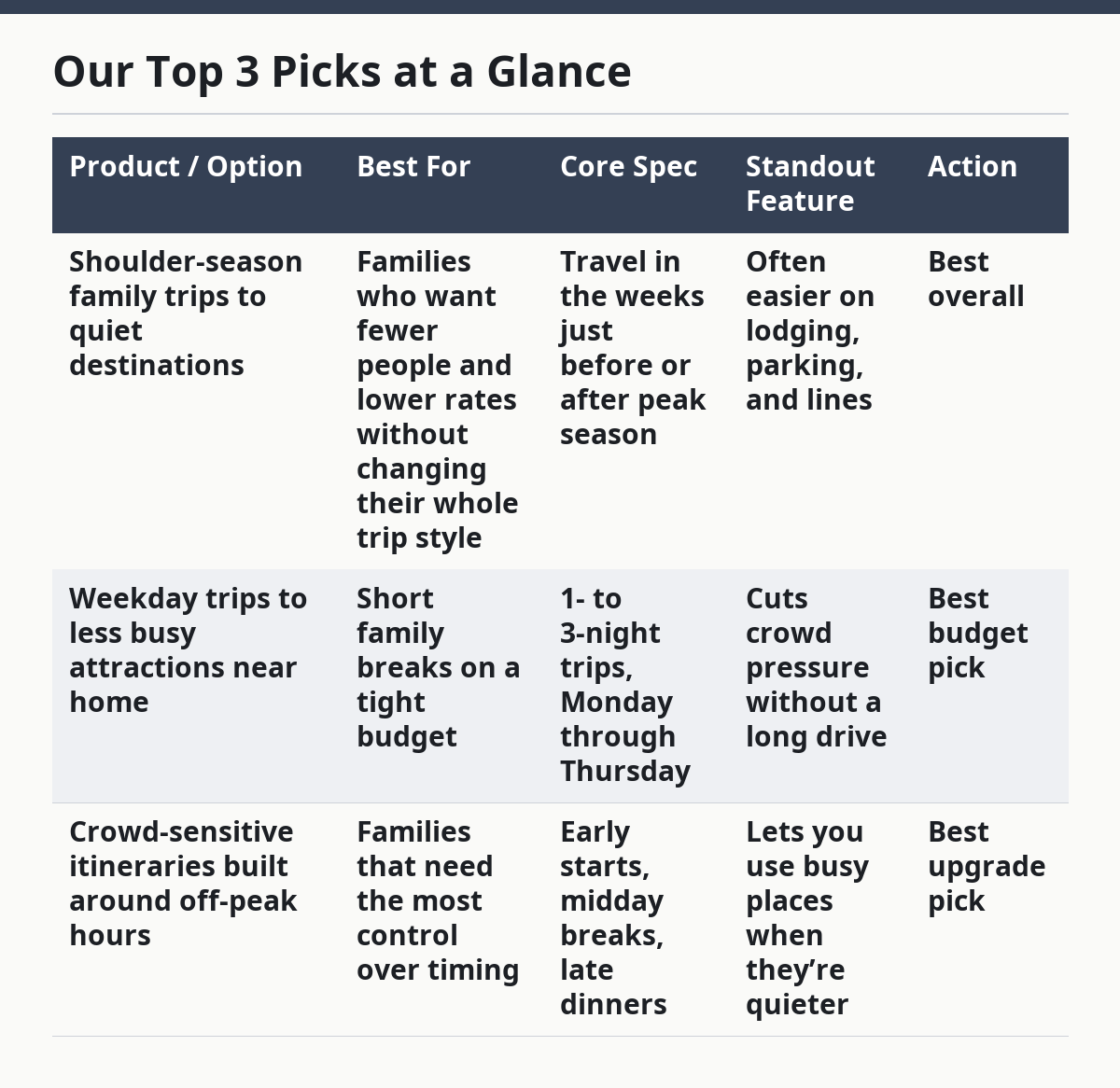
Our Top 3 Picks at a Glance
- #1 Best Overall: Shoulder-season family trips to quiet destinations
- #2 Best Budget Pick: Weekday trips to less busy attractions near home
- #3 Best Heavy-Duty / Upgrade Pick: Crowd-sensitive itineraries built around off-peak hours
| Product / Option | Best For | Core Spec | Standout Feature | Action |
|---|---|---|---|---|
| Shoulder-season family trips to quiet destinations | Families who want fewer people and lower rates without changing their whole trip style | Travel in the weeks just before or after peak season | Often easier on lodging, parking, and lines | Best overall |
| Weekday trips to less busy attractions near home | Short family breaks on a tight budget | 1- to 3-night trips, Monday through Thursday | Cuts crowd pressure without a long drive | Best budget pick |
| Crowd-sensitive itineraries built around off-peak hours | Families that need the most control over timing | Early starts, midday breaks, late dinners | Lets you use busy places when they’re quieter | Best upgrade pick |
What kind of trip cuts crowds without blowing the budget?
The answer is a shoulder-season, weekday, low-key trip that avoids headline attractions at peak hours. That usually means late spring or early fall, a Monday-to-Thursday stay, and a destination with more than one way to fill a day.
Picture this: you want a trip where the kids still get pool time, a beach, or a museum, but you’re not stuck in a 40-minute snack line. You need fewer crowds, not a luxury resort. As a result, the cheapest “popular” trip can cost more in time and frustration than a quieter place that is a little less famous.
A useful rule is simple:
- Pick shoulder season before chasing peak summer.
- Choose weekday travel over Friday-to-Sunday arrivals.
- Favor less busy attractions over the one big draw everyone else is chasing.
- Build around places where a 10-minute walk or a 15-minute drive gives you a backup plan.
That’s the whole game. Just smart.
Where should a family go if crowds are the main problem?
The best places are usually quiet destinations with enough family basics to keep the trip cheap: public beaches, state parks, small museums, lake towns, and smaller cities with a few free things to do. You’re looking for places where the main appeal is spread out, not concentrated in one hotspot.
For example, you may be scanning maps and reviews at 9 p.m., trying to find a place that won’t feel like a theme-park line disguised as a vacation. A good budget crowd-avoidance trip usually has parking that doesn’t require a reservation, sidewalks or trails that don’t bottleneck, and attractions that accept walk-ins. That matters more than a famous name on the sign.
Strong candidates often share these traits:
- A local beach or lake with multiple access points
- A town center with free public space, not just one crowded strip
- Museums or historical sites with timed entry that still has slack during weekdays
- State or regional parks with more than one trailhead
- Family lodging outside the main tourist core, even if it’s 10 to 20 minutes farther out
The trade-off is real. These places may have fewer big-ticket sights, and the food scene may be simpler. Once a place gets overloaded online, it can stop feeling quiet fast.
One solid source for trip planning is the U.S. National Park Service’s guide to timing visits, which explains how off-peak hours and less busy periods change the experience; the same idea applies outside parks too. The National Park Service also has public trip-planning advice on crowded times and access. The U.S. Travel Association also publishes practical travel-planning guidance that points to the same basic idea: timing changes the experience. That’s not a guarantee of empty trails. It is a reminder that timing matters.
How do you avoid crowds without paying more?
You avoid crowds without paying more by shifting when and where you go, not by adding premium extras. A Tuesday in a modest town often costs less in parking stress, line time, and food markup than a Saturday in a famous place.
Picture this: you’re trying to keep the trip under control while still giving the kids something worth talking about on the ride home. The best move is usually to keep the trip short, keep the base simple, and use free or low-cost places that spread people out. A 2-night trip can beat a 5-night one if it lands on the right days.
Specifically, use this planning order:
- Start with dates, not destination. Pick a Monday-through-Thursday window first, or a Sunday arrival if you must travel far. The goal is to miss the Friday rush.
- Check shoulder season first. Look for the weeks right before school vacation season or right after it ends. Prices are often less intense, and crowds usually thin out.
- Choose a destination with built-in backups. You need at least 3 options: one main attraction, one free outdoor place, and one indoor fallback for rain.
- Book near the action, not in it. A lodging choice 10 to 20 minutes outside the busiest block can save money and reduce morning gridlock.
- Plan the day around off-peak windows. Early mornings and late afternoons are often quieter than midday. That’s where the breathing room lives.
Ultimately, these steps don’t require a bigger budget. They just require a calendar and some discipline.
Which trip types are best for small kids and fewer lines?
Trips built around beaches, lakes, and smaller museums are usually best, because they let kids move around without locking you into one crowded queue. A 30-minute delay at a playground is easier to handle than a 90-minute wait for a single ride or exhibit.
Then, if you’ve got one child who hates waiting and another who gets tired fast, a low-crowd trip works when the day has natural breaks built in—sand time, snack time, nap time, short trail time. That rhythm keeps the whole family calmer and makes the trip feel bigger than it is.
Best trip types for this job:
- Lake towns with public swim areas and picnic spots
- Beach towns away from the most famous boardwalk
- Small historic cities with compact, free walking areas
- State parks with easy trails and day-use areas
- Agritourism stops like farms, orchards, and pick-your-own spots in off-peak weeks
However, some “quiet” trips are quiet for a reason. A remote cabin can mean a long drive to groceries, urgent care, or a decent dinner. That can help the budget, but it can also make a family trip harder than it needs to be.
A practical filter is this: if the destination only works by renting a big house, buying every meal out, or driving 45 minutes for basics, it may not be a true budget option. For family trips, ease matters. So does backup planning.
A simple low-crowd family trip plan you can copy
A good crowd-sensitive trip is built in layers: one anchor activity, one backup, one easy low-cost filler. That structure keeps the day from collapsing when the first choice is busy.
Because of that, if you arrive and the main attraction is full, the day does not have to go sideways. If your plan has only one thing to do, the day goes sideways. If you planned for a 45-minute pivot, the trip stays on track.
Use this structure:
- Pick one anchor. Choose the thing the kids care about most, like a beach, aquarium, zoo, or state park trail.
- Add one backup within 15 minutes. That could be a playground, visitors center, library, splash pad, or quieter trail.
- Reserve the busiest part for off-peak hours. Go early if it’s outdoors. Go later if it’s an indoor attraction with a lunchtime dip.
- Leave 2 hours unassigned each day. That gives you room to dodge crowds, weather, or tired kids.
- Stay 1 night longer only if it lowers stress. More nights can help if the extra day lets you skip a Saturday arrival or departure rush.
This approach works because it keeps you from overpaying for “must-do” hours. It also keeps you out of the trap where every family in the region is doing the same thing at the same time.
The truth is, a crowd-free trip usually looks boring on paper. That is a good sign. It means the trip has slack in it.
What mistakes make a cheap trip feel crowded anyway?
The biggest mistake is choosing a famous place and hoping timing alone will fix it. It won’t. A crowded place in shoulder season can still feel crowded if every family in three states had the same idea.
Meanwhile, you may have saved money on the hotel, then spent the whole trip waiting in lines, circling for parking, and eating at the only place with a table. That isn’t a win. It is just a cheaper headache.
Watch for these common mistakes:
- Arriving on Friday afternoon. That hits the same road traffic and check-in crush as everyone else.
- Staying inside the main tourist strip. The room rate may look fine, but the crowd pressure lives right outside.
- Ignoring school calendars. A “cheap” week can still be packed if half the region is off.
- Picking one attraction with no backup. One bottleneck can shape the entire day.
- Assuming less famous means empty. Some smaller places get slammed because they have too little capacity.
What to do instead:
- Aim for Tuesday or Wednesday arrivals.
- Stay outside the core zone when the map shows only one busy street.
- Use a two-activity rule so a packed first stop doesn’t ruin the day.
- Check the destination’s local events calendar before you commit.
For families, the right trip is not the most exciting one on paper. It’s the one that still feels easy after breakfast.
How do you tell if a destination is truly crowd-friendly?
A destination is truly crowd-friendly if it has multiple low-cost ways to spend a day and doesn’t force everyone through one choke point. If every review talks about parking, timed entry, or one famous street, expect pressure.
For instance, you may open the map and see a place with beaches, trails, picnic areas, and a couple of museums spread out over a larger area. That is promising. Now picture a place where every family funnels into one downtown block by 11 a.m. That is a crowd trap, even if the destination is beautiful.
Look for these signs:
- Public parks or trails with several access points
- Free or low-cost attractions away from the main square
- Lodging choices not clustered around one popular block
- Family activities that don’t require advance tickets for everything
- A calendar that doesn’t revolve around one giant annual event
And one more thing: if the destination is known mainly for a single seasonal event, it can be a great trip on the wrong dates and a miserable one on the right ones. That is why the calendar matters as much as the map.
A good crowd-friendly trip should let you change plans in 15 minutes, not 3 hours.
What’s the best overall strategy for this kind of trip?
The best overall strategy is to choose shoulder season + weekdays + a less busy destination + an off-peak itinerary. That four-part mix gives you the best chance of staying on budget while avoiding the worst crowd crush.
After all, you want a family trip that feels calm enough for real rest, not just a change of scenery. This is how you get there without paying luxury rates. Pick the calmer window first, then build a trip around places that don’t force you into a single line of people.
Use these standards as your filter:
- Shoulder season: travel just outside peak demand
- Weekday travel: arrive and do the main activities Monday through Thursday when possible
- Quiet destinations: smaller towns, lakes, beaches, and parks with spread-out access
- Less busy attractions: free parks, smaller museums, side streets, and backup spots
That is the version that holds up best for families. It is not the flashiest trip. It is the one you can actually enjoy.
The National Park Service and the U.S. Travel Association both publish practical timing and trip-planning advice that points in the same direction: timing matters, and busy periods change the whole feel of a place. The specifics vary by destination, but the principle does not.
What destinations are best for families who want fewer crowds?
The best destinations are quiet beaches, lake towns, small museum cities, and state park areas with more than one place to spend the day. These spots spread people out instead of funneling them through one crowded center. They also tend to work better on weekdays and in shoulder season, when lines and parking pressure usually ease.
How do you avoid crowds without paying more?
You avoid crowds without paying more by changing dates, staying outside the busiest block, and choosing places with free or low-cost backups. Monday-through-Thursday trips often work better than weekend trips, and shoulder season can help too. The trick is to plan around off-peak hours instead of adding expensive extras.
Is shoulder season better for families?
Yes, shoulder season is often better for families because it usually brings lighter crowds without forcing a pricey upgrade. You may give up perfect weather or a few peak-season amenities, but you often get shorter waits and better room rates. That trade-off is worth it when crowd control is the main goal.
Drafted with AI; not yet reviewed by a person.