

Last updated: November 19, 2026
Quick Answer: for a family trip, use a fare hold when you need 12 to 72 hours to confirm plans; buy a flexible fare if a change would cost more than the upgrade; and if you want to rebook after a price drop, confirm the airline’s rules first because the savings may come back as credit rather than cash. Fare hold, price drop protection, and rebooking rules can save a family trip from turning into a rushed, expensive gamble. The right move is usually to hold the fare only when your dates are still shaky, buy when the itinerary is set, and use rebooking policies only if the airline lets you reprice without a penalty. For airline rule details, see the U.S. Department of Transportation and your airline’s contract of carriage, and for fare-hold timing and credit terms, check the booking page before you pay.
Key takeaways
- Fare hold buys time; it does not freeze every part of the fare.
- Price drop protection matters most on tickets that can be reissued without a large change fee.
- Family trips benefit most from flexible fares when seat assignment, school dates, or a third-party connection still might change.
- A low fare with strict rules can cost more than a higher fare with free changes if you are buying for 4 or 5 people.
- The fine print on airlines, travel insurance, and booking policies matters more than the headline fare.
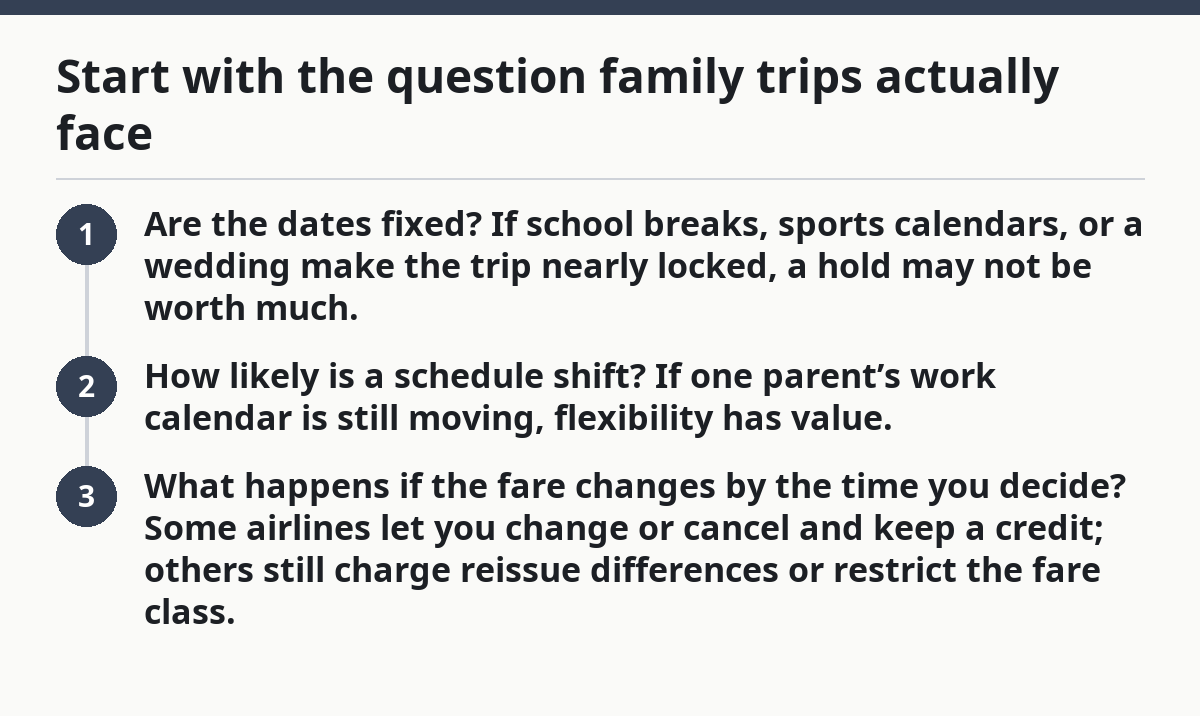
Start with the question family trips actually face
The real question for How to Use Fare Hold, Price Drop, and Rebooking Options for Family Trips is not “Should I buy now or wait?” It is “How much risk can I carry across 3, 4, or 5 tickets if one detail changes?”
A family trip magnifies every rule because the cost multiplies across each traveler. A $25 change fee is annoying on one ticket and a real line item on four or six. A fare that looks cheap on day one can become expensive once seat assignments, baggage, or a later reissue are added. That is why fare hold, price drop, and rebooking options belong in the same decision, not as separate tricks.
Start by asking three things:
- Are the dates fixed? If school breaks, sports calendars, or a wedding make the trip nearly locked, a hold may not be worth much.
- How likely is a schedule shift? If one parent’s work calendar is still moving, flexibility has value.
- What happens if the fare changes by the time you decide? Some airlines let you change or cancel and keep a credit; others still charge reissue differences or restrict the fare class.
A family with rigid dates often does better with a fare that allows a no-fee change, even if the fare is slightly higher. A family with uncertain dates may prefer a short hold window or a fare hold feature, then buy once everyone has confirmed. That logic is basic, but it is where most mistakes begin: people chase the lowest fare first and only look at the rules after the price rises.
If you are building a broader family travel plan around price timing, this sits neatly inside the hub on budget family travel planning by booking timing and pricing. For route-specific timing, it also helps to compare cheap flights for families and family travel insurance before you commit.
What a fare hold actually buys you
A fare hold buys time, not certainty. It usually reserves a seat and a price for a short window, often 24 hours or another limited period set by the airline or booking site.
That short window is the point. A hold helps when you need to check school dates, coordinate child care, or wait for one more person to confirm. It is most useful when the fare is good enough that losing it would sting, but not so urgent that you need to pay immediately.
The catch is that fare hold features vary a lot. Some airlines hold only the base fare. Some hold the full itinerary price. Some do not include checked bags or seat selection in the held amount. A hold can also expire with no warning beyond the countdown on the page, so consult the airline’s rules or a travel professional before relying on it, and review the fare-hold terms on the booking page or in the airline’s help pages.
Use a fare hold when:
- the family trip date is likely but not final,
- the fare is unusually good for the route,
- you need 12 to 72 hours to compare alternate flights,
- or you are waiting for one traveler’s schedule to clear.
Do not use it when:
- you already know you will buy within an hour,
- the hold fee is high enough that it erases the value,
- or the airline’s hold rules are so narrow that baggage and seats still need separate payment.
One practical rule helps: if the fare hold costs money, compare that fee against the likely fare increase over the hold period. If the price difference is small, the hold is often just paying for indecision. If the route is volatile and the family needs coordinated seats, the hold may be worth more than the fee.
How to compare price drop protection before you buy
Price drop protection is only useful if the fare rules allow a real reprice after purchase. It does not mean every lower fare automatically sends cash back.
The first thing to check is the airline’s rebooking policy. Many airlines now let you change certain tickets without a change fee, but that does not always mean a refund. In some cases, if the new fare is lower, you get an eCredit or travel credit for the difference. In other cases, the airline reprices only if the fare class and route rules match what you bought. The U.S. Department of Transportation’s airline consumer guidance explains why policy terms matter.
Before you pay, look for four details:
- Change fee: Is there one at all?
- Fare difference: If the replacement fare is lower, do you keep the difference or only receive credit?
- Time limit: Can you rebook up to departure, or only within a set window?
- Fare class limits: Are basic economy or deeply restricted fares excluded?
A family should care about this more than a solo traveler because there are more seats to protect. If one ticket can be repriced but the others cannot, you may end up with uneven costs and awkward seat maps. That is a hidden downside of chasing the lowest fare on each ticket.
Look closely at the booking policy wording too. “Cancel for credit” is not the same as “price drop refund,” and “change allowed” is not the same as “free to rebook to a cheaper fare.” Those terms sound close, but they produce different outcomes. A family that expects actual cash back can be disappointed when the airline only offers a credit tied to the original traveler.
Travel insurance can help in some trip interruption situations, but it usually does not exist to protect you from ordinary fare drops. Read the policy wording if you are counting on that feature. For covered-trip questions, the Department of Transportation and your insurer’s policy pages are better references than the fare headline.
Can I rebook if the price drops after I buy?
Yes, but only if the fare rules and the airline’s rebooking system allow it. The answer is often “credit, not cash,” and sometimes “only if you catch the lower fare before departure.”
This is where many people misread the policy. A lower fare after purchase may let you reissue the ticket, but the difference might come back as an airline credit rather than a refund to your card. On a family trip, that distinction matters because $80 back in credit is less useful if the return leg or next trip is uncertain.
A simple process helps:
- Check the ticket type before purchase. Look for change rules, redeposit rules, and whether basic economy is excluded.
- Save the original fare details. Keep the fare class, booking code, and receipt email in one folder.
- Track the route for 24 to 72 hours. Price swings are more common close to departure changes, schedule changes, or sale periods.
- Search the same itinerary, not a “similar” one. Different flight numbers, connection times, or fare buckets can make a comparison useless.
- If the price drops, compare the new total after fees. A lower base fare can disappear once a change fee, seat fee, or baggage difference is added.
- Rebook only when the savings beat the hassle. For a family, a $10 difference per traveler may not justify reissuing four separate tickets.
The biggest mistake is rebooking too quickly on a fare that looks lower but carries tighter restrictions. Another is assuming all tickets in the same family booking will reprice the same way. That is not guaranteed; each ticket follows its own fare rules, even if the purchase was made in one transaction.
If the original fare is fully flexible, rebooking can be worth the time. If it is heavily restricted, the “price drop” may only create more work. For examples of current consumer protections, check the airline’s contract of carriage and the DOT’s consumer pages before you act.
Which family fares are worth paying extra for?
Flexible fares are worth paying extra for when one change would be expensive or disruptive, not when you are simply hoping for a better deal later.
For a family trip, a strong case for flexibility is easy to define: dates are tied to school breaks, a child’s schedule may change, or one adult’s work calendar is not settled. In those cases, a fare with a free change rule can be cheaper in practice than a rock-bottom fare with a strict change penalty and a narrow reissue window.
A practical way to compare is to add up the full risk cost:
- the fare difference between the flexible and nonflexible ticket,
- any change fee,
- any likely fare increase if you need to rebook,
- and the cost of losing adjacent seat choices.
That last point matters more than many travelers admit. Families often care as much about sitting together as about the fare itself. If changing a ticket means your family gets split across rows or flights, the inconvenience can outweigh a small savings.
Where flexible fares are often not worth it:
- when the trip dates are fixed and the purchase will not change,
- when the airline’s basic economy restrictions still allow the family to travel as planned,
- or when the premium for flexibility is large relative to the route.
Where they are often worth it:
- when one family member’s schedule is uncertain,
- when the trip depends on weather-sensitive timing,
- or when the route is expensive enough that a later change could be painful.
Check the fare rules, not just the marketing label. “Flexible” can mean free changes, or it can mean a slightly wider window to alter the trip with fare differences still due. Those are not the same product. If you need a side-by-side comparison, use the airline booking page and a fare-rule summary from the carrier before you decide.
Common mistakes that cost families money
One expensive mistake is buying a fare because it is the cheapest today and ignoring what happens if you need to move it tomorrow. That can turn a low advertised price into a higher total after fees, seat changes, and reissue rules.
Here are the mistakes I would avoid:
Mistake 1: Treating fare hold like a full reservation.
Cost: the hold can expire before you finalize everyone’s plans.
Do instead: use the hold only when you know you can complete the purchase within the stated window, such as 12, 24, or 48 hours.
Mistake 2: Assuming a lower fare means cash back.
Cost: you may get only a credit, or no savings at all after fees.
Do instead: read the rebooking policy line by line and look for “refund,” “credit,” or “fare difference.”
Mistake 3: Buying the cheapest basic fare for a group.
Cost: one change can force a separate reissue or make seat selection painful.
Do instead: compare the total family cost, not the headline fare on one ticket.
Mistake 4: Ignoring the expiration on credits.
Cost: the “savings” can vanish if the credit cannot be used in time.
Do instead: note the credit’s deadline the day you get it.
Mistake 5: Checking only one airline.
Cost: you may miss a carrier with clearer price protection or better rebooking terms.
Do instead: compare at least two airlines on the same route and the same dates before deciding.
A final warning: travel insurance can help with covered events, but it is not a replacement for a fair airline policy. If your family trip depends on having room to move, the ticket rules matter more than the promotional fare. For policy comparisons, consult the airline and an insurance professional before you buy.
The shortest decision rule I would use
Buy now if the trip is fixed and the fare rules are decent. Hold the fare if the dates are close but not final and you need a day or two to coordinate. Pay extra for flexibility when a change would be more expensive than the upgrade.
That rule works because it matches the real problem family travelers face: uncertainty is costly. A fare hold is useful when the family is still aligning schedules. Price drop protection matters when you think the market may move and the airline will let you reprice. Rebooking options matter when a plan can shift without warning.
The wrong move is waiting for perfection. Airfare rules change, seats sell, and the cheapest fare often carries the least useful protection. The better move is to choose the option that fits the amount of uncertainty still left in the trip.
What is a fare hold for family flights?
A fare hold for family flights is a short-term reservation of the fare and often the seat space without immediate payment. It gives a family time to confirm dates, compare options, or wait for one more traveler to approve the trip before buying.
Can I rebook if the price drops after I buy?
Yes, sometimes you can, but the result depends on the airline’s rules and fare class. The lower fare may come back as travel credit instead of cash, and fees or restrictions can reduce the savings.
Are flexible tickets worth it for family trips?
Flexible tickets are worth it when a date change would be costly or stressful, such as around school breaks or uncertain work schedules. If the trip is fixed and unlikely to move, the extra cost may not be worth paying.
Drafted with AI; not yet reviewed by a person.
