
Last updated: November 19, 2026
Key Takeaways
- Family budget trips work best when transport, lodging, food, and local movement stay predictable.
- The right choice depends on whether lower daily costs or lower daily stress matters more.
- City breaks suit families that want inexpensive variety.
- Good value destinations often let families skip a car, cut transfer costs, and avoid daily paid entertainment.
Budget family travel works best when the destination does the money-saving for you. Pick a place with cheap ground transport, kid-friendly housing, free or low-cost activities, and easy food options, and the rest of the trip gets simpler fast. I write travel planning content with a focus on real-world trade-offs, especially how families avoid hidden costs that can wreck a “cheap” trip. Budget family travel destination planning — The Complete Guide is about those trade-offs, and a quick answer is this: a family can often keep the trip affordable by controlling the four biggest costs, not by chasing the lowest headline price.
What makes a family destination affordable?

A family destination is affordable when the big costs stay predictable: getting there, sleeping there, eating there, and moving around once you arrive. The cheapest-looking city on paper can become expensive if it needs taxis everywhere, charges resort fees, or only offers family rooms that disappear months ahead of time.
The best budget destinations usually share four traits. First, they have public transport that is easy to use with strollers, car seats, or tired kids. Second, they offer family lodging with kitchens, laundry, or at least breakfast included. Third, they have a lot of low-cost activities that do not require bookings and timed entry every day. Fourth, they have grocery stores, markets, or casual restaurants where a normal family meal does not become a special event.
The mistake most generic guides make is treating “cheap destination” as a single label. It is not, and families should compare costs carefully or consult a qualified travel professional if they are unsure. A beach town can be cheap in shoulder season and expensive during school holidays. A capital city can look pricey, but if museums are free on certain days and transit is simple, the total trip can still beat a remote resort once you add rental cars and meals. The decision is not “Where is cheapest?” The decision is “Where can my family spend less without making every day harder?”
For planning, that means choosing a destination with a low-friction cost structure, not just a low nightly rate. A place that saves $40 a night but forces a family of four into two taxis a day is not really saving money. Destination planning is about total trip cost, not sticker price.
Should you choose a city break or a beach trip?
A city break usually wins for budget family travel if the family wants lower transport costs, indoor backup plans, and free attractions; a beach trip wins if the kids need long, simple days and the lodging includes a kitchen. The better choice depends on whether you are minimizing daily spending or minimizing daily stress.
City trips tend to give more control. Many cities have museums, parks, waterfronts, public squares, and free walking areas that fill a day without buying tickets for every hour. They also make short trips easier because you can swap plans when a child is tired or the weather turns ugly. A place like Lisbon, Budapest, Kuala Lumpur, or Mexico City can work well for families because transit and food options are broad enough to keep costs down. The downside is that cities often punish poor planning: popular attractions sell out, and walking five kilometers with a preschooler is not a smart “budget” move if it leads to a taxi anyway.
Beach trips win when your family wants fewer moving parts. A coastal place with self-catering apartments, a grocery shop nearby, and a safe swimming area can be cheaper than a city if you spend most of the day in one place. The cost trap is resort dependence. Once you are locked into paid beach clubs, paid shuttles, and restaurant meals for every lunch, the “relaxing” trip can become surprisingly expensive. Also, beach destinations often have sharper seasonal pricing. A family can save a lot by going in shoulder months, but if travel is during school holidays, the savings can disappear.
The right call is simple: choose a city if you want the most free and flexible days for the money; choose a beach if your family values low-effort days and can self-cater. Neither is right for a family that hates crowds, since both can become overwhelming in peak season.
The honest side-by-side

The city option wins for families who need low-cost variety. The beach option wins for families who need simplicity. If you are trying to decide quickly, the table below is one practical way to see which one fits the trip you are actually planning.
| Criteria | City break | Beach trip | Winner for condition |
|---|---|---|---|
| Typical activity mix | Museums, parks, public spaces, food markets, short excursions | Swimming, sand time, waterfront walks, limited day trips | City break for mixed-age families |
| Daily transport cost | Often lower if transit is strong and the core is walkable | Often lower only if the beach area is compact | City break in transit-friendly destinations |
| Food flexibility | High if supermarkets and casual eateries are close | High if self-catering lodging is available; low in resort zones | Tie, depending on lodging |
| Weather backup | Strong; indoor options matter on rainy days | Weaker unless there are indoor attractions nearby | City break in unstable weather |
| Lodging choice | More apartment and hotel variety | More apartments near beaches, fewer near prime sand | City break for choice |
| Risk of hidden costs | Taxis, timed tickets, city taxes, attraction tickets | Resort fees, beach chairs, parking, shuttles | City break for tighter budgets |
| Pace for younger children | Better if parks and naps are easy to fit in | Better if the family wants one main base all day | Beach trip for very young kids |
| Holiday-season pricing | Can spike around events and school breaks | Often spikes hard in peak sun months | City break in shoulder season |
| Energy required | More planning, more transitions | Less movement, fewer daily decisions | Beach trip for tired parents |
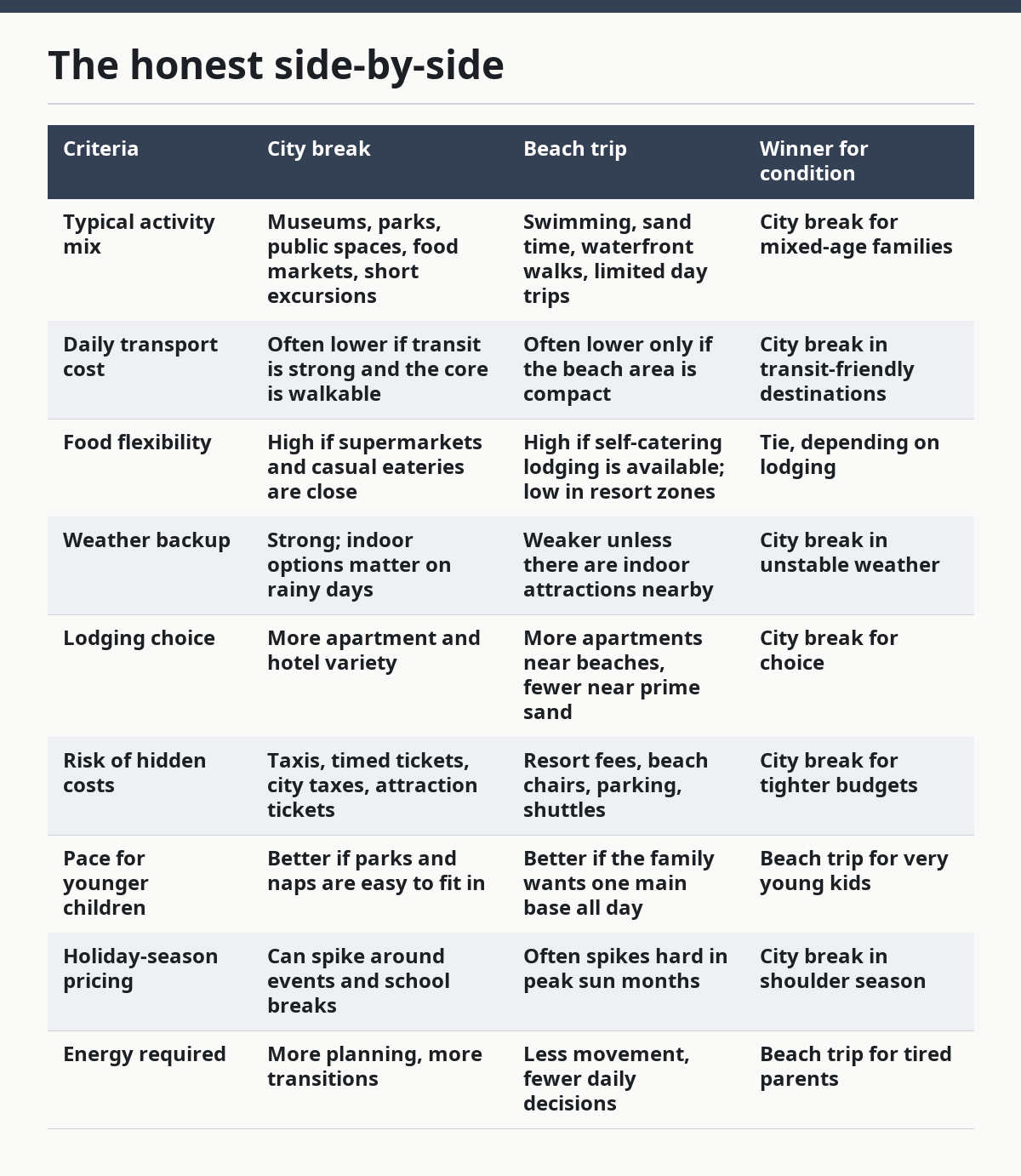
The table is not meant to crown one universal winner. It is meant to show where the money goes. The city breaks on transport and variety. The beach breaks on simplicity and a slower pace. If your family struggles with transitions, the beach is easier. If your family gets bored quickly and wants the option to switch plans without paying for it, the city is stronger.
The big warning is that “beach” is not automatically budget-friendly. A self-catering apartment near a public beach can be excellent value. A resort with mandatory extras can be the opposite. The same is true for cities: a room in the center can save time and transit money, but a “central” room that is tiny and poorly located can cost more in stress than it saves in cash. Look at the whole day, not the room rate.
Which destinations usually work best for tight family budgets?
The best budget family destinations are the ones that let you skip a car, skip expensive transfers, and skip buying entertainment every day. That usually points toward cities with strong transit, smaller capitals, and coastal towns where apartments and public beaches are common.
For European trips, compact cities with reliable transit and lots of free public spaces often beat sprawling resorts. Lisbon, Porto, Valencia, and Budapest are often discussed this way because families can build days around walking areas, parks, trams, markets, and low-cost meals. Eastern and Central European capitals can also be strong values if flights are reasonable from your home airport. The trade-off is that long-haul flights can erase local savings quickly, so the departure city matters as much as the destination.
Outside Europe, some of the best-value family destinations are in places where food and transit are cheap and the dollar stretches further. Mexico City is a good example of the type: large enough for plenty of things to do, varied enough for different ages, and often more affordable day to day than many U.S. cities. Kuala Lumpur is another strong model because a family can find modern transit, broad food choices, and large city attractions without needing to rent a car. In parts of Southeast Asia, the budget advantage can be significant, but long travel time and jet lag are the price.
The family-specific mistake is chasing a “cheap country” without checking actual logistics. A low-cost destination becomes costly if flights are expensive, visa rules are annoying, or the route requires overnight travel that forces an extra hotel. A place that looks cheap on a blog post may be a terrible fit if your children do badly with time-zone shifts or if your family needs easy medical access, reliable tap water, or baby supplies in range. The best destination is not only affordable; it is affordable for your exact family size, age mix, and tolerance for friction.
A practical rule: shortlist destinations where you can stay in one area, eat at least one meal a day from a grocery or market, and use transit for most movement. If the destination cannot support those three things, it is probably not a real budget option. For more detailed planning, many families also check their airline’s rules and their destination’s official tourism guidance before booking.
How do you build a budget that survives reality?
A budget survives reality when it includes the costs families forget first: transfers, baggage, snacks, laundry, seat selection, local transport, and one expensive day that goes wrong. A destination is only affordable if the trip budget includes those line items before you book.
Start with the four core buckets. Flights or long-distance transport usually take the biggest share. Lodging comes next, and family rooms or apartments can change the total dramatically. Then add local transport, which is where many trips quietly go off budget. Finally, add food, because families almost always spend more on snacks and convenience than they planned.
Then add the hidden items that generic travel articles often ignore. Airport transfers can matter more than one dinner out. If a destination requires a car seat in taxis, car rental may become unavoidable. If your hotel charges for breakfast, you may spend the same as a cheaper room elsewhere. Laundry matters on trips longer than about a week, especially with children. So do museum bookings, beach equipment, and small costs like water bottles, sunscreen, and city tourist taxes.
The smartest planning move is to compare destinations by total daily cost, not by room rate alone. A city with a slightly higher hotel price but free museums and cheap transit can beat a resort with a “good deal” room once you count taxis and food. A place with a kitchen can save enough over several nights to justify a slightly higher apartment rate. That is why family-friendly budget planning is less about finding one magical cheap destination and more about designing a cheap trip inside the destination.
One useful source for trip planning habits is the U.S. Department of State’s travel information pages, which remind travelers to check entry rules and local conditions before departure: https://travel.state.gov/content/travel/en/international-travel.html. If the family is traveling abroad, that sort of check belongs in the budget stage, not the night before departure.
What should a family look for before booking?
A family should look for kitchen access, transit access, and cancellation terms before booking anything else. Those three details have more impact on the trip than a glossy listing photo ever will.
Kitchen access matters because breakfast and at least one simple meal a day are the easiest food savings a family can control. A kitchenette, even a basic one with a fridge and kettle, lets you buy fruit, yogurt, bread, and drinks in a grocery store instead of buying every bite outside. Transit access matters because a destination that needs cars all the time will usually cost more and add stress. If the listing is “family-friendly” but sits far from the core, the family may save on the room and lose it on transfers. Cancellation terms matter because family trips change. A sick child, a school calendar shift, or a flight schedule problem can turn a cheap nonrefundable stay into an expensive mistake.
The other things to check are the ones that families regret missing. How many beds are actually available? Is there a lift if you have a stroller? Is the room quiet enough for naps? Is there a laundromat nearby? Is the beach public or controlled by private operators? If the listing says “walkable,” walkable to what? A grocery store is more useful than a scenic landmark if the goal is a practical budget trip.
This is also where travelers should be careful with “best area” advice. A neighborhood can be great for solo travelers and poor for families. A nightlife district may be cheap late at night and miserable at 6 a.m. A suburban resort may be fine for parking and terrible for groceries. The right neighborhood is the one where the family can function without constantly buying transport.
For official airline disruption guidance, the U.S. Department of Transportation’s family travel and passenger rights materials are a useful reference point: https://www.transportation.gov/airconsumer. That does not plan the trip for you, but it helps you understand what happens when a flight change affects the budget.
When does the budget choice flip?
The budget choice flips when the family has a special constraint that makes the “cheapest” destination expensive in practice. There are four common exception scenarios.
First, if the family is traveling with very young children, a beach or resort-style base can beat a city even when it costs a little more. Fewer transfers, fewer rules, and fewer high-energy transitions can save real money because fewer plans get abandoned halfway through the day. A stroller on cobblestones and stairs can turn a cheap city into a tiring one fast.
Second, if the family is traveling in a shoulder season, a city can lose its budget advantage if major attractions are closed or transport is reduced. A coastal destination might still offer enough open space and simple activities to justify the trip. This is especially true when weather is mild and the family mostly wants a slow week.
Third, if one child needs a strict routine, the best destination may be the one with the fewest moving parts, even if it is not the cheapest on paper. A kitchen, a laundry, a playground within walking distance, and a single base can be worth more than a lower room rate in a complicated area. The cost of disrupted naps and late dinners is real even if it never shows up on a receipt.
Fourth, if flights are the dominant cost, the “best” destination can shift toward the place with the cheapest direct route from your home airport. A destination that is inexpensive locally is not a bargain if it requires an expensive connection or an overnight layover. In that case, the winning move is often to choose the place with the easiest flight pattern and build a lean ground plan around it.
Those exceptions do not cancel the main rule. They sharpen it. Budget family travel is about reducing total friction, not just reducing the nightly bill.
The Verdict: which one should you choose?
Choose a city break if your family wants the lowest-cost mix of activities, transit, and flexible weather backup, and you can stay in a walkable area with a kitchen or breakfast included. Choose a beach trip if your family needs fewer daily decisions, can self-cater, and will actually relax more by staying in one place. Neither if your budget only works with a perfect airfare, because one delay, one transfer, or one school-holiday surcharge can break the whole plan.
If the destination has strong public transport, free parks, and cheap casual food, the city usually gives better value. If the destination has a public beach, simple lodging, and a grocery shop nearby, the beach can be the smarter family buy. The wrong choice is the one that looks cheap only because it ignores transfers, food, and the rhythm of the kids.
How do I avoid the hidden costs that ruin a cheap trip?
You avoid them by pricing the whole trip before you book the first night. Add airport transfers, local transport, baggage, breakfast, snacks, laundry, and one “bad weather” day to the estimate.
That single habit catches most budget failures. A room rate is only one line in the budget. Families usually lose money when they book the cheapest base and then spend more moving around, feeding everyone, and fixing the gaps in the booking.
Can budget family travel still feel comfortable?
Yes, if the destination has one base, easy food access, and enough low-cost things to do that you do not need a paid activity every day. Comfort on a budget usually comes from fewer transitions, not from a luxury hotel.
The best budget trips feel calm because the family is not improvising every meal and every ride. A simple apartment near transit can feel better than an expensive resort that requires a shuttle for everything.
Is it better to book early or wait for deals?
Book early if the family needs a specific room type, school-holiday dates, or direct flights. Waiting can help only when your dates are flexible and the destination has broad inventory.
For family travel, flexibility is the lever that saves money. If the dates are fixed, waiting often narrows the options and pushes you into the last expensive room category instead of a genuine deal.
What if my kids are different ages?
Pick the destination around the youngest child’s needs and then add one or two older-kid activities, not the other way around. A stroller-friendly park, a playground, and a short museum visit often work better than a packed itinerary built for one age group.
Different ages usually mean different energy levels, so the budget winner is the destination that lets the family split the day without spending extra every time. That usually favors city bases with easy transport or beach bases with a simple daily routine.
Drafted with AI; not yet reviewed by a person.