
Last updated: November 19, 2026
In short: this guide to how to cut family trip costs with one-car, no-car, and transit-friendly itineraries saves money by shifting the budget from parking, fuel, and a rental car to a walkable area, transit passes, and a short airport transfer plan. Quick answer: one well-placed hotel can cut a family’s paid rides to just a few per day, and a practical airport transfer plan can prevent a costly arrival-day taxi. The trick is not picking the “cheapest city” first. It is building the trip around the one place where your family can sleep, eat, and move around with the fewest paid rides.
Key Takeaways
- Start with the lodging location; one smart base can replace a full day of paid transport.
- Build the trip around one arrival path, one neighborhood, and one repeatable transit pattern.
- Transit passes pay off only when the ride count and pass rules fit the itinerary.
- Airport transfer planning should be part of the first budget decisions, not the last.
If you choose the right base, a family can often get by with public transit, a subway, a bus route, a tram, and a little walking instead of paying for a car all day. That changes the shape of the budget. Lodging near attractions matters more than resort-style parking. Stroller storage matters more than trunk size. A good airport shuttle matters more than a long list of attractions spread across the map. For families comparing family trip cost guides, this is the part that usually changes the total most.
The guide below shows how to plan one-car, no-car, and transit-friendly itineraries so the transit works for the family, not the other way around. It also covers where the trade-offs are real, because no-car travel is not a fit for every family or every destination.
Start with the one cost center that controls the rest of the itinerary

Car-free family trip planning works best when the lodging choice comes first, because one well-placed hotel can replace a full day of paid transport. A room near a subway stop or in a walkable neighborhood changes almost every other decision. A property 20 minutes from the main sights by foot or transit is usually easier on the budget than a cheaper room far away that forces repeated taxi rides. According to the U.S. Department of Transportation, transit access and walkable connections can materially affect travel choices, so it is worth checking them early.
Think in terms of “base camp,” not “best hotel deal.” A family that stays near a tram line and a grocery store can often skip breakfast delivery, cut rides to one or two per day, and return to the room for naps without paying a surge fare. A family that books outside the core area may save on the nightly rate but lose that advantage in transfers, convenience fees, and wasted time. The same logic applies whether the plan is no-car or one-car, because location still drives the daily budget.
Use this order:
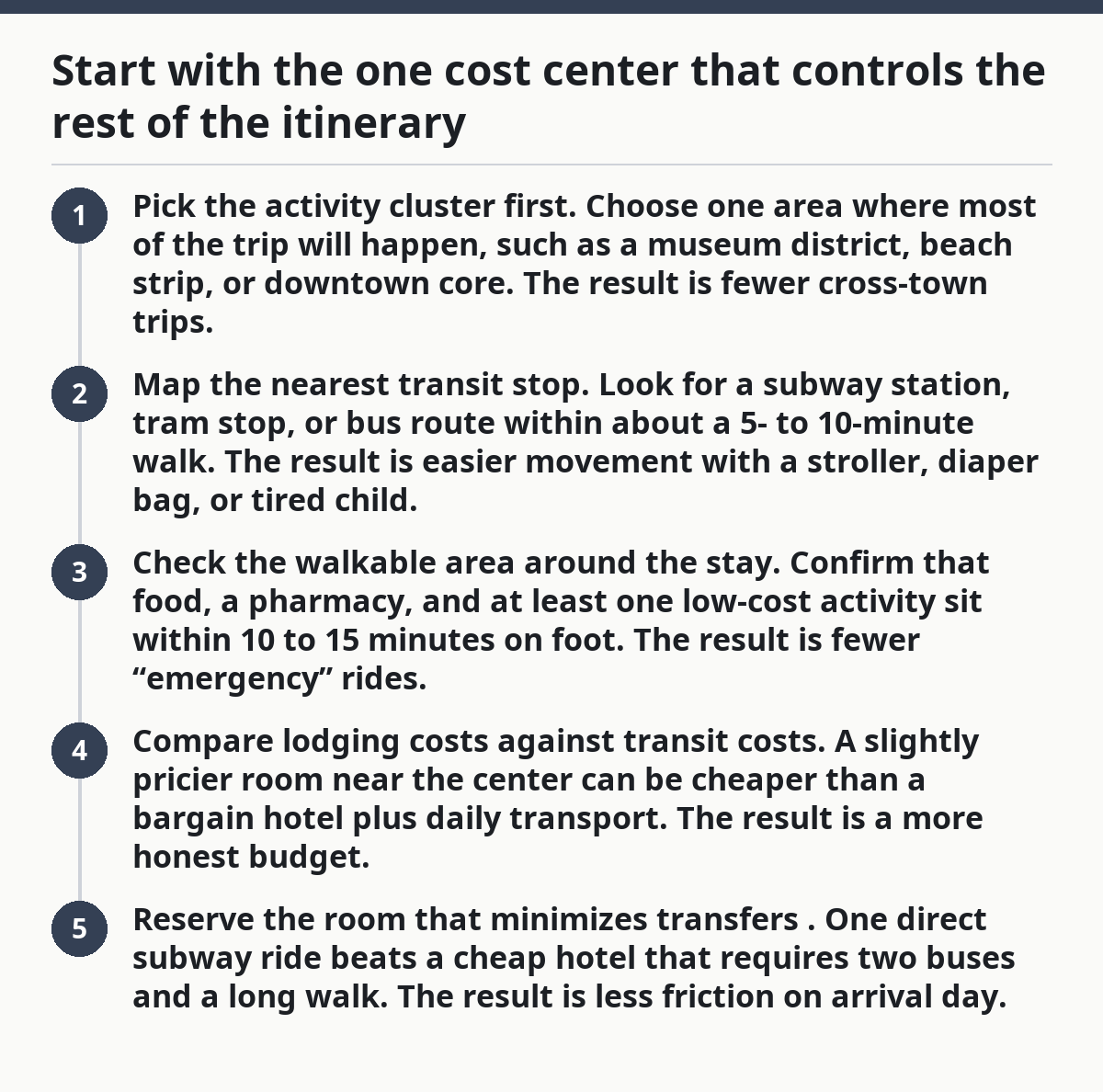
- Pick the activity cluster first. Choose one area where most of the trip will happen, such as a museum district, beach strip, or downtown core. The result is fewer cross-town trips.
- Map the nearest transit stop. Look for a subway station, tram stop, or bus route within about a 5- to 10-minute walk. The result is easier movement with a stroller, diaper bag, or tired child.
- Check the walkable area around the stay. Confirm that food, a pharmacy, and at least one low-cost activity sit within 10 to 15 minutes on foot. The result is fewer “emergency” rides.
- Compare lodging costs against transit costs. A slightly pricier room near the center can be cheaper than a bargain hotel plus daily transport. The result is a more honest budget.
- Reserve the room that minimizes transfers. One direct subway ride beats a cheap hotel that requires two buses and a long walk. The result is less friction on arrival day.
This approach is not for families who need a car for medical equipment, multiple large car seats, or a remote cabin stay. It also does not work well when the “main attraction” is spread across a wide suburban area. For that kind of trip, a car may still be the cheaper choice.
The American Public Transportation Association and local transit agencies are useful starting points when checking pass rules and service maps. Their route planners often show whether the trip depends on one line or several. For broader trip planning, the National Association of City Transportation Officials also publishes useful walkability and street-design guidance.
How do I plan a car-free family trip without overcomplicating it?
You plan it by building around one arrival path, one neighborhood, and one daily transit pattern. That keeps the trip from turning into a puzzle with too many moving parts. It also makes how to cut family trip costs with one-car, no-car, and transit-friendly itineraries easier to explain to everyone traveling.
The simplest version is easier than most people expect. It often looks like this: airport shuttle to hotel, two full sightseeing days on foot and transit, one meal near the lodging, and one low-pressure backup plan for weather. The budget stays lower because each day has a repeatable shape. In practice, that means fewer surprise rides and less time spent deciding how to move between stops.
A workable planning sequence:
- Choose the arrival method before anything else. Decide whether the family will use an airport shuttle, train, subway, or bus route from the airport. The result is one fixed transfer plan instead of an expensive same-day scramble.
- Pick lodging within a 15-minute walk of a transit stop. That distance matters with kids, luggage, and weather. The result is a first and last day that do not require a private car.
- List the top 3 things the family actually wants to do. Put them on a map. If two sit on the same transit line, the trip becomes cheaper automatically.
- Buy only the transit passes you will use. Some cities offer 24-hour, 72-hour, or family passes; others do not. The result should be a pass that matches the stay, not one bought out of habit.
- Leave one half-day uncommitted. The reserve block covers naps, delays, or rain without booking a last-minute ride.
- Check walkability at the exact times you will travel. A street that feels fine at noon may be uncomfortable after dark or during rush hour. The result is fewer surprises.
The biggest mistake here is building a day plan before choosing the base. That usually creates a zigzag route, and zigzags cost money. Every extra transfer adds a chance to pay a second fare, miss a connection, or give in and hail a car.
For route planning, official transit maps are better than general travel blogs because they show service frequency and transfer points. If a stop looks close on a map but the route requires stairs, a line change, or a long platform walk, the “cheap” option may not actually be cheap for a family with kids.
Use transit passes only when the math and the route match

Transit passes save money only when the family rides often enough and the pass rules fit the itinerary. A pass that sounds simple can be wasteful if the family makes just two or three trips a day, walks a lot, or uses one airport transfer and one sightseeing line. The pricing only works when the route pattern matches the product.
The right pass depends on three things: number of rides, age rules, and transfer windows. Some systems count each entry. Some let riders transfer for a set time, such as 90 minutes. Some offer child discounts or family bundles. The name on the pass matters less than the structure.
What to check before buying:
- Daily ride count. If the family will use transit 4 or more times in a day, a day pass may make sense.
- Length of stay. A 72-hour pass can work for a 3-day city break if the family stays in the same area.
- Airport connection. If the airport shuttle or express train is not covered, the pass may still leave a gap.
- Age-based pricing. Children may ride free, ride discounted, or need their own ticket depending on the city.
- Transfer rules. One fare with free transfers is very different from paying every time the family changes lines.
A good rule is simple: if the family is using public transit for the airport, the hotel, and at least one major outing per day, a pass is worth checking. If the daily plan is mostly walking with one evening ride, single fares may be cheaper. For many families, that difference is enough to make the trip either smooth or unexpectedly expensive.
The common error is buying passes too early because they feel efficient. That can cost more than expected, especially in cities where children under a certain age already ride free or where the main sights are clustered inside a compact walkable area. It is better to calculate against the actual itinerary than to guess.
Transit passes are a topic where local transit agency pages matter more than generic travel advice. A subway system with one pricing model can be completely different from a tram network with another. If the trip crosses city lines or airport zones, the fine print matters.
Make airport transfer planning part of the budget, not an afterthought
Airport transfer planning saves money when it is treated as the first transit decision, not the last one. The airport leg is where many families lose control of the budget because they are tired, carrying luggage, and tempted by the easiest ride on the curb. For that reason, it is worth checking transfer options before booking the hotel, not after.
A family with children should know three things before landing: which terminal the train or shuttle uses, how far it is to the hotel stop, and whether the transfer works with strollers and bags. A direct airport shuttle may cost more than a city bus route, but it can still be cheaper than a private transfer for four or five people. The right answer depends on walking distance, transfers, and how much luggage the family brings. The U.S. Federal Aviation Administration and local airport pages can help confirm terminal access and ground-transport details.
Use this filter:
- If the hotel is near a rail line, check the subway or airport train first.
- If the hotel is outside the center, compare the airport shuttle to a bus route plus one short taxi.
- If the flight lands late at night, verify whether the last bus or tram still runs.
- If the family has two large suitcases and a stroller, avoid routes with multiple stairs or narrow platform changes.
A lot of budget trips become expensive on arrival day because the family assumes “we’ll figure it out.” That usually leads to one of two outcomes: an overpriced ride or a long, frustrating transfer that leaves everyone too tired to enjoy the first day. Either outcome costs more than a little planning.
A practical approach is to save the airport route in the phone before travel. Screenshot the stop name, the line number, and the hotel address. If data roaming fails, the plan still works. That tiny step can prevent a costly taxi decision at the curb.
For families traveling with a car-free plan, airport transfers are where a little structure pays back quickly. The best option is usually the one that gets everyone to the room with the fewest handoffs, not the one that looks cheapest on paper. In a one-car or no-car itinerary, that decision can set the tone for the whole trip.
Pack for walkability, not for a trunk
Packing lighter cuts family trip costs because it keeps the trip inside transit limits and away from extra taxi or storage fees. It also makes stairs, platforms, and short walks easier. A car-free family does not need a “just in case” loadout that assumes a trunk will absorb everything. That matters even more in transit-friendly itineraries, where every extra bag slows boarding.
The goal is to carry what a family can manage on a subway platform or a bus stop without drama. For most trips, that means one main bag per adult, one compact day bag, and only the stroller or child gear that truly gets used every day. A foldable stroller is easier to move through a tram door than a bulky one-piece model. A backpack leaves both hands free on escalators.
Packing priorities:
- Use soft-sided bags when possible. They fit under seats and into tighter storage spaces.
- Keep one small item bag ready. Snacks, wipes, chargers, and a water bottle should stay easy to reach during transfers.
- Choose layers over bulky extras. A light jacket and a compact rain shell often beat multiple heavy outfits.
- Plan for laundry. A stay with a washer or nearby laundromat can cut the number of bags by half.
- Limit the stroller load. A lightweight stroller is easier on bus steps and station platforms than a heavy travel system.
The trade-off is real: packing lighter can mean giving up some convenience. You may wash clothes midtrip, carry fewer toys, or skip the oversized cooler bag. That is usually a better bargain than hauling extra weight through stations and paying for the trouble of moving it.
A common mistake is packing as if the family will have a curbside drop-off at every stop. On a no-car trip, every added pound shows up on stairs, in line, and on the last half-mile to the hotel. The cheaper the transit plan, the more important the packing plan becomes.
How to choose a walkable area that actually reduces spending
A walkable area cuts spending when it puts food, transit, and a few attractions inside one compact zone. It does not need to be famous or trendy. It needs to be practical. The family should be able to leave the room, walk 10 minutes, and reach at least one meal option, one transit stop, and one place to buy basics. That is the core of a transit-friendly itinerary.
The best walkable area for a family trip usually has three features: safe footpaths, mixed uses, and simple access to transit. Mixed uses matter because families need more than scenery. They need breakfast, a pharmacy, a convenience store, and a place to rest without paying for transportation every time. Cities with complete streets and shorter blocks tend to make this easier to manage.
Look for these signs on a map:
- A subway station or tram stop near the center of the area
- Sidewalks with short blocks, not giant crossings
- Several low-cost meal options within about 1 kilometer
- One or two parks or squares for downtime
- Attractions clustered tightly enough to visit on foot
What this avoids is the “budget hotel trap.” That trap happens when a hotel is cheap but isolated. A family then spends more on bus fares, taxis, and convenience food than it saved on the room. A better location often feels pricier up front and cheaper by the end of the trip.
There is also a comfort advantage. When the family can walk back to the room after lunch or after an early evening activity, the schedule becomes more forgiving. That can reduce the need for a second ride of the day, which is where many travel budgets quietly leak.
This is where the page’s core idea matters most: the destination type is less important than how the lodging, transit, and daily routes fit together. That is the foundation of budget family trip planning by transportation and lodging, and it is the part most generic guides skip.
Common mistakes that raise the bill fast
The biggest money leaks come from bad location choices, oversized expectations, and too many transfer points. A family can do everything else right and still overspend if the trip design fights the transit system. When that happens, even a good itinerary turns expensive.
Three mistakes show up again and again:
- Booking far from the action because the nightly rate looks lower. The cost is higher transport spending and more wasted time. Choose a closer base, even if the room rate rises a little.
- Assuming every city has a useful family pass. The cost is paying for a pass that does not match the route pattern. Check the transit agency rules before buying.
- Packing for a road trip instead of a transit trip. The cost is extra baggage hassle, slower boarding, and sometimes a private transfer you did not plan for. Pack to carry, not to load into a trunk.
Another mistake is splitting the itinerary across too many neighborhoods. That turns a simple trip into a chain of cross-town rides. The family ends up paying in money and energy. A compact plan is usually better than an ambitious one.
The final mistake is ignoring the return trip. Families often budget carefully for the first day and then spend freely on the last day because they are tired. Planning the airport or station transfer in advance keeps the whole itinerary consistent from start to finish.
Drafted with AI; not yet reviewed by a person.