
Last updated: November 20, 2026
Quick Answer: A budget family trip with a rental car is often cheapest when you compare the full trip cost, not the daily rate, and when you keep the total extra charges in view from the start. A budget family trip with a rental car gets expensive fast if you miss the hidden fees, the car-seat setup, or the parking bill. Plan the rental car like a major trip cost, not a side detail. The steps below show where the money goes, what to book first, and what to skip.
Key Takeaways
- The cheapest daily rate is not always the cheapest trip, once fees and add-ons are included.
- Airport counters can add cost through fees, timing, and longer pickup lines.
- One-way rentals, insurance choices, tolls, car seats, and parking can change the total more than the base price.
- The right car is the one that fits your luggage, child seats, and driving plan without forcing upgrades.
- A little planning before pickup can save more than chasing a lower rate after booking.
Start with the trip shape, not the car
Picture this: you know your dates, your airport, and the size of your family, but the rental quote looks cheap until the extras stack up. The right budget plan starts with trip shape, not vehicle shape.
A rental car makes sense when your family needs point-to-point flexibility, will carry luggage and gear, or will make several stops in a day. It is often a poor fit for a city stay with strong transit, because parking garages, hotel parking, and short-trip convenience charges can erase the savings.
Use this quick filter before you shop:
- Three or more stops a day: a car often helps.
- One base hotel, walkable area: parking may cost more than the car helps.
- Two car seats or more: plan for space, not just price.
- One-way trip: expect a possible one-way fee.
- Airport arrival late at night: pickup timing matters because counters and shuttles can slow you down.
The truth is, the cheapest family trip is usually the one that avoids the most add-ons. A compact car with nowhere for strollers and suitcases can lead to a forced upgrade at the counter. That is not a bargain.
If you are comparing transportation styles for the whole trip, the hub article in this cluster is the better starting point before you lock in the rental car piece.
How do you price the rental car before you book?
You should price the rental car as a total trip cost, not as a daily rate. The quote often looks simple, then the bill grows through taxes, fees, child seats, tolls, fuel, and parking.
Here’s the catch: a family quote needs a checklist, not a headline price. If you only compare the base rate, you can miss the real trip cost by a wide margin.
Use this booking checklist:
- Compare the same car class at at least 3 rental car companies. A midsize SUV at one company is not a fair comparison to a compact car at another.
- Check pickup and drop-off location. Airport pickup counters can be easier with kids and bags, but off-airport locations sometimes avoid airport fees.
- Look for one-way fees if the route ends in another city. These fees can change the whole plan.
- Add the likely extras: car seats, toll charges, parking, and any young-driver surcharge if it applies.
- Read the fuel rule. A full-to-full policy is usually easier to budget than a prepaid tank.
- Check the mileage rule if you’ll drive far. Unlimited mileage is simpler for family road trips.
- Compare the deposit and card hold. Some families get caught by the temporary hold on the credit card, not the daily rate.
Therefore, a 10-minute quote check can tell you whether the trip still fits your budget. If the total jumps after add-ons, the answer is often to change pickup location, shorten the rental, or choose a smaller car class.
What fees should you check before renting a car for a family vacation?
You should check four fees first: airport fees, one-way fees, insurance charges, and child-seat charges. Those are the ones that most often change a “cheap” reservation into an expensive one.
A generic rental quote leaves out the parts that matter most to families. I’d watch the line items in this order.
- Airport pickup costs: airport counters are convenient, but airport fees can be built into the rate.
- One-way fees: dropping the car in a different city can add a large charge, especially on popular routes.
- Insurance: collision coverage, loss damage waivers, and liability add-ons can be costly if you buy everything at the desk.
- Car seats: if the rental company supplies them, they often add cost and still may not fit your child’s exact age and size needs.
- Parking: hotel garages and downtown parking lots can be daily expenses, not one-time surprises.
- Tolls: some companies offer toll programs, but the convenience can come with extra daily charges or service fees.
As a result, it is worth asking for the out-the-door total before you confirm. Then ask what happens if you return the car to a different branch, add a second driver, or need to change the return time by 2 hours. Small changes can trigger new charges.
The truth is, many budget family trips are won or lost on these “small” fees. A quote with a low base rate and high add-ons is not a bargain.
How should you handle car seats without wasting money?
You should plan car seats before you book, because the seat plan can decide the car class, the pickup time, and the total cost. Families with toddlers or multiple children often pay more when they treat this as a last-minute desk problem, so if you are unsure about fit or installation, consult a child passenger safety professional or your pediatrician and check the American Academy of Pediatrics guidance before you book.
Car seats are tricky because you are solving both safety and space. A rear-facing seat takes more room than a booster, and two child restraints can make a compact car unusable. That means the right answer is often a larger back seat, not a fancier car.
Use this practical approach:
- Bring your own seats if you can travel with them safely. That avoids rental charges and removes the fit guesswork.
- Check the car’s rear-seat width before you book if you need 2 seats side by side.
- Reserve seats early if you cannot bring them. Do not assume the counter will have the exact type you need.
- Think about the luggage space too. A stroller plus 2 car seats can crowd a small trunk fast.
One honest trade-off: bringing your own seat saves money, but it adds bulk through the airport and on the shuttle. Renting a seat saves baggage hassle, but the fit, cleanliness, and exact model can be uncertain. That is why many budget-conscious families carry the seats and choose a slightly larger car class.
The National Highway Traffic Safety Administration has clear child passenger safety guidance, and the American Academy of Pediatrics also publishes age- and size-based child passenger safety advice. Those sources are worth checking when you are sorting out seat type and placement.
What kind of car keeps the trip cheap without making it miserable?
The cheapest car is the one that fits your luggage, child seats, and driving pattern without forcing an upgrade. For many families, that means a midsize sedan, compact SUV, or minivan depending on the number of passengers and bags.
Picture this: you have 2 adults, 2 kids, 2 carry-ons, a stroller, and a cooler. A tiny car can look inexpensive online, then become a bad deal when the trunk cannot close or the child seats squeeze the back row.
Choose with the trip in mind:
- Compact car: best only for a light pack and one or two people.
- Midsize sedan: often enough for a small family with moderate luggage.
- Compact SUV: useful when you need a taller cargo area or easier loading.
- Minivan: the sensible choice for 5 to 7 passengers, multiple car seats, or long road days.
Do not chase features you will not use. Four-wheel drive, a premium trim, or a large entertainment package can raise the price without helping a weekend family trip. The better question is whether the vehicle can hold your stuff without stacking bags on laps.
Here’s the catch: the wrong size is expensive twice. You may pay for an upgrade at pickup, and you may also pay in stress when the family is cramped for 4 hours on the road.
How do you keep parking and pickup from eating the budget?
You keep parking and pickup cheap by choosing where the car enters the trip, not just which car you rent. Airport pickup counters are convenient, but they are not automatically the lowest-cost choice once parking, hotel fees, and timing are included.
Start with pickup timing. If you land late, a delayed plane can force a rushed counter visit or a longer shuttle wait. If you rent from an off-airport branch, make sure the office hours match your arrival and return plan. A branch that closes early can turn a budget trip into an expensive taxi ride.
Then think through parking:
- Hotel parking can be the biggest hidden charge on a city trip.
- Garage parking is often safer and more central, but it can cost more than surface lots.
- Street parking may be cheaper, but it can be time-limited and harder with kids in the car.
- Theme park or resort parking can add another daily line item.
Specifically, decide where the car will sleep every night before you book the rental. If the hotel charges parking and the destination is walkable, the rental may no longer earn its keep. If the family will do day trips outside the city, parking may still be worth it.
On the flip side, a rental car can save money when it replaces multiple rideshares, airport transfers, and child-seat requests. The math depends on the route, not the habit.
A simple budget rental car plan you can follow
You can plan the trip in 20 minutes if you focus on the few costs that change the total. The goal is not perfection; it is avoiding surprise charges at the counter.
- Write down the trip shape. Note the dates, cities, hotel parking situation, and whether the trip ends where it starts.
- Count riders and car seats. This tells you whether a compact car is unrealistic.
- Pick 2 or 3 car classes. Compare the same class across rental car companies.
- Add the hidden costs. Include airport fees, one-way fees, insurance, car seats, tolls, fuel, and parking.
- Check pickup timing. Make sure the branch hours fit your flight and return.
- Choose the lowest total that still fits the family. Not the lowest daily rate.
- Save the reservation details. Keep the rate, fuel rule, and return terms in one place.
A family that does this once usually gets better at it fast. The quote stops being a mystery, and the budget stops being a guess.
The core rule is simple: a rental car is a budget win only when the total cost stays below the value of the flexibility it gives you. If it does not, choose a different trip shape.
When does a rental car make sense for a family trip?
A rental car makes sense when your family needs flexible stops, luggage space, or travel outside a walkable area. It is usually the better fit for road-heavy trips, suburban stays, or routes with multiple attractions spread apart.
It is less attractive when you are staying in one city with strong transit and high parking costs. In that case, the car can become a daily fee machine. The key question is not “Do I want a car?” It is “Will the car save more than it costs?”
What fees should you check before renting a car for a family vacation?
You should check airport fees, one-way fees, insurance charges, car-seat charges, and parking costs before you book. Those are the charges that most often change the final bill.
Also check the fuel rule, mileage limits, and the return-time policy. A 2-hour delay or a different drop-off city can trigger a new fee. Ask for the total before taxes and after taxes so you know what the reservation really costs.
How do you save money on car seats and parking when renting a car?
You save money on car seats by bringing your own if travel logistics allow it, or by reserving the exact seat type early if you cannot. That avoids last-minute desk charges and fit problems.
You save money on parking by checking hotel parking before you book the room and by deciding whether you truly need a car every day. If the destination is walkable for part of the trip, parking a rental for 2 or 3 days can waste money fast.
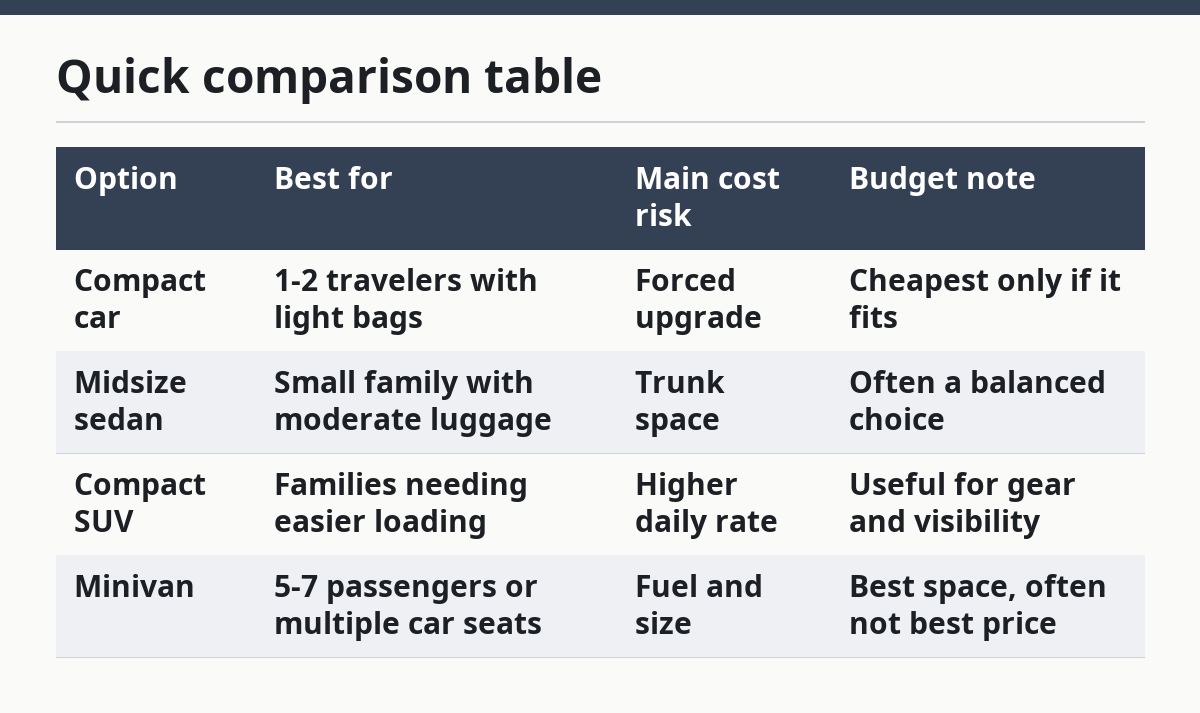
Quick comparison table
| Option | Best for | Main cost risk | Budget note |
|---|---|---|---|
| Compact car | 1-2 travelers with light bags | Forced upgrade | Cheapest only if it fits |
| Midsize sedan | Small family with moderate luggage | Trunk space | Often a balanced choice |
| Compact SUV | Families needing easier loading | Higher daily rate | Useful for gear and visibility |
| Minivan | 5-7 passengers or multiple car seats | Fuel and size | Best space, often not best price |
Sources and planning checks
- National Highway Traffic Safety Administration: child passenger safety guidance — https://www.nhtsa.gov/vehicle-safety/child-safety
- American Academy of Pediatrics: child passenger safety advice — https://www.healthychildren.org/English/safety-prevention/on-the-go/Pages/Car-Safety.aspx
- Consumer Reports: rental car and travel cost planning — https://www.consumerreports.org/cars/travel/rental-car-tips/
Drafted with AI; not yet reviewed by a person.