
Last updated: November 20, 2026
Quick Answer: For most families, the right booking sequence starts with the hardest-to-replace piece, and that often means choosing the flight or lodging first based on the family trip booking decisions you are making; a simple budget gap of $80 to $120 can disappear once bags, seat selection, transfers, and taxes are added. Family trip booking decisions come down to one thing: book the trip that fits the most limited traveler first, then build around that limit. That usually means the youngest child’s sleep, the least flexible budget, or the longest transfer time.
This guide for Family trip booking decisions — The Complete Guide settles the trade-offs, the order to book in, and the choices that save money without turning the trip into a slog.
Key Takeaways
- Start with the bottleneck: sleep, budget, mobility, or school dates.
- Flights, lodging, and transport should be chosen in that order unless a package locks in a better total cost.
- The cheapest headline fare can become poor total trip value once bags, seat selection, and transfers are added.
- A good family booking plan protects arrival day and the first morning, not just the lowest fare.
- The right choice is the one that keeps the least flexible person comfortable.
A good rule from the start: I write travel and buying guidance for a living, and family trip planning is one of the few areas where the “best” option is often the one with the fewest moving parts, not the lowest sticker price.
What family trip booking decisions really hinge on
Family trip booking decisions are mostly about constraints, not inspiration. If your child sleeps at 7:30 p.m., a late-night arrival can ruin day one. If one adult can’t lift luggage or manage stairs well, a “great deal” on a walk-up room is not a deal at all.
The right booking starts with the trip’s hardest constraint.
Here’s the catch: most families look at destination first and only later discover the real limiter is transit, room layout, or cancellation rules. That’s how a simple weekend turns into a spreadsheet.
The trip usually breaks at one of these points:
- Sleep schedule
- Budget ceiling
- School calendar
- Mobility needs
- Transit tolerance
- Weather risk
If one of those is strict, it gets priority. A 9 p.m. landing can be fine for adults and brutal for a toddler. A walkable city can beat a resort if you don’t want a rental car. A refundable room can beat a lower nonrefundable rate if the trip depends on work leave or a child’s health.
Therefore, it helps to name the trip’s non-negotiable before you compare prices, even if you later adjust the plan.
How do you decide what to book first?
You decide what to book first by locking the item that creates the most scarcity, then filling in the rest around it. For most family trips, that means either flights or lodging, and the order depends on season and inventory.
This is the part many generic guides get backward.
If your trip is during a school break, flights and rooms in the right location can disappear fast. If your trip is to a small hotel, a cruise port city, or a national park gateway, lodging may be the real bottleneck. If you need a specific room type — two queens, a suite, a kitchen, connecting rooms — book that before you shop for extras.
That’s not glamorous.
Because of that, a simple order helps:
- Set the dates
- Fix the budget ceiling
- Choose the destination area, not just the city
- Book the scarce piece first
- Add transport and extras last
A lot of families ask whether they should book the cheapest flight first. Usually, no. A fare that saves $80 can cost more in a midnight arrival, checked bags, or a long airport transfer. If the family has a child under 6, those trade-offs matter more than they do for adults traveling light.
The same logic applies to lodging. A room with a kitchenette, a crib, or a sofa bed can be more valuable than a lower nightly rate. Food savings alone can offset a difference you would otherwise call “expensive.” That’s especially true on a 5-night stay.
Flights versus lodging: which one deserves your attention first?
Flights deserve first attention when the trip is time-sensitive or the route has limited seats. Lodging deserves first attention when room type, kitchen access, or location will make or break the trip.
That’s the clean answer, and it’s the one most readers actually need.
Picture this: you’ve found a destination your kids will love, but the airfare jumps every time you check and the hotel you want only has a few family rooms left. You can’t optimize both with equal effort. You have to protect the thing that will be hardest to replace.
That’s the decision.
Here’s a practical split:
- Choose flights first if you’re traveling during holidays, on a route with few nonstop options, or with a child who struggles with late arrivals.
- Choose lodging first if you need adjoining rooms, a suite, a pool, a kitchen, or easy walking access to the main activity.
- Choose the package first if the bundle clearly locks in a better total cost and the cancellation terms still give you room to move.
The truth is, a “good” flight can still make a trip bad if it lands too late. A “good” hotel can still make a trip bad if the route there requires a long taxi ride after a red-eye. The family trip is not just a set of prices. It’s a chain of handoffs. For more on planning family travel around those handoffs, see the family travel planning guide and the hotel room types guide.
The honest trade-off between cheap and easy
Cheap wins only when the savings survive the full trip. Easy wins when the trip is already complex, because complexity is expensive in time, energy, and mistakes.
This is where family booking decisions usually go wrong.
A low fare with two connections, a 45-minute layover, and no seat choice may look smart on a booking screen. Then the child gets tired, the bags don’t arrive with you, and the transfer to the hotel adds another layer. The same problem shows up with “budget” hotels that charge for parking, resort fees, breakfast, or extra beds.
The listed rate is not the full rate.
Before you book, compare these items:
- Bags
- Seat selection
- Transfer time
- Food costs
- Parking
- Taxes and fees
- Cancellation terms
That list matters more than a flashy headline fare. If the route saves $120 but forces a 2-hour airport wait with children, the cheaper option may be the more expensive one in practice. If the hotel costs more but includes breakfast and a kitchen, it can come out ahead over a 4-night stay.
On the flip side, easy can become wasteful if you pay for convenience you don’t need. A short nonstop and a nearby hotel are worth it for younger kids or a short trip. They are less useful for older children on a long, low-pressure vacation where the savings can be used on activities instead.
Which booking details families often miss?
Families often miss the details that change the trip after the payment goes through. The biggest ones are room configuration, luggage rules, transfer timing, and cancellation windows.
That’s where the hidden cost lives.
Picture this: you’ve booked the “family room,” only to learn it’s one bed plus a sleeper sofa and no door between sleeping areas. Or you’ve bought a flight that looks fine until you notice the carry-on allowance is tight and the airline charges for assigned seats. The trip still exists, but the comfort level drops fast.
It helps to check policy details before you pay.
Watch for these booking details:
- Room layout
- Bed count
- Stairs or elevator access
- Kitchen or mini-fridge
- Crib or rollaway rules
- Baggage policy
- Seat assignment policy
- Airport transfer length
If you’re traveling with a baby or a child who naps, room layout matters more than many people admit. A door between the sleep space and the living space can save an evening. If you’re traveling with grandparents, elevator access and short walking distances matter just as much as the destination. A “nice” room with four flights of stairs is a poor fit.
The best part is that these details are often visible before you pay, if you look for them. The problem is not lack of information. It’s checking the wrong information first.
How to compare options without getting lost
You compare options by using a short list of criteria that actually change the trip. Price alone does not tell you whether a booking works.
A family trip choice should be judged like a system, not a single line item.
| Criteria | Option A: Book the flight first | Option B: Book the lodging first | Winner for [condition] |
|---|---|---|---|
| Scarcity | Best when seats on your route sell out fast or nonstop flights are limited | Best when suites, adjoining rooms, or kitchen units are the bottleneck | Flight first for holiday air routes; lodging first for small inventory |
| Flexibility | Less flexible if airfare rules are strict | More flexible if you can change hotels more easily | Lodging first when plans may shift |
| Comfort for kids | Can protect better arrival times and shorter travel days | Can protect naps, room space, and bedtime routines | Depends on sleep schedule |
| Total cost control | Can lock in a fare before it rises, but bags and seats may add cost | Can reduce meal costs with a kitchen or breakfast | Flight first for peak-season airfare; lodging first for long stays |
| Trip complexity | Works well when the destination is simple after arrival | Works well when local transit is easy or parking is included | Flight first for city breaks; lodging first for drive trips |
| School-calendar pressure | Better when travel dates are fixed by school breaks | Better when the exact room type matters more than flight timing | Flight first for short holiday windows |
| Cancellation risk | Riskier if the fare is nonrefundable | Often safer if the hotel offers more flexible terms | Lodging first for uncertain plans |
| Need for special rooms | No effect on room layout needs | Directly solves adjoining rooms, kitchens, and extra bedding | Lodging first for larger or multigenerational groups |
| Transit burden | Can minimize total travel time | Can shorten ground transport after arrival | Flight first for long-haul trips; lodging first near airports or parks |
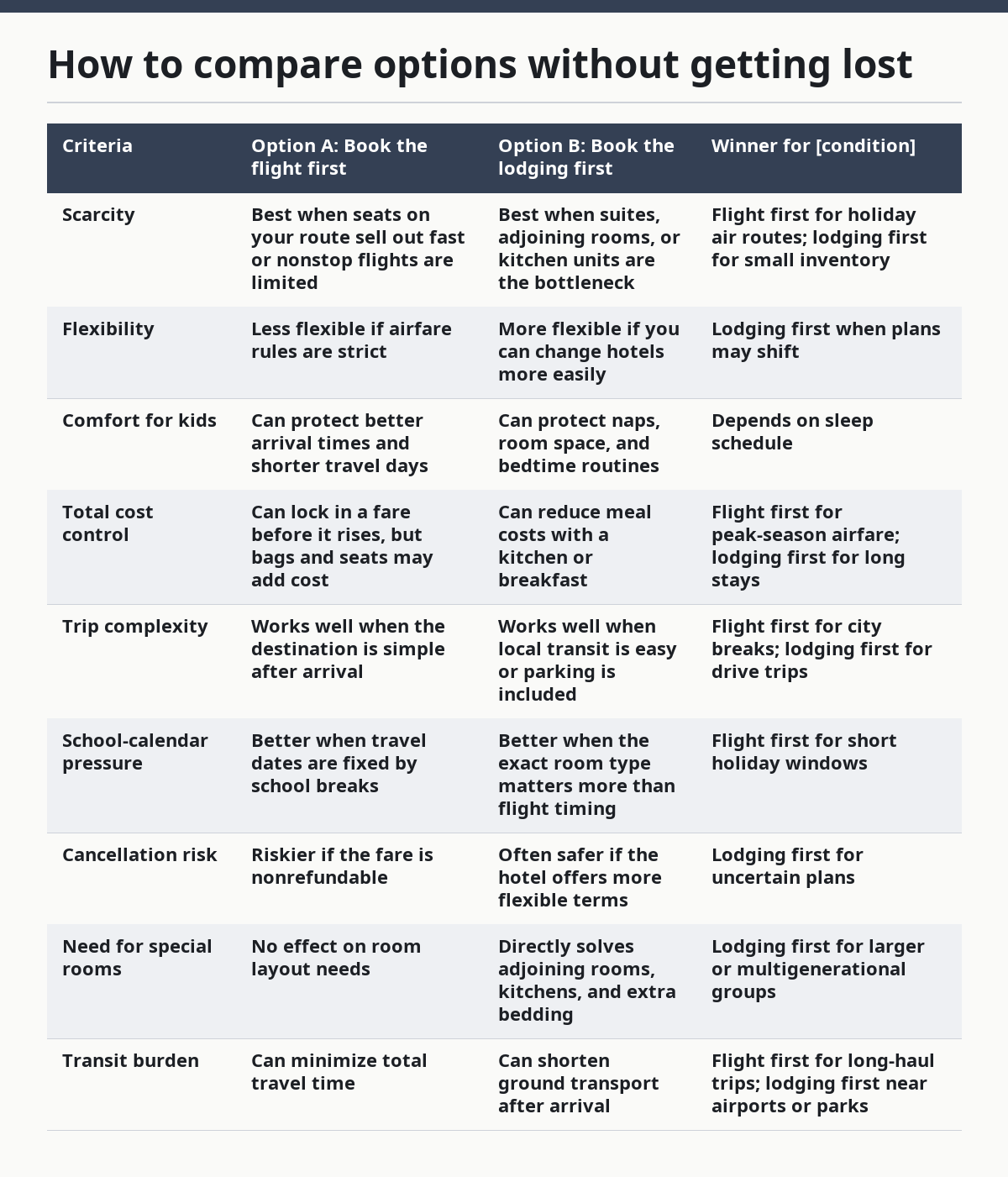
The table points to a blunt truth: there is no universal first booking. There is only the item that is hardest to replace. If you get that wrong, the rest of the plan starts to wobble. If you get it right, the rest gets easier fast.
That’s the real win.
The real difference between package deals and booking separately
Package deals win when the bundle solves two problems at once: price and coordination. Booking separately wins when you need room to adjust dates, room type, or flight times.
That’s the split.
Picture this: you’re planning a 6-night trip with two kids, and you want one reservation instead of three different systems to babysit. A package can reduce friction if the terms are clear and the parts line up with your schedule. But the wrong bundle can also trap you into a worse flight time or a room that doesn’t fit your group.
Convenience has a cost.
Packages are strongest when:
- The trip dates are firm
- The destination is mainstream
- The airline and hotel in the bundle both meet your needs
- The cancellation terms are acceptable
For package-heavy planning, check current traveler protections and booking rules from the U.S. Department of Transportation and review refund or change policies before you buy.
Booking separately is stronger when:
- You need a very specific room layout
- You want a nonstop flight that the package doesn’t include
- You are mixing points, miles, or vouchers
- One part of the trip is likely to change
The mistake people make is treating a bundle as automatically cheaper. It sometimes is. It also sometimes hides weaker flight times or a less useful hotel. If the package includes a 10 p.m. arrival and a hotel 40 minutes from the main area, the saved money can vanish in tired kids and extra taxis.
The family that values one checkout, one confirmation, and fewer moving parts is often a good fit for packages. The family that needs precision more than simplicity is not.
How to book with kids, grandparents, or both
You book differently when the trip includes different age groups, because the group’s pace is no longer uniform. The youngest child, the oldest adult, or the person with the hardest mobility need sets the speed of the whole trip.
Ignoring that leads to bad booking choices.
Picture this: a three-generation trip where one adult wants a busy city break, one grandparent needs short walks, and the kids need a pool and bedtime routine. A central location can be worth more than a lower nightly rate because it cuts transit strain. A suite can be worth more than two standard rooms because it keeps the group close without forcing everyone into the same bedtime.
That’s real value.
For trips with young children, favor:
- Earlier flights
- Shorter ground transfers
- Kitchens or breakfast included
- Rooms with separate sleeping space
For trips with grandparents, favor:
- Elevator access
- Minimal stair use
- Airport assistance if needed
- Less packing and fewer room changes
For trips with both, prioritize:
- One stop or nonstop when possible
- Lodging near the main activity
- Accessible bathrooms
- Flexible cancellation terms
The catch is that “more people” does not always mean “more room.” Sometimes it means a better layout. A 1-bedroom suite can beat two rooms if the group needs to be together. Two rooms can beat a suite if sleep schedules are wildly different. The right answer depends on bedtime, not just headcount.
The verdict: which booking path wins?
Choose flights first if your route is in peak season, your travel dates are fixed, and the trip fails if arrival time is too late. Choose lodging first if your group needs a specific room type, a kitchen, or an easy ground setup. Neither if your dates are loose and you haven’t set a budget ceiling.
That’s the clean call.
Picture this: you’re staring at two tabs and one calendar, and every option looks “pretty good.” The right move is not to keep shopping forever. It’s to decide which part of the trip has the least wiggle room and lock that in first.
That part wins.
For most families, the smarter default is to book the scarce piece first, then secure the other major item within a narrow window. If you need connecting rooms during spring break, book those before you fine-tune the airline. If your route has only one decent nonstop, book it before it disappears.
The wrong move is waiting for perfection.
This is also where a lot of readers make a second mistake: they treat the cheapest total as the best total. A trip that is $100 lower but adds stress, transfers, or a bad sleep setup is not a better family booking. It is just a cheaper receipt.
When to reconsider the whole plan
You should reconsider the whole plan when the trip depends on too many fixed points at once. If the flights are expensive, the lodging is scarce, and the schedule is fragile, the destination may be the wrong choice for this year.
That may be the most practical answer.
Picture this: you’re trying to force a beach week during a holiday period, but the nonstop flights are poor, the hotel choices are thin, and the room rates only make sense if you ignore the transfer cost. That’s a sign to shift the dates, change the destination, or shorten the stay.
A bad fit is still a bad fit.
Reconsider if:
- The trip has a strict budget but no flexible dates
- The destination requires long transfers with small children
- The room setup does not match your group’s sleep needs
- The cancellation terms are too rigid for the risk involved
The best family trip booking decisions are often the ones that say no to the wrong version of the trip. A shorter trip in the right place can beat a longer trip in the wrong one. A direct route can beat a fancy hotel that’s far from everything. That’s not settling. It’s choosing the trip that fits.
What a strong booking checklist looks like
A strong checklist turns a messy decision into a short series of yes-or-no calls. It should take 10 minutes, not 10 tabs.
That’s the point.
Next, use this sequence:
-
Confirm the hardest constraint
Sleep, budget, mobility, or dates. -
Pick the booking priority
Flight first, lodging first, or package first. -
Compare total trip cost
Fare or rate plus bags, seats, transfers, meals, and parking. -
Check the room or seat details
Bed count, layout, baggage rules, seat choice, and transfer time. -
Read the cancellation terms
Refundable, changeable, or locked. -
Book the scarce item first
The one that will be hardest to replace. -
Recheck the second item quickly
Keep the full trip aligned, not just one piece.
If a choice fails step 1 or step 4, it is probably the wrong one. A booking that looks fine on price but fails on sleep, layout, or transfer time usually creates the most regret later. That’s the pattern.
Can points or miles change the decision?
Yes, points or miles can change the decision if they materially improve the total trip or solve a scarce booking problem. They should not drive the whole trip by themselves.
That’s the honest line.
If you have enough points for a room with a kitchen, a suite, or a better flight time, the value can be real. If using points forces a worse arrival, a longer transfer, or an awkward split booking, the redemption may not help much. The same goes for vouchers that only work on certain dates.
The redemption has to fit the trip, not the other way around.
Points can be strongest when:
- Cash rates are high
- The trip is during school break
- You need a room type that is hard to buy outright
- You want to reduce out-of-pocket spend on a long stay
Points are weaker when:
- Availability is poor
- The redemption locks you into bad timing
- The family needs flexibility
- You have to add cash for fees anyway
According to the American Society of Travel Advisors, travelers should compare all terms and fees before using rewards in a complex itinerary.
The best way to use points is not “spend them because they exist.” It is “use them where they remove the most pain.” If a points booking makes the whole trip calmer, it has done its job.
FAQ
What is the first thing to book for a family trip?
The first thing to book is the hardest-to-replace part of the trip, which is usually the flight or the lodging. If your dates are fixed and airfare is tight, book the flight first. If you need a specific room type or location, book the lodging first.
Is it better to book a flight or hotel together?
Booking together is better only when the package clearly fits your dates, your room needs, and your cancellation risk. If the bundle gives you the right flight time and the right room type, it can reduce hassle. If it forces one bad piece, book separately.
How do I keep family trip costs from creeping up?
Add the full trip cost before you compare options. Include bags, seat selection, transfers, parking, breakfast, and taxes. The headline rate is often not the real rate, and the extras can change which option is actually cheaper.
What matters most for traveling with young children?
Sleep timing and room layout matter most. A late arrival, a long transfer, or a room without separate sleeping space can make the whole trip harder. Shorter travel days and a kitchen or breakfast also help.
When should I skip a trip this year and wait?
Skip or delay the trip if the dates are rigid, the budget is stretched, and the available flights or rooms don’t fit your group’s needs. A better date, a different destination, or a shorter stay often makes more sense than forcing a bad fit.
Drafted with AI; not yet reviewed by a person.
