
Last updated: November 20, 2026
Quick Answer: driving usually wins on total cost for a budget family trip to the same destination, but flying can be the better value if the road trip would take a full extra day, require a hotel stop, or leave everyone too worn out to enjoy the trip. This guide to How to Choose Between Flying and Driving for a Budget Family Trip to the Same Destination compares airfare, fuel cost, baggage, parking fee, and travel time so you can pick the cheaper option in practice, not just on paper.
Key takeaways
- Compare the whole trip cost, not just airfare or gas.
- Driving often looks cheaper until a hotel stop, parking fee, and extra food get added.
- Flying can save a day or more of travel time, which matters with young kids.
- Heavy bags help driving; light packing helps flying.
- If the drive needs an overnight stop, the price gap can shrink fast.
- See the IRS standard mileage rate and the TSA baggage rules when you compare costs.
How should I compare flying and driving?

Compare flying and driving for a budget family trip to the same destination by total trip cost, total travel time, and how much friction your kids can handle, not by one ticket or one tank of gas. The cleanest way to decide is to add airfare, ground transport, baggage, and airport time on one side, then fuel cost, parking fee, hotel stop, and food on the other.
A useful starting point is the IRS standard mileage rate, which the IRS publishes for business use; it gives a rough way to think about fuel, wear, and tear in one figure. For airport rules that affect bags and carry-ons, the TSA has a current baggage and screening page here: https://www.tsa.gov/travel/security-screening/whatcanibring/all. For broader travel planning, the U.S. Department of Transportation also tracks airline consumer rules.
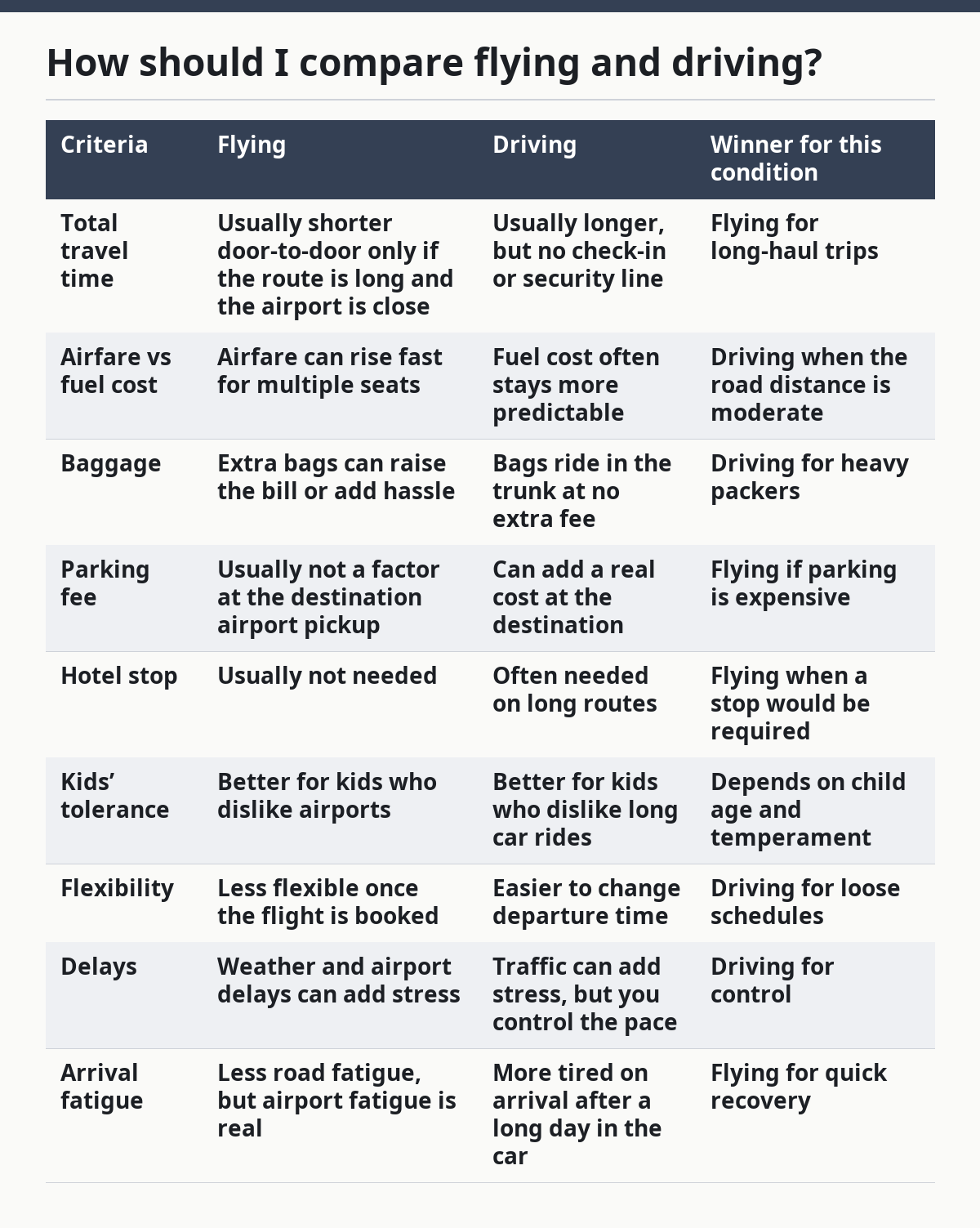
Here is the head-to-head view:
| Criteria | Flying | Driving | Winner for this condition |
|---|---|---|---|
| Total travel time | Usually shorter door-to-door only if the route is long and the airport is close | Usually longer, but no check-in or security line | Flying for long-haul trips |
| Airfare vs fuel cost | Airfare can rise fast for multiple seats | Fuel cost often stays more predictable | Driving when the road distance is moderate |
| Baggage | Extra bags can raise the bill or add hassle | Bags ride in the trunk at no extra fee | Driving for heavy packers |
| Parking fee | Usually not a factor at the destination airport pickup | Can add a real cost at the destination | Flying if parking is expensive |
| Hotel stop | Usually not needed | Often needed on long routes | Flying when a stop would be required |
| Kids’ tolerance | Better for kids who dislike airports | Better for kids who dislike long car rides | Depends on child age and temperament |
| Flexibility | Less flexible once the flight is booked | Easier to change departure time | Driving for loose schedules |
| Delays | Weather and airport delays can add stress | Traffic can add stress, but you control the pace | Driving for control |
| Arrival fatigue | Less road fatigue, but airport fatigue is real | More tired on arrival after a long day in the car | Flying for quick recovery |
When does flying make sense?
Flying makes sense when the trip is long enough that the car would eat up most of a day, or when a hotel stop would be needed on the road. If the destination is far enough that your actual travel day becomes two days by car, the extra airfare may buy back time, sleep, and patience.
Flying also wins when baggage is light and the airport is close to both ends of the trip. A short flight with one carry-on each can be easier than a long drive with a car full of snacks, chargers, and bags. That matters even more if the airport choice cuts down on ground transport after landing. The Federal Aviation Administration and TSA both matter here because airport timing and screening shape the real trip length.
The weak spot is obvious: airfare can jump once you multiply it by several seats, and the savings can vanish after baggage and airport parking are added. Flying is also the wrong pick for a tight schedule that can’t absorb delays or for a child who struggles with security lines and waiting. If the trip is short enough to drive in one easy day, flying usually loses on value.
When does driving make sense?

Driving makes sense when the destination is reachable without a hotel stop and the car ride will not wreck the mood before the trip even starts. For a budget family trip to the same destination, that is the key advantage: one vehicle can carry people, snacks, jackets, and bulky gear without baggage fees.
Driving is also the better call when the group has heavy luggage or awkward items. A trunk handles strollers, sports gear, or extra clothes better than an airline counter. You also avoid airport parking on the outbound side and keep control of meal breaks, bathroom stops, and departure time. For route planning, Roadtrippers and Google Maps can help you see whether the trip stays within one day.
The downside is the hidden cost of a long drive. Fuel cost is only part of the bill. Add parking fee at the destination, extra food on the road, and possibly a hotel stop if the route is too long for one day. Driving is not always the better choice when kids hate long stretches in the car, because the cheapest option on paper can become the most stressful one in practice.
What does the honest side-by-side look like?
Flying is the better pick for time-sensitive trips, while driving is the better pick for trips where the family can absorb a longer day on the road. The real choice is not “cheap vs expensive”; it is “cash cost vs time cost.”
Here is the part people often miss. A drive that looks cheap at first can pick up a hotel stop and a parking fee, while a flight that looks pricey can still win if it saves a full day and avoids an overnight. That is why the same destination can flip the answer depending on how far it is from home. For family trip planning, the CDC travel guidance can also help you think through stamina and timing.
Flying: pros and cons
Pros
- Usually saves the most time on long routes.
- Reduces road fatigue on arrival.
- Works well with light luggage.
- Can be simpler when the drive would require a hotel stop.
Cons
- Airfare can be high for multiple seats.
- Baggage can add hassle.
- Airport time is not free, even if the flight is short.
- Delays are outside your control.
Driving: pros and cons
Pros
- Fuel cost is easier to predict than airfare for many trips.
- No airline baggage rules for the trunk.
- More control over stops, snacks, and timing.
- Often best for a one-day route.
Cons
- Long driving days wear kids down.
- Parking fee can add to the trip.
- A hotel stop can erase some savings.
- Arrival can feel rough after hours in the car.
Which choice is best for a budget family trip?
Choose driving if the destination is reachable in one long but manageable day, the car can hold the luggage, and the trip would stay cheaper after adding fuel cost, parking fee, and food. Choose flying if the drive would need a hotel stop, the kids will not tolerate long road time, or the time saved is worth more than the extra airfare.
Neither is the right choice if the trip is short enough to drive easily but the flight cost is being stretched to justify itself. In that case, the flight buys inconvenience instead of savings, and the budget loses twice.
What can change the answer?
The verdict can flip in a few specific cases. First, if the drive requires an overnight stop, flying gets much stronger because the hotel stop changes the math. Second, if parking at the destination is expensive or hard to find, driving loses part of its edge. Third, if you are checking several bags, flying gets less attractive because the loadout is no longer light. Fourth, if your kids do badly on long car rides, the road trip may be cheaper in cash but worse in every way that matters.
The smartest rule is simple: if you can reach the destination in one day without draining everyone, drive. If the route is long enough to turn travel into a trip inside the trip, fly. The AAA trip-planning tools can help you test those assumptions against a real route.
FAQ
is flying or driving cheaper for a family trip?
Driving is often cheaper when the trip stays within one long day and does not need a hotel stop. Flying can beat driving when the route is long enough that fuel cost, parking fee, food, and overnight lodging push the road trip past the airfare.
when does driving beat flying for families?
Driving beats flying when the destination is close enough for one day on the road, the luggage is bulky, and the airport side would add baggage costs or a long connection. It also wins when the schedule is flexible and the kids handle car time better than airport time.
how do i compare flight and drive costs for a family vacation?
Add airfare, baggage, airport parking, and ground transport for the flight. Then add fuel cost, parking fee, food, and any hotel stop for the drive. Compare the totals, then weigh them against total travel time and how hard each option will feel with your kids.
Drafted with AI; not yet reviewed by a person.