
Last updated: November 19, 2026
Key Takeaways
- Pack light on purpose instead of cramming every “maybe” item into one giant suitcase.
- A family should pack documents, meds, chargers, and one change of clothes per child first.
- Most budget family trips work best with one carry-on or personal item per person, plus one shared checked bag only when needed.
- Use a packing list that helps prevent repeat buying at the destination.
Budget family trip packing and gear decisions are about cutting weight, duplicates, and last-minute buys without creating a miserable trip. Pack fewer clothes, fewer “just in case” extras, and the gear that saves money twice—on baggage fees and emergency purchases. The list below settles what to bring, what to skip, and where a cheap item is smarter than a fancy one.
Budget family trip packing and gear decisions — The Complete Guide starts with one rule: every item must earn its space in your bag or your wallet. I write about family travel gear, baggage rules, and trip planning choices, and the pattern is the same every time—families waste money on duplicates, oversized bags, and gear that solves a problem they don’t actually have. The simplest gear is often the easiest to live with.
The packing choice that saves the most money
The packing choice that saves the most money is packing light on purpose—not cramming every “maybe” item into one giant suitcase. A family that trims even one checked bag can dodge a lot of fee pain, but the bigger win is avoiding the extra stuff that turns into clutter the moment you arrive.
Picture this: you’re laying clothes on a bed, one child’s shoes by the door, one charger in your hand, and a suitcase that already looks too full before toiletries go in. That’s the moment to make the hard calls. The guide below gives you the calls, not the guilt.
For most families, the first budget win is a carry-on-first plan with a small shared kit: meds, chargers, wipes, snacks, and one weather layer per person. If a family has very young kids, long driving days, or a destination with laundry, the plan shifts a little. But the same rule holds: the bag should solve problems, not collect them.
What gets overpacked most often:
- Extra outfits “just in case”
- Too many shoes
- Large toiletry bottles
- Separate entertainment for every child
- Duplicate chargers and cables
- Bulky blankets and pillows
The truth is, one shared system beats four separate “emergency” systems. A zip pouch for cords, a small pouch for meds, and one snack bag cut down on forgotten items and duplicate purchases at the destination.
What should a family pack first?
A family should pack documents, meds, chargers, and one change of clothes per child first. Those are the items that are hardest to replace fast, and they solve the biggest travel problems before you even think about outfits.
Picture this: you’re at the car, train station, or airport with 20 minutes left, and the bags still need to close. If these core items are already packed, the rest becomes a cleanup job instead of a panic.
The order matters because it keeps the whole trip from wobbling if one bag gets delayed or one child spills a drink. Start with the “can’t-replace-easily” items, then move to comfort items, then fillers. That sequence keeps the trip practical and cheap.
Pack these first:
- IDs, tickets, confirmation numbers, insurance cards
- Prescription meds and basic first-aid items
- Phone chargers and a power bank
- One weather layer per person
- One full outfit change per child
- Snacks and refillable water bottles
- Small toiletries in travel sizes
A small, cheap packing cube set can help here, but it’s not required. A zip-top bag works fine for meds or cables if the budget is tight. The setup that works best is the one the parent can keep straight at 6 a.m.
How many bags does a budget family really need?
Most budget family trips work best with one carry-on or personal item per person, plus one shared checked bag only when needed. That setup keeps baggage fees under control and makes it easier to move through buses, trains, and hotel rooms without a pile of loose bags.
Picture this: you’re carrying a toddler, a backpack, and a coffee while trying to keep one child from wandering off. Every extra bag makes that scene worse. Fewer bags are not just cheaper; they are safer and less annoying.
The bag count depends on trip type:
- Short flight trip: one personal item each if possible
- Road trip: soft duffels or backpacks that fit in the trunk
- Beach or resort trip: one shared checked bag can make sense if gear is bulky
- Multi-stop city trip: light bags win every time
A lot of generic advice tells families to buy matching luggage sets. That’s a trap. Sets are often bigger than needed and encourage overpacking. One sturdy backpack, one small roller, and one soft duffel usually do more real work than three oversized suitcases.
The budget family packing list that actually holds up
The best packing list is the one that stops repeat buying at the destination. That means packing the boring stuff with the same care as the fun stuff, because the boring stuff is what usually costs you cash in a hotel shop.
Picture this: you’re three hours from home and someone needs sunscreen, a new toothbrush, or another phone cable. A $4 item becomes a $14 item fast when you buy it at a tourist stop. The point of the list is to prevent that kind of leak.
Use this as a real-world core list:
- 1–2 outfits per day only if laundry is available
- 1 warm layer, even for warm destinations
- 1 rain layer if the forecast is unstable
- 2 pairs of shoes max per person
- Travel-size toiletries
- Wipes or tissues
- Snack stash
- Reusable water bottle
- Portable charger
- Small laundry kit if staying more than a few nights
A budget list should also include one “problem solver” item per child, not five. That might be a tablet, coloring book, deck of cards, or audiobook downloads. The point is not to create perfect entertainment. It’s to prevent boredom from becoming an airport purchase.
What gear is worth buying, and what can stay home?
The simplest gear is often the easiest gear to use on every trip, not the novelty item with one cute feature. A strong backpack, simple packing cubes, a power bank, and refillable bottles usually beat specialty gadgets with more moving parts.
Picture this: you’re staring at a travel aisle full of collapsible this and foldable that. The safe choice is usually the plain one. If the item won’t be used at home, on road trips, and on flights, it probably doesn’t belong in a budget kit.
Here’s the gear breakdown that matters most:
| Gear | Worth Buying? | Why It Helps | Skip If |
|---|---|---|---|
| Durable backpack | Yes | Works as personal item and day bag | You only take one annual road trip |
| Packing cubes | Yes | Keeps kids’ clothes sorted fast | You pack tiny bags already |
| Power bank | Yes | Saves money on emergency charging | You always travel with easy outlets |
| Refillable water bottles | Yes | Cuts airport and theme park spending | The trip has no refill access |
| Neck pillows | Sometimes | Helps on long flights or drives | They take up too much room |
| Travel-size toiletry bottles | Yes | Avoids buying duplicate full-size items | You already use hotel toiletries only |
| Foldable shopping tote | Yes | Great for snacks, laundry, or souvenirs | Your main bag already has spare room |
| Travel stroller | Sometimes | Useful for long walking days | Your child walks easily all day |
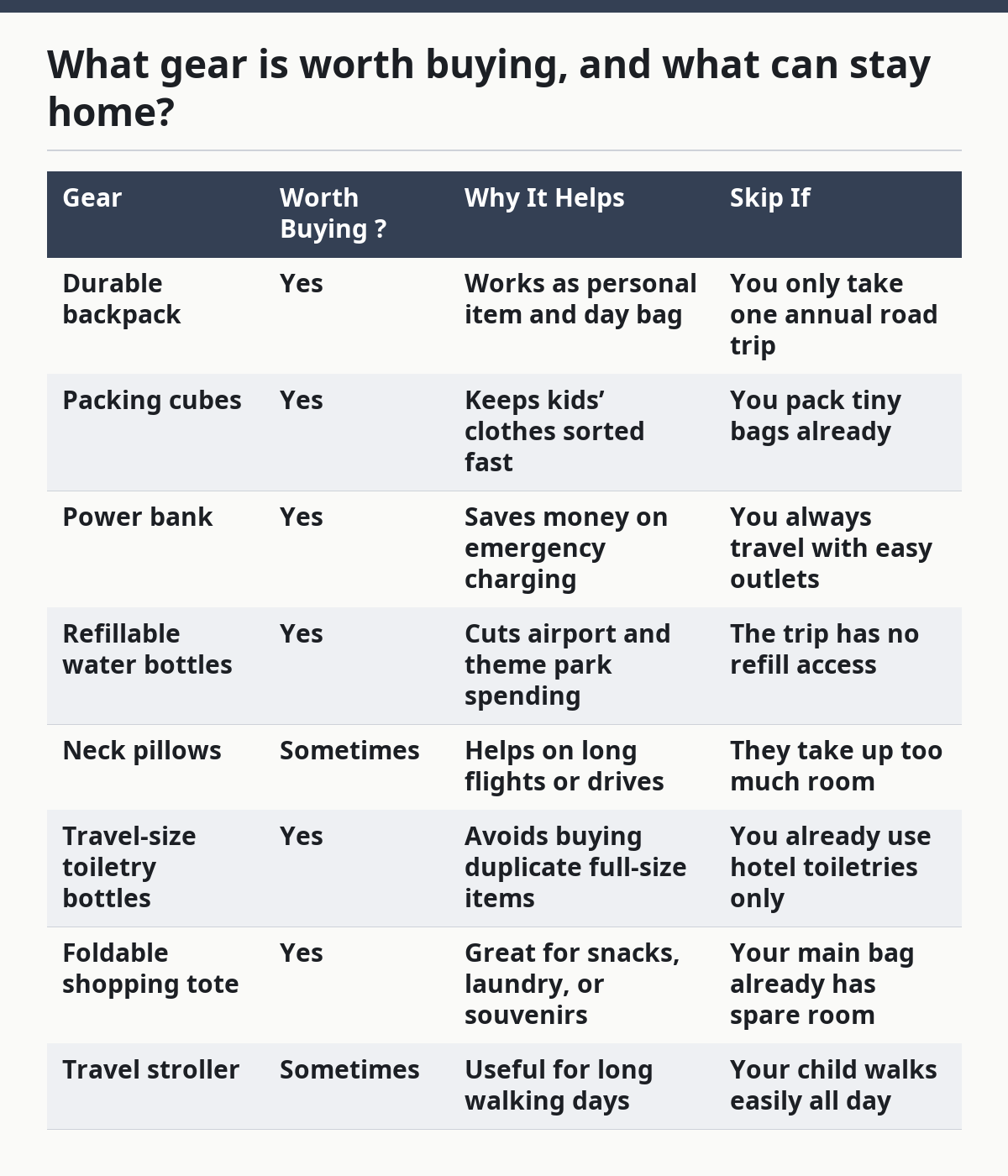
The gear that often gets oversold is the stuff designed for “perfect organization.” If a product needs three extra accessories to work, it’s not really budget gear. It’s a hobby.
What are the best cheap choices for kids’ stuff?
The best cheap kids’ gear is simple, washable, and replaceable. That usually means soft-sided items, not hard cases or special-purpose products that only work one way.
Picture this: you’re trying to keep a child calm on a delayed bus, and the toy bag has half a dozen fragile items that roll under seats. Cheap gear is only a good deal if it survives the trip and doesn’t create cleanup work every night.
Good budget choices for kids include:
- Zip pouch with crayons and paper
- Small sticker book or magnetic game
- Reusable snack container
- Lightweight blanket or hoodie
- Spill-proof cup if needed
- One comfort item per child
Here’s the catch: the cheapest item is not always the budget choice if it breaks on day one. A $10 toy that lasts the whole trip beats a $3 toy that gets tossed after dinner. The same logic applies to shoes. A single pair that fits well is smarter than a “just in case” backup pair that never gets worn.
How do you pack for different trip types without overspending?
You save the most when the packing plan matches the trip shape. A flight, a road trip, and a beach trip all need different gear, and copying the same list for all three is how families overpack.
Picture this: you’re planning for a three-night city break, but the bag looks ready for a two-week cabin stay. That mismatch costs money in baggage fees and packing time. Match the trip, then trim the list.
Use these trip-specific rules:
- Flight trip: focus on one-bag efficiency and TSA-friendly liquids.
- Road trip: bring more snacks, comfort items, and layered clothing.
- Beach trip: pack fewer outfits, more sun protection, and a laundry plan.
- Theme park trip: prioritize water bottles, blister care, and a compact day bag.
- Cabin trip: bring extra layers, trash bags, and basic kitchen supplies if the rental is bare.
A lot of families buy special gear for each type of trip. That’s rarely necessary. A foldable tote, a backup charger, and packing cubes do useful work across nearly every trip type. The rest should be borrowed, reused, or left behind.
The real money traps to avoid
The biggest budget trap is buying gear because a packing video made it look smart. A lot of travel items solve tiny problems and create new ones: more weight, more clutter, more time sorting pockets, more things to forget.
Picture this: you’re standing in a store with a cart full of “must-have” items, and none of them are the things that actually ruin budgets. The real damage comes from overbuying before the trip and repurchasing during the trip.
Watch for these traps:
- Oversized luggage that tempts overpacking
- Duplicate toiletry kits for each adult
- Single-use organizers for one trip only
- Fancy snacks that cost more than the destination version
- Gadgets that need batteries, apps, or special chargers
- “Emergency” items you already own at home
The best budget travel decision is often subtraction. Leave one item home, then notice how little it mattered. That’s the habit that saves money trip after trip.
What should you do if the budget is really tight?
If the budget is tight, borrow, reuse, and simplify before you buy anything new. A family does not need a fresh travel system to have a good trip; it needs a clear plan and a hard line on what counts as necessary.
Picture this: you’ve got a trip coming up and the shopping list is already longer than the itinerary. The smartest move is to pause and ask which items are truly missing and which are just nice to have.
Start here:
- Use existing backpacks before buying luggage
- Refill travel bottles from home products
- Pack snacks from your pantry
- Share chargers and cables
- Skip matching sets
- Buy only one or two new items with the highest payoff
If one new purchase is all you can manage, make it a power bank or a quality day bag. Those two items tend to save the most money and frustration across different kinds of trips. Everything else can wait.
What the best packing plan looks like in practice
The best packing plan is small, repeatable, and boring. That sounds unglamorous, but boring is what keeps the trip cheap and the bags manageable.
Picture this: your family leaves the house with fewer bags, fewer duplicates, and no mystery items rattling around in a suitcase. That’s the goal. It is not a perfect suitcase. It is a trip that starts without a spending mess.
A practical budget plan looks like this:
- Pack the essentials first
- Limit shoes and extra clothes
- Use one shared family kit for cords, meds, and snacks
- Choose multipurpose gear over specialty gear
- Leave room for laundry or small souvenirs
- Buy only what solves a repeated problem
The verdict is simple: the budget family trip gear that works best is the gear that serves more than one purpose and never needs babysitting. Anything else belongs on the maybe list, not in the suitcase.
Which packing choice is right for your family?
Choose light packing with shared gear if you want lower fees, less clutter, and easier movement through airports, trains, or city streets. Choose a slightly fuller setup if you have very young kids, long driving days, or no laundry access. Neither works well if you pack every “just in case” item and then expect the trip to stay cheap.
That is the line that matters. The budget win comes from matching the bag to the trip, not from buying more gear and hoping it fixes overpacking.
What if one child has special gear needs?
Then that gear gets priority, but only for the child who needs it. A medical item, sensory item, or sleep aid can earn its space fast. Keep the rest of the packing list lean so one real need doesn’t turn into four extra bags.
Is it worth buying packing cubes?
Yes, if your family packs for more than one trip a year or shares a suitcase. Packing cubes help sort clothes and keep dirty items separate, which cuts rummaging and repacking time. If you only travel once in a blue moon, zip bags may be enough.
Should every child get their own bag?
No, not unless the trip is long or each child is old enough to manage it. One shared family system is easier to track and cheaper to pack. Separate bags become a problem when kids drop them, forget them, or fill them with random extras.
What should I never skip?
Don’t skip meds, chargers, ID, weather protection, and one clean change of clothes for each child. Those are the items that keep a small trip problem from turning into a bigger, more expensive one.
How do I keep the packing list from growing every trip?
After each trip, remove one thing you didn’t use. That simple reset keeps the list honest. If an item doesn’t solve a recurring problem, it probably doesn’t belong in the next bag either.
Drafted with AI; not yet reviewed by a person.
