

Last updated: November 19, 2026
Key Takeaways
- Overall, trip type affects the budget more than the headline city.
- Beach towns are often the easiest choice for first-time family travelers.
- Small cities suit culture-focused family trips with museums, walkable neighborhoods, and easier meals.
- Lake towns can work well for mixed-age families that want calm water and simpler routines.
The best budget family vacation destinations by travel style are the ones that match how your family actually travels: beach towns for low-planning downtime, national park gateways for active kids, small cities for culture, lake towns for easy days, mountain towns for cooler weather and hiking, and theme park areas for a high-energy trip. A good match saves more money than a famous name ever will.
I write destination guides for families because the hardest part is not finding a cheap place; it is finding a place that fits young kids, older kids, nap schedules, food moods, and the amount of walking your group can handle.
If you want a quick answer, the cheapest fit is usually the trip style that reduces paid activities, driving, and convenience costs. In many cases that means a lake town, beach town, or compact small city. A low-cost nightly rate alone does not make a trip affordable.
Disclosure: This is an informational comparison, not a booking offer. I do not claim first-hand visits or testing.
How family destination types change the budget

The budget changes less by the headline city and more by the kind of trip you are buying. A beach town can look expensive on paper, then turn out to be easier on the wallet because the day fills itself with sand, water, and free outdoor time. A theme park area can look simple, then run up the bill because lodging, parking, and tickets stack fast. That basic split matters more than state lines.
For families, the real money question is not “Where is cheapest?” It is “Where can I keep entertainment, transport, and meltdowns under control?” A good destination type does that by matching your rhythm. If your kids are happiest with one big activity and one quiet afternoon, a lake town or national park gateway often works better than a packed urban itinerary. If you need stroller-friendly breaks and easy meals, a small city with a walkable downtown can beat a sprawling resort zone.
This is also where first-time family travelers usually go wrong. They choose by price alone and ignore logistics. A place that looks inexpensive may still demand a rental car, paid parking, timed-entry reservations, or long driving days between attractions. By contrast, some destinations look pricier but reduce the number of paid choices you have to make once you arrive.
Two trustworthy planning sources are worth keeping open while you compare: the U.S. National Park Service for park access and safety rules, and the Centers for Disease Control and Prevention for child travel health basics. The National Park Service explains access and reservation rules at nps.gov, and the CDC’s travel guidance is at cdc.gov/travel. Both affect family trip planning far more than generic deal lists.
Beach towns: best for first-time family travelers
Beach towns win for first-time family travelers because they are forgiving. If you miss one activity, the day still works. If a child is tired, the beach itself becomes the plan. That low-pressure structure is the reason many families find them easier than museums or crowded attraction corridors.
The strength is not just sand. It is the built-in pacing. A beach town usually gives you one simple anchor—water, boardwalk, or shoreline—and everything else can stay optional. That keeps decision fatigue down, which matters when you are traveling with toddlers, teens, or a mixed-age group. Families also tend to spend less on scheduled entertainment when the day is naturally full.
The downside is obvious: beach towns can still be expensive in peak dates, and the easy-going feel can hide pricey lodging or parking. They are not a universal fit if your family gets bored quickly without structure. A child who wants constant stimulation may get restless after a day and a half of sand and snacks.
Beach towns are a strong fit if you want a low-stress first trip, a baby or toddler-friendly pace, or a destination where grandparents and kids can do different things without splitting up. They are not the right call if your group needs lots of built-in learning, if you hate sun and sand, or if your budget depends on free parking and short stays. Even the simplest beach trip still needs careful checks on access fees, beach rules, and lodging distance from the water.
Which is better for active families: national park gateways or mountain towns?

National park gateways are better for active families that want the most variety in one trip; mountain towns win if you want hiking plus a more comfortable base with shops, restaurants, and shorter after-dinner walks. That is the short version, and it is the split most readers actually need.
Here is the practical comparison:
| Criteria | National park gateways | Mountain towns | Winner for [condition] |
|---|---|---|---|
| Daily activity level | Trails, ranger programs, scenic drives, wildlife viewing | Hiking, overlooks, bike paths, sometimes river access | National park gateways for full-day outdoor plans |
| Ease with kids | Great if the family likes structure and short hikes | Better if you want a gentler pace between outings | Mountain towns for mixed-age groups |
| Costs to control | Entry passes, parking, lodging near park entrances | Lodging can be moderate; activities vary | Tie, depending on lodging distance |
| Crowds | Can be heavy near iconic parks | Often less intense outside peak ski or leaf seasons | Mountain towns for lower-pressure trips |
| Weather flexibility | Weather can change fast and shut down plans | Also variable, but towns usually offer backup options | Mountain towns for backup-plan needs |
| Food and basics | Limited and spread out near many parks | Usually more services in town centers | Mountain towns |
| Car dependence | Often high | Often high, but drives are shorter | Mountain towns |
| Educational value | Strong ranger talks, geology, ecology | Strong outdoors, less formal interpretation | National park gateways |
| Pace | Outdoors-first, plan around daylight | More balanced, easier to mix activity and rest | Mountain towns |
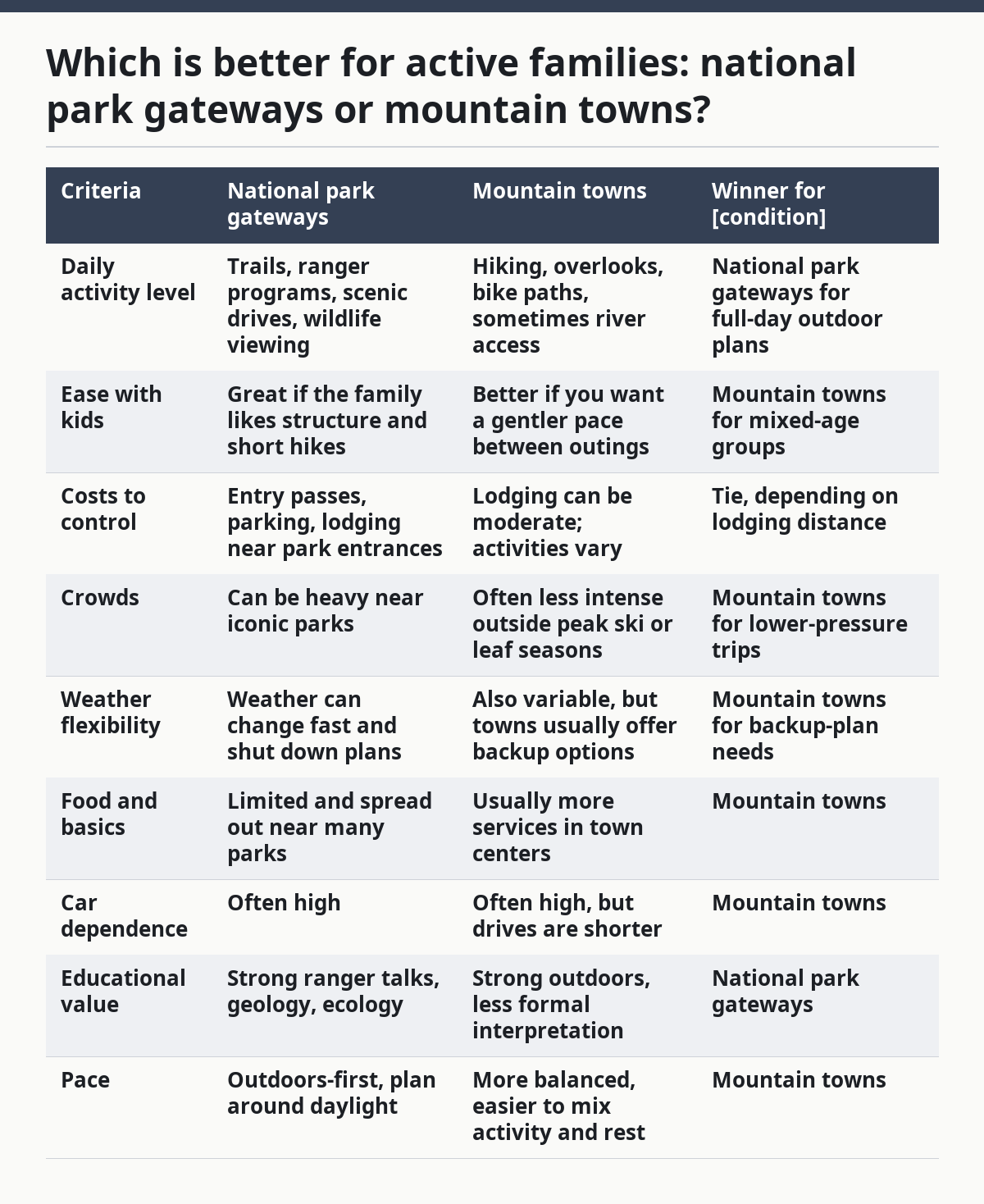
National park gateways win when the family wants a trip centered on scenery, junior ranger programs, and easy “everyone goes outside” days. The drawback is that many gateways are built for access, not convenience. Food choices can be limited, lodging near the entrance may book up early, and the best experiences can require short hikes or early starts. Families who need nightlife, indoor variety, or walk-to-everything convenience should not make a park gateway their first choice.
Mountain towns are better for families who want activity without feeling stranded. You usually get a more complete town center, easier meal planning, and more non-outdoor backup if a child is tired or the weather turns. The trade-off is that some mountain towns depend on paid recreation—lift rides, adventure parks, or guided excursions—so the budget can drift if you do not set limits. They are not ideal for families who want the trip to be entirely free-form and car-light.
Where small cities fit for culture-focused trips
Because small cities give you museums, walkable neighborhoods, and easy meals in a compact area, they can be a strong budget fit for culture-focused trips. They work especially well for families who want one or two anchors a day, not a packed itinerary.
The advantage is density without overload. A good small city gives you a compact downtown, a children’s museum or science center, a public market, and parks that break up the day. That structure helps families with school-age kids who get restless on purely outdoor trips but do not need an enormous attraction list. It also helps parents who want to skip long drives between sights.
The drawback is that “culture” can turn into “lots of paid admissions” if you do not choose carefully. Museums, planetariums, and special exhibits add up quickly. Small cities can also feel thin if your family wants a large-scale attraction every day or needs a beach-and-hike combo. If you are hoping for all-day resort entertainment, this category will feel too restrained.
This is the right pick for families who enjoy local food, public spaces, history, music, and shorter travel days between activities. It is not the best choice for very young children who need open-ended play for most of the day, or for families who get bored if an itinerary centers on museums and downtown blocks. A smart small-city trip keeps one paid attraction per day and fills the rest with free walking, parks, and neighborhood exploring.
Lake towns: the quiet budget choice for mixed-age families
Lake towns can be a very good budget option for mixed-age families that want calm water, simple routines, and fewer scheduling decisions. They are often the easiest place to keep both toddlers and teens happy because the day can stretch around swimming, fishing, paddling, or doing nothing at all.
Lake towns usually win on flexibility. You can build a day around a public beach, a dock, a trail loop, or a picnic area without needing a packed calendar. That makes them a strong fit for multigenerational trips, siblings with different energy levels, and families who want together time without a strict schedule. They also tend to feel less overwhelming than tourist-heavy beach strips.
The drawback is that lake towns are not always rich in attractions. If your family wants rides, shows, or a long list of indoor backups, the trip can feel thin after two days. Weather matters a lot too. A cold front or rainy stretch can reduce the main appeal fast. Families who need constant novelty should skip this style unless the town has a strong secondary draw.
Lake towns work best for relaxed travelers, grandparents with kids, and families who prefer inexpensive daytime habits over expensive admissions. They are a poor fit for anyone who needs a destination that can entertain a hard-to-please teen for an entire week. A lake town works because it lowers friction, not because it overwhelms you with options.
Why theme park areas are the wrong “budget” choice for some families
Theme park areas are only budget-friendly if you already want a high-intensity, ticket-centered trip and you can tolerate extra trade-offs. For many families, they are the most expensive option in this comparison once lodging, parking, food, and tickets are all in the same basket.
The appeal is easy to understand. A theme park area gives you predictable entertainment, strong kid appeal, and lots of services in one place. That can make the trip feel simpler than a more open-ended vacation. Families with a child who is obsessed with rides, characters, or themed experiences may find that the value is real even when the total bill is not light.
The catch is that theme park areas often require you to pay for convenience at every turn. The closest lodging is rarely the cheapest. Meals are easy to find but not always cheap. Transportation can become part of the cost if you need parking or shuttles. If the family is not planning to spend most of the trip inside the parks, the value drops quickly.
This style is best for families who want the park itself to be the destination. It is not a good match for travelers who want a broad, flexible vacation with free time, outdoor balance, or low-cost days built in. The honest rule: if the main goal is “keep the kids busy,” a theme park area can work; if the main goal is “stretch the budget,” it is usually the weakest pick here.
The verdict: which family destination type should you choose?
Choose beach towns if your family wants the easiest first trip and you need a low-pressure daily rhythm. Choose national park gateways if your group likes hiking, ranger programs, and scenery over comfort. Choose mountain towns if you want an active trip with better backup options and a more balanced town base. Choose small cities if culture, food, and walkability matter more than outdoor time. Choose lake towns if you want the calmest, most mixed-age-friendly budget trip. Choose theme park areas only if the park is the whole point of the vacation. Neither if your family needs a fully car-free trip, because most of these styles still depend on driving and parking.
The best budget family vacation destination is the one that cuts the number of paid choices your family has to make every day. If a destination type matches your kids’ ages and your tolerance for planning, it will usually beat a more famous place that does not.
When this choice should flip
The answer should flip if your family has one child with very specific needs. A child who needs a stroller, nap breaks, or frequent indoor stops may do better in a small city or beach town than in a park gateway with long drives between stops. A child who wants nonstop motion may do better in a theme park area even if it is not the cheapest in the usual sense.
The choice should also flip if your trip length is only two or three nights. Short trips reward low-friction places with simple logistics, such as beach towns or walkable small cities. Longer trips can absorb the slower pace of a lake town or the day-to-day repetition of a national park gateway.
Weather can flip the call too. If the forecast is likely to be wet, extremely hot, or stormy, a destination that depends on one outdoor activity becomes fragile. In that case, the better “budget” destination is the one with the strongest indoor backup, not the one with the lowest starting cost.
What kind of family destination is cheapest for our travel style?
The cheapest family destination type is usually the one with the fewest paid activities, the shortest drives, and the easiest meals. For many families that means a lake town, a beach town, or a small city with a compact downtown. The cheapest choice is not always the one with the lowest nightly rate; it is the one that prevents extra spending on transport, admissions, and forced convenience.
How do I choose a budget destination that fits our kids’ ages?
Choose the destination type around attention span, mobility, and how much structure your kids need. Toddlers often do best in beach towns or lake towns with simple routines and room to wander. School-age kids usually handle national park gateways and small cities well if you keep the day to one main outing. Teens often need more variety, so mountain towns or theme park areas may work better.
Drafted with AI; not yet reviewed by a person.
