Last updated: November 20, 2026
How to Know When a Family Vacation Rental Has Enough Beds for Everyone to Sleep Well
Quick answer: a family vacation rental has enough beds when the listing gives every sleeper a real place to sleep and enough room to use it well. How to Know When a Family Vacation Rental Has Enough Beds for Everyone to Sleep Well starts with bed count, bedroom layout, and real sleeping space that fit your group’s ages and sleep needs. A listing can say it sleeps eight and still be a bad fit if two people end up on a pullout sofa, a child shares a bunk bed with no privacy, or a pack and play has nowhere safe to go.
Key takeaways
- Bed count and guest capacity are not the same thing.
- A sofa bed can count as sleeping space, but it is not equal to a real bed for every sleeper.
- Room layout matters as much as the number of mattresses.
- Age changes the equation fast, especially with bunk beds and pack and plays.
- A good listing gives you enough beds plus enough floor space to place them without blocking doors or making the room feel cramped.
How do I tell if a vacation rental has enough beds?
A vacation rental has enough beds when every sleeper has a place that fits their body, sleep habit, and privacy needs, not just a place on a booking site’s headcount. That means checking the listing for bed count, bedroom count, bed type, and the size of each sleeping area before you book.
Therefore, start with the listing title and the “sleeping arrangements” section, if it has one. A home with 3 bedrooms and 4 beds can work better than a place with 5 beds in one open room, because door placement and room separation matter for naps, early bedtimes, and anyone who snores.
Use this quick check before you decide:
- Count every person who needs a sleeping spot, including adults, kids, and anyone using a pack and play.
- Count only actual beds first: king, queen, full, twin, bunk bed, or daybed.
- Mark any sofa bed, trundle, or air mattress as backup sleep, not equal to a regular bed.
- Check whether the bedrooms give parents privacy and whether kids can sleep without waking each other.
- Look for floor space around each bed so the room still functions.
If the math only works by using every couch, every pullout, and a corner of the living room, the place may technically fit the group and still sleep poorly. That is the point where many families get surprised after the 10 p.m. lights-out scramble.
Bed count versus bedroom count: what matters more?
Bed count matters more for headcount, but bedroom count matters more for sleep quality. A listing with 6 beds in 2 bedrooms can still be awkward if one room holds most of the sleeping spots and the other room is only for the adults.
This is where many listings confuse people. A “sleeps 10” label often means the place can host 10 people in some combination of beds and backup sleeping spaces, not that 10 people will each get a normal bed in a private room.
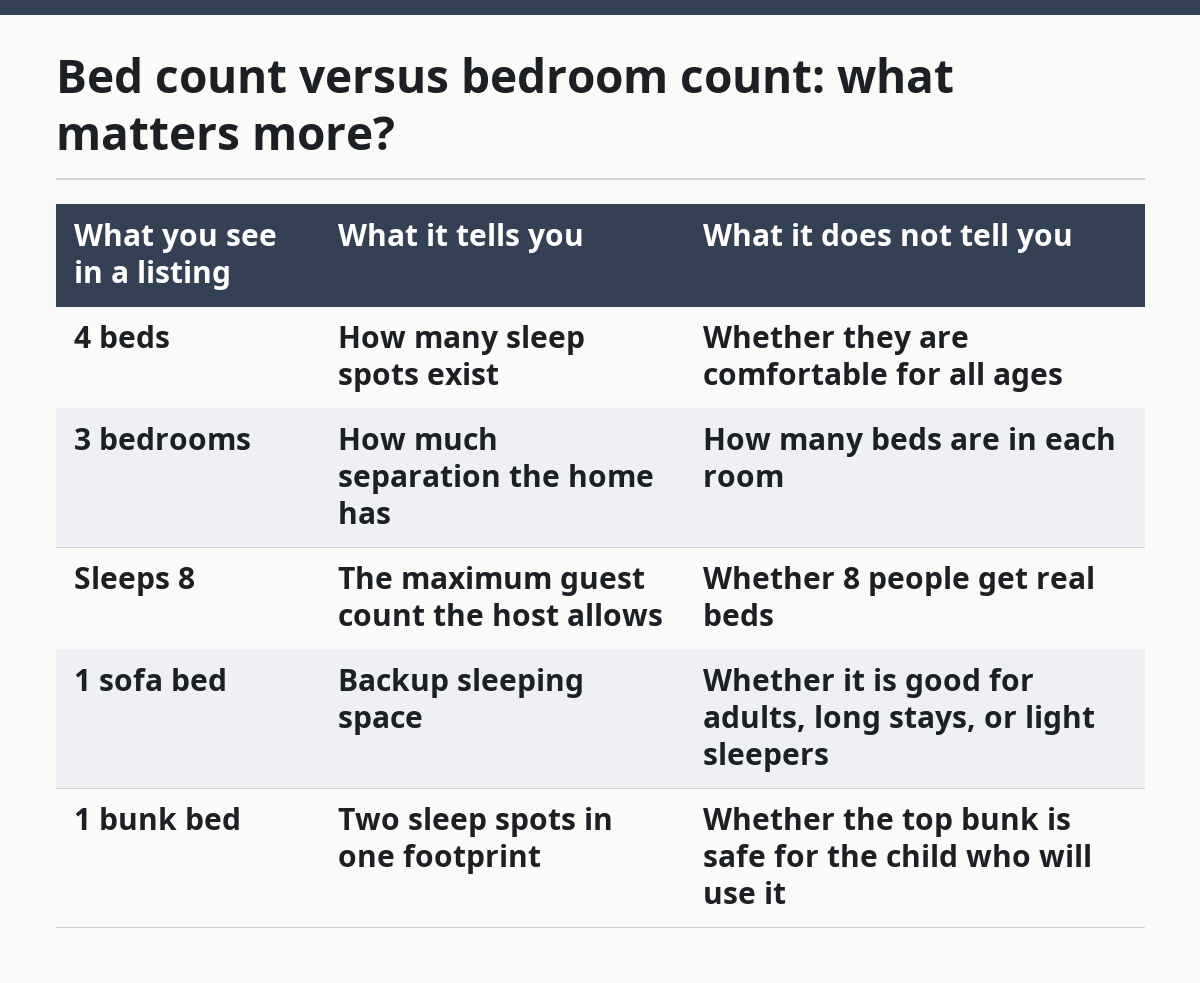
In contrast, a simple way to compare the two is below:
| What you see in a listing | What it tells you | What it does not tell you |
|---|---|---|
| 4 beds | How many sleep spots exist | Whether they are comfortable for all ages |
| 3 bedrooms | How much separation the home has | How many beds are in each room |
| Sleeps 8 | The maximum guest count the host allows | Whether 8 people get real beds |
| 1 sofa bed | Backup sleeping space | Whether it is good for adults, long stays, or light sleepers |
| 1 bunk bed | Two sleep spots in one footprint | Whether the top bunk is safe for the child who will use it |
If parents need quiet after 9 p.m. and kids wake at 6 a.m., a bedroom count of at least 2 usually matters more than squeezing in one extra mattress. This is also where the link to broader budget family lodging planning helps, because sleep quality affects the whole trip. See our family vacation rental checklist and budget family lodging guide.
Which beds are fine for adults, kids, and babies?
Different bed types work for different sleepers, and the right match changes with age. A queen bed is usually fine for two adults, a twin bed is fine for one child, and a pack and play is a sleep space for a baby, not a substitute for a bed list that already works.
Treat these as practical rules, not promises, and consult a professional or follow the manufacturer’s guidance when a child uses a bunk bed or an infant uses a pack and play. The U.S. Consumer Product Safety Commission and the American Academy of Pediatrics publish safety guidance for these sleep setups: CPSC bunk bed safety and AAP safe sleep.
- Real beds: Best for the people who need the most stable sleep, like adults or older kids.
- Sofa beds: Good as backup, but the mattress is often thinner and the frame can leave a seam or bar in the middle.
- Bunk beds: Useful for siblings, but only if the child sleeping on top is old enough and steady enough for ladder use.
- Pack and play: Works for infants and toddlers when the rental has enough floor space and a safe spot away from cords, blinds, and stairs.
With the sofa bed in mind, it can be acceptable for kids, especially for a short stay. It is less ideal for an adult after a long travel day, and it is a poor choice for anyone with back pain or a light sleep pattern. If a listing counts a sofa bed as one of the main sleeping spots, read that as “possible” rather than “comfortable.”
Bunk beds need extra attention because the top bunk changes the risk picture. The U.S. Consumer Product Safety Commission has guidance on bunk bed safety, and the American Academy of Pediatrics has safe sleep guidance for infants. Those are the right references when a listing includes a bunk bed or a pack and play, because age and safety matter as much as the mattress count.
How much sleeping space does each person really need?
Each person needs enough sleeping space to move, turn over, and sleep without bumping knees, elbows, or another sleeper’s headboard. The room can have the right number of beds and still feel too tight if beds are pushed against every wall or the only path to the bathroom cuts through someone’s mattress space.
The listing photos help here, but only if you read them carefully. Look for the gap around each bed, the number of nightstands, and whether a crib or pack and play would fit without blocking a closet or door. A room with one king bed and a clear walkway can sleep two adults more comfortably than a room crammed with three small beds.
Because room shape matters, also check the layout. A long narrow bedroom with two twin beds may be easier to use than a square room with the same beds and a bulky dresser in the middle. The math is not just “how many beds,” but “can a person get in, out, and through the night without waking everyone else?”
If the host uses floor-plan words like “open concept,” treat that as a clue that some sleeping space may have little privacy, and ask the host for a room-by-room layout or a floor plan before you book. Open layouts are fine for short stays with kids who sleep through noise, but they are not ideal for families with very different bedtimes. See also our vacation rental floor plans guide.
What should I ask the host before I book?
You should ask the host exactly how the beds are arranged, because listing text often leaves out the part that affects sleep most. A direct question can save you from arriving to find that the “extra bedroom” is actually a den with a sofa bed.
For example, ask these questions in one message:
- Which bed is in each bedroom?
- Is the sofa bed in a private room or in the living room?
- What size is each bed: queen, full, twin, or bunk?
- Is the pack and play included, or must I bring one?
- Is there room to set up the pack and play without blocking a door?
- Which bedroom is quietest for the parents?
- Are the bunk beds suitable for the child who will use them?
A host’s reply should make the sleeping setup plain enough that you could draw it on paper. If the answer is vague, such as “plenty of room for everyone,” keep going until you get specific bed placement. The cost of guessing is usually a bad night, and that can ruin the first full day of the trip.
This is also where a family rental differs from a hotel suite. A listing may look large in photos, but sleeping comfort depends on where each bed sits and how the rooms connect. See our how to choose a family vacation rental guide.
How do age and sleep habits change the bed count?
Age changes the bed count because not every sleeper needs the same kind of space. A toddler in a pack and play, a 10-year-old in a twin bed, and two adults in a queen bed do not place the same demand on the rental.
Specifically, use this simple lens:
- Babies need a pack and play or crib space plus room for nighttime care.
- Toddlers often do fine in a small bed or pack and play, but only if the room is safe and calm.
- School-age kids can share a bunk room or twin beds more easily.
- Adults usually need a real bed, especially for more than one or two nights.
Sleeping habits matter just as much as age. A child who wakes at the slightest sound should usually not be placed next to the living room sofa bed, and a parent who snores should not be the person the whole room depends on for the best mattress.
This is where many good-looking listings fail. They may technically provide enough places to lie down, but not enough separation for different bedtimes, nap times, and early mornings. If one child goes to sleep at 8 p.m. and another stays up past 10 p.m., one shared room can become a nightly problem.
When is a listing not enough beds, even if the count adds up?
A listing is not enough beds when the total number of sleeping spots only works on paper. That happens when the “extra” beds are sofa beds, the bunk bed is in a cramped room, or the adults are left with the least comfortable setup while kids get the real mattresses.
A listing is also not enough when privacy breaks the trip. If parents end up on a pullout in the living room, early risers will wake them, late sleepers will feel exposed, and nobody gets a clean shutdown at night. That is not a bed-count problem alone; it is a sleep-space problem.
These are the warning signs that matter most:
- The listing relies on 1 or 2 backup beds for most of the group.
- Bedroom doors do not give enough separation for naps or early bedtime.
- The sofa bed sits in a main traffic area.
- The bunk bed is the only option for a child who may not do well with height.
- There is no clear place for a pack and play.
- The photos show beds pushed so close together that the room feels like a storage unit.
I would pass on a place like that for a trip where sleep matters, even if the guest count looks fine. It is not for families who need quiet, different bedtimes, or a real bed for every adult.
Key takeaways
- Count beds, not just guests, and then check where each bed sits.
- A rental can be “big enough” and still sleep badly if the rooms are open or cramped.
- Put parents in the quietest private room when possible.
- Treat sofa beds and pullouts as fallback sleeping spaces.
- Use a pack and play only when the room layout leaves safe floor space.
How many beds should a family rental have?
A family rental should have enough beds for every sleeper to have a real place to sleep, not just a spot on the floor plan. In practice, that means checking both bed count and room layout, then making sure the setup fits adults, kids, and any baby gear. If the listing only works when every backup bed is used, it is probably not a good fit.
Is a sofa bed acceptable for kids?
A sofa bed is often acceptable for kids, especially for a short stay, but it is still a backup sleep option. It works best when the mattress is decent, the room is quiet, and the child is old enough to sleep comfortably there. It is a weaker choice for adults or for children who wake often at night.
What should I check in a rental listing for sleeping space?
Check the bedroom count, bed count, bed types, and the layout shown in the photos or description. Then look for where the sofa bed, bunk bed, and pack and play would actually fit, not just whether they are listed. If the host gives room-by-room bed details, that is much more useful than a simple “sleeps 8” line.
Drafted with AI; not yet reviewed by a person.