Last updated: November 19, 2026
How to Plan a Family Road Trip Stop That Actually Works for Toddlers and Teens is a road trip stop guide for families who need a break that resets bodies, not one that tries to entertain everyone for an hour. Aim for a stop with a bathroom, a chance to move for 10 to 20 minutes, and one clear next step so nobody has to guess what happens after the break.
Key takeaways
- Pick the stop for the youngest child first, then add one thing for the teen.
- A good break is short enough to prevent a full reset of the whole day.
- Rest stop, playground, gas station, quick-service restaurant, and park each solve a different problem.
- Meals and bathroom timing matter more than fancy scenery.
- Teens need a role, a task, or a small choice so they do not feel stranded by the stop.
What kind of stop works for both ages?
A good road trip stop for toddlers and teens is one that gives the toddler motion and the teen control. A rest stop with a clean bathroom, a playground, or a park usually beats a long sit-down meal when the goal is to calm both age groups at once. The right choice depends on whether the trip problem is fussiness, boredom, hunger, or sleepiness.
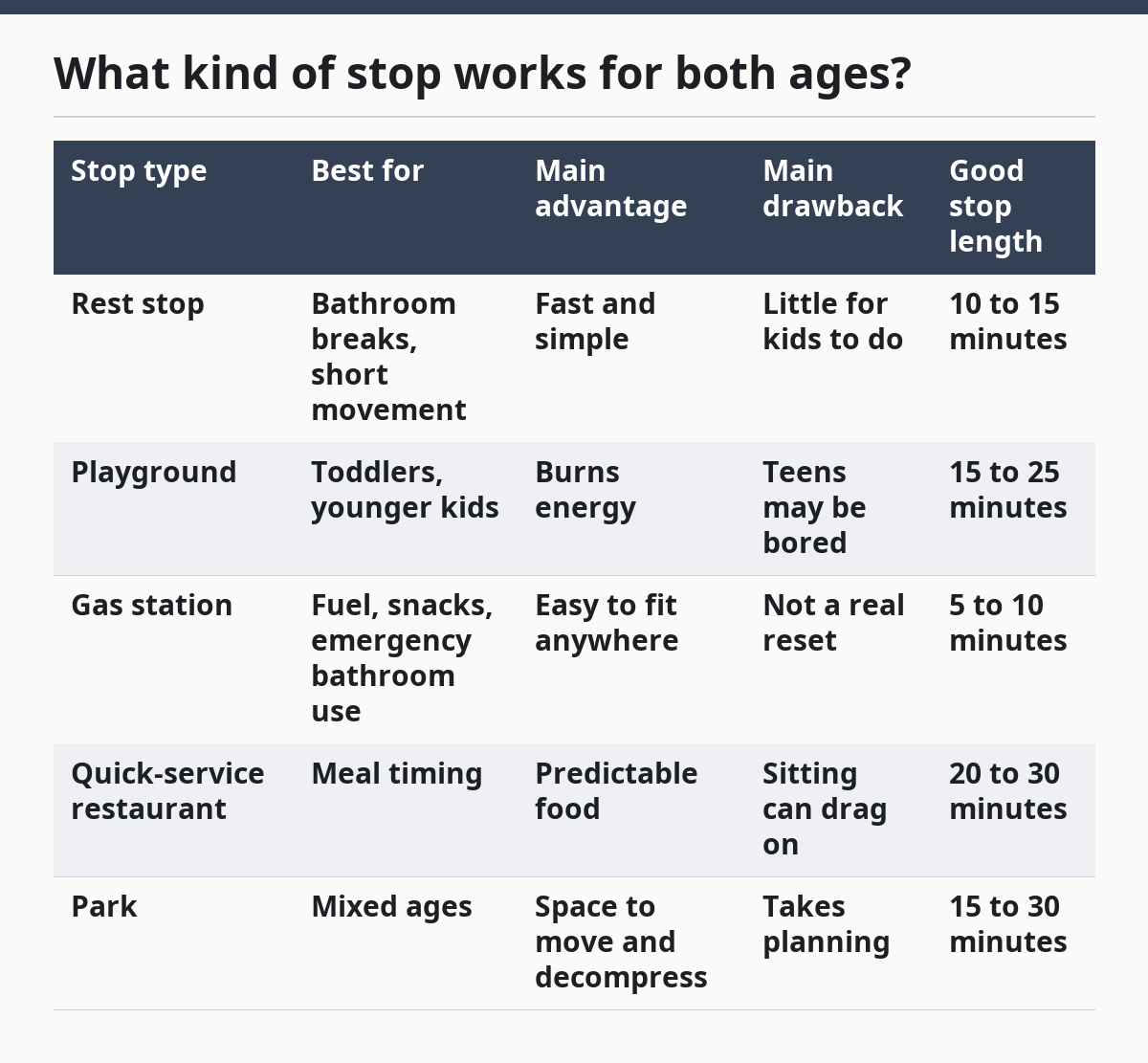
Think of the stop as a reset, not an event. A quick-service restaurant can solve hunger in about 20 to 30 minutes, but it often fails if the toddler needs to run and the teen wants to leave fast. A park is often the best choice for movement, while a gas station is usually the fastest bathroom-and-fuel fix.
| Stop type | Best for | Main advantage | Main drawback | Good stop length |
|---|---|---|---|---|
| Rest stop | Bathroom breaks, short movement | Fast and simple | Little for kids to do | 10 to 15 minutes |
| Playground | Toddlers, younger kids | Burns energy | Teens may be bored | 15 to 25 minutes |
| Gas station | Fuel, snacks, emergency bathroom use | Easy to fit anywhere | Not a real reset | 5 to 10 minutes |
| Quick-service restaurant | Meal timing | Predictable food | Sitting can drag on | 20 to 30 minutes |
| Park | Mixed ages | Space to move and decompress | Takes planning | 15 to 30 minutes |
The mistake is trying to make one stop solve every problem. That turns a 15-minute reset into a 45-minute drag. The better plan is to decide the main job first: bathroom, food, movement, or quiet.
How long should the stop be?
A road trip stop should usually be short enough that the car still feels like part of the day, not a new day. For toddlers, the useful part often ends before the 30-minute mark. For teens, the stop feels worth it if there is enough space to stretch, charge a phone, or choose a snack without being rushed every second.
The right stop length depends on the reason for stopping. If the car needs fuel, a 10-minute gas station stop may be enough. If the kids need to move, 15 to 20 minutes is often the sweet spot. If the stop includes food, give it closer to 20 to 30 minutes and keep the order simple.
A practical way to judge timing is this:
- Stop for the bathroom before anyone is desperate, because a rushed bathroom break creates the most friction.
- Add 5 to 10 minutes for movement if the youngest child has been sitting too long.
- Add another 10 minutes only if food is part of the plan.
- Leave before the kids start asking what else there is to do.
That last step matters. A stop that runs too long often creates a second round of whining as soon as the car starts again. The goal is not maximum fun. The goal is a calmer next 60 minutes on the road.
How do toddlers and teens need different things?
Toddlers need motion, routine, and a clear next step, while teens need choice, privacy, and something that does not feel childish. That difference is why one stop can fail for both ages if it is planned as a single activity. A toddler may light up at a swing set while a teen sees the same stop as wasted time.
Toddlers usually do best when the break includes 2 simple moves: bathroom, then run or climb. Teens do better when the stop includes one decision they can make, such as choosing a snack, picking music for the next leg, or deciding whether to walk or sit. If the teen is restless, give them a task instead of a lecture.
A useful split looks like this:
- Toddler needs: movement, snack, bathroom, visual calm.
- Teen needs: autonomy, phone time, food choice, a reason the stop matters.
- Shared need: no one wants a stop that drags past the point of usefulness.
A playground may be perfect for the toddler and useless for the teen. A quick-service restaurant may work for the teen and trap the toddler in a chair. The fix is not to find one magic place. The fix is to build the stop so each age gets one thing it actually values.
Which stop should I choose first?
Choose the stop based on the most urgent need: bathroom, energy, food, or sleep. If the youngest child is near meltdown, a rest stop or playground comes first. If the teen is hungry and the toddler is calm, a quick-service restaurant may be the better move. If the car is low on gas, the gas station becomes the anchor and everything else fits around it.
A simple decision order helps:
- Bathroom first: if anyone is close to an accident, do not gamble on a nicer stop.
- Energy next: if the toddler is climbing the seat back, choose a park or playground.
- Food next: if it has been a while since the last meal, go where food is fast and predictable.
- Sleep next: if one child is getting drowsy and the other is wound up, use a short, quiet stop and get moving again.
Here is the trade-off. A park can give the strongest energy reset, but it may be a poor choice if rain, heat, or a late arrival window will make the stop messy. A restaurant is easy when everyone is hungry, but it can make a restless toddler worse. A rest stop is practical when time is tight, but it may do little for boredom.
This is also where a teen traveler can help. Give the teen one job: check the next stop, carry the water bottles, or choose the snack lineup. The point is not to make the teen responsible for the trip. The point is to keep the break from feeling like a dead zone.
What should happen before the car stops?
The stop that actually works starts with a quick check of bathroom timing, hunger, and who is most likely to need motion next. That planning step takes a few minutes and saves a lot of arguing in the parking lot.
Use this order:
- Watch the clock on meals. If the last meal was a while ago, a quick-service restaurant may be smarter than a playground.
- Check the youngest child first. If the toddler has already had a long stretch in the car, give that child the next break before anyone else’s preference.
- Name the stop out loud. Say, “Bathroom, stretch, snack, then back in the car.” Clear words cut down on surprise.
- Set the end point. A 15-minute playground stop ends when the timer ends, not when the teen feels ready to leave.
- Give one small choice. Let the teen pick the drink or let the toddler choose between two snacks.
This step matters because vague stops become long stops. The child who hears, “We’ll just stop for a bit,” assumes the break can stretch forever. A named plan makes the stop easier to accept, even when nobody loves the idea of getting back in the car.
If the route already includes a longer trip planning tool on this site, use it as the wider route guide and keep this page focused on the stop itself. The hub on budget family trip route decision tools and timing should handle the bigger path questions; this page is for making the pause usable.
What should you avoid on purpose?
Avoid stops that create a new problem while solving the old one. The most common mistake is choosing a place that looks good on paper but fails in practice, such as a scenic spot with no bathroom, a restaurant with a long wait, or a playground that leaves the teen bored and irritated. A bad stop can cost more energy than it saves.
A few errors show up again and again:
- Too long in one place: the trip loses momentum and the next car stretch starts with resistance.
- No bathroom plan: a small delay turns into a crisis.
- Only one age in mind: the toddler is happy, the teen is annoyed, and the stop becomes a fight.
- Too much screen time during the break: the toddler gets harder to restart, and the teen never really gets a mental reset.
A better rule is to match the stop to the day’s weak point. If the day is already loud and rushed, choose a simpler stop with less walking. If the kids are cranky from sitting still, pick a stop with open space. If everyone is hungry, food comes before scenery.
There is one honest limit here: this approach is not for a day when the route is already too tight to allow any real pause. If the schedule gives no room for a bathroom stop, a meal stop, or a stretch break, the problem is the route, not the rest stop. This page cannot fix a day that has been overpacked.
What should you do with sleepy or restless travelers?
A sleepy traveler and a restless traveler need opposite breaks, so the stop should favor the one who is most likely to cause trouble next. If the toddler is sleepy, keep the stop quiet, short, and low on stimulation. If the teen is restless, use the break to move, walk, or get a snack with a little choice attached.
For sleepy travelers, a gas station bathroom stop or a quick snack may be enough. Keep lights, noise, and running around down. For restless travelers, a park or playground works better because movement gives the body a job to do. A quick-service restaurant can split the difference if the group is hungry and the teen needs something to do with hands and attention.
The trade-off is simple. A quiet stop helps the sleepy child but can make the restless child more impatient. A busy stop helps the restless child but can make the sleepy child melt down. That is why the answer changes by hour, not by destination type.
If you want one rule to remember, make it this: stop for the state of the child, not the shape of the day. A 12-minute break that fits the child in front of you is worth more than a “perfect” stop that misses the moment.
What sources help keep the stop safe?
Two good safety references are the American Academy of Pediatrics HealthyChildren.org and the National Highway Traffic Safety Administration. Both are useful when a stop plan needs a safety check for kids in cars, especially around seat use and travel routines. For child passenger safety details, the NHTSA child passenger safety pages are also worth checking before a long drive.
FAQ
How long should a family road trip stop be?
A family road trip stop should be long enough to cover the real need and short enough to keep the day moving. For many stops, that means about 10 to 30 minutes, depending on whether the goal is a bathroom break, a snack, a stretch, or a meal.
What kind of stop helps toddlers the most?
A stop with movement helps toddlers the most. A playground or park usually works better than a long meal because toddlers often need to climb, run, or walk before they can settle again. A clean bathroom and a short snack also help, but the movement is what usually changes the mood.
How do you keep teens from getting bored on breaks?
A teen is less bored when the stop gives a little control. Let the teen choose the snack, carry something, or decide whether the break is a walk or a sit-down. A stop that lasts 15 to 25 minutes and has a clear end is often easier for a teen to accept than a stop with no plan.
Drafted with AI; not yet reviewed by a person.