
Last updated: November 19, 2026
Quick answer: for How to Choose the Best Airport Connection for a Family Trip Without Rushing Kids, start with a 45-minute same-terminal connection, then add more time if you need a terminal change, a shuttle, or another security checkpoint. A cheap fare with a 35-minute connection can cost more in stress than it saves in cash. The right choice is often a longer connection, a same-terminal change, or a route with a simple airport shuttle.
Key takeaways
- Therefore, pick the connection that fits your slowest traveler, not your fastest adult.
- Same-terminal connections are usually the easiest, even when the fare is a little higher.
- A terminal change, airport train, or shuttle adds time that does not show up in the fare screen.
- If you must recheck bags or pass security again, add a wider cushion than you think you need.
- A stroller helps after the checkpoint, but it can also slow you down at the transfer point.
What makes an airport connection good for kids?

Therefore, a good airport connection for kids is one that gives you extra time, fewer handoffs, and a simple path from gate to gate. The right choice is not the shortest connection on the booking page; it is the one that matches your group’s walking speed, bag count, and need for breaks.
Start with three questions. First, do you stay in the same terminal, or do you need a terminal change? Second, do you have to clear a security checkpoint again? Third, can you move by foot, or do you need an airport train or shuttle? Each of those adds time that can turn a 45-minute connection into a tight squeeze.
For example, a family with one child and light carry-ons can sometimes manage a tighter connection than a group with a stroller, a car seat, and checked bags. That said, tighter is still risky when the route includes a second security line or a long walk. A connection that works for an adult business traveler can be a poor fit for a 6-year-old who needs water, a bathroom stop, and a slower pace.
Ultimately, the goal is not comfort for its own sake. The goal is to avoid the kind of rush that leads to missed gates, skipped snacks, and a connection that feels harder than the whole flight. A connection that gives you 1 clear path and 0 guesswork is usually the better buy.
Which connection type fits your trip?
Therefore, the easiest connection for most families is a same-terminal change with no security recheck. It is often the most practical balance of speed and calm. A terminal change by train or shuttle can still work, but it needs more buffer. A self-transfer is the least forgiving choice and should be skipped unless the schedule is very generous.
| Connection type | Best for | Main benefit | Main drawback | What to skip |
|---|---|---|---|---|
| Same terminal, same security area | Families with young children, strollers, or checked bags | Shorter walking time and fewer steps | Not always the cheapest fare | Skipping the buffer because the map looks simple |
| Terminal change with airport train or shuttle | Families with enough time and light carry-ons | Better flight options than a single-terminal route | Extra transfer step can eat up the cushion | Tight turns under an hour |
| Connection that needs security again | Families that can tolerate a slower pace | Sometimes the only workable fare or route | Second line, more stress, more waiting | Planning it like a normal connection |
| Self-transfer between separate tickets | Very flexible planners with older kids | Can open up more fares | Bags, terminals, and missed connections are on you | Booking it for a short layover |
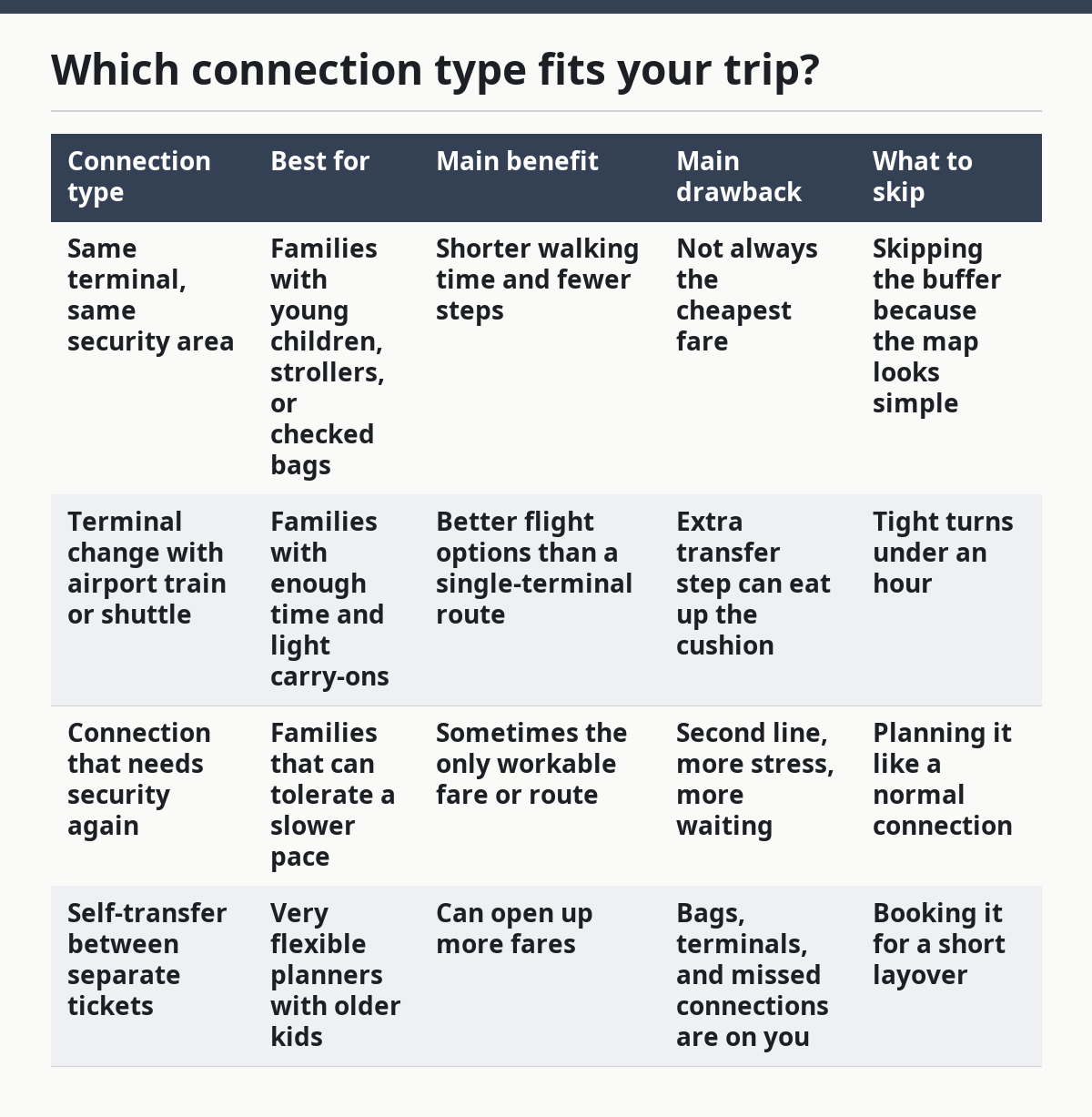
For most trips, a same-terminal connection is the one I would choose first for a trip with kids under 10. It is also the most sensible choice if you are traveling with a stroller. The drawback is simple: not every airport offers it, and it may cost more than a less convenient route.
Meanwhile, a terminal change is fine when the airport map is clear and the airport shuttle or train is frequent enough that you are not waiting 20 minutes for it. It is not a good fit for a connection that already feels tight. Skip it if the route involves stairs, a long trek, or a second security checkpoint.
Because of that, a self-transfer is wrong for many families because the responsibility shifts to you. If the first flight is late by a little, the whole plan can collapse. That risk grows when you have checked bags and more than one child.
How do you judge minimum connection time?

However, minimum connection time is the smallest legal or published window that an airport or airline allows between flights, but it is not the right target for a family trip. It tells you what is technically possible, not what is comfortable with children. For that reason, use it as the floor, not the goal.
A useful way to read minimum connection time is to treat it as one input among several. If the route includes a terminal change, security recheck, or airport shuttle, the published minimum can be too short for a family moving at normal pace. A route that looks fine for one adult can fall apart once a stroller, snack stop, and bathroom break enter the picture.
Here is the practical rule: if a connection feels “just enough,” it is probably too tight for a family. The safer choice is the one that leaves room for delays, slow walking, and one unexpected stop. That is especially true when the airline ticket is on separate bookings or when the airport is large and the terminal map shows a long walk.
For instance, a useful way to compare options is to count steps, not just minutes. A connection with 2 steps is easier than one with 5 steps, even if both show the same layover time. For example, a simple gate-to-gate transfer is much less stressful than one that requires deplaning, a train, a terminal change, security, and another walk to the next gate.
What should you check before you book?
Therefore, the connection is only as good as the route you can actually explain. If you cannot say how you get from the first gate to the second gate, the route is too complicated for a family trip.
Use this process before you buy:
- Open the airport terminal map and find both gates. The result should tell you whether the transfer is one straight walk, a train ride, or a shuttle ride.
- Check whether the route changes terminals. A terminal change usually means more walking and a bigger time cushion.
- Look for a second security checkpoint. If you have to recheck security, the connection needs more breathing room than a normal gate change.
- Check the baggage plan. If checked bags do not move through to the final airport, you need time for bag claim and recheck, not just boarding.
- Note whether the airport offers a stroller-friendly path. Stairs, long corridors, and crowded trains can slow a family down fast.
- Compare the published minimum connection time with your real pace. If the route includes children under 8, plan for slower movement than the schedule assumes.
Because of that, this is also where many people make the wrong choice. They sort by fare first and connection second, then assume the map will be easy. That can work on a light solo trip. It is a poor plan when one child needs the bathroom 10 minutes after landing and the next gate is across another terminal.
If you want one clean rule, use this: the connection that can survive a small delay without turning into a sprint is usually the better pick. A route that depends on perfect timing is not a family-friendly connection.
How do bags, security, and stroller handling change the choice?
However, bags, security, and stroller handling can turn a decent connection into a bad one. If any of those steps are awkward, the connection should be longer or simpler. This is where the airport details matter more than the fare screen.
Checked bags are the first issue. If bags transfer automatically, the connection is easier. If they do not, the family may need to collect them and check them again, which adds a whole extra task. That is a strong reason to avoid a short connection, even if the first and second flights are both cheap.
Security is the second issue. A second security checkpoint can add a line you did not budget for, and lines are the enemy of a kid-friendly transfer. A family with shoes, jackets, liquids, and a folded stroller has more to manage than a single adult with a backpack. Even a 15-minute wait can feel much longer when two children are tired.
Stroller handling is the third issue. Many families plan around the stroller as if it is only a comfort item, but it is also a logistics item. If the stroller must be folded, checked, picked up, or carried through a train platform, that step matters. A stroller-friendly route usually beats a shorter route that requires more handling.
For that reason, I would skip a connection that looks fine on paper but involves all three problems: bags, security, and a stroller transfer. One of those can be manageable. Two is harder. Three is where the connection often stops being worth it.
For checkpoint details, the Transportation Security Administration’s guidance on traveling with children and strollers is a useful reference point: https://www.tsa.gov/travel/tsa-cares/traveling-children
When is a longer layover the better buy?
Therefore, a longer layover is the better buy when the airport is large, the route changes terminals, or your children need time to reset. It is also the better choice when the connection includes an airport train or shuttle, because those moving parts can eat into a short layover fast.
Longer does not always mean best, though. A very long wait can be tiring in a different way, especially if the airport has few places to sit, eat, or move around. A family with a 3-hour gap in a quiet terminal may still have a bad time if the kids are restless and the gate area is crowded.
The balance is simple: long enough to absorb normal delays, short enough that the wait does not become its own problem. For most families, that means avoiding the tightest connections and choosing the middle ground when the fare difference is not huge. If the longer layover also keeps you in one terminal and avoids another security line, it is often the stronger choice.
Meanwhile, this is also where the cheapest fare can mislead you. The low fare may hide the real cost of a stressful transfer. A calmer connection can be the better value even if it is not the lowest price on the page.
What should you skip when booking a family connection?
Therefore, skip any connection that looks efficient only because the search screen hides the airport work. A short layover with a terminal change, security recheck, and stroller handling is not efficient; it is compressed risk.
Skip connections that force you to guess at the terminal map. If you cannot tell where the airport train or shuttle leaves from, that is a sign the route may be more complicated than it looks. Skip any option that leaves no room for one delay, one bathroom stop, or one slow walker.
Next, skip the habit of picking the first fare that fits the dates. That approach is fine for a solo trip with a backpack. It is not fine for a family trip where the connection has to work for several people at once. The better choice is usually the route that reduces handoffs, not the route that squeezes every minute out of the schedule.
If you want a simple final test, ask this: would I still choose this connection if one child needed 10 extra minutes after landing? If the answer is no, keep looking. That question catches the plans that are too tight long before they reach the gate.
For a wider planning framework, this sits inside budget family trip routing and connection planning, where the right choice is the one that saves both time and nerves without piling on hidden transfer steps. See also family travel checklist, airport terminal maps, and travel with kids.
The shortest honest answer
Ultimately, the airport connection for a family trip is the one with the fewest moving parts, not the fewest minutes. Same-terminal connections are usually easiest, terminal changes need more cushion, and any route with a second security checkpoint or awkward stroller handling should be treated with caution.
If the connection is simple, the kids are older, and the bags transfer cleanly, a shorter layover can work. If the route includes a train, shuttle, or recheck, choose a longer one. The right connection is the one that lets the trip continue at walking speed, not sprint speed.
For more on planning around fare rules and baggage, see airline baggage policies and family trip budgeting.
Drafted with AI; not yet reviewed by a person.